Gego's Infinite Lines, Forever Remaking Space
Artist Spotlight · The Collection Editorial
“I never thought of myself as a sculptor. I was always making drawings, but in space.”
Gego, interview with Iris Peruga, 1991
In the spring of 2023, the Guggenheim Museum Bilbao mounted a landmark retrospective of Gego, drawing visitors into the Venezuelan artist's extraordinary world of suspended wire, delicate mesh, and drawings that seem to breathe. The exhibition, which traveled and generated considerable international press, reminded a new generation of collectors and curators what devotees of Latin American modernism have long understood: that Gertrud Goldschmidt, who signed her work simply as Gego, was one of the twentieth century's most singular and quietly radical artists. Standing inside a room filled with her undulating Reticulárea installations, one does not merely look at the work. One inhabits it, as if the air itself has been rewoven into something alive.
Gego
Gego
Gego was born Gertrud Louise Goldschmidt in Hamburg, Germany, in 1912, into a prosperous Jewish family. She studied architecture and engineering at the Technische Hochschule Stuttgart, graduating in 1938, a credential that would leave a permanent and visible imprint on every structure she would later create. The political terror rising across Germany forced her departure, and in 1939 she arrived in Venezuela, a country she would make her permanent home and that would, in turn, claim her as one of its greatest artistic voices. This trajectory, from German precision and structural thinking to the light, warmth, and cultural openness of Caracas, is not incidental to her art.
It is the art. For much of the 1940s and early 1950s, Gego worked as an architect and furniture designer, building a practical fluency with materials and spatial logic that few artists of her era possessed from the inside out. She began making art in earnest in the mid 1950s, initially working in printmaking and drawing before turning to sculpture. Her early sculptures engaged directly with the kinetic and geometric abstraction movements flourishing in Venezuela at the time, a scene animated by figures such as Jesús Rafael Soto and Carlos Cruz Diez.
Gego
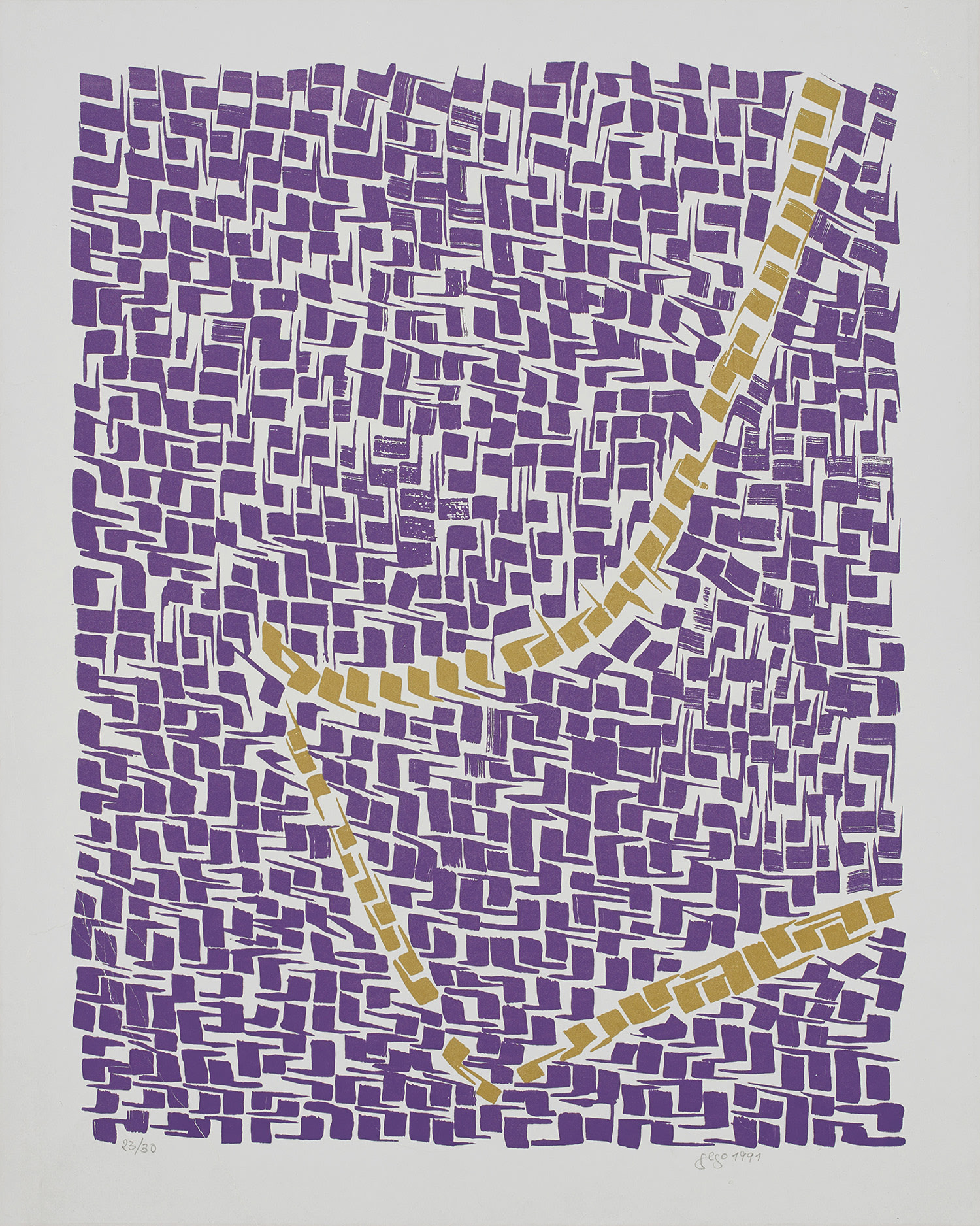
Acumulación
Yet Gego's sensibility was never purely optical or demonstrative. Even in her earliest wire works, there is an intimacy, a handmade quality that resists the cool industrial finish favored by many of her contemporaries. The breakthrough came in the late 1960s with the development of what she called Reticulárea, a term she coined to describe large scale, room filling mesh environments constructed from wire linked together without any soldering or fastening, relying instead on small connective hooks and the inherent tension of the material. The first major Reticulárea installation debuted at the Museo de Bellas Artes in Caracas in 1969, and it was immediately understood as something unprecedented.
Unlike conventional sculpture, which occupies space, Reticulárea generates space. The viewer does not stand before the work; the work envelops the viewer. Light passes through the mesh and casts shifting shadows that become secondary drawings on floors and walls. The installation is never exactly the same twice, because the light is never the same twice.
Gego
Sin título (Reticulárea), 1969
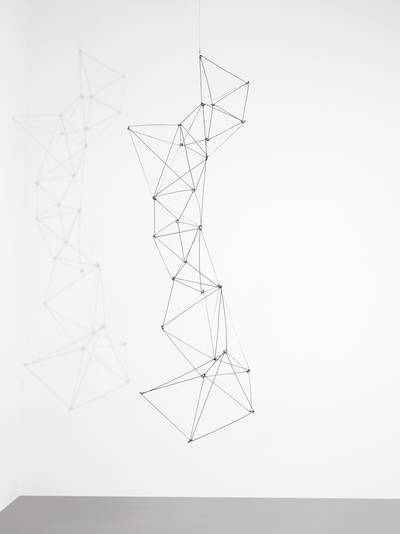
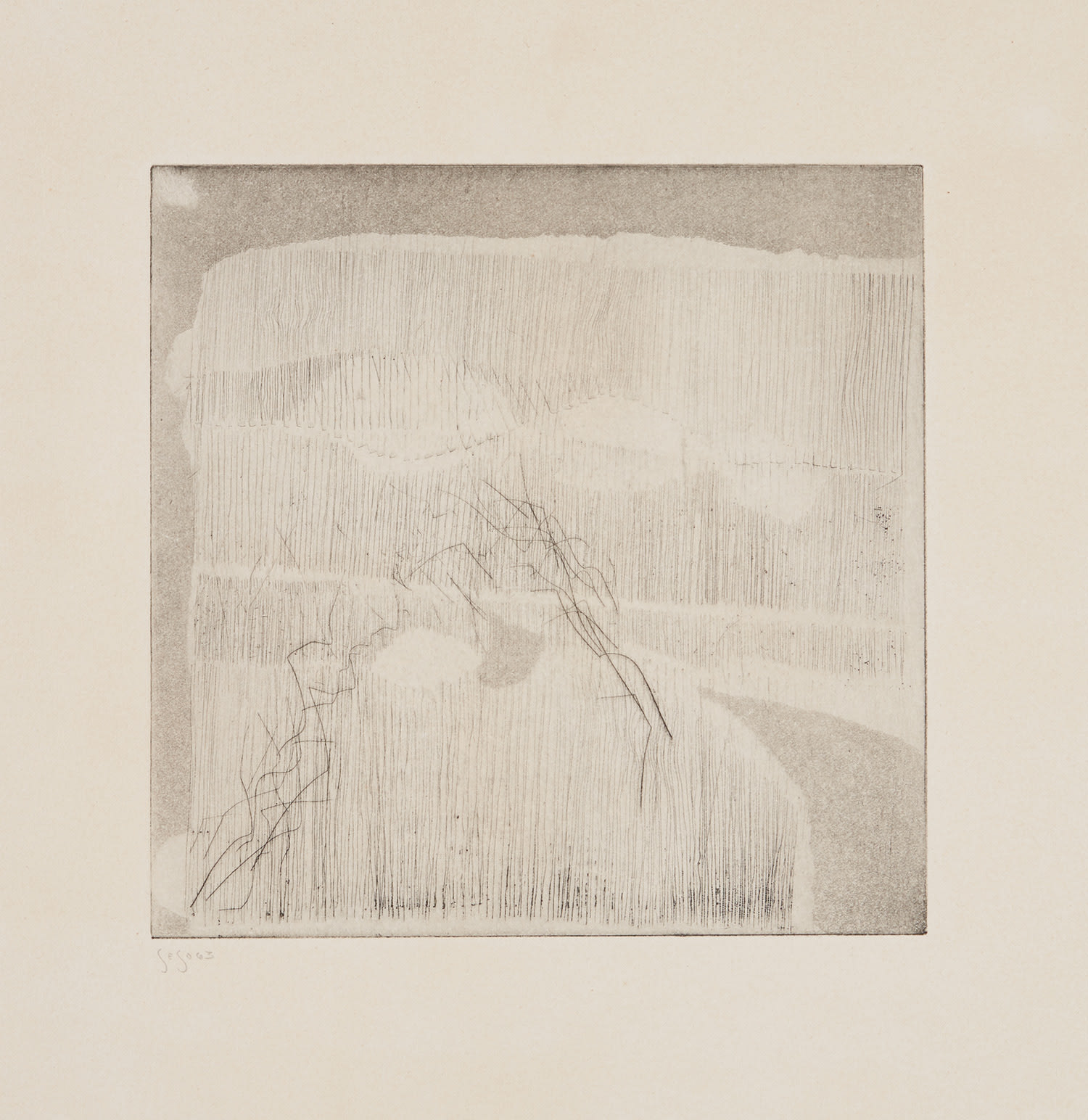
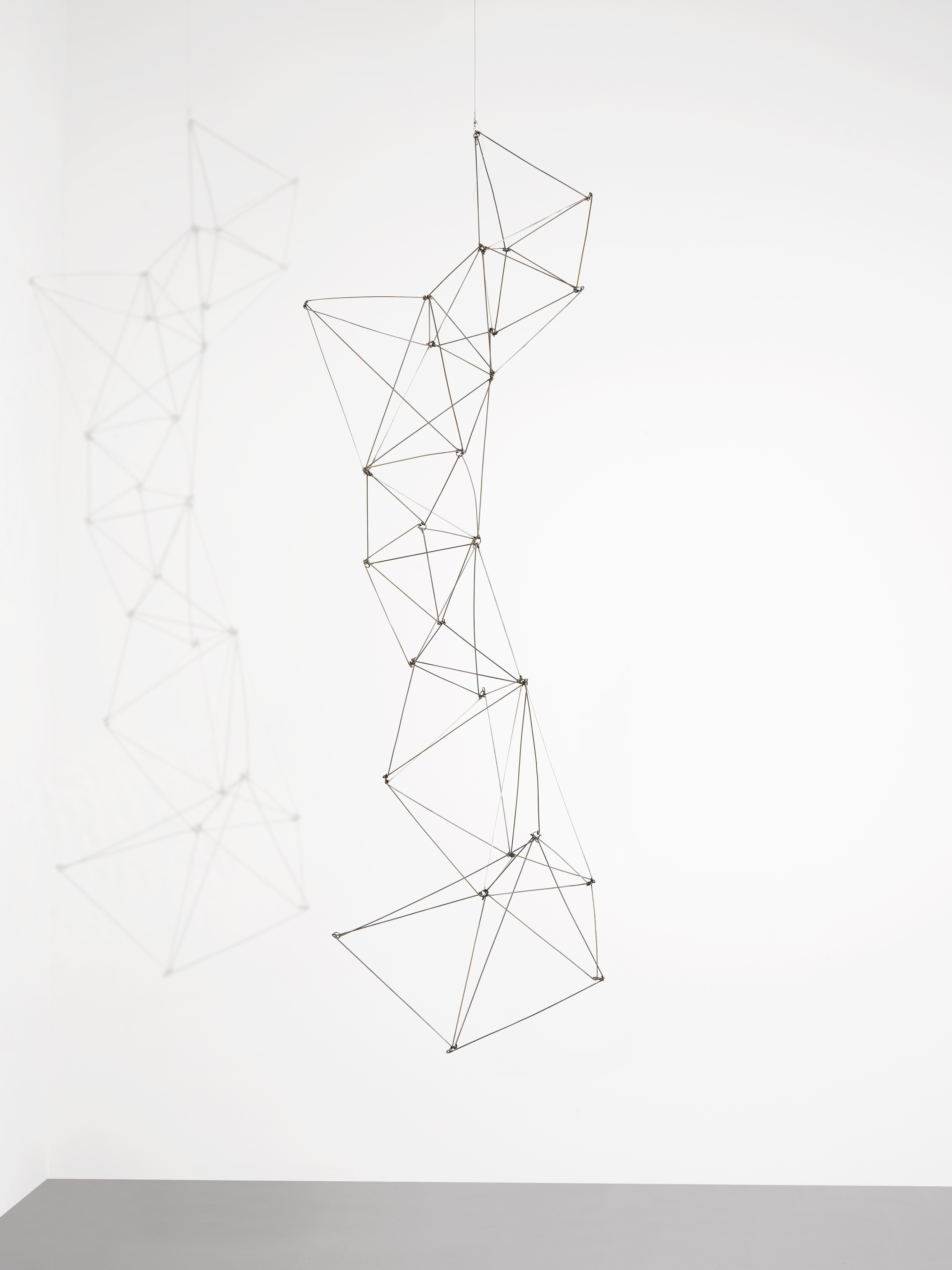
Among the works that best illuminate her range are the Dibujos sin papel series, which translates as drawings without paper. These are freestanding wire sculptures, some using stainless steel and Plexiglas, that propose the audacious idea that a line in three dimensional space is itself a drawing. The piece now known as Dibujo sin papel 76/7, made in 1976 in stainless steel and Plexiglas, is a particularly elegant example of how Gego collapsed the boundary between drawing and sculpture, between the flat plane and the volumetric object. Her printmaking practice ran in parallel to the sculptural work, with etchings and aquatints on Arches paper and screenprints on cardboard that carry the same visual language of networked lines into the intimate scale of works on paper.
These prints, some of which are available on The Collection, represent an accessible and rewarding entry point for collectors discovering her practice for the first time. From a collecting perspective, Gego occupies a position of considerable and still growing significance. Her work has been acquired by major institutions including the Museum of Modern Art in New York, the Cisneros Fontanals Art Foundation, and the Museo de Arte Contemporáneo de Caracas. Auction interest has intensified notably since the early 2010s as the broader critical reassessment of Latin American modernism accelerated, with works on paper and smaller sculptural editions offering accessible price points alongside her rarer large scale works.
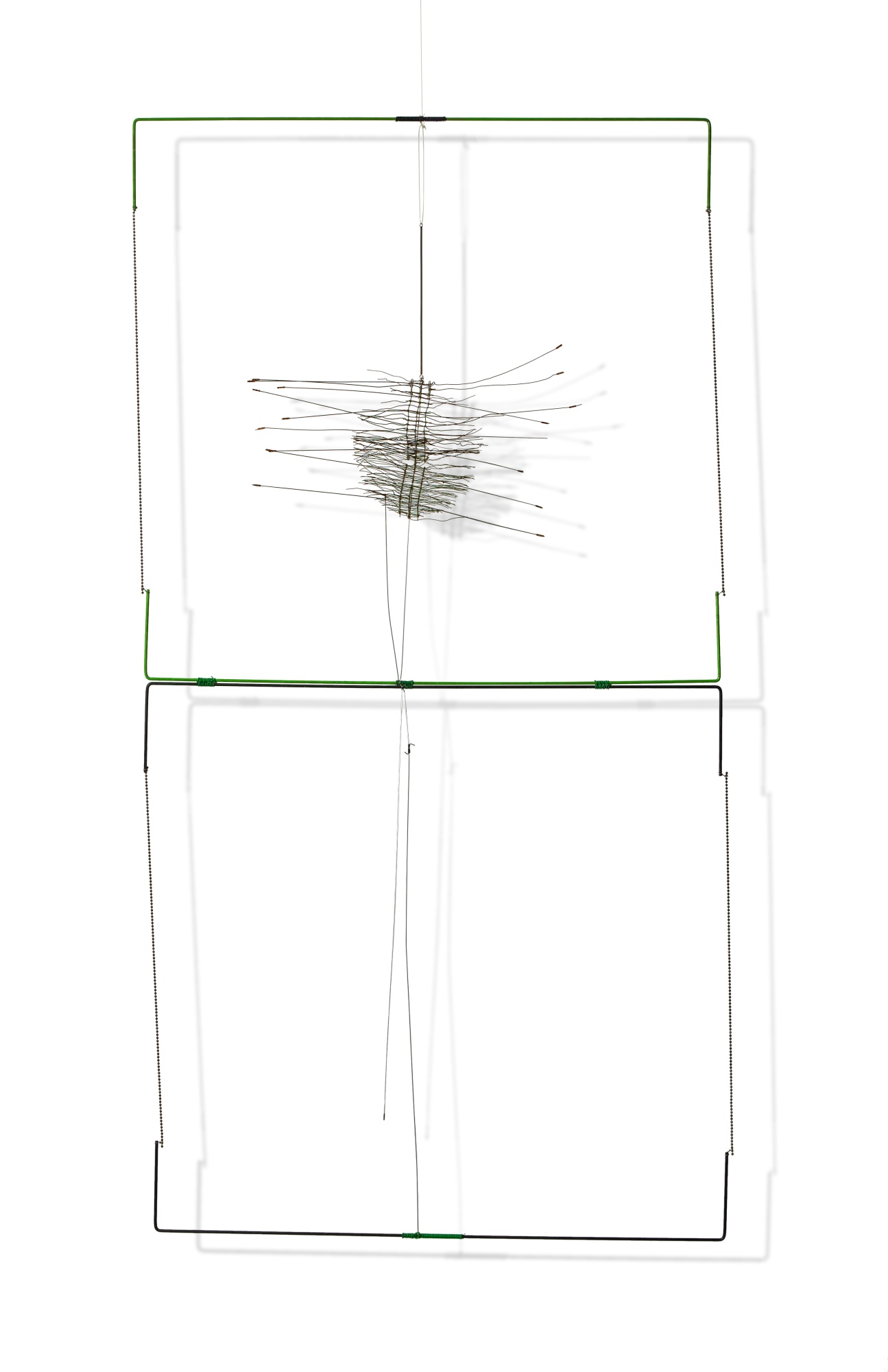
Gego
Dibujo sin papel, 1985
Collectors who have built meaningful holdings in artists such as Lygia Clark, Hélio Oiticica, or Mira Schendel will find in Gego a natural and deeply rewarding companion. Her work shares with those artists a commitment to the phenomenological, to art as something experienced in the body rather than merely processed by the eye. Yet her particular fusion of engineering logic and poetic openness gives her a distinct and irreplaceable identity within that constellation. Gego's relationship to art history is layered and still being fully mapped.
She emerged from a dialogue with concrete art and kinetic abstraction but transcended both categories. Her work anticipates concerns central to process art and installation art that would become dominant in the 1970s and 1980s in Europe and North America, even as she developed her practice largely outside those critical conversations. This geographic distance, once used to marginalize her, is now recognized as a mark of independence and originality. Scholars and curators have increasingly argued that any honest account of postwar abstraction and spatial art must include Gego at or near its center.
She continued working with remarkable consistency until near the end of her life, dying in Caracas in 1994. The Fundación Gego, established to steward her legacy, has worked diligently to place her work in the contexts it deserves, and the results are now unmistakable. Museum retrospectives, scholarly catalogues, and a sustained presence in the most serious collections in the world have cemented her reputation across generations. For collectors encountering Gego now through works on paper, prints, or the rare opportunity to acquire a wire sculpture, there is both the pleasure of discovering an artist of genuine greatness and the satisfaction of participating in a conversation that art history is actively deepening.
Her lines, suspended in space or pressed quietly onto paper, continue to find new rooms to transform.
Explore books about Gego
Gego: Abstraction in Space, 1955-1668
Catherine de Zegher
Gego: A Retrospective
Museum of Modern Art
Gego: Drawn from Life
Catherine de Zegher
Gego: Between Abstraction and Nature
Fundación Gego
Gego: Forms in Space
Conrado Eisenberg