Friedensreich Hundertwasser
Hundertwasser: Where Nature and Art Converge
Artist Spotlight · The Collection Editorial
“The straight line is godless and immoral. The straight line is not a creative line, it is a line of destruction.”
Hundertwasser, 1958 Mould Manifesto Against Rationalism in Architecture
In the grand atrium of the Kunsthaus Wien, the museum that Hundertwasser himself designed and that opened in 1991 in Vienna, visitors still pause in something close to disbelief. The floors undulate beneath their feet. The walls breathe with ceramic tile and overgrown vegetation. The windows are mismatched, each one unique, because Hundertwasser believed that a person's window was their sovereign territory, their right to express individuality against the tyranny of the straight line.
Friedensreich Hundertwasser
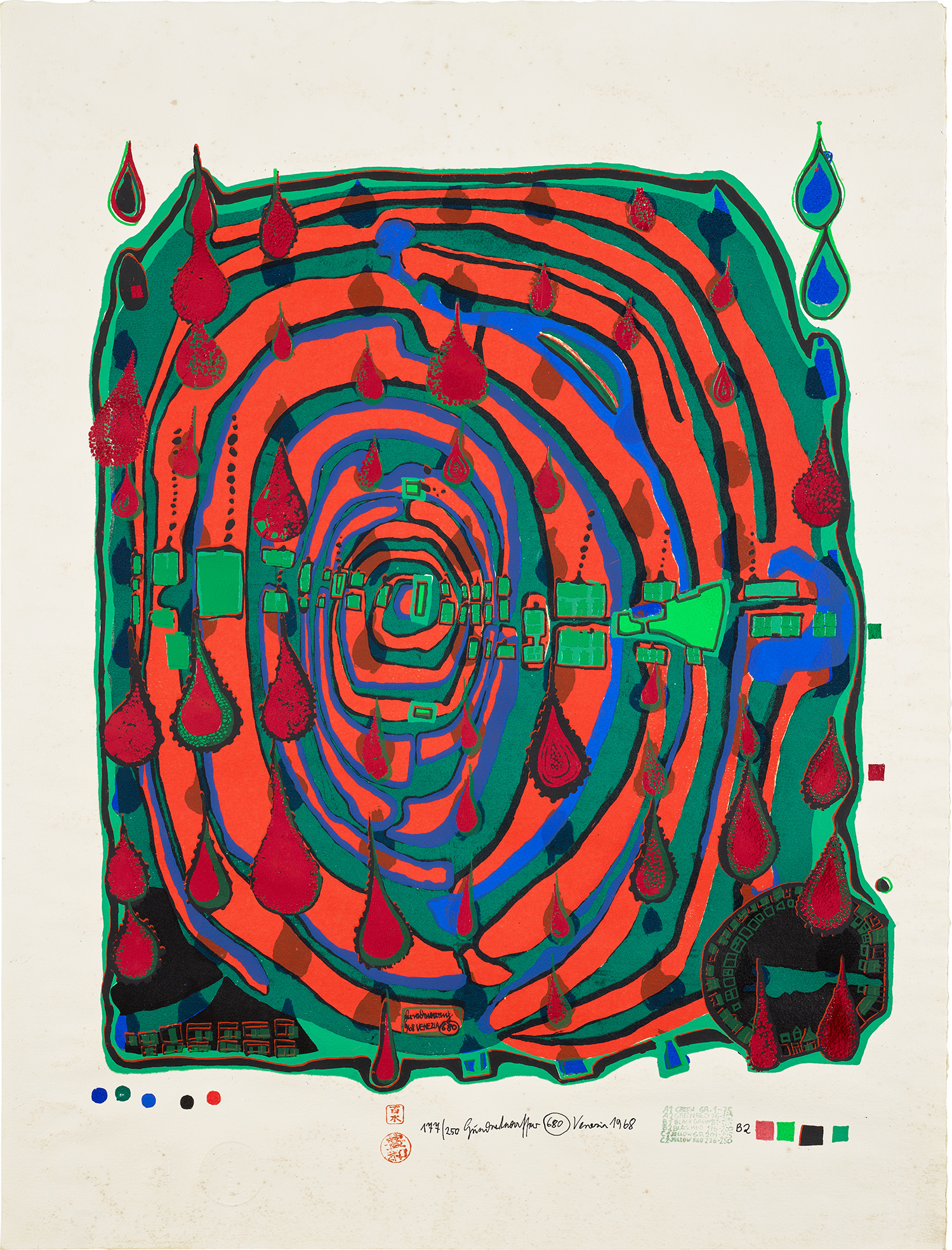
Sad Not So Sad is Rainshine, from Rainday on a Rainy Day (K. 39a)
Decades after his death in 2000, the building remains one of the most visited contemporary art destinations in Austria, and it tells you everything you need to know about a man who refused, with extraordinary consistency and joy, to separate art from life. Friedensreich Hundertwasser was born Friedrich Stowasser on December 15, 1928, in Vienna. His early years were marked by profound instability. His father died when he was barely a year old, and his mother, Elsa, raised him alone through the turbulent years of the Second World War.
As a Jewish family in Nazi occupied Austria, they survived through a combination of circumstance and concealment. The experience of that precariousness, of a world that could be dismantled without warning, seems to have planted in him a lifelong hunger for organic permanence, for forms drawn not from the ruler and the blueprint but from the spiraling, self renewing logic of nature. He studied briefly at the Academy of Fine Arts in Vienna in 1948, staying only three months before striking out on his own path through Italy and France. Those early travels proved formative.
![Friedensreich Hundertwasser — Look at it on a rainy day [Regentag Portfolio]: One plate](https://rtwaymdozgnhgluydsys.supabase.co/storage/v1/object/public/artwork-images/auction-lots/N10866-20211203-lot44.jpg)
Friedensreich Hundertwasser
Look at it on a rainy day [Regentag Portfolio]: One plate
Paris in the early 1950s was still electric with postwar creative energy, and Hundertwasser absorbed the lessons of the great colorists with voracious attention. He was drawn particularly to the example of Egon Schiele and Gustav Klimt, his great Viennese predecessors, whose decorative intensity and psychological charge he recognized as a kindred sensibility. He was also deeply moved by the work of Paul Klee, whose layered symbolic systems and childlike wonder at the world resonated with his own emerging vision. Yet Hundertwasser quickly departed from all of these influences toward something entirely his own: a language of spiral forms, densely patterned surfaces, and luminous, unexpected color combinations that seemed to pulse with biological energy.
“If you want to build, you must work with nature, not against it.”
Friedensreich Hundertwasser
By the late 1950s and into the 1960s, Hundertwasser had developed the core of his mature practice. He worked across painting, printmaking, and ultimately architecture, treating each discipline as a continuation of the same fundamental inquiry into how human beings might live in greater harmony with the natural world. His paintings of this period, dense watercolors and mixed media works layered with egg tempera and oils on unusual supports, established his reputation across Europe. Works like the 1956 watercolor "Vapeur dans la vallée verte" reveal a young artist already in full command of his chromatic instincts, the landscape dissolved into zones of glowing, jeweled color that feel simultaneously ancient and urgently contemporary.
Friedensreich Hundertwasser
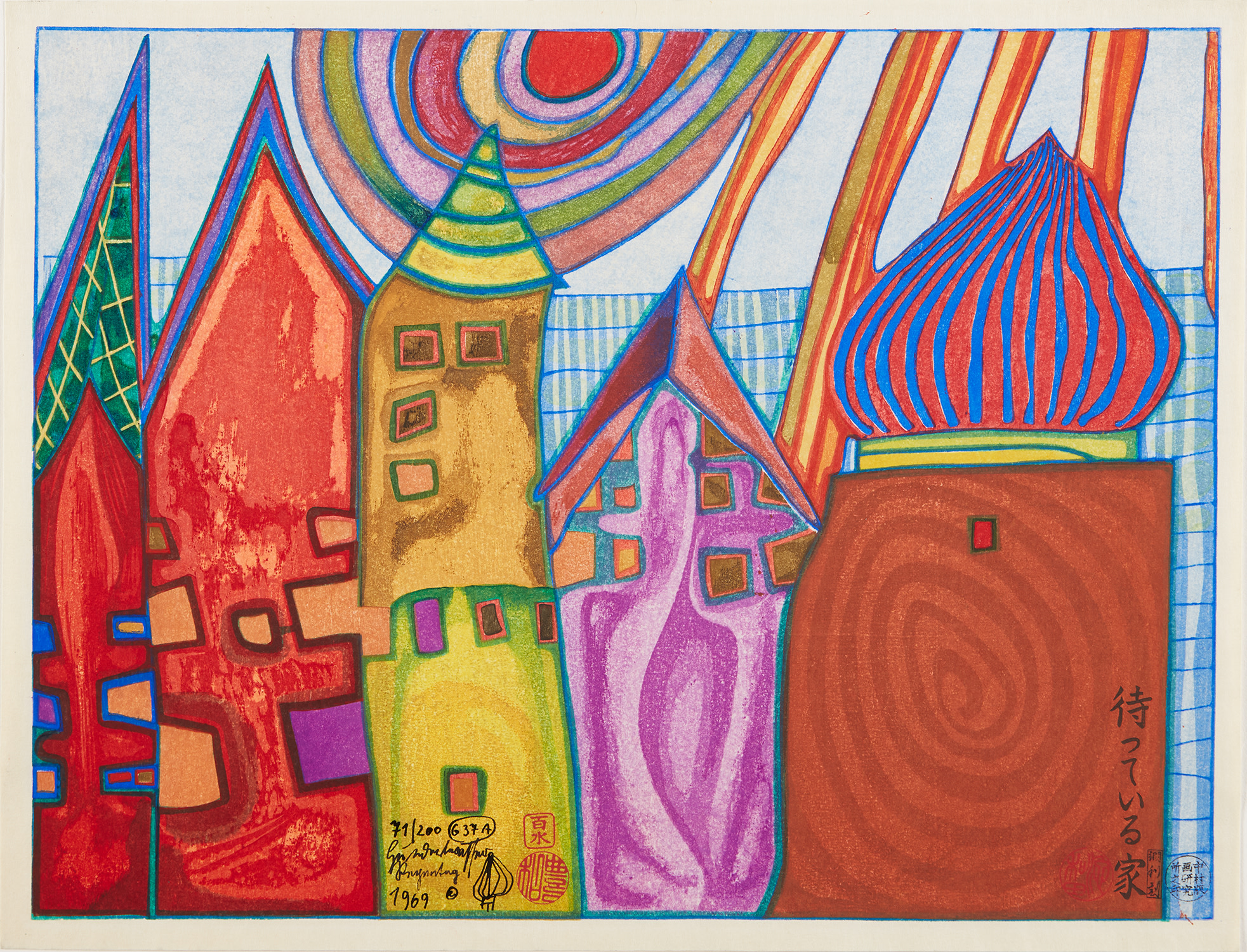
Waiting houses, from Nana Hyaku Mizu (K. 37)
His adoption of the name Friedensreich Hundertwasser, meaning roughly Kingdom of Peace and Hundred Waters, was itself a artistic act, a renaming of the self as a declaration of intent. The print editions that followed through the late 1960s and 1970s represent some of the most collectible and technically inventive work of his career. The celebrated Regentag portfolio, produced between 1970 and 1972 and published by Ars Viva in Zurich, stands as a landmark of postwar European printmaking. Comprising ten screenprints with embossing, each from an overall edition of 3,000, the series takes rain, and specifically the experience of looking at the world through rain, as its central theme and metaphor.
“A person in a rented apartment must be able to lean out of his window and scrape off the masonry within arm's reach.”
Hundertwasser, Window Right speech, 1990
Individual plates such as "Look at it on a Rainy Day" demonstrate Hundertwasser's extraordinary gift for combining technical processes: the screenprint laid in vivid, overlapping colors, then enriched with embossing that gives the surface a tactile, almost geological depth. Rarer still are the hand signed complete sets numbered 1 through 300, which represent the most coveted tier of the edition. His woodcuts, particularly those on Japanese paper such as "Waiting Houses" from the Nana Hyaku Mizu series and "Blood Garden House," carry the same density of feeling translated into a different material logic, the grain of the wood itself becoming a collaborator in the composition. For collectors, Hundertwasser offers a remarkable range of entry points.
Friedensreich Hundertwasser
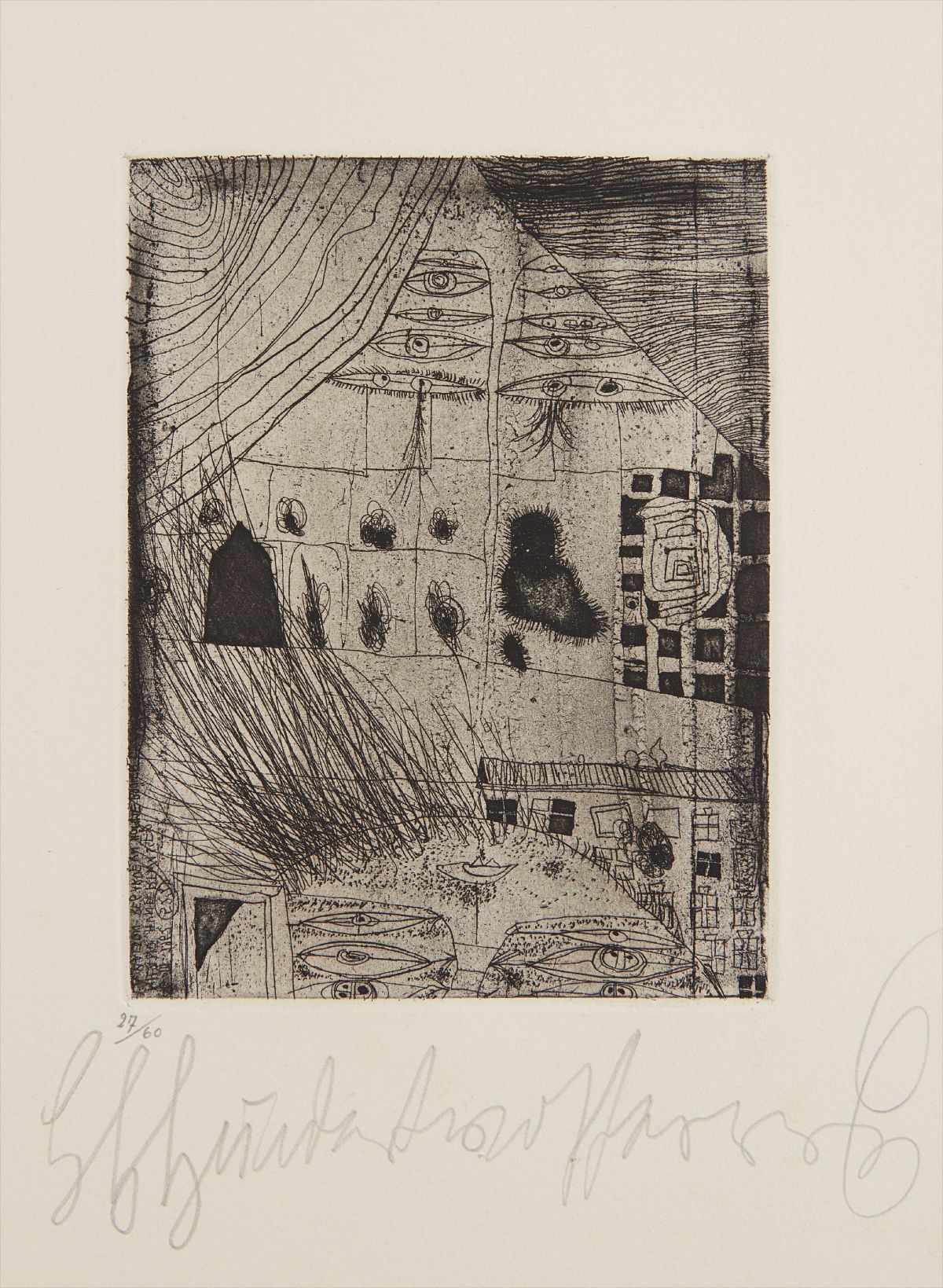
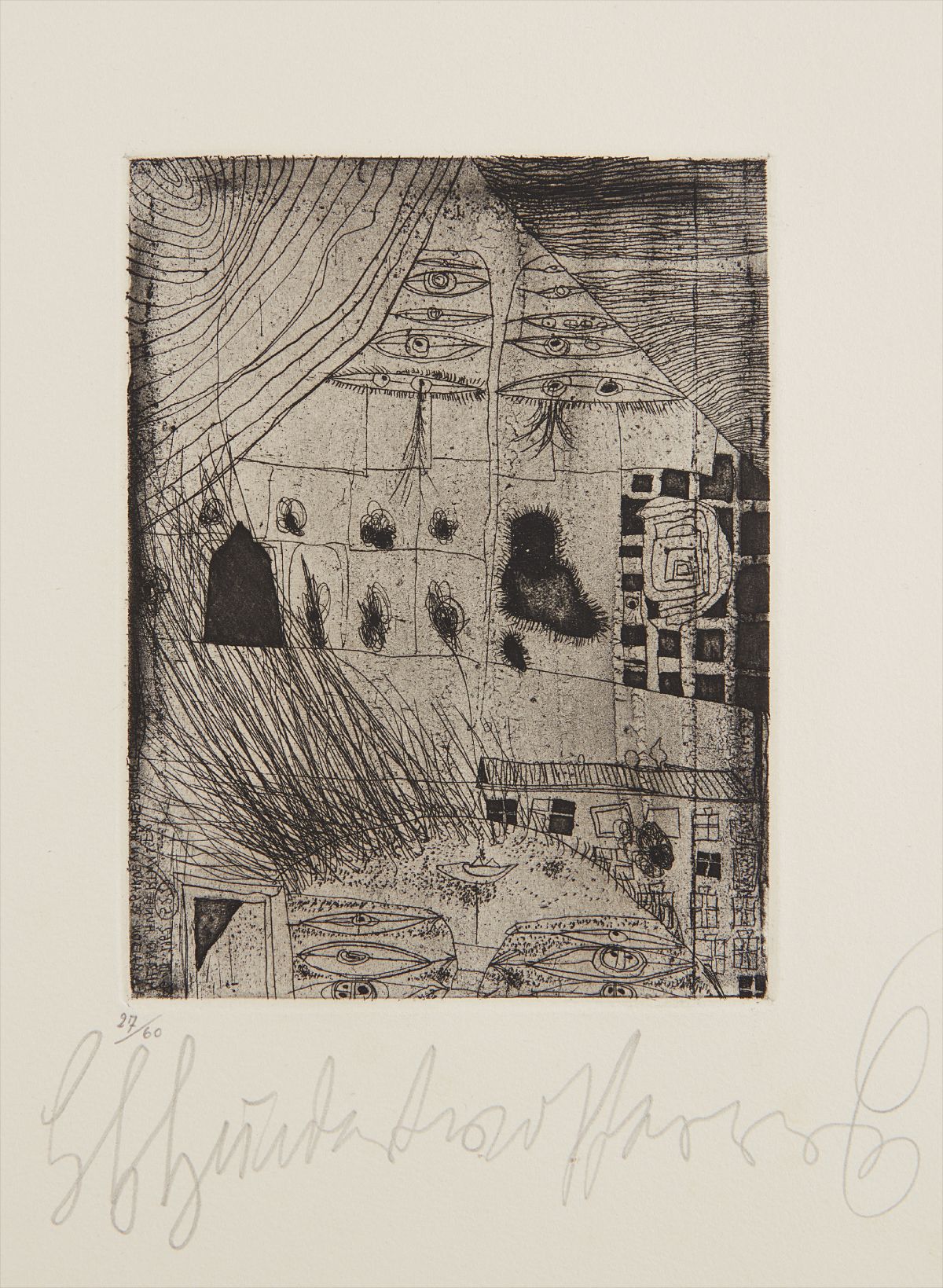
Das Haus sieht einen Menschen Brennen (The House Looks at a Burning Man)
His prints, produced with the meticulous involvement of master printers including the Dietz Offizin workshop in Bavaria, were conceived from the outset as genuinely democratic art objects, works of real quality and ambition intended for a broad audience. Yet within those editions, distinctions of numbering, signing, and provenance create meaningful hierarchies that reward careful attention. Unique works on paper and his rare oil and mixed media paintings occupy a different register entirely. The watercolor "Vapeur dans la vallée verte" from 1956, a fully realized early painting on paper laid on canvas, offers collectors access to the most intimate layer of his practice.
His architectural commissions, including the famed Hundertwasserhaus apartment building completed in Vienna in 1986, exist beyond the market but profoundly shape the cultural context in which all his works are understood. Within the broader sweep of twentieth century European art, Hundertwasser occupies a singular position. He shares with the Viennese Secessionists a commitment to Gesamtkunstwerk, the total work of art that dissolves boundaries between painting, decoration, and architecture. He shares with Arte Povera artists a suspicion of industrial modernity and a turn toward organic, elemental materials and forms.
His ecological philosophy anticipates by decades the concerns that now preoccupy artists working in the tradition of land art and environmental practice. Artists such as Antoni Gaudi, whom Hundertwasser openly admired, and the great colorists of the Nabis tradition offer useful adjacent reference points, though Hundertwasser's own synthesis remains irreducible to any single lineage. Hundertwasser died on February 19, 2000, aboard the Queen Elizabeth 2 ocean liner, in the Pacific Ocean, on a journey from New Zealand, where he had made his home in his later years. He was buried on his New Zealand property, under a tulip tree, without a coffin, in accordance with his beliefs about the cycle of life and the return of the body to the earth.
It was a death, and a burial, entirely consistent with the philosophy he had lived and painted. Today, with ecological thinking central to contemporary culture, with questions of human scale and organic form reshaping architecture globally, and with collectors increasingly drawn to work that carries genuine feeling and a coherent worldview, Hundertwasser's art feels not like a relic of the past but like a set of answers we are only now catching up to asking.
Explore books about Friedensreich Hundertwasser
Hundertwasser 1928-2000: Catalogue Raisonné
Joram Hrel, Peter Selz

Hundertwasser: Architecture and Ecology
Peter Simulan
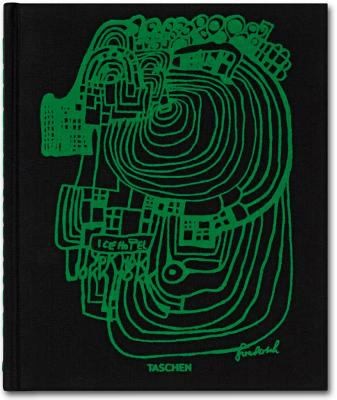
Friedensreich Hundertwasser
Wieland Schmied

Hundertwasser: Art and Ecology
Joram Hrel
The Art of Hundertwasser
Walter Schurian
Hundertwasser: His Life and Works
Peter Selz
Hundertwasser Architecture: For a More Human Architecture
Peter Simulan, Friedensreich Hundertwasser