French, 19th century
France's Gilded Century Glows Anew
Artist Spotlight · The Collection Editorial
There is a particular quality of light that seems to emanate from the finest French decorative arts of the nineteenth century, a warm, burnished radiance that collectors and museum curators alike have spent generations trying to describe and, more urgently, to possess. That glow is on vivid display right now in major European institutions: the Musée des Arts Décoratifs in Paris has in recent years devoted renewed scholarly attention to the applied arts of the post Revolutionary period, and auction houses from Christie's to Sotheby's consistently record strong results for refined French bronzes, marble objects, and enamel work from this era. The market, in short, has never been more alert to the exceptional craftsmanship produced in France between the fall of Napoleon and the close of the Belle Époque. To speak of French nineteenth century work is necessarily to speak of inheritance.
French, 19th century
Column
The craftsmen and ateliers who defined this period were heirs to centuries of royal patronage, guild tradition, and the relentless pursuit of technical perfection that had made France the envy of every European court since Louis XIV installed his workshops at Versailles. The Revolution had disrupted much but could not extinguish this hunger for beauty. By the early decades of the 1800s, Parisian workshops were again producing objects of staggering ambition: furniture with gilt bronze mounts of extraordinary intricacy, marble objects worked with the patience and precision of jewelers, and enamel pieces that revived medieval techniques while speaking the visual language of a modernizing nation. The artistic development of French decorative production across the nineteenth century can be understood as a series of passionate conversations with the past.
Early in the century, the Empire style drew heavily on classical antiquity, with craftsmen incorporating Roman and Greek motifs into bronzes, column forms, and architectural ornament. By mid century, a Gothic and Renaissance revival swept through Parisian workshops, sending artists and artisans back to study medieval enamels, polychrome sculpture, and early Flemish and French religious art. It is within this current of revivalism, scholarly and yet intensely creative, that some of the most compelling objects of the era were produced, including works that engaged directly with the pre Reformation visual world of triptychs, saints, and royal devotion. Among the most revealing works associated with French nineteenth century practice are those that demonstrate this dialogue between eras with particular eloquence.
French, 19th century
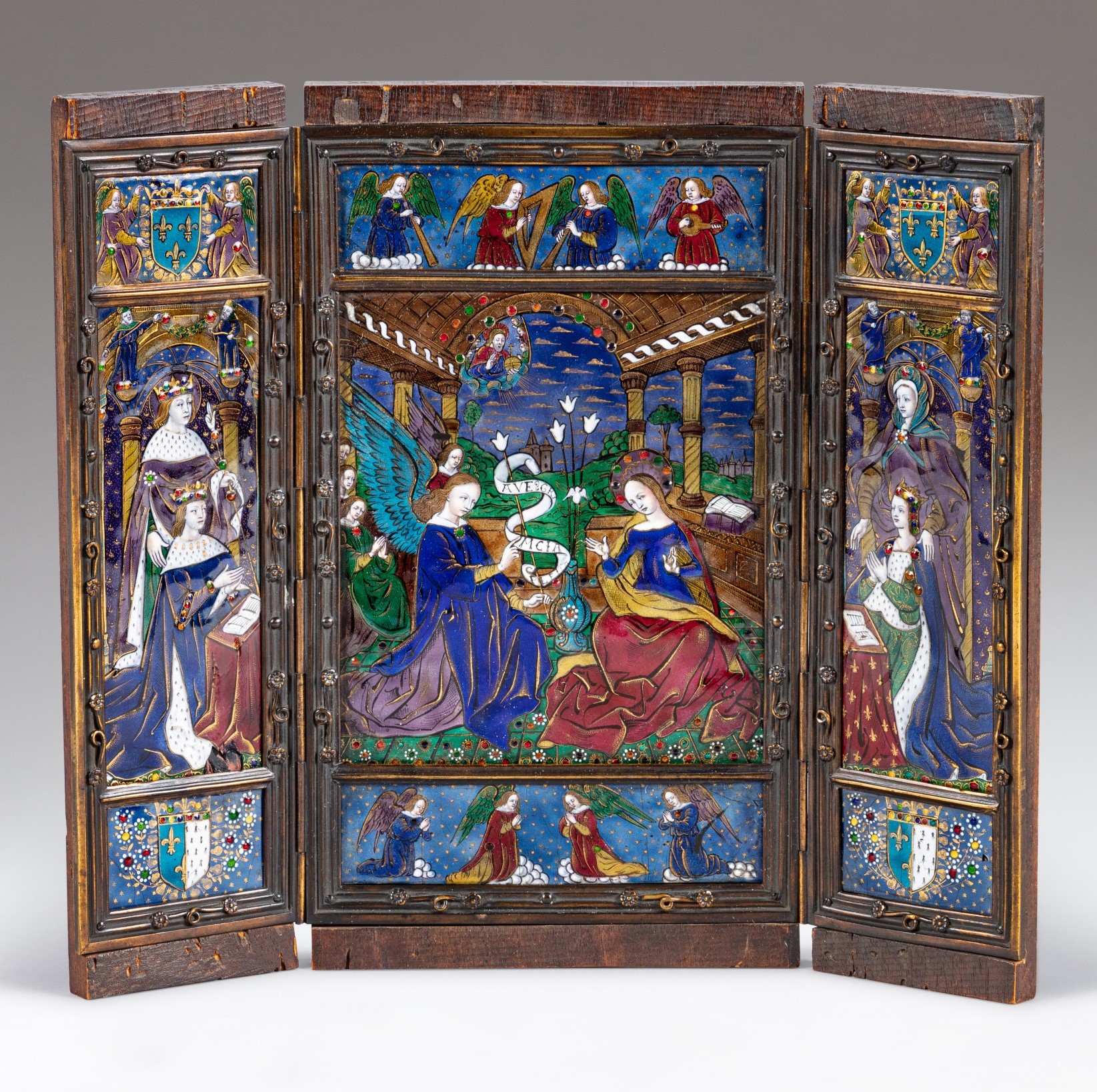
L'Annonciation avec Louis XII et Anne de Bretagne
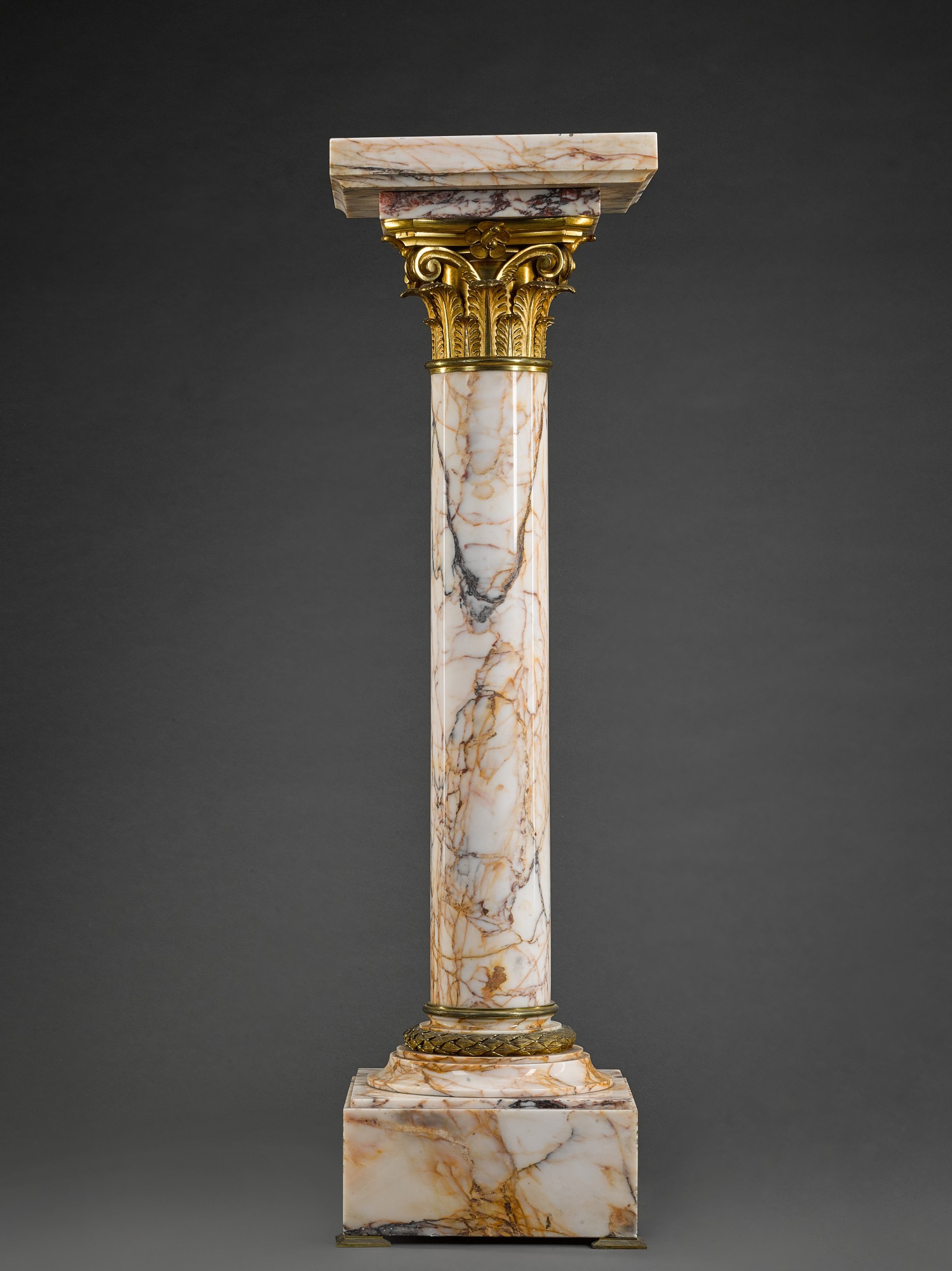
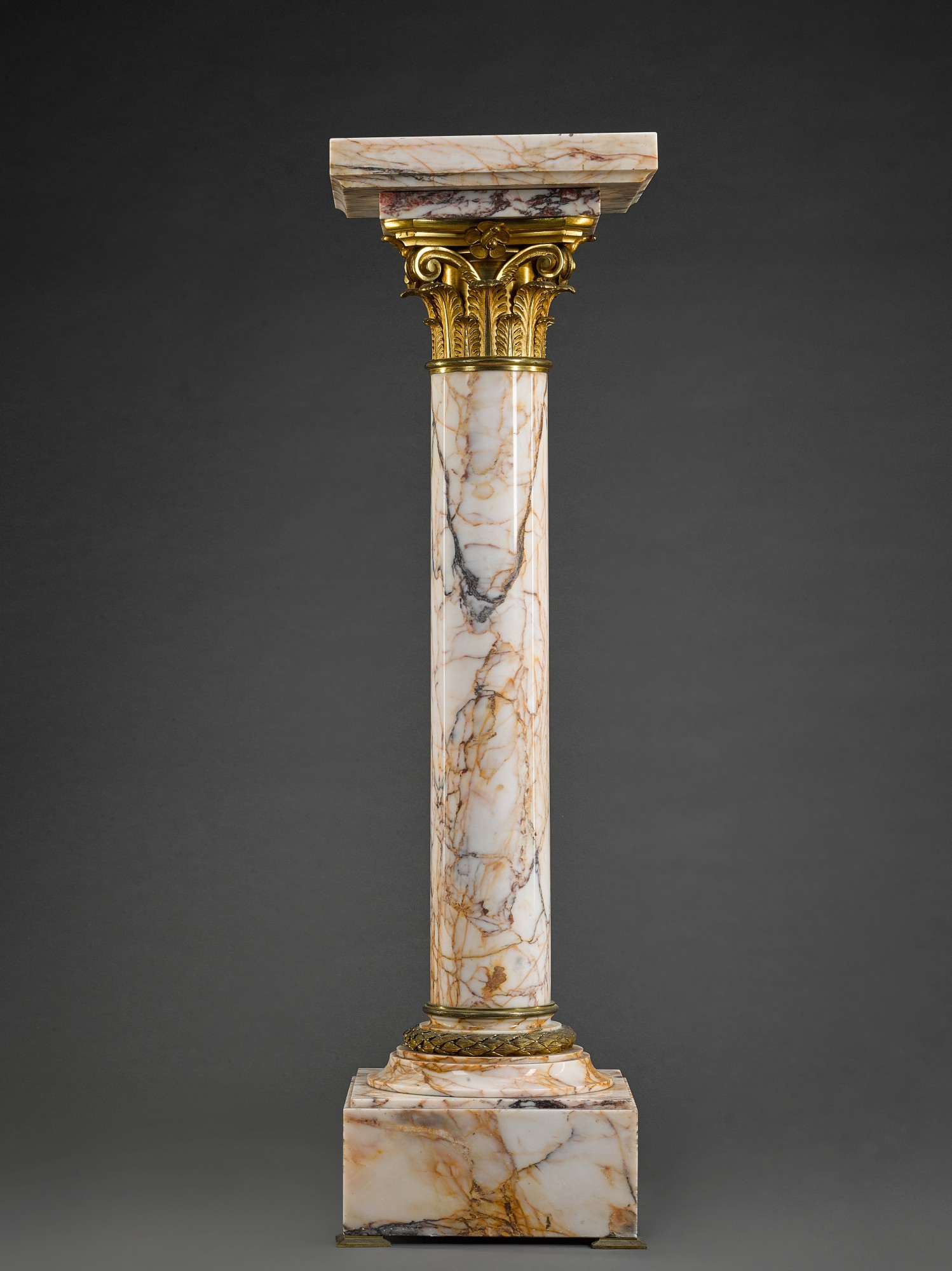
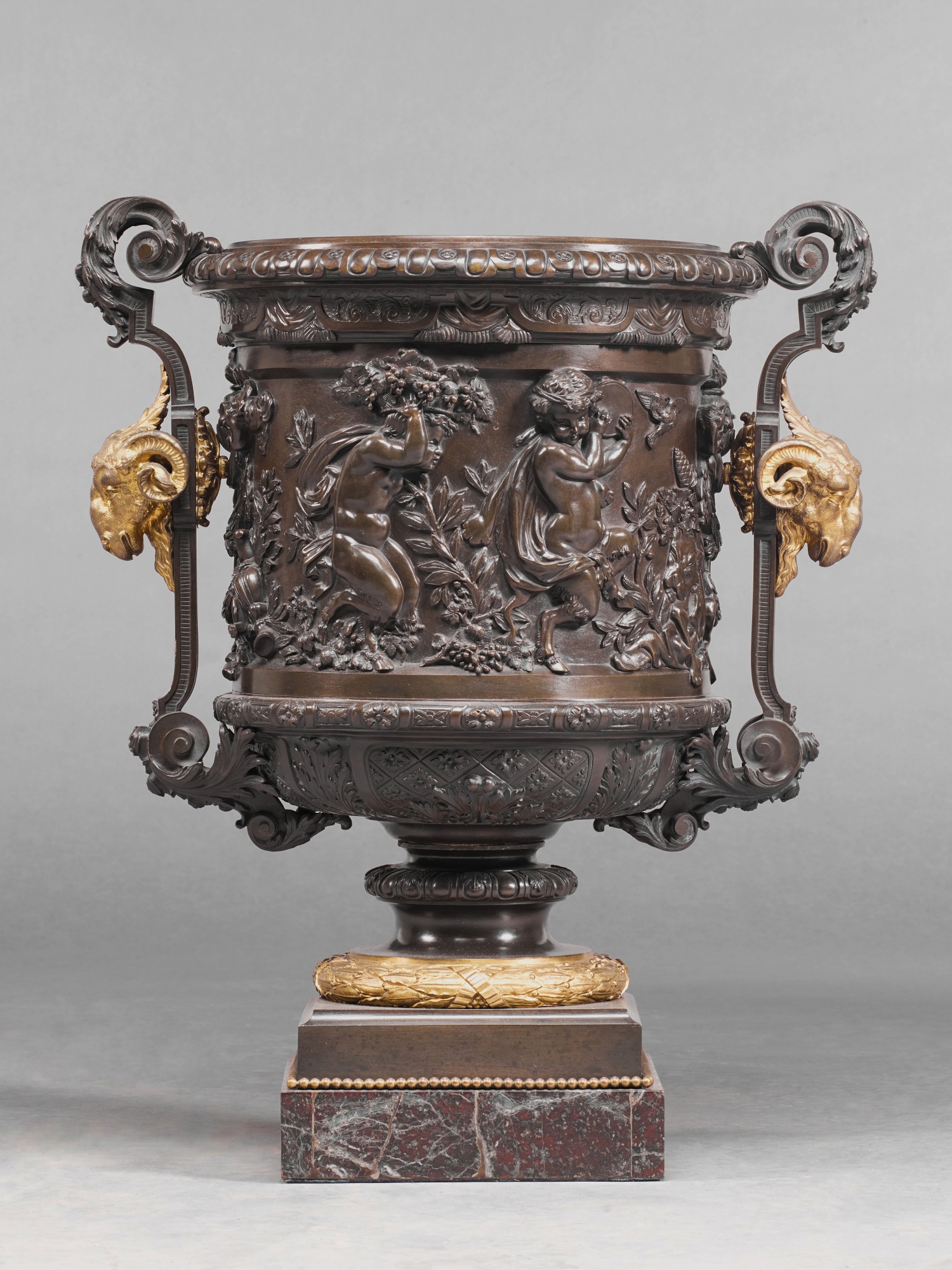
A column in panazeau marble fitted with gilt bronze mounts speaks to the era's command of luxurious materials and its understanding of classical proportion: panazeau, with its deep, warm veining, was prized by Parisian marchands merciers and their clients for its ability to anchor a room with understated authority. The gilt bronze mounts on such a piece would have required the skills of a fondeur, a ciseleur, and a doreur working in close collaboration, a reminder that the greatest French decorative objects of this period were collective achievements as much as individual ones. A bronze figure on a veined red marble base, finished in brown and gilt patina, demonstrates the era's mastery of surface treatment: the combination of two patinas, one deep and shadowed, one luminous and warm, was a sophisticated technique that gave bronze sculpture a vitality and visual complexity that single finish bronzes could rarely match. Perhaps no object type better encapsulates the ambitions of French nineteenth century craft than the polychrome enameled triptych.
Works that revisit subjects such as the Annunciation, rendered with figures and iconography drawn from the late medieval and early Renaissance periods, represent both extraordinary technical achievement and a genuine act of cultural memory. Limoges had been the great center of enamel production in France since the medieval period, and nineteenth century craftsmen working in that tradition were acutely conscious of the masters they were honoring: artists such as Léonard Limosin and Pierre Reymond, whose sixteenth century enamels were already treasured in royal and aristocratic collections. A triptych presenting a sacred scene alongside royal figures, set in a gilt bronze frame and housed within a wood surround, would have appealed to the era's deep appetite for objects that were simultaneously devotional, historical, and magnificently beautiful. From a collecting perspective, French nineteenth century decorative arts occupy a particularly rewarding position in the current market.
French, 19th century
French, 19th century
The category is broad enough to encompass objects at a wide range of price points, yet distinguished enough that even modest examples carry genuine historical weight. Collectors are advised to attend closely to quality of finish, the coherence of mounts with their marble or stone supports, and the legibility of patination on bronzes. Works that show evidence of thoughtful, historically informed design rather than purely mechanical reproduction tend to hold their value and their appeal most durably. Comparable collecting areas include the work of firms and artisans associated with the great Paris exhibitions, particularly the Expositions Universelles of 1855 and 1867, which served as showcases for the finest French craft of the mid century.
In terms of artistic kinship, French nineteenth century decorative production sits in productive conversation with a wide community of makers and movements. The English Arts and Crafts movement, which emerged in the latter half of the century partly in response to French industrial craft, shared the same reverence for material integrity and historical continuity. Closer to home, the work of individual artist craftsmen such as Eugène Grasset and the designers associated with the Union Centrale des Arts Décoratifs drew on the same deep wells of French visual tradition. Collectors who are drawn to this period often find themselves equally captivated by Renaissance metalwork, by the enamel production of the Sèvres manufactory, and by the great bronziers of the Second Empire such as Ferdinand Barbedienne, whose foundry set standards of quality that shaped the entire market.
The legacy of French nineteenth century craft is, finally, a legacy of seriousness. These objects were made by people who believed that beauty was not incidental to human life but essential to it, that a well made column or a carefully fired enamel triptych could carry meaning across centuries and cultures. That belief has proved correct. The works endure, they continue to move and delight those who encounter them, and they continue to find passionate new stewards among collectors who understand that the finest decorative arts are not merely furniture for rooms but furniture for the imagination.
To collect in this area is to participate in one of the longest and most distinguished conversations in Western visual culture.
Explore books about French, 19th century
Manet and His Circle
George Moore
The History of Impressionism
John Rewald
The Life and Work of Edgar Degas
Lillian Browse
Cézanne: A Study of His Development
Roger Fry
Renoir
Barbara Ehrlich White
The Symbolist Movement in Literature
Arthur Symons
Van Gogh: A Life
Steven Naifeh and Gregory White Smith
Monet: A Life
Claire Joyes