Frederick Arthur Bridgman
Frederick Bridgman, America's Master of Light
Artist Spotlight · The Collection Editorial
Stand before a Bridgman canvas long enough and the heat becomes almost palpable. The whitewashed walls catch the Algerian sun at a particular angle, the fabric drapes with the weight of silk in still afternoon air, and figures move through shadow and brilliance with the unhurried grace of people who have always belonged to that landscape. Frederick Arthur Bridgman occupies a singular place in the story of American art, and renewed collector appetite for 19th century Orientalist painting has placed his work at the center of a conversation about mastery, beauty, and the enduring power of meticulous observation. Bridgman was born in Tuskegee, Alabama in 1847, a circumstance that seems almost novelistic given the trajectory his life would take.
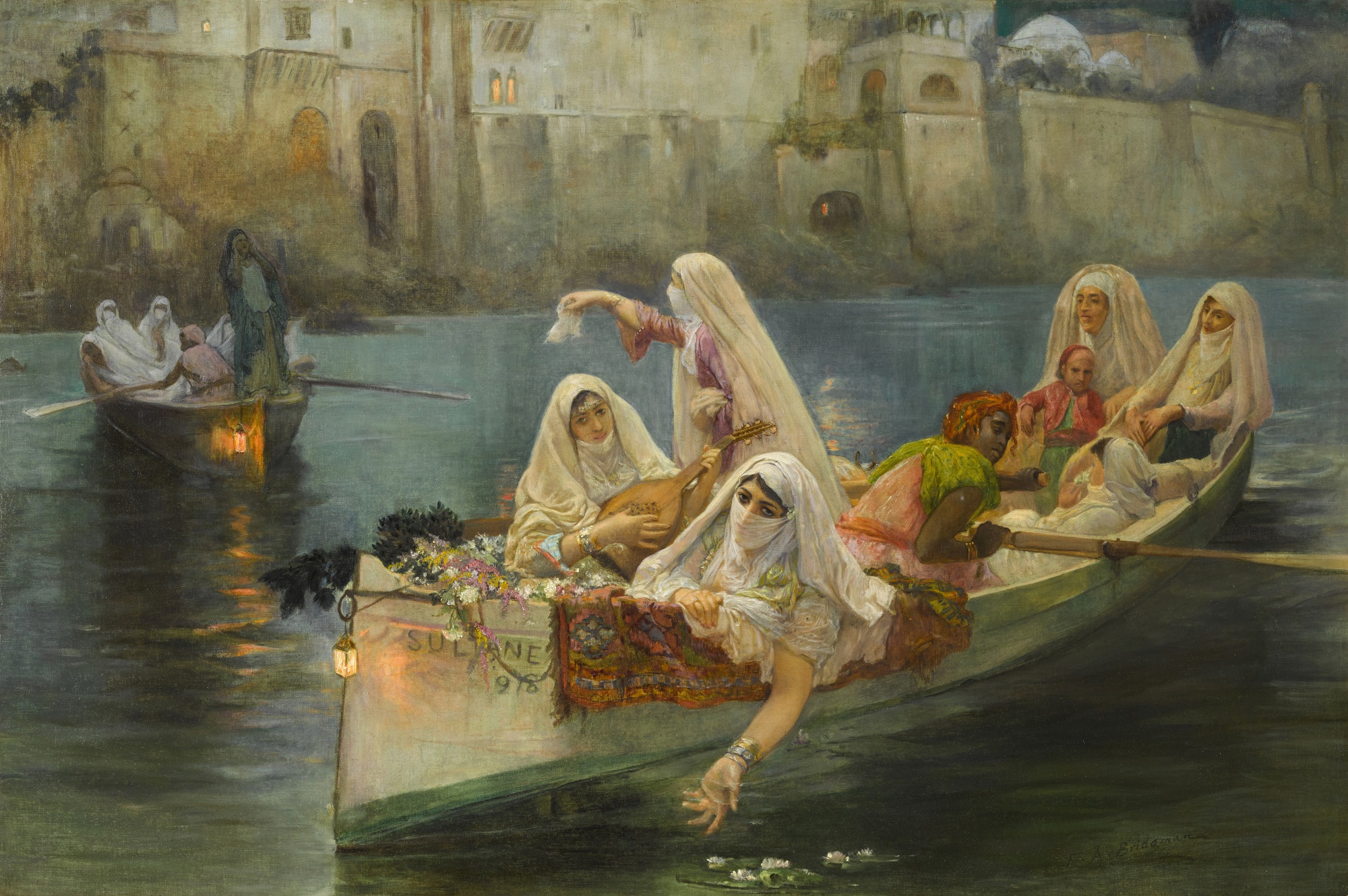
Frederick Arthur Bridgman
Return from the festival, Algiers
Raised in Brooklyn, New York, he showed an early and insistent talent for drawing that led him first to the American Bank Note Company, where he worked as an engraver. That early discipline with line and detail would prove foundational to everything that followed. By his early twenties he had resolved to pursue painting seriously, and like so many ambitious American artists of his generation he understood that the path ran through Paris. He arrived in France in 1866 and entered the studio of Jean Léon Gérôme at the École des Beaux Arts, a placement that would define the entire arc of his career.
Gérôme was at that moment the preeminent practitioner of Orientalist painting in Europe, a figure whose commitment to archaeological accuracy, luminous surfaces, and narrative precision had made him both famous and influential. Bridgman proved an exceptional student. He absorbed not just technique but a philosophy of approach: that the faraway world deserved the same scrupulous attention as any subject closer to home, perhaps more, given the obligation to render it honestly for audiences who had never seen it. His first journey to North Africa came in 1872 and changed everything.
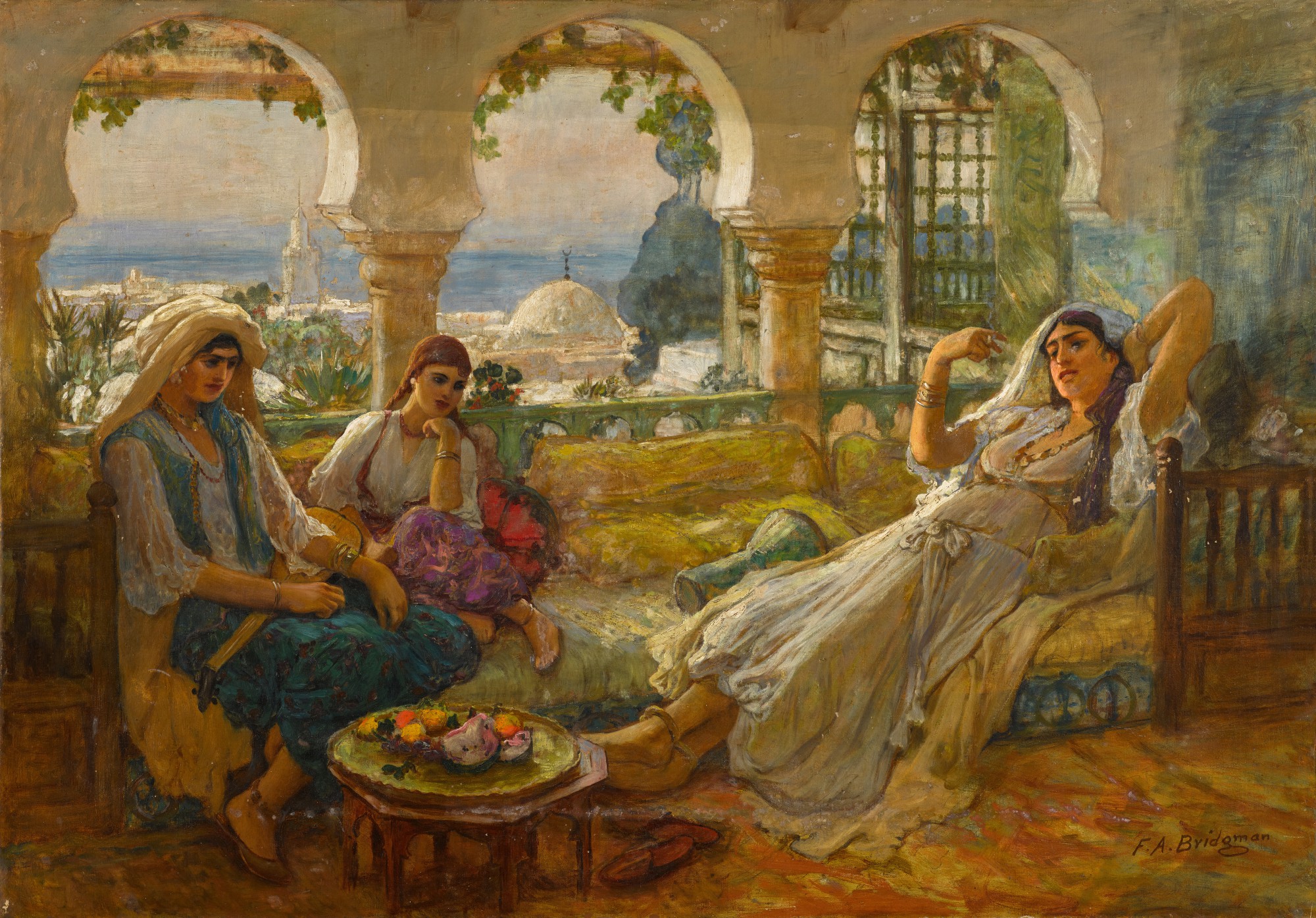
Frederick Arthur Bridgman
On the Terrace
Traveling through Egypt and Algeria, Bridgman filled sketchbooks with drawings, absorbed color and architecture, watched how light behaved on different surfaces at different hours, and returned to Paris with a transformed sense of purpose. The paintings he produced in the years that followed brought him immediate acclaim. His large canvas depicting an American expedition through Egypt, exhibited at the Paris Salon in 1875, established him as a major talent on both sides of the Atlantic. He would return to Algeria and Egypt repeatedly over the coming decades, maintaining studios that allowed him to work directly from observation rather than imagination alone.
The works that collectors prize most today demonstrate the full range of what made Bridgman exceptional. A painting like Return from the Festival, Algiers captures the particular festive energy of a procession while remaining anchored in specific, observed detail: the color of a garment, the posture of a figure adjusting to the weight she carries, the way a crowd opens and closes around its center. On the Terrace offers something quieter and perhaps even more seductive, a moment of repose that uses architectural framing and the quality of afternoon light to create an almost meditative stillness. Abdallah, a portrait study in oil on board, reveals Bridgman's particular gift for individuality within his broader subject matter: this is not a type but a person, rendered with psychological presence as well as technical brilliance.
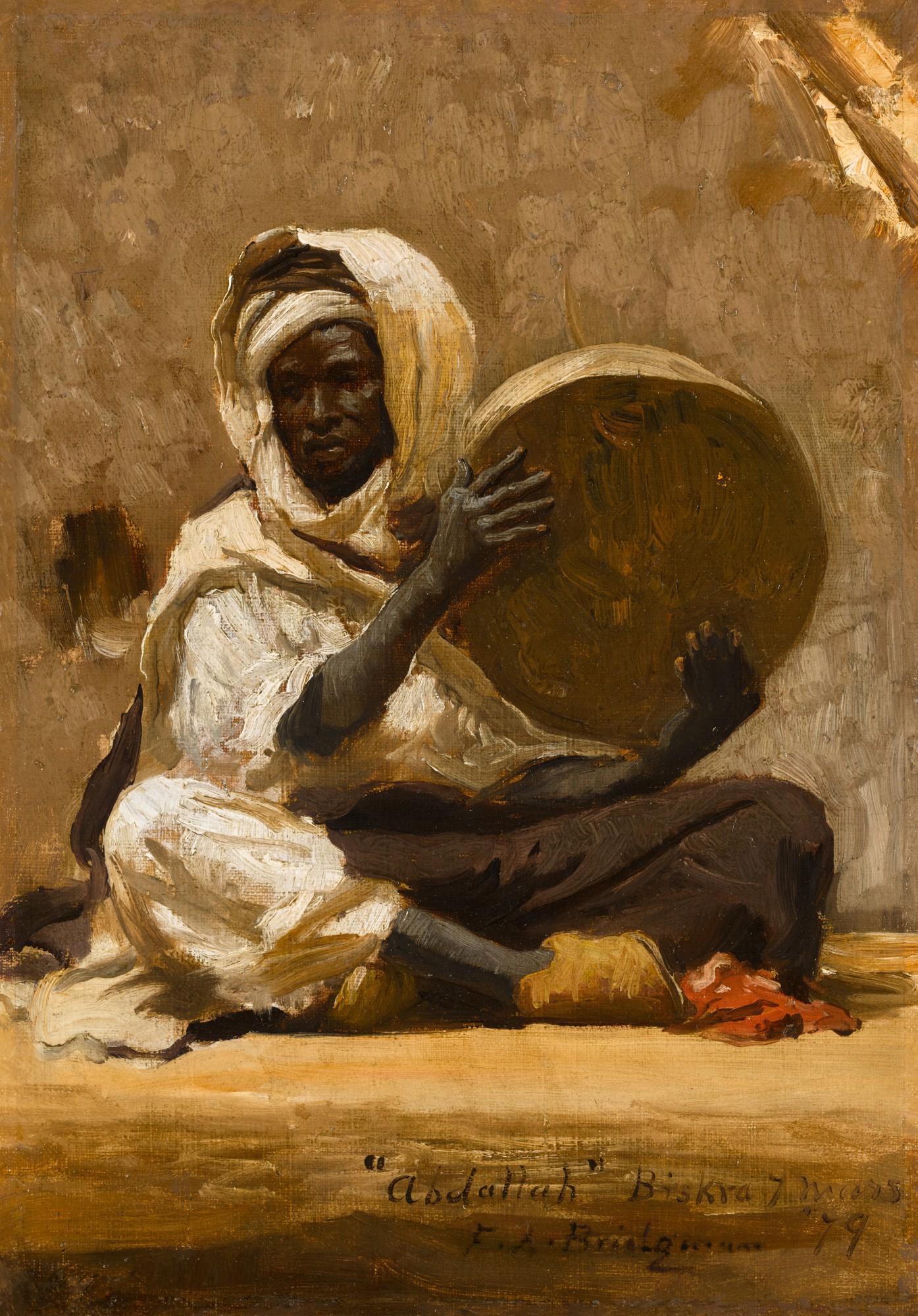
Frederick Arthur Bridgman
Abdallah
The Arabian stallion Romeo demonstrates that his capacities extended well beyond the figure, encompassing landscape and animal painting with equal fluency. What distinguishes Bridgman within the Orientalist tradition is a quality that might be called warmth of regard. Where some of his contemporaries rendered the peoples and places of North Africa as spectacle or abstraction, Bridgman's figures carry genuine interiority. A Veiled Beauty is not simply an exercise in exotic surface but a study in the relationship between concealment and expression.
A Precious Jewel and Afternoon Rest, Algiers both inhabit domestic spaces with a quality of intimacy that suggests the painter was welcomed rather than merely tolerated. The Bazaar and A Chieftain and His Entourage work at a larger social scale while maintaining the same commitment to specific, observed humanity. For collectors, Bridgman's market presents a genuinely compelling case. His works appear regularly at the major auction houses in New York and London, and examples in good condition with strong provenance have consistently attracted serious bidding from private collectors in the United States, Europe, and the Gulf states.
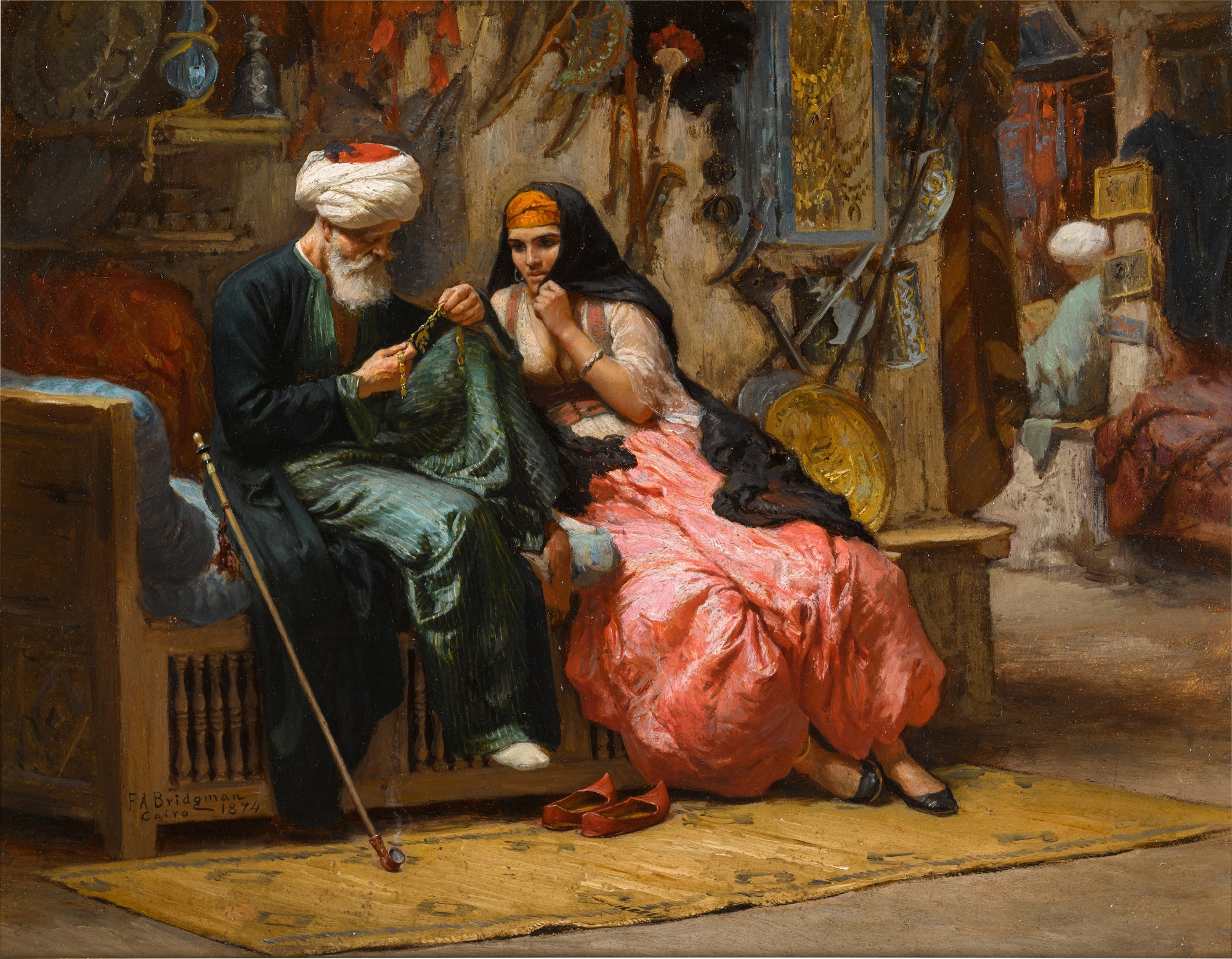
Frederick Arthur Bridgman
A Precious Jewel
The latter audience brings particular resonance: collectors from the Arab world who recognize in Bridgman's North African subjects an attentiveness and respect not always found in Western 19th century work. His oils on canvas and oils on panel both command strong interest, with the smaller format works offering accessible entry points for collectors building a collection and the larger exhibition pieces representing genuine museum quality acquisitions. Condition and provenance are paramount, as with all 19th century oil on canvas work, and buyers should pay particular attention to the clarity of the original paint surface. Within the broader landscape of Orientalist painting, Bridgman stands alongside figures including his teacher Gérôme, the British painter John Frederick Lewis, and the French Algerian specialist Eugène Fromentin.
Each brought different temperamental qualities to shared subject matter. Lewis worked with an almost obsessive precision that bordered on the jewel like; Fromentin brought a romantic spaciousness to his Algerian desert scenes; Gérôme wielded an almost cool authority. Bridgman synthesized elements of all these tendencies while remaining distinctly himself: more warm than Gérôme, more dynamic than Lewis, more grounded in human presence than Fromentin. His American identity also inflects his work in subtle ways, with an openness of composition and a democratic attention to individual subjects that feels distinct from his European contemporaries.
Bridgman spent his later years between France and the United States and died in Rouen in 1928 at the age of eighty. He had witnessed the entire transformation of modern art from Impressionism through Cubism and beyond, and while the critical consensus of the early 20th century largely set aside academic Orientalist painting in favor of the avant garde, history has been steadily returning to reassess what was dismissed. Bridgman now appears not as a relic of a superseded tradition but as a master of a distinct mode of seeing, one that rewarded patience, expertise, and genuine curiosity about a wider world. For the collector who values technical accomplishment alongside human feeling, there are few figures from his era who offer more.
Explore books about Frederick Arthur Bridgman