Fred Tomaselli
Fred Tomaselli's Luminous World Beckons Collectors
Artist Spotlight · The Collection Editorial
“I want my paintings to be a kind of redemptive, Utopian space where things that are normally at war with each other can coexist.”
Fred Tomaselli, interview with BOMB Magazine
When the Brooklyn Museum mounted a major survey of Fred Tomaselli's work, visitors found themselves standing closer and closer to the panels, drawn in by a compulsive need to identify what, exactly, they were looking at. Leaves pressed flat beneath glassy resin. Pharmaceutical tablets arranged in radiant halos. Insects pinned like sacred relics into mandalas of impossible intricacy.
Fred Tomaselli
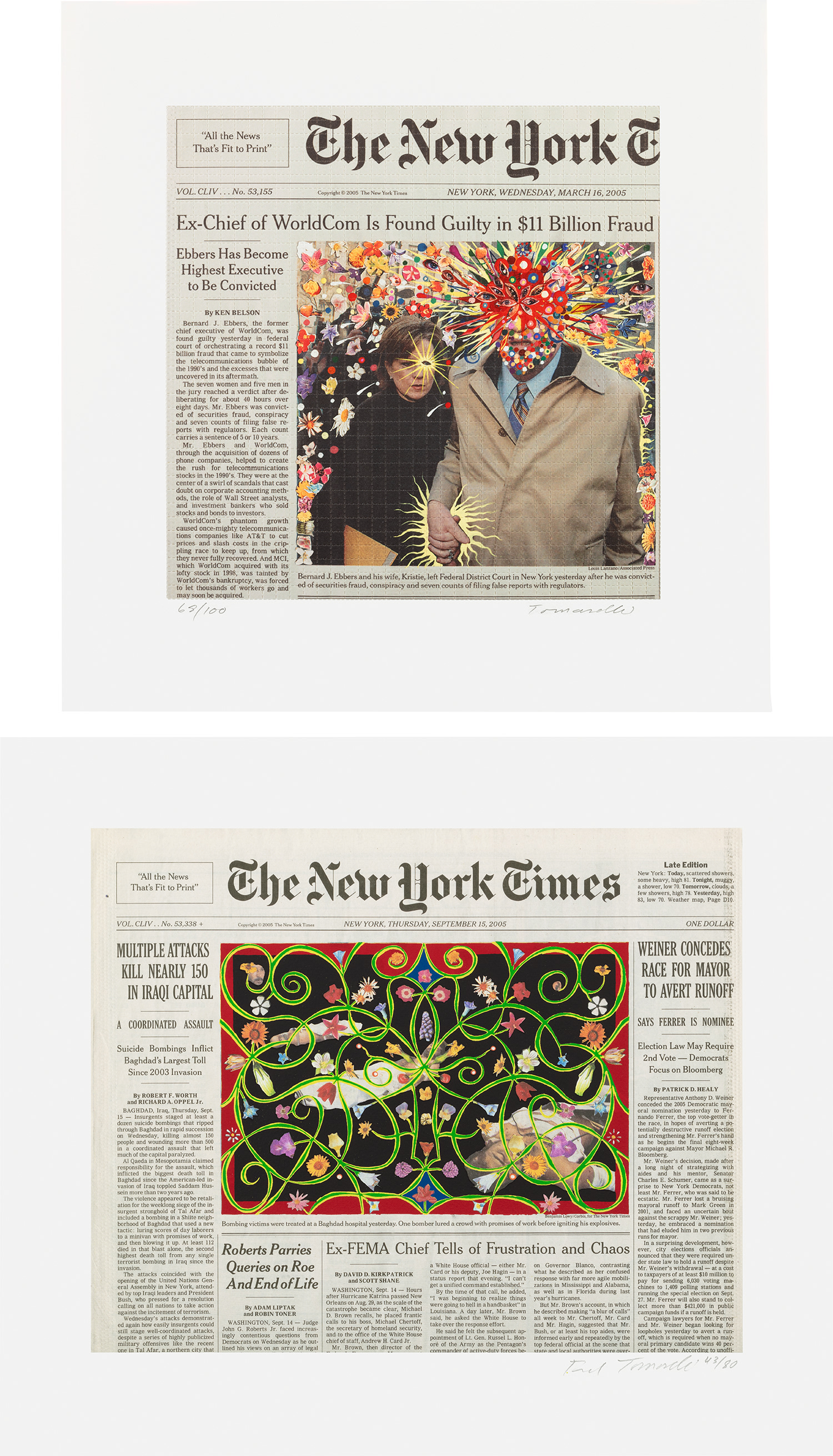
Guilty; and Sep. 15, 2005 (Half Page), from The New York Times
The show confirmed what a devoted community of collectors and curators had long understood: Tomaselli is among the most genuinely original painters working in America today, an artist whose canvases reward prolonged attention in ways that few contemporary works can claim. Fred Tomaselli was born in Santa Monica, California in 1956, and came of age during a period when the boundaries between popular culture, psychedelia, and fine art were gloriously unstable. Southern California in the 1960s and 1970s offered a particular kind of visual education, one saturated with the imagery of counterculture, the luminous flatness of Pacific light, and a pervasive curiosity about altered states of consciousness. Tomaselli studied at California State University, Fullerton, where he earned his Bachelor of Arts degree, and in the early 1980s he relocated to New York, eventually settling in Brooklyn.
The move proved decisive. New York gave him critical friction, community, and the distance needed to look back at his California inheritance with clear eyes. His early practice incorporated elements of installation and sculpture, and it was during the late 1980s and into the 1990s that Tomaselli began developing the technique that would define his reputation. He started embedding actual objects into layers of epoxy resin applied over wood panels, working with herbs, leaves, pills, seeds, and other organic and synthetic materials as if constructing a kind of archaeological specimen that had been trapped mid transformation.
Fred Tomaselli
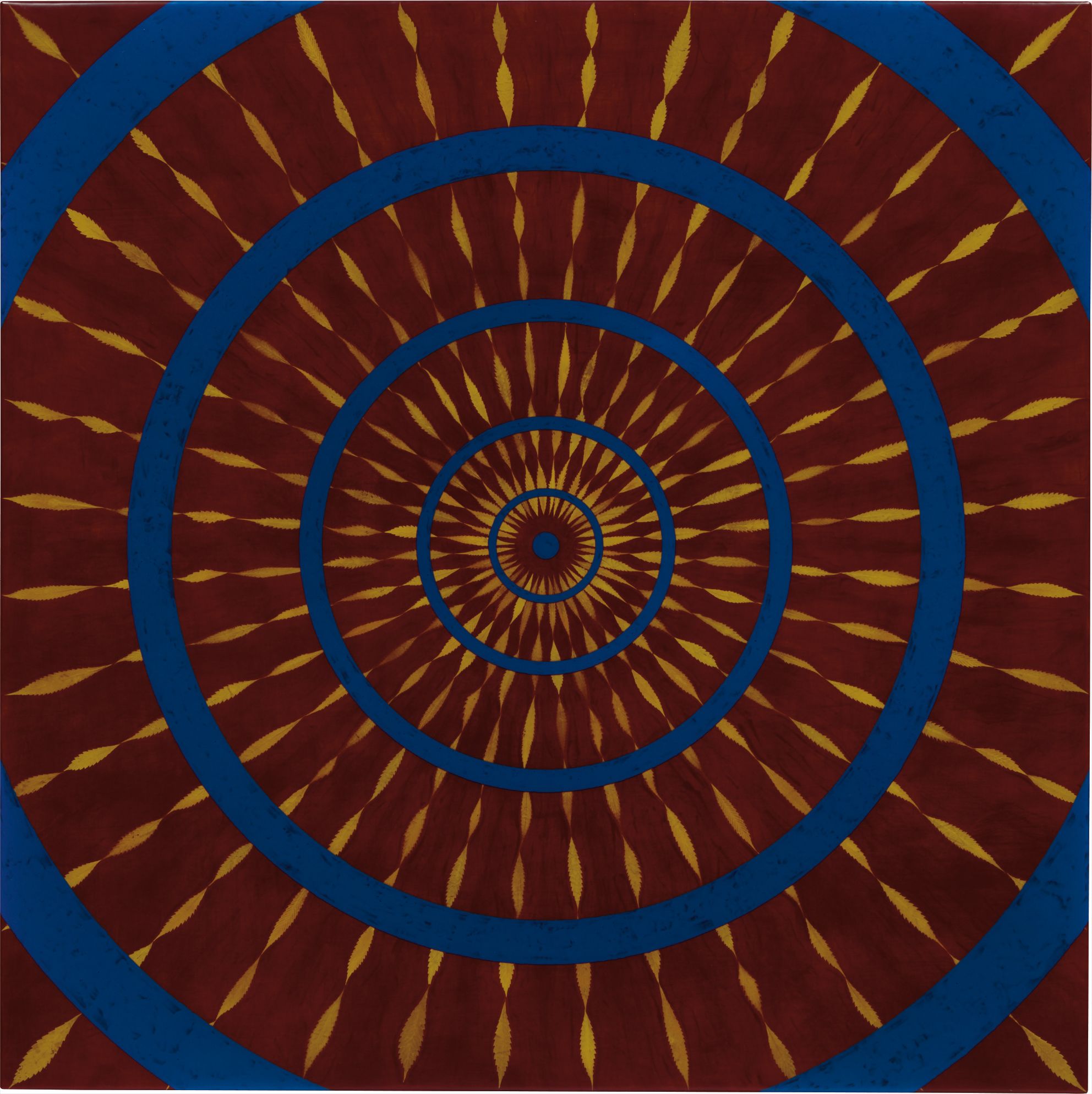
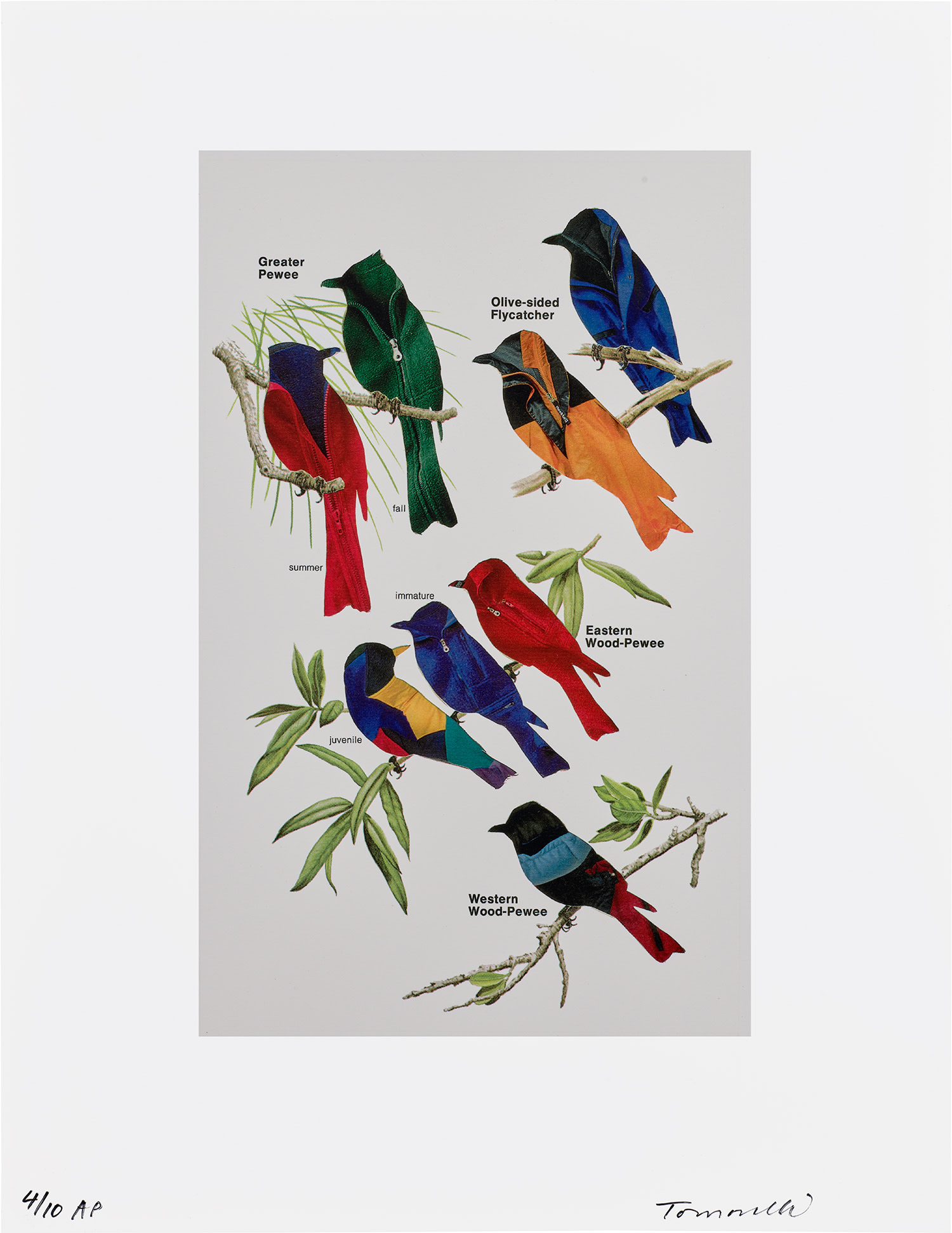
Greater Pewee, Olive-Sided Flycatcher, Eastern Wood-Pewee, Western Wood Pewee
The decision to use real pharmaceuticals was not merely provocative. It was conceptually precise. The pills are not representations of altered consciousness but rather the literal chemical agents of it, frozen into decorative abundance, their power made aesthetic and their aesthetics made powerful. Tomaselli has described his work as a kind of archive of the senses, and the resin serves as both preservative and magnifier.
“The materials I use are the actual agents of the altered states I am depicting. They are not metaphors.”
Fred Tomaselli, artist statement
By the late 1990s, Tomaselli had begun exhibiting with James Cohan Gallery in New York, a relationship that helped bring his work to serious critical and institutional attention. His paintings from this period, dense kaleidoscopic compositions organized around radial symmetry, drew immediate comparisons to illuminated manuscripts, Buddhist thangkas, and the visionary botanical illustrations of the seventeenth and eighteenth centuries. Yet there is nothing antiquarian about them. Works such as Airborne, from 2000, and his celebrated bird compositions from the mid 2000s, demonstrate a painterly confidence and an almost ruthless decorative intelligence that situates them firmly in the tradition of American pattern and decoration while simultaneously transcending it.
Fred Tomaselli
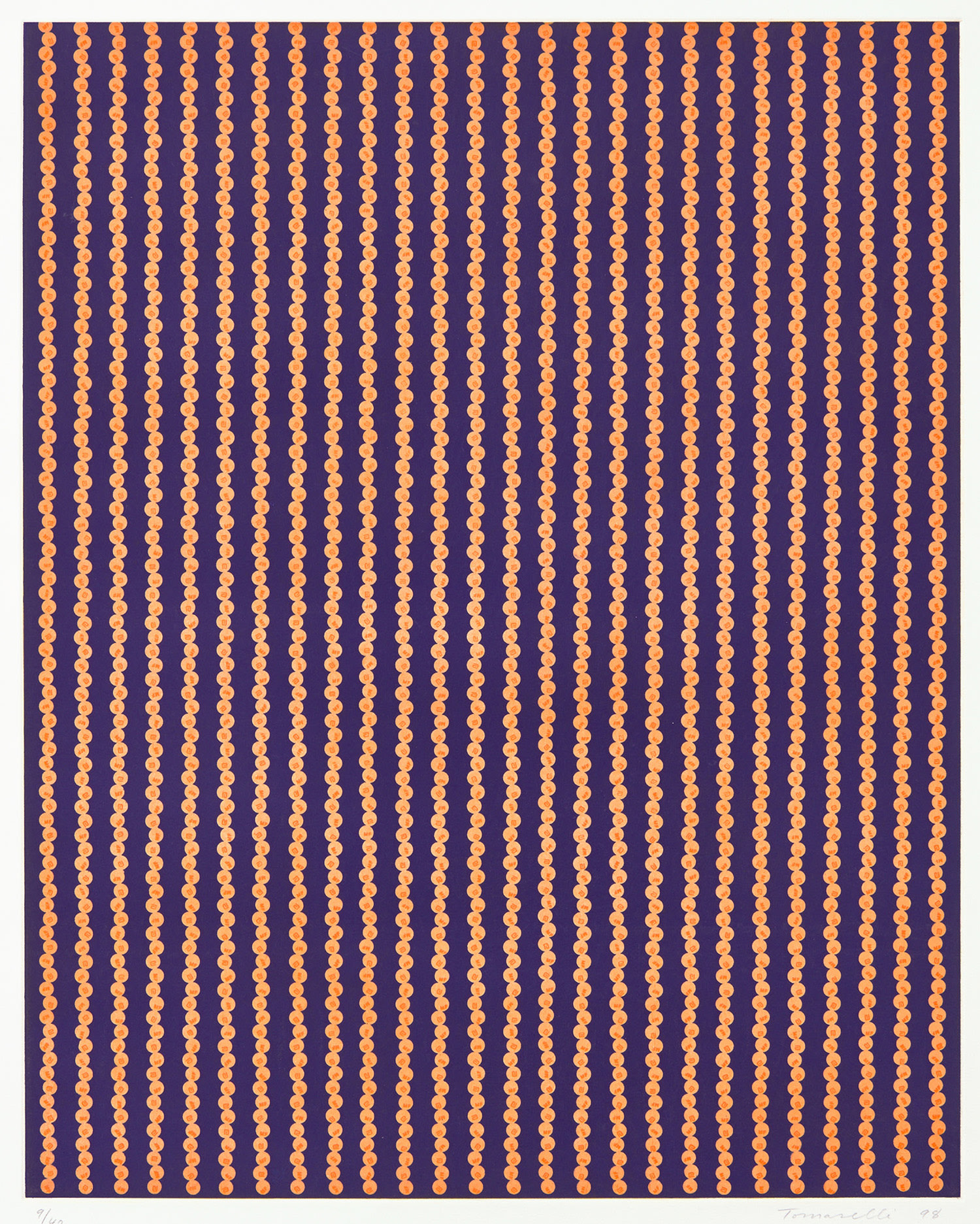
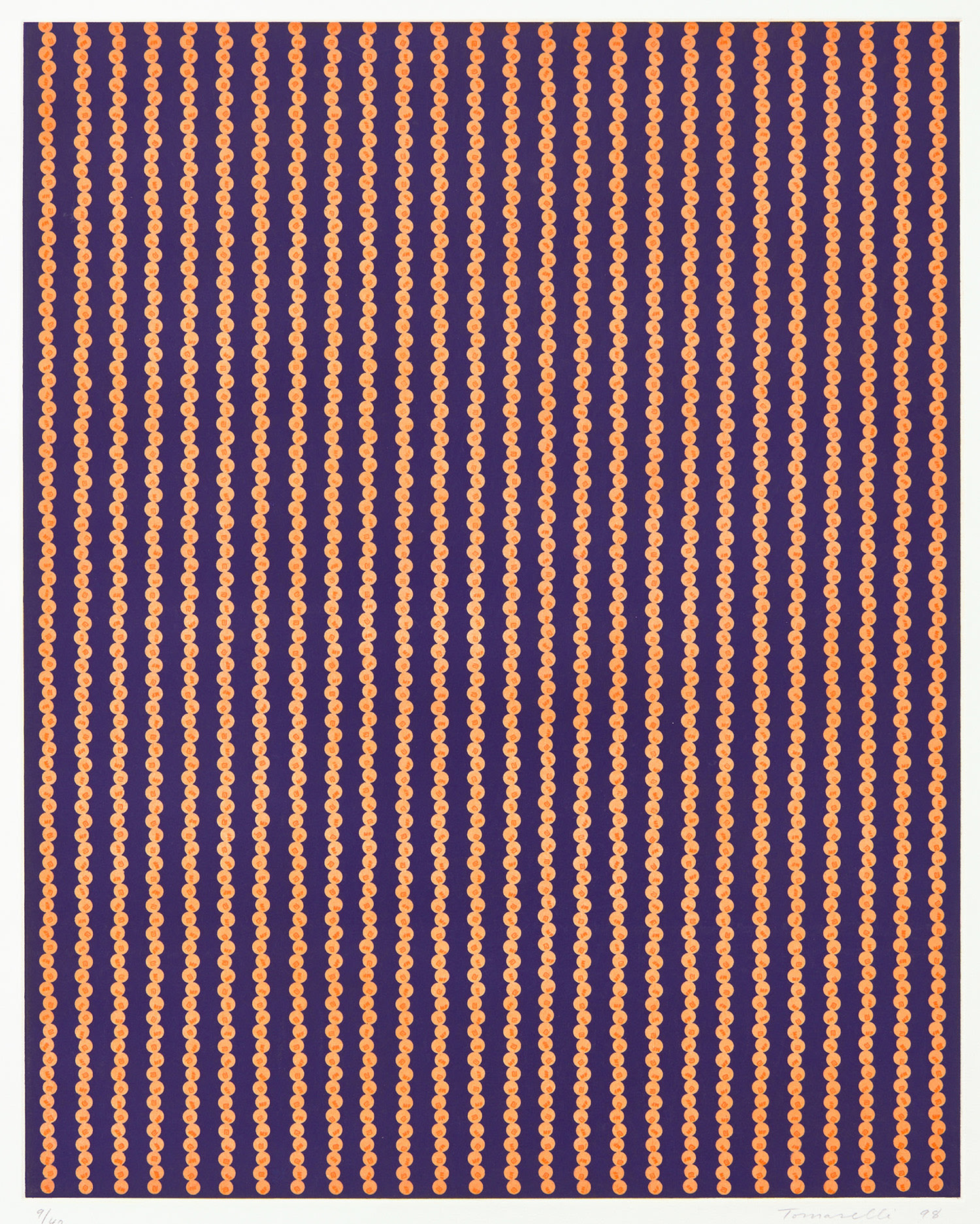
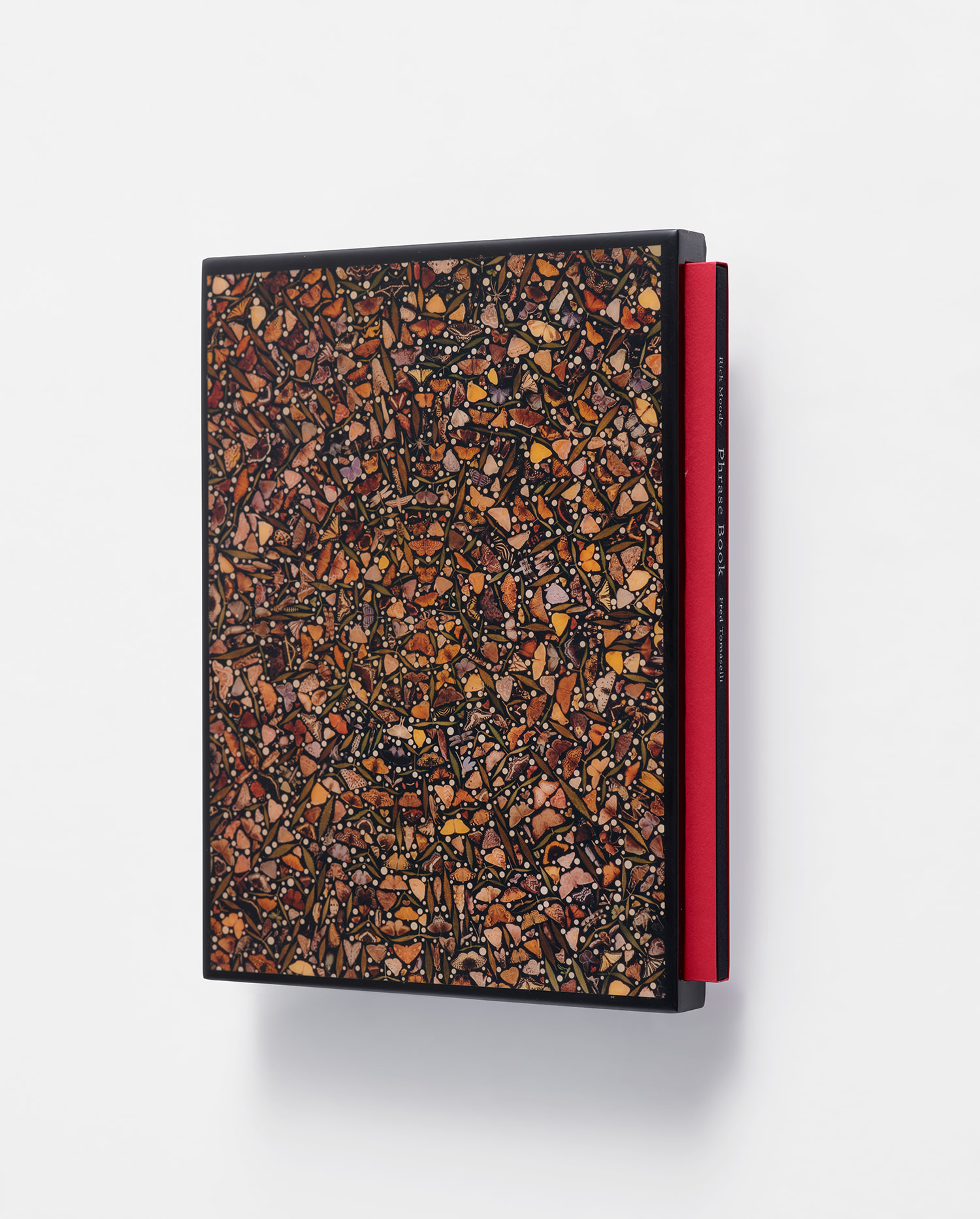
Phrase Book
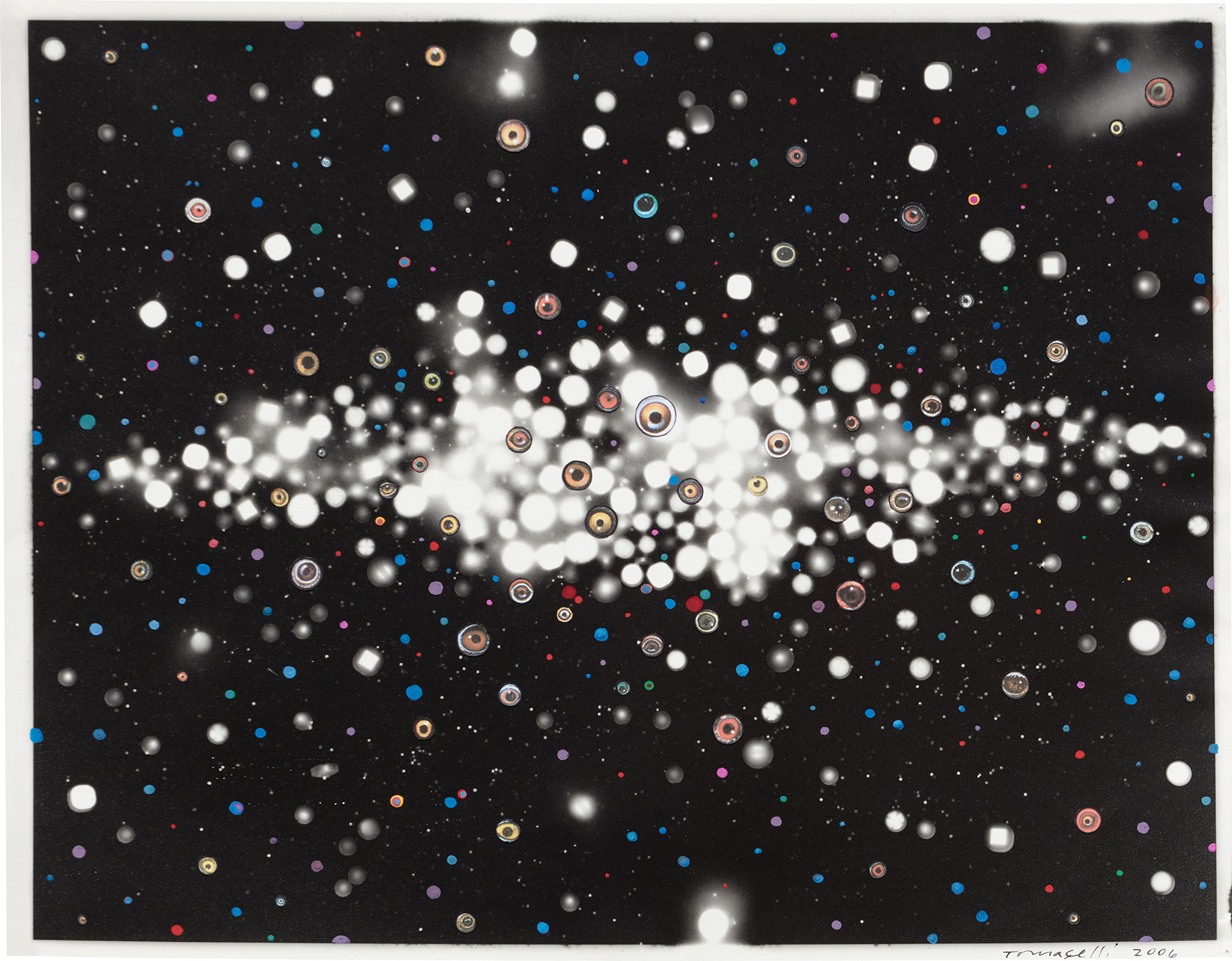
The birds, sourced from field guides and natural history illustration, are collaged and repainted until they become something altogether stranger and more beautiful than their origins suggest. Among the works that demonstrate the full range of Tomaselli's ambition are pieces like Slow Riot, a photo collage and gouache work on photogram from 2006, and Study for Tower of Peace Towers, which layers photo collage, acrylic, gouache, and resin on wood into a meditative construction of near architectural complexity. His ongoing series of works responding to the front pages of The New York Times, begun around 2005, shows yet another dimension of his practice: a journalistic impulse refracted through his signature hallucinatory lens. Works like November 11, 2010 and the paired Guilty and Sep.
15, 2005 transform newspaper imagery into something that feels simultaneously documentary and dreamlike, grounding his cosmic visual language in the specific textures of contemporary political life. These pieces make clear that Tomaselli is not retreating from the world but rather finding new ways to metabolize it. For collectors, Tomaselli's work presents an unusually compelling proposition. His output spans multiple mediums with great consistency of vision, from large scale resin panels that anchor institutional collections to works on paper, etchings, aquatints, and inkjet prints that offer entry points at various price levels.
Fred Tomaselli
Fred Tomaselli
Works such as 15 mg of Meth Times 2000 Plus, an etching and aquatint in colors, and Sleeping Pills arranged into the constellations of Orion, Perseus, Gemini, and Taurus, demonstrate his ability to translate the obsessive physicality of his panel works into the discipline of printmaking without losing any of their charge. Editions signed and numbered by the artist, including collaborative projects with publishers like Brooke Alexander Editions, have found enthusiastic audiences among collectors who recognize that Tomaselli prints carry the full weight of his conceptual seriousness. His unique works have been acquired by major institutions including the Whitney Museum of American Art, the Museum of Modern Art, and the Los Angeles County Museum of Art. Tomaselli occupies a distinctive position in the contemporary landscape, and understanding his context helps illuminate why his work endures.
He shares with artists like Sigmar Polke a fascination with chemistry, with the material substrates of perception, and with the comic and cosmic implications of intoxication. His collage sensibility connects him to the lineage running from Hannah Höch through John Heartfield to Wangechi Mutu. His mandala structures echo the work of Islamic geometric art and the visionary illustration traditions of European natural history. Yet no single comparison quite contains him.
Tomaselli has built something genuinely sui generis: a body of work that is immediately recognizable and perpetually surprising, grounded in craft and devoted to wonder. The deeper legacy of Fred Tomaselli's practice may lie in what it asks of viewers and collectors alike. His work insists on slowness in a culture organized around speed. It demands proximity, patience, and a willingness to let the eye wander without arriving anywhere in particular.
In this sense, his art functions precisely as the psychedelic materials embedded within it were once said to function: as an invitation to notice what was always there, made newly vivid by a shift in attention. For those who have spent time with his panels, that shift tends to be permanent. Once you have seen the world through Tomaselli's resin, the ordinary world looks, somehow, both stranger and more beautiful.
Featured Works