Franz Marc
Franz Marc: Spirit, Color, and Sacred Animals
Artist Spotlight · The Collection Editorial
“Is there a more mysterious idea for an artist than to imagine how nature is reflected in the eyes of an animal?”
Franz Marc, letter to August Macke, 1910
There are moments in art history when a single canvas feels like a declaration of faith. Franz Marc's "Tiger" of 1912, a woodcut of compressed, almost electric energy, is one of those moments. It announces an artist who believed that to paint an animal was not merely to depict a creature but to inhabit its inner world, to feel the pull of gravity through four legs, to sense the world as pure color and instinct. Today, as institutions from the Städtische Galerie im Lenbachhaus in Munich to the Solomon R.
Franz Marc
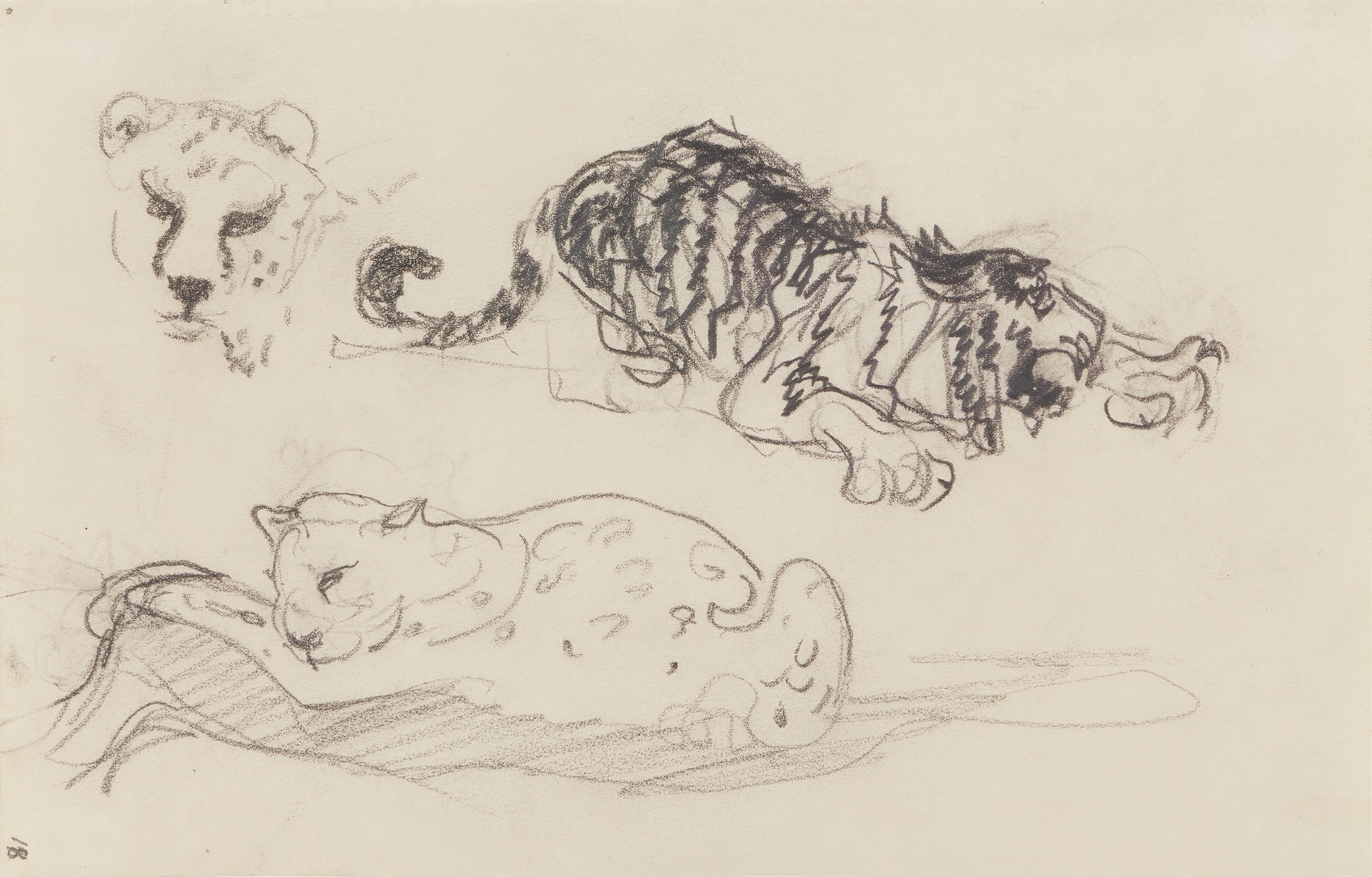
Zwei Leoparden und ein Leopardenkopf, 1909
Guggenheim Museum in New York continue to position Marc's work at the center of Expressionist scholarship, his reputation feels not like a historical footnote but a living, urgent conversation. Franz Marc was born in Munich in 1880, the son of Wilhelm Marc, a landscape painter of modest renown. Growing up in a household where art was a daily practice rather than a distant ambition gave the young Franz an unusual freedom to take creativity seriously from the very beginning. He studied theology briefly before enrolling at the Academy of Fine Arts in Munich in 1900, a conventional training that would serve him well even as he eventually dismantled everything he learned there.
Early travels to Paris in 1903 and again in 1907 proved transformative. On that second visit he encountered the work of Vincent van Gogh and Paul Gauguin, and something shifted permanently in his understanding of what color could do. The years between 1907 and 1910 were years of searching. Marc worked through Post Impressionist influences while developing an obsession that would define his entire career: the animal as a spiritual subject.
Franz Marc
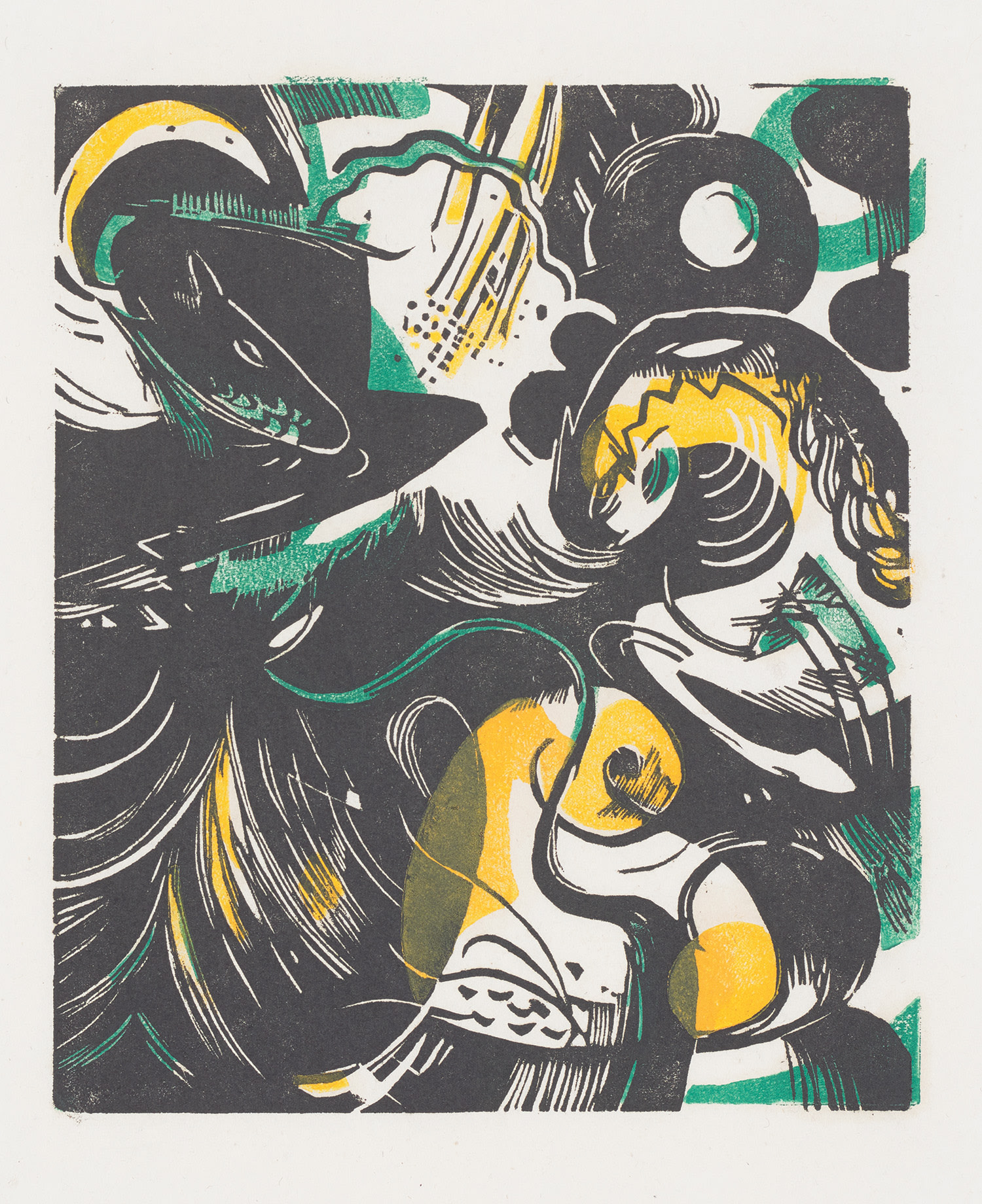
The Creation II (Schöpfungsgeschichte II) from The First Portfolio (Die Erste Mappe) (H. & J. 42)
He began spending long hours studying horses, deer, cattle, and foxes, not at a distance but up close, lying in fields and visiting farms. His conviction was sincere and almost mystical. He believed that animals possessed an innocence and a harmony with the natural world that modern humanity had lost. To paint them faithfully was to reach for something beyond the merely visual.
“I am trying to intensify my feeling for the organic rhythm of all things, to achieve pantheistic empathy with the throbbing of nature.”
Franz Marc, letter, circa 1908
Works on paper from this period, including the delicate pencil studies of cattle such as "Zwei Kühe in Landschaft" from 1910, show an artist building an intimate vocabulary of form and gesture, learning the architecture of animal bodies before he would begin to dissolve them into color. The decisive turn came through friendship. In 1910 Marc met August Macke, and in 1911 he deepened his connection with Wassily Kandinsky. Together with Kandinsky and the painter Gabriele Münter, Marc became a founding member of Der Blaue Reiter, the Blue Rider, one of the most consequential artist groups in twentieth century art.
Franz Marc
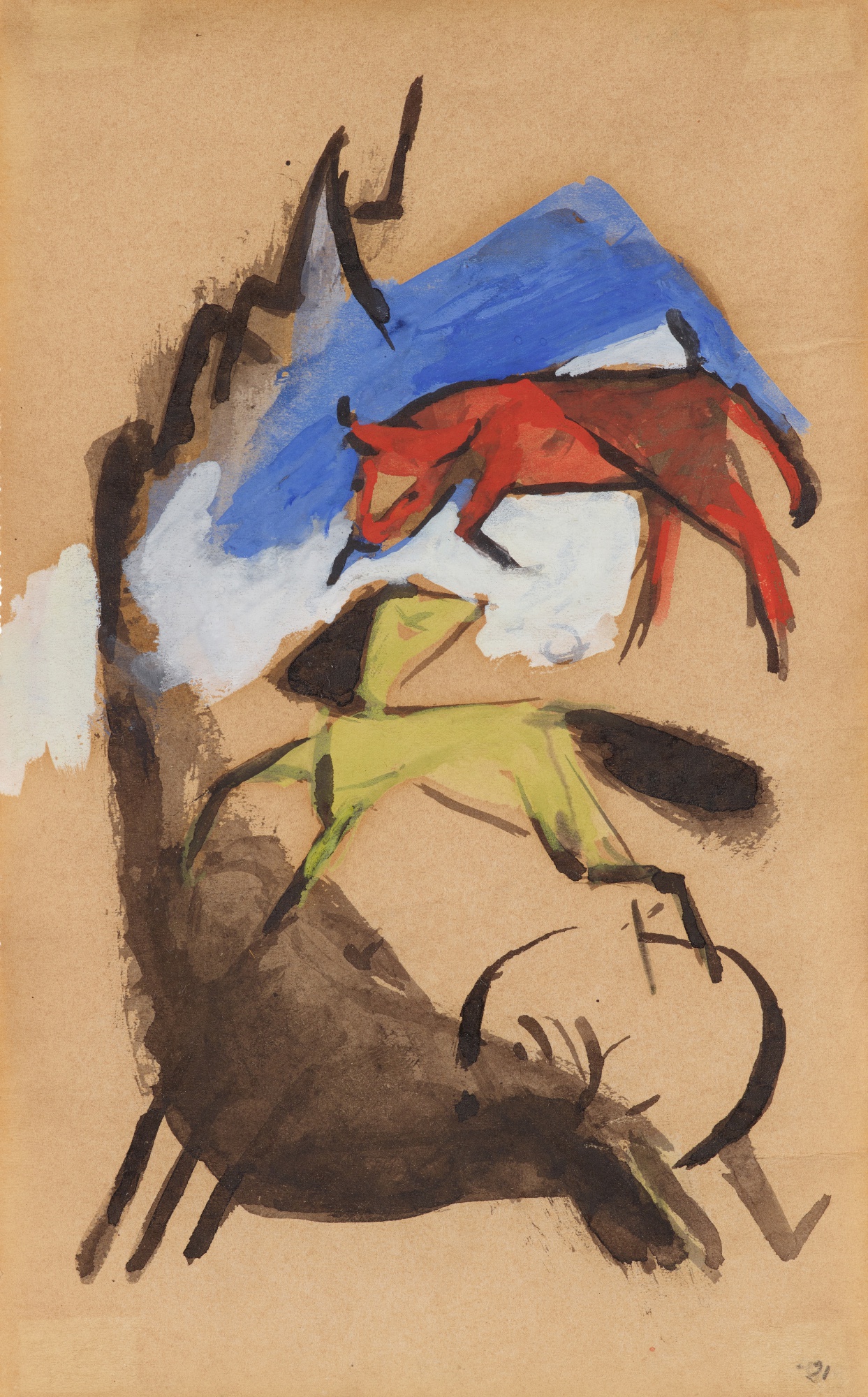
Zitronenpferd und Feuerochse, 1913
The name came from a painting by Kandinsky and from Marc's love of horses and the color blue. Marc edited the famous Der Blaue Reiter Almanac alongside Kandinsky in 1912, a publication that remains one of the great manifestos of spiritual modernism. In it, Marc argued that art must seek inner truth rather than outward appearance, a belief that would give his subsequent paintings their particular fever and intensity. Works from this peak period, including "Zitronenpferd und Feuerochse" of 1913 and "Stier" of 1911, use color not as description but as emotion.
Blue meant spirituality and masculinity to Marc. Yellow meant feminine joy. Red meant violence and the material world. His animals move through these fields of meaning like figures in a theology only he had fully imagined.
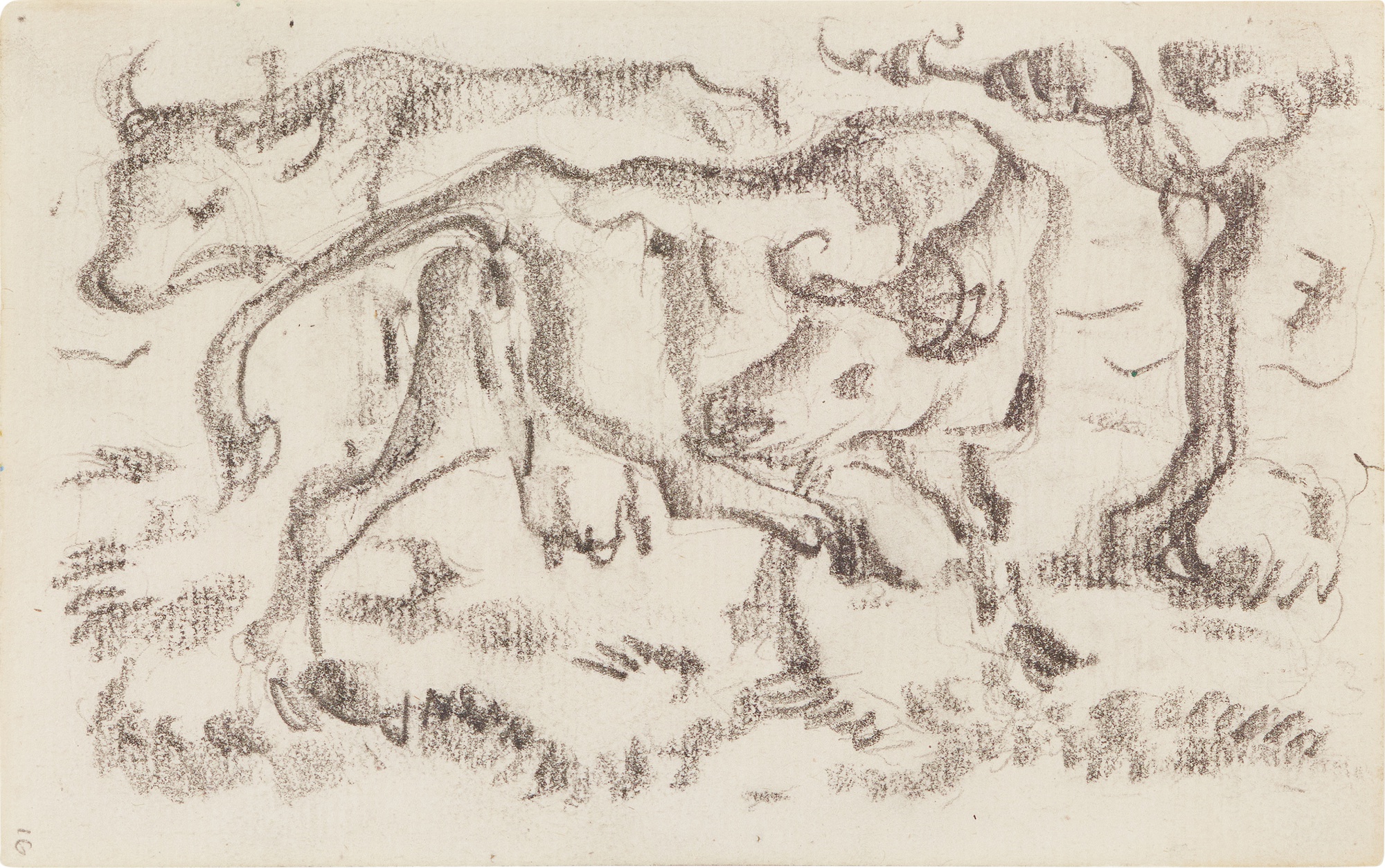
Franz Marc
Zwei Kühe in Landschaft, 1910
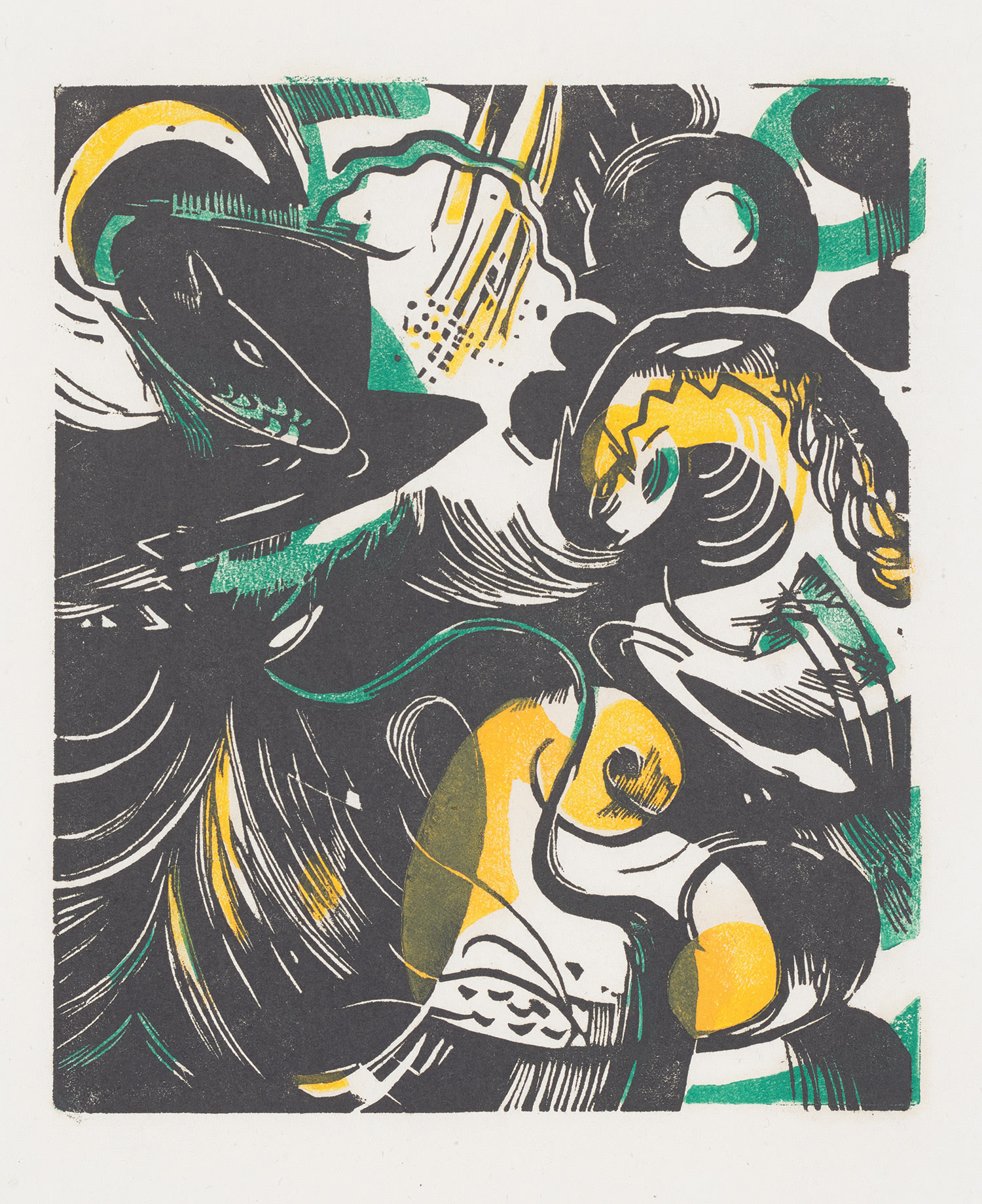
The woodcuts occupy a special place within his output. "Genesis II" from 1914 and "Tiger" from 1912 demonstrate Marc's command of a medium that suited his increasingly abstract ambitions perfectly. The reduction of form required by the woodcut pushed him toward essences rather than surfaces. His color woodcuts in particular, including the extraordinary "The Creation II" from the First Portfolio, show an artist on the verge of pure abstraction, using fragmented planes of color that feel almost like stained glass in motion.
These works were not retreats into decoration. They were Marc pressing forward, toward something he could feel but not yet fully name. The portfolio works were produced in collaboration with the printmaker workshop and distributed among a circle of serious collectors and fellow artists, cementing Marc's reputation as both a visionary and a rigorous craftsman. For collectors, Marc's works occupy a particularly meaningful position in the market.
His paintings command significant attention at auction, with major canvases having achieved prices well into the tens of millions of dollars at houses including Sotheby's and Christie's. Works on paper and prints, while more accessible in price, carry the same concentrated spiritual energy as the large paintings and offer an equally direct window into his thinking. The pencil drawings are especially revealing, showing the careful observation behind the eventual explosion of color. A work like "Zwei Leoparden und ein Leopardenkopf" from 1909, rendered in pencil and India ink, rewards sustained looking precisely because it is so unguarded, a record of a mind in the act of learning.
Collectors who seek artists at the intersection of beauty, philosophy, and historical significance find in Marc a figure who satisfies all three dimensions without compromise. Marc's place within art history is inseparable from the constellation of artists around him. His dialogue with Kandinsky shaped the entire trajectory of abstract spiritualism in European modernism. His friendship with Macke, cut short when Macke died in the First World War in 1914, produced some of the warmest and most productive exchanges in the Expressionist circle.
Paul Klee was also part of the Blaue Reiter world, and the four of them together represent a moment of almost unparalleled creative density in Munich before the catastrophe of the war. Marc himself was killed at the Battle of Verdun in March 1916, aged thirty six, leaving a body of work that feels both complete and devastatingly unfinished. What makes Franz Marc matter today is not sentiment, though there is something genuinely moving about a life cut so short at such a moment of flowering. What matters is the seriousness of his proposition.
In an era saturated with images and overwhelmed by the purely visual, Marc insists that the act of looking must be an act of feeling, and that art's highest function is to reach the places where language cannot follow. His animals are not illustrations. They are arguments, made in color, about what it means to be alive in a world that is always more strange and more sacred than our habits allow us to notice. To encounter a Franz Marc in person, whether a woodcut or a tempera study or one of the great oil paintings, is to be briefly returned to that attentiveness.
Explore books about Franz Marc
Franz Marc: 1880-1916
Klaus Lankheit
Franz Marc: Cats and Dogs, Birds and Fish
Vivian Endicott Barnett
The Blue Horse: The Life and Work of Franz Marc
Reinhard Piper
Franz Marc: The Complete Works
Klaus Lankheit
Franz Marc and the Animal
Stephanie Baron
Franz Marc: Spiritual Abstraction and Symbolism
Frederick S. Levine
Franz Marc: 1880-1916, Retrospective
Jean Leymarie
Letters of Franz Marc
Else Wasmuths Verlag