Francisco Sobrino
Francisco Sobrino: Light, Order, and Infinite Wonder
Artist Spotlight · The Collection Editorial
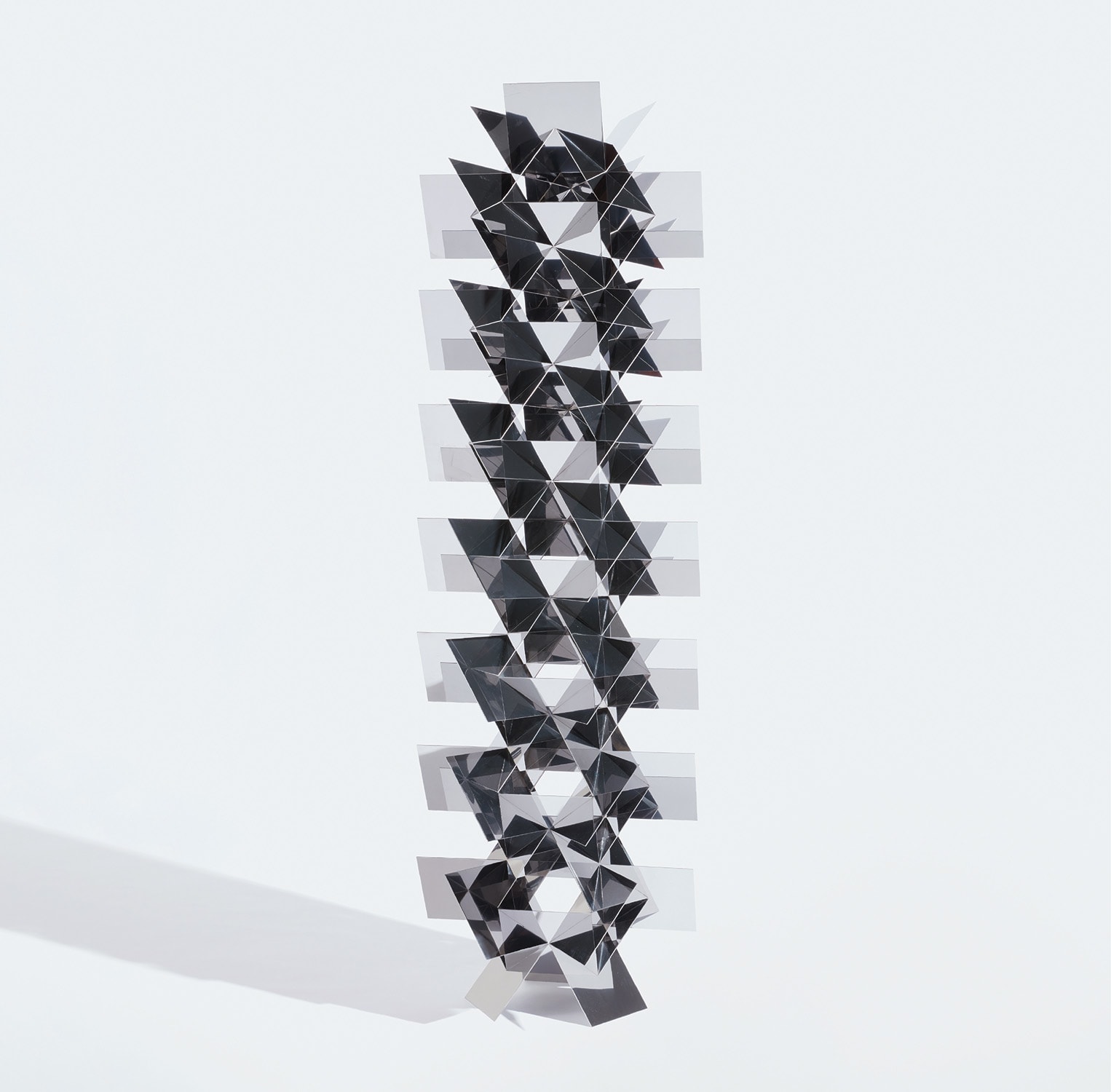
There is a moment, standing before a Francisco Sobrino sculpture, when the eye refuses to settle. The mirrored stainless steel fragments the room, multiplies the viewer, and dissolves the boundary between object and space. It is a disorienting pleasure, and it was entirely intentional. Sobrino spent decades engineering exactly this experience, crafting works that feel simultaneously mathematical and alive, rigorous and generous.
Francisco Sobrino
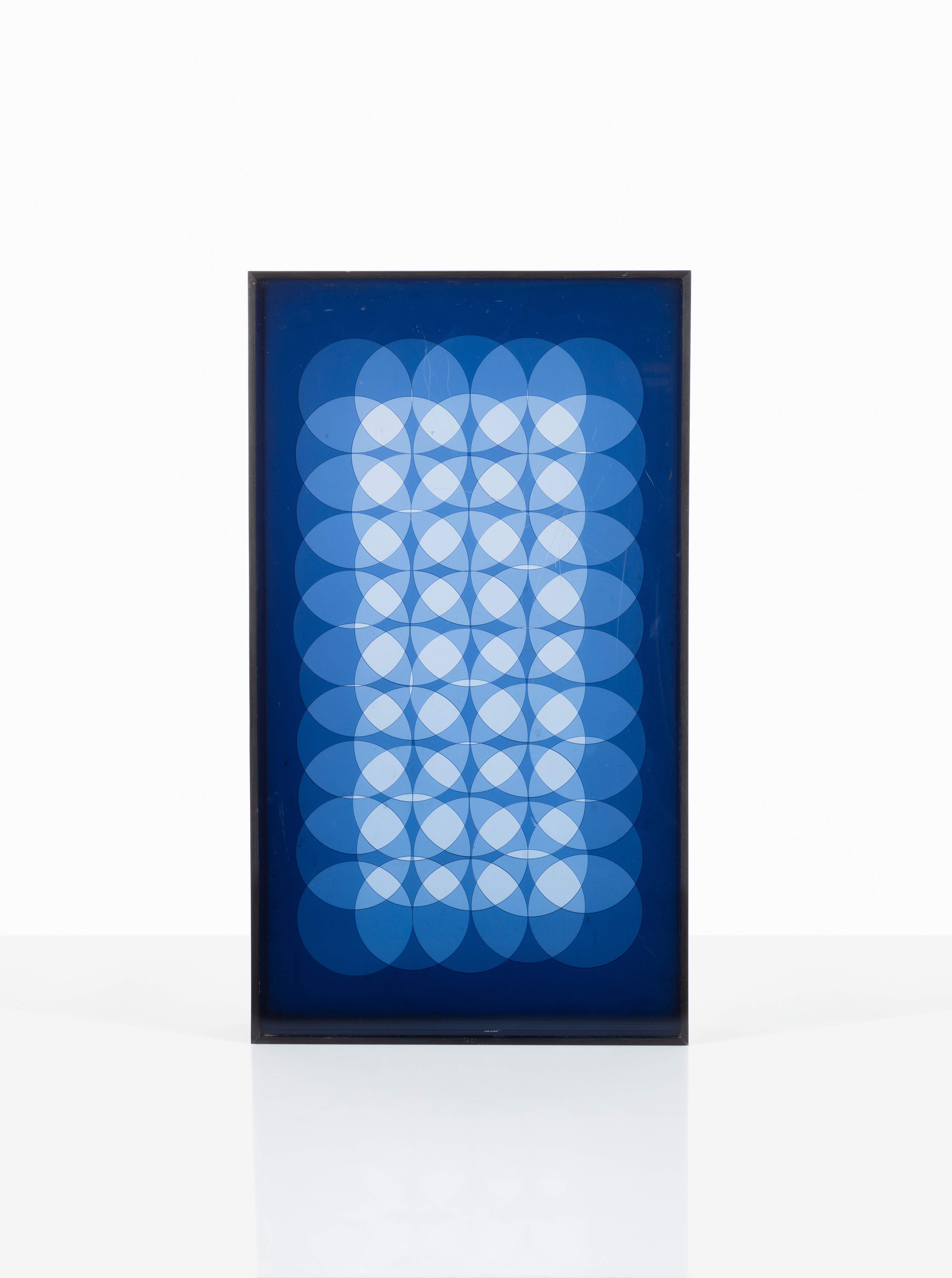
Sans Titre
That his name is not yet a household word in the way of some of his contemporaries is one of the quiet injustices of twentieth century art history, and one that collectors and institutions are only now beginning to address with the seriousness it deserves. Francisco Sobrino was born in 1932 in Guadalajara, Spain, a city whose golden light and architectural geometry would quietly echo throughout his later practice. He trained at the School of Fine Arts in Madrid before emigrating to Buenos Aires in 1949, a move that placed him within the vibrant currents of South American constructivism at a formative moment. Buenos Aires in the early 1950s was a crucible of geometric abstraction, and Sobrino absorbed its lessons deeply.
By 1959 he had relocated to Paris, which would remain his base for the rest of his life, and it was there that his mature vision crystallized. In Paris, Sobrino became a founding member of the Groupe de Recherche d'Art Visuel, known as GRAV, in 1960. The group included Horacio Garcia Rossi, Julio Le Parc, François Morellet, Joël Stein, and Yvaral, and together they pursued a collective, democratic, and scientifically grounded approach to visual art. GRAV rejected the mythology of the lone artistic genius, instead embracing collaboration, optical experiment, and the active participation of the viewer.
Francisco Sobrino
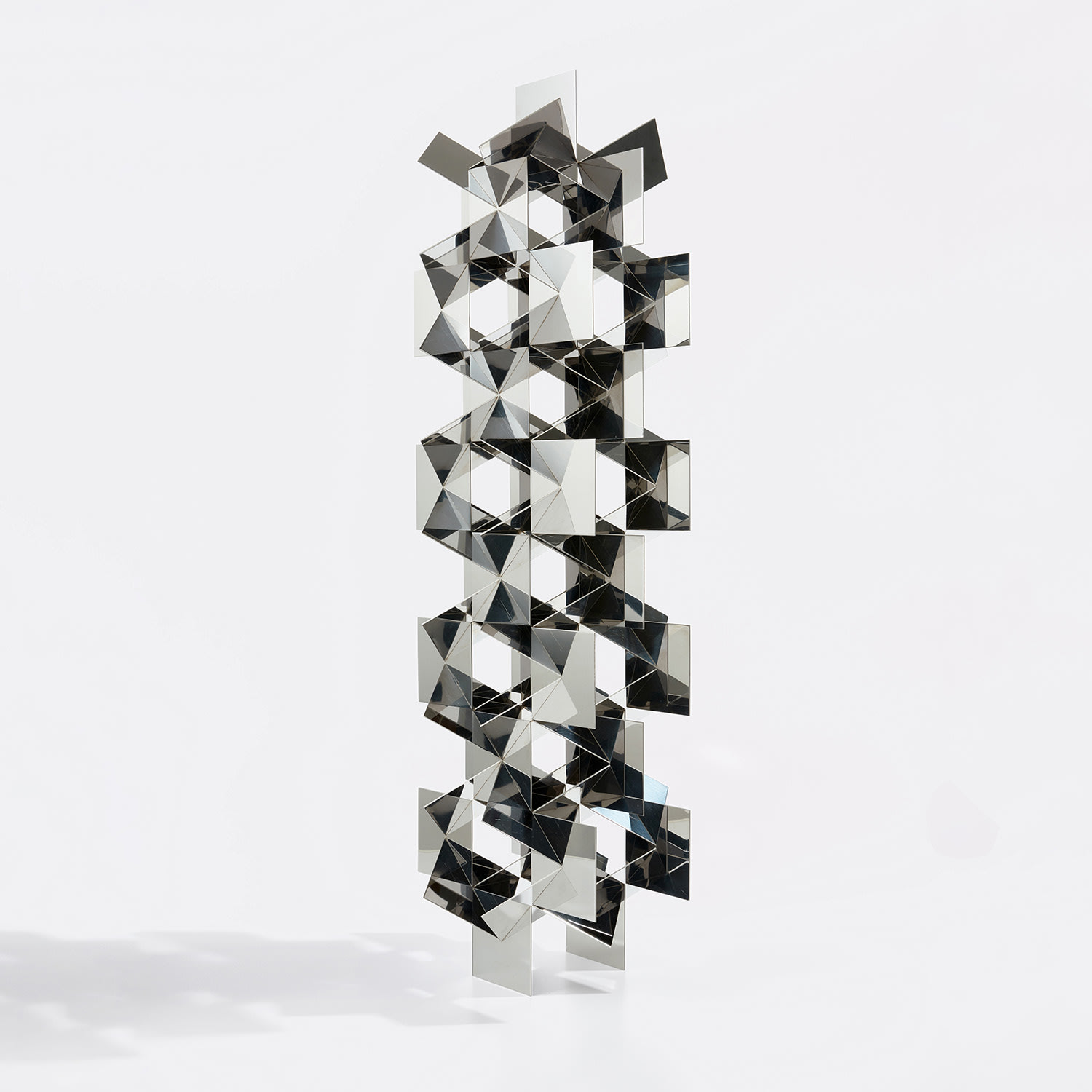
Structure permutationelle B-11-G, 1967
Their famous Labyrinths, first presented in Paris in 1963 and again at the 1966 Venice Biennale, invited audiences to walk through environments of shifting light and unstable perception. Sobrino was central to this project, and the ideas forged within GRAV would shape his individual practice for decades to come. Sobrino's solo work concentrated on what he called permutational structures, systematic arrangements of geometric units that could be endlessly recombined according to logical rules. His series of works bearing the title Structure permutationelle, including the striking stainless steel piece dated 1967, exemplifies this approach.
Here, identical or near identical modules are arranged in sequences that generate visual rhythm and apparent movement without any mechanical assistance. The viewer's eye does the work, tracking patterns, finding repetitions, and then discovering disruptions that send the whole composition into a gentle oscillation. These are not cold exercises in mathematics. They are warm invitations to look more carefully at the world.
Francisco Sobrino
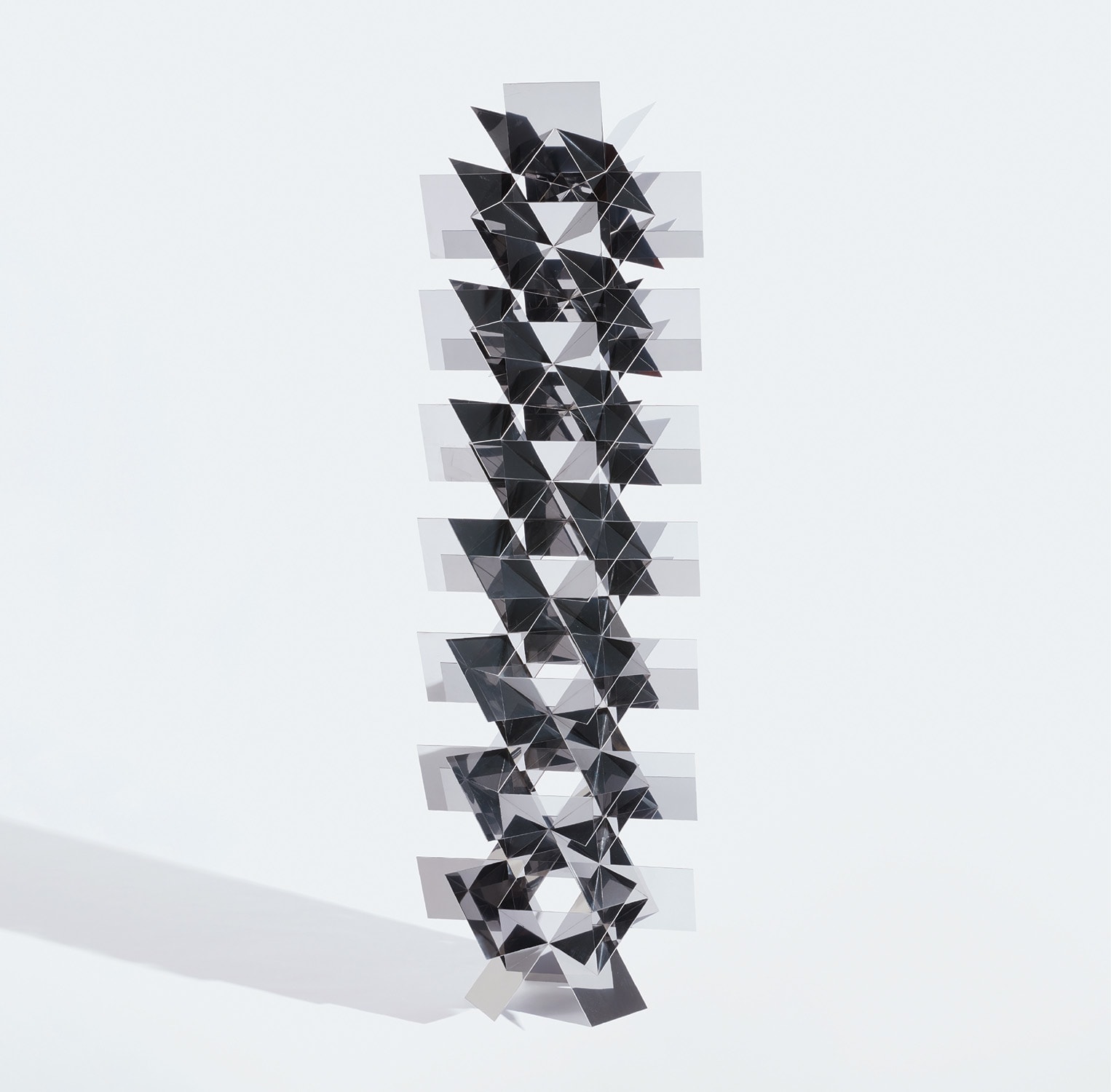
Permutationelle M, 1967
The use of mirrored stainless steel, as seen in works such as Permutationelle M from 1967, gave Sobrino's sculpture an additional dimension of environmental responsiveness. The reflective surface transforms with every shift of natural light, every change of season, every new viewer who approaches. A work installed in a Parisian gallery in winter holds a completely different character than the same piece encountered under summer daylight. This built in variability was not an accident but a feature, a way of insisting that the artwork was never finished, never static, always in dialogue with the conditions of its encounter.
It placed Sobrino in productive company with artists such as Carlos Cruz Diez, Jesús Rafael Soto, and Bridget Riley, all of whom were exploring the optical and perceptual frontier during the same fertile decade. Sobrino also worked extensively in print, and his screenprints from the late 1960s and early 1970s represent a significant and often underappreciated dimension of his output. The screenprint in colors on wove paper from circa 1969 demonstrates how completely he translated his sculptural logic into two dimensions. The layers of color interact to suggest depth and movement, the flat surface trembling with implied space.
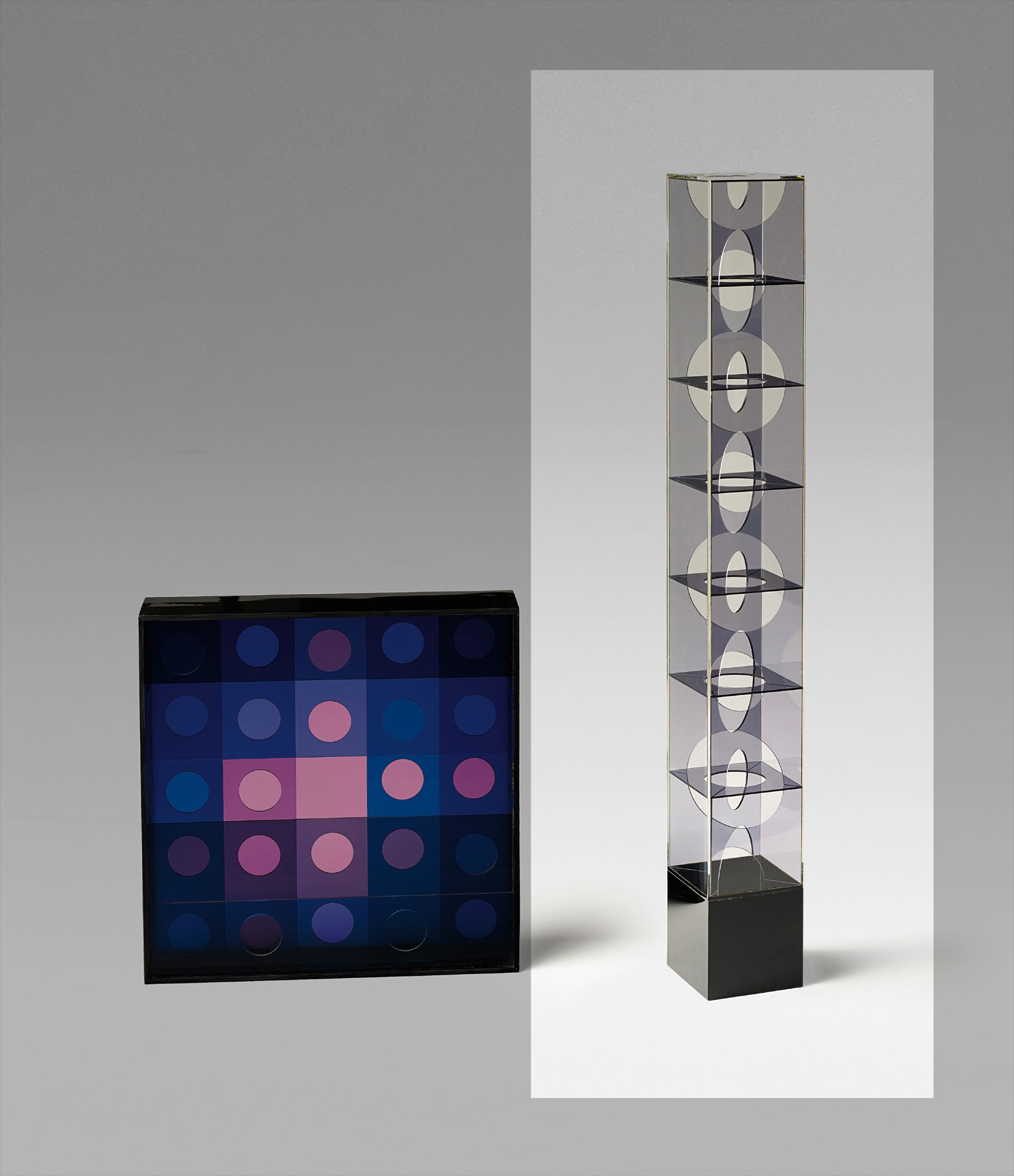
Francisco Sobrino
02M
These works on paper gave Sobrino a vehicle for wider distribution of his ideas at a moment when the international art market was beginning to take optical and kinetic art seriously, and they remain among the most accessible entry points into his practice for collectors today. From a collecting standpoint, Sobrino occupies a position of considerable interest. GRAV as a group has attracted sustained institutional attention, and major works by its members are held in collections including the Musée National d'Art Moderne at the Centre Pompidou in Paris. Sobrino's individual market has historically been quieter than those of some peers, which represents an opportunity.
Stainless steel sculptures from the key period of 1965 to 1972 are the most sought after works, combining formal rigor with material presence in a way that translates beautifully into both private and corporate environments. Works on paper from the same period offer a more accessible price point without sacrificing conceptual depth. Collectors who have entered the market for kinetic and Op Art over the past decade, drawn by the renewed critical attention to artists such as Soto and Le Parc, have increasingly turned their attention toward Sobrino as a natural complement and, in some respects, a more purely structural voice within that broader movement. Sobrino disbanded with GRAV in 1968, a year that felt like the end of many collective projects in Paris, as the upheavals of May 1968 reshuffled cultural priorities across Europe.
But rather than retreating, Sobrino continued to develop his practice with quiet consistency, producing work that deepened his permutational concerns while remaining remarkably coherent across decades. He lived and worked in Paris until his death in 2014, maintaining a low public profile that stood in deliberate contrast to the spectacular visibility some of his contemporaries cultivated. There is a dignity in that consistency, a commitment to the work itself over the apparatus of reputation. The legacy of Francisco Sobrino is inseparable from the broader story of how European and Latin American artists reimagined the relationship between art, science, and human perception in the second half of the twentieth century.
His works do not shout for attention. They reward it. Standing before a Structure permutationelle, the viewer earns a small but genuine revelation about the nature of order, the pleasure of pattern, and the generosity of an art that places the experience of looking at its absolute center. In a cultural moment hungry for art that is both intellectually serious and visually joyful, Sobrino feels not like a figure from the archive but like a discovery waiting to happen.