Francis Upritchard
Francis Upritchard Sculpts Worlds Worth Believing In
Artist Spotlight · The Collection Editorial
When Francis Upritchard filled the cavernous spaces of the Wellcome Collection in London with her travelling exhibition Jealous Saboteurs, it became clear that her practice had crossed a threshold into something genuinely difficult to categorise. The show, which brought together dozens of her handcrafted figures in elaborate, carefully staged tableaux, drew visitors from across the art world and confirmed what a growing community of collectors and curators had long sensed: that Upritchard occupies a singular position in contemporary sculpture, one that is entirely her own. Her work does not belong neatly to any movement or moment, and that independence is precisely its power. Born in Hamilton, New Zealand in 1976, Upritchard came of age in a country whose geographic isolation and layered cultural inheritance left a permanent mark on her imagination.
Francis Upritchard
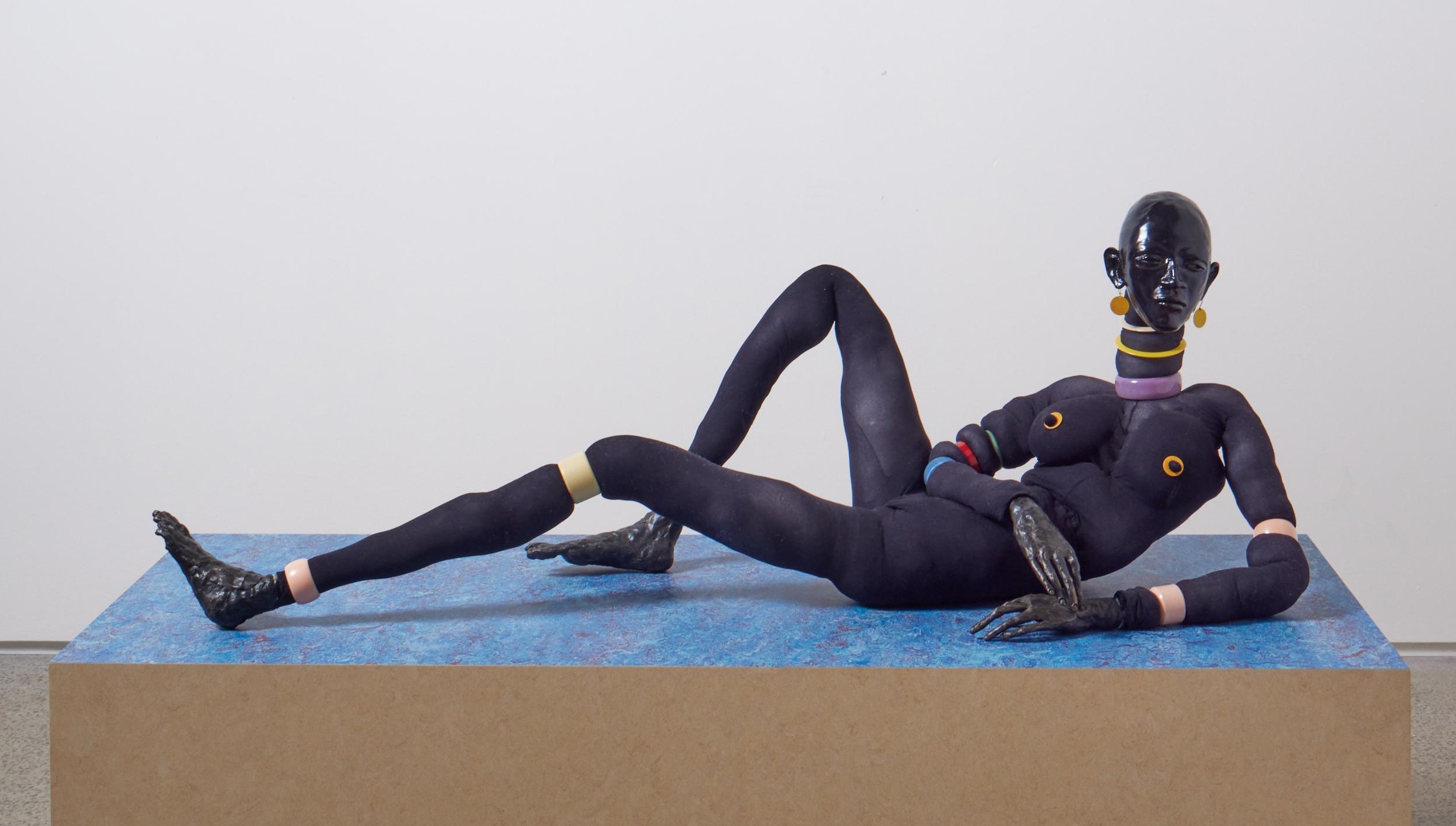
Bangle, 2016
She studied at the Elam School of Fine Arts at the University of Auckland before relocating to London, where she has been based for the better part of her adult life. That distance between origin and residence is not merely biographical. It surfaces in the work itself, in figures that seem to belong nowhere specific and everywhere at once, as though they have stepped out of a museum vitrine from an undiscovered civilisation and chosen, for reasons of their own, to linger. Her development as an artist has been defined by an extraordinary patience with materials and a refusal to rush meaning.
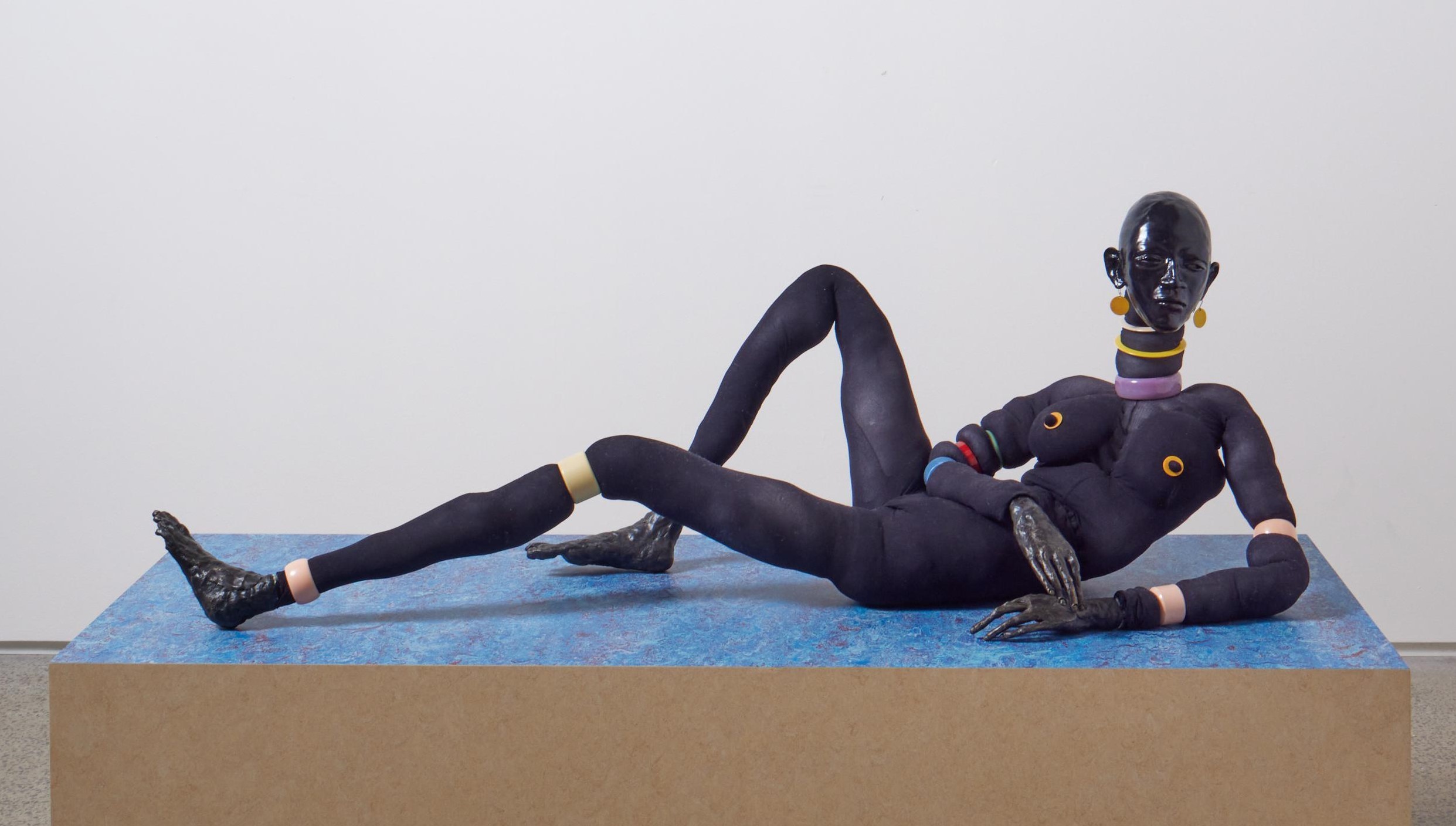
Working primarily in polymer clay, leather, fabric, wire, and foil, she builds her figures by hand over long periods, giving each one a distinct physical presence and an emotional interiority that larger, more industrially produced sculpture rarely achieves. The figures tend toward the elongated and the strange, their proportions stretched beyond naturalism without tipping into caricature. They carry objects, strike poses, wear expressions that hover between serenity and something more unsettled. They feel ancient and contemporary simultaneously, as though time has agreed to suspend itself around them.
Francis Upritchard
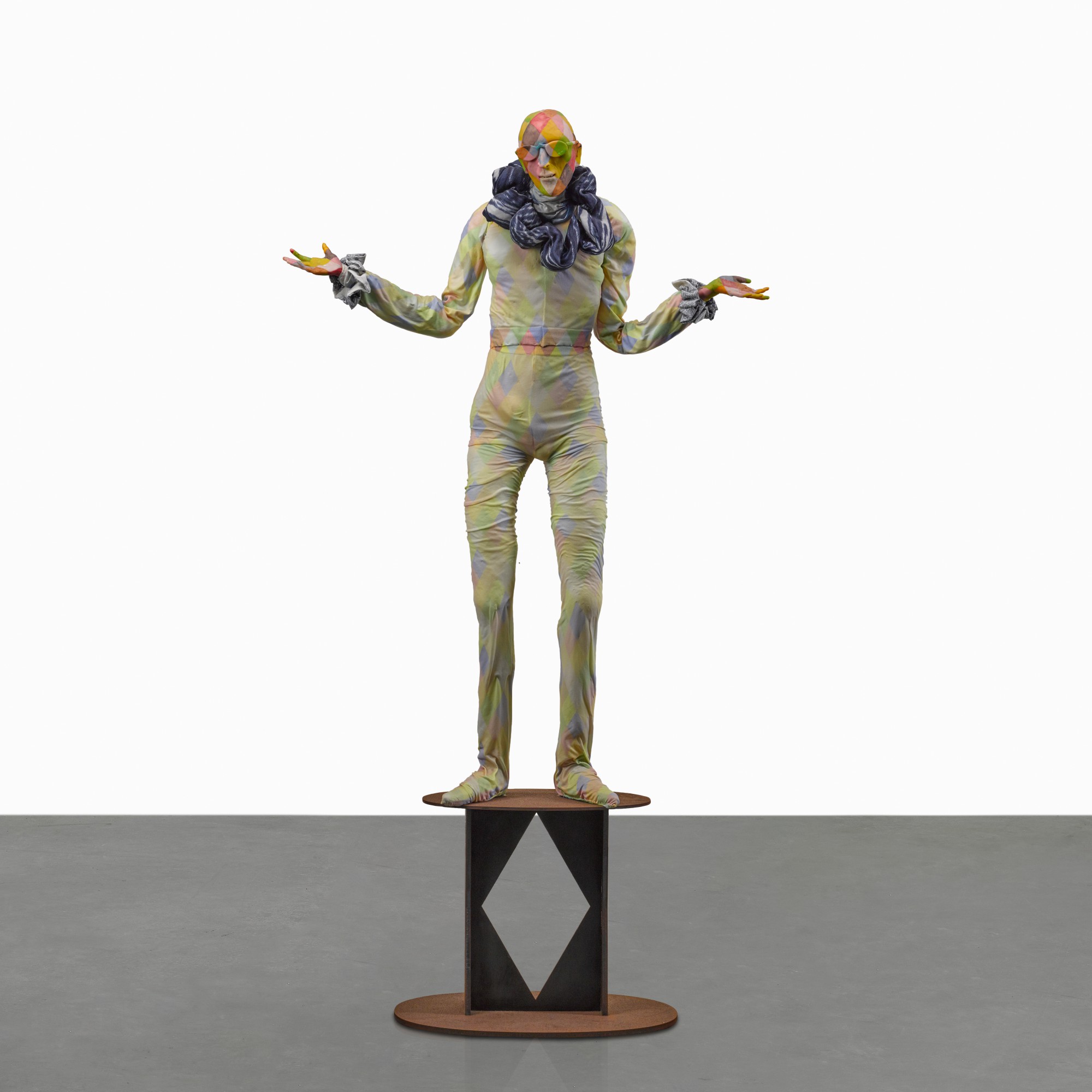
Mandrake, 2013
The pivotal moment in Upritchard's international recognition came in 2009, when she represented New Zealand at the Venice Biennale. Her presentation in the New Zealand Pavilion, titled Wear Me Out, introduced her work to a global audience and established her reputation as one of the most compelling sculptors working anywhere in the world at that time. The Venice presentation was characterised by the same quality that runs through all of her best work: an uncanny ability to make handmade objects feel cosmologically significant, as though they were artefacts recovered from a future archaeology rather than things made by a single pair of hands in a London studio. Among the works available through The Collection, Bangle from 2016 is a fine example of her mature practice.
Constructed from modeling material, foil, wire, and fabric, it demonstrates her command of humble materials elevated through obsessive attention and formal intelligence. Mandrake from 2013, a mixed media work, speaks to her longstanding interest in botanical mythology and the symbolic charge that certain plants and figures carry across cultures and centuries. Both works reward prolonged looking. They are objects that change as you spend time with them, revealing new details and emotional registers that are not immediately apparent.
For collectors, Upritchard's work offers something that is increasingly rare: genuine originality paired with institutional validation. Her sculptures have entered the collections of major museums and have been exhibited at institutions including the Museum of New Zealand Te Papa Tongarewa and prominent commercial galleries in London and internationally. She has been represented by Kate MacGarry in London, a gallery with a strong record of supporting artists whose practices resist easy categorisation. The relative intimacy of her output, each piece made by hand and impossible to replicate in any meaningful sense, gives her work a scarcity that the market has recognised and that collectors find compelling.
In terms of artistic context, Upritchard sits in productive conversation with a group of artists who share her interest in the figure as a vehicle for exploring time, identity, and cultural memory. The work of Paul McCarthy and Mike Kelley explored adjacent territory in their willingness to use the crafted object as a site of psychological intensity. Closer to Upritchard in sensibility are artists like Patricia Piccinini, whose fabricated beings also occupy the boundary between the familiar and the unsettling, and the broader tradition of Arte Povera, which elevated modest materials into carriers of serious meaning. Upritchard is also frequently discussed alongside a generation of New Zealand and Pacific artists who have challenged the hierarchies of the international art world by insisting on their own terms of engagement.
What makes Upritchard matter today is not simply the quality of her objects, extraordinary as that quality is, but the questions her practice keeps asking. At a moment when art production is increasingly dominated by scale, spectacle, and digital mediation, she persists in making things slowly, by hand, at human scale. Her figures seem to ask what it means to be a body, to carry a history, to move through a world that does not quite fit. Those are not small questions.
They are among the most important ones sculpture can pose, and Upritchard poses them with a wit, tenderness, and formal rigour that very few artists working today can match. To collect her work is to acquire something that will continue to think alongside you for a very long time.
Explore books about Francis Upritchard