Follower of Nicolas Poussin
Drawing in the Shadow of Greatness
Artist Spotlight · The Collection Editorial
There is a particular kind of reverence that lives inside a drawing made in Rome in the seventeenth century. When the Louvre mounted its landmark retrospective of Nicolas Poussin in 1994, celebrating the four hundredth anniversary of the French master's birth, curators found themselves confronted not only with the genius of the man himself but with the extraordinary gravitational pull his practice exerted on those around him. Drawings, paintings, and studies by artists working in close proximity to Poussin surfaced from private collections and museum storerooms across Europe, and the picture that emerged was one of a living school, a community of devoted hands translating classical ideals onto paper and canvas with remarkable discipline and beauty. The artist known to scholarship and the auction world as Follower of Nicolas Poussin is, in the most literal sense, a mystery.
Follower of Nicolas Poussin
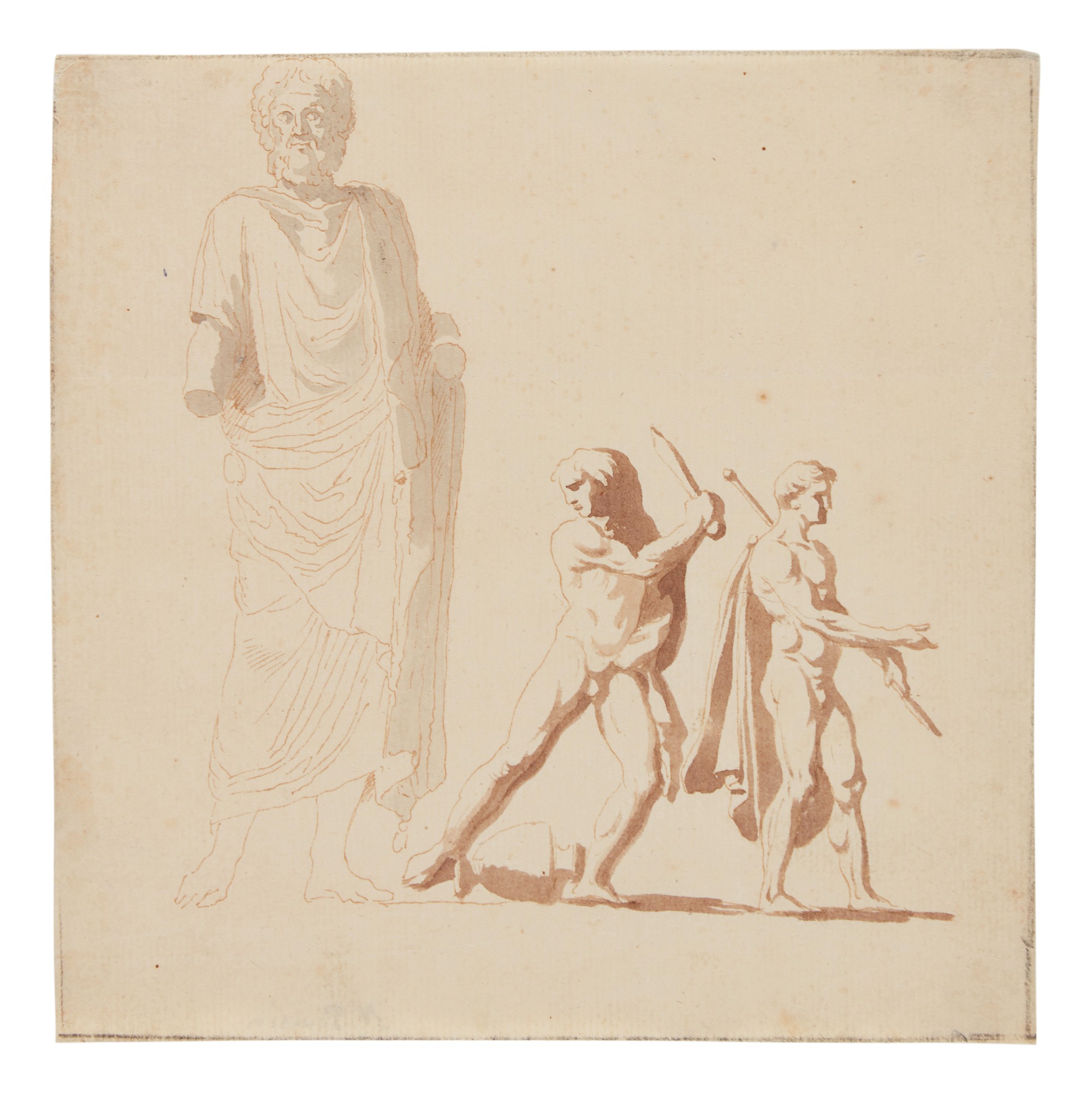
A male statue and two nude men
The attribution term is not a single name but rather a scholarly shorthand, a careful designation applied when the evidence of style, technique, and historical context points unmistakably toward someone who trained within, or in very close proximity to, Poussin's orbit in Rome. The city itself is the essential backdrop. Poussin arrived in Rome around 1624 and made it his permanent home for the rest of his life, living and working there until his death in 1665. His studio and his circle drew painters, draughtsmen, and students from across France, Italy, and beyond, all of them seeking access to his rigorous visual language and his deep engagement with antiquity.
To understand what it meant to follow Poussin is to understand the particular demands of his classicism. Poussin drew and painted from ancient sculpture with an almost archaeological seriousness. He studied Titian, Raphael, and the reliefs on Roman sarcophagi. He developed a compositional grammar built on measured geometry, on the careful arrangement of figures in lateral friezes, and on a palette of cool, resolved color that rejected the theatrical excess of his Baroque contemporaries.
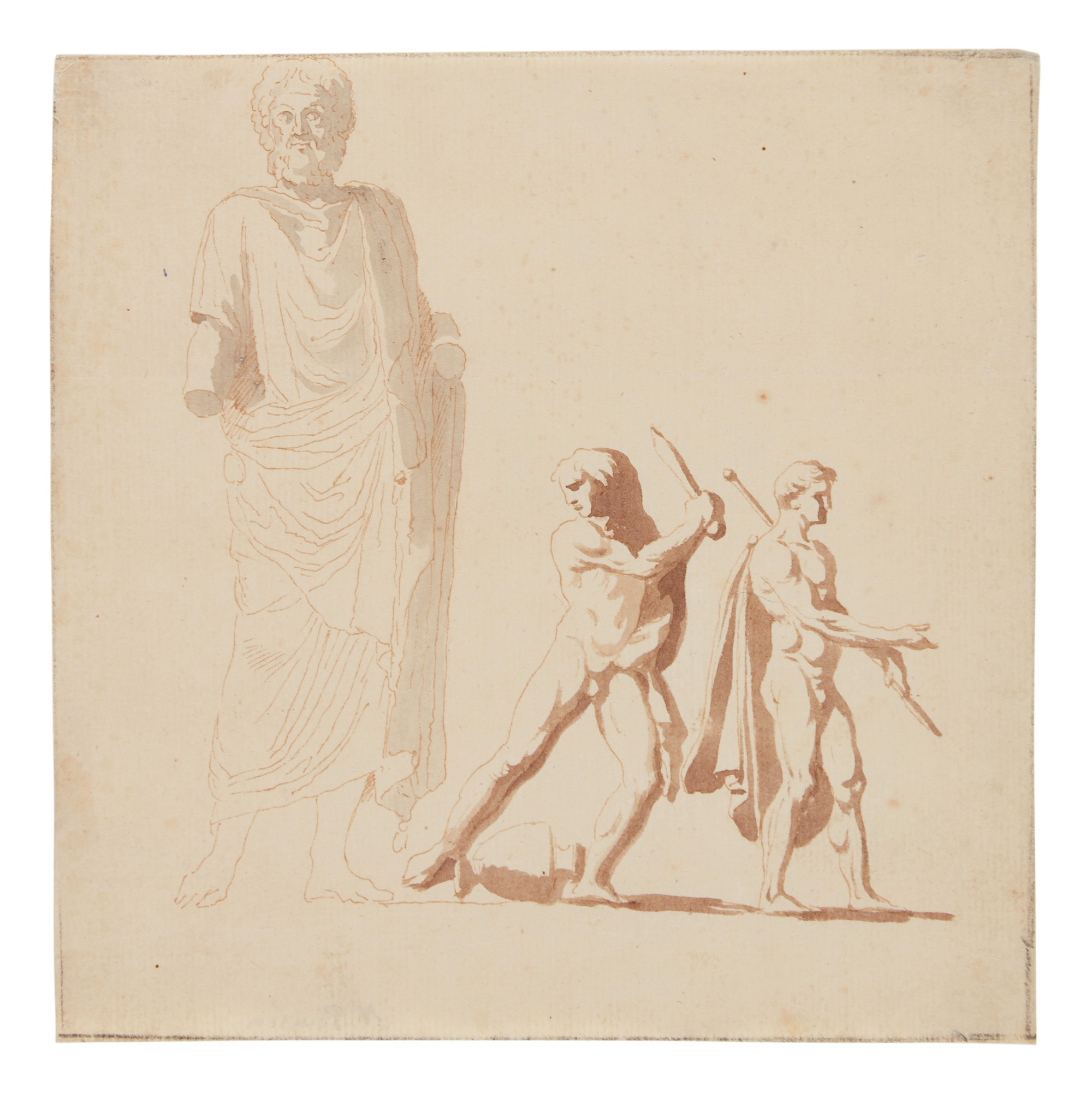
His subjects were drawn from Ovid, Virgil, the Old Testament, and the Gospels, but in every case the emotional register was one of stoic contemplation rather than operatic feeling. To work in his manner required genuine intellectual formation, not simply technical imitation. The work attributed to the Follower of Nicolas Poussin that is held within The Collection, a pen and brown ink drawing with brown and gray wash entitled A Male Statue and Two Nude Men, is precisely the kind of object that rewards close attention. The medium itself speaks to a specific Roman practice.
Working with pen and ink and building atmospheric depth through wash was a method Poussin himself used extensively, and his drawings are among the most studied and admired in the history of European art. A work in this tradition would involve careful observation of the male nude, almost certainly drawn from sculptural sources as much as from life, with the wash serving to model volume and describe the fall of light across form. The triangulation of a static sculptural figure alongside two living male nudes suggests the kind of comparative exercise central to academic formation in this period, the student or associate testing the ideal against the observed, the marble against the flesh. From a collecting perspective, works attributed to followers or circles of great masters occupy a fascinating and genuinely rewarding space in the market.
They are available at a fraction of the price commanded by securely attributed works by the master himself. A drawing by Nicolas Poussin, were one to appear at Christie's or Sotheby's, would attract competition at the highest level of the market. Works by his followers and associates offer collectors the opportunity to engage with the same visual ideas, the same Roman atmosphere, and the same classical ambition at a far more accessible price point. The connoisseurship required to appreciate them is real and pleasurable.
These are not second best objects. They are documents of a living tradition. The question of attribution in seventeenth century French and Italian drawing is one of the most active areas of scholarship in the field. Scholars including Anthony Blunt, whose foundational 1966 catalogue raisonné of Poussin's work set the terms for a generation of study, and more recently figures such as Pierre Rosenberg, who curated the 1994 Louvre retrospective with Nicolas Poussin's work at its center, have spent careers distinguishing between autograph works and those produced within the wider Poussin tradition.
The process is painstaking and ongoing, and occasional revisions of attribution bring genuine excitement. A work catalogued today as by a follower may in future scholarship be assigned a name, even elevated to an autograph attribution. Collecting in this space means participating in a live conversation. The artists most closely associated with Poussin's circle and tradition give a sense of the richness of the world surrounding him.
Jacques Stella, who was among Poussin's closest friends in Rome, shared his commitment to classical subject matter and his disinterest in Baroque theatricality. Charles Errard, Gaspard Dughet, who was Poussin's brother in law, and later figures such as Charles Le Brun, who absorbed the Poussinesque tradition into the official language of French academic painting, all represent ways in which this visual inheritance was carried forward. The Follower of Nicolas Poussin stands within this company, anonymous but not without distinction, a voice in a chorus that shaped European painting for more than a century. The legacy of this tradition is felt everywhere in the history of Western art.
The neoclassicism of Jacques Louis David in the late eighteenth century is unthinkable without Poussin. Cézanne, who famously expressed his desire to redo Poussin from nature, acknowledged the debt that the entire French classical tradition owed to this one figure. To collect a work by a Follower of Nicolas Poussin is to hold in one's hands a piece of that long, continuous story. It is to own a document from the very ground where European classicism was forged, made by a hand close enough to the source to carry its heat.