Florentine School, late 16th Century
Florence Forever: Elegance, Power, and Grace
Artist Spotlight · The Collection Editorial
There is a room in the Uffizi Gallery in Florence where time seems to slow. Light falls across gilded frames and dark panel paintings, and the faces looking back at you carry a particular quality of stillness, a composure that feels almost supernatural in its refinement. This is the world of the Florentine School of the late 16th century, a tradition so rich in technical accomplishment and intellectual ambition that it continues to command reverence in museums, auction houses, and private collections across the globe. Recent years have seen renewed scholarly attention to this period, with major exhibitions at the Palazzo Strozzi and sustained institutional interest from the Kunsthistorisches Museum in Vienna reminding contemporary audiences that the Mannerist moment in Florence was not a decline from Renaissance glory but a profound and sophisticated reinvention of it.
Florentine School, late 16th Century
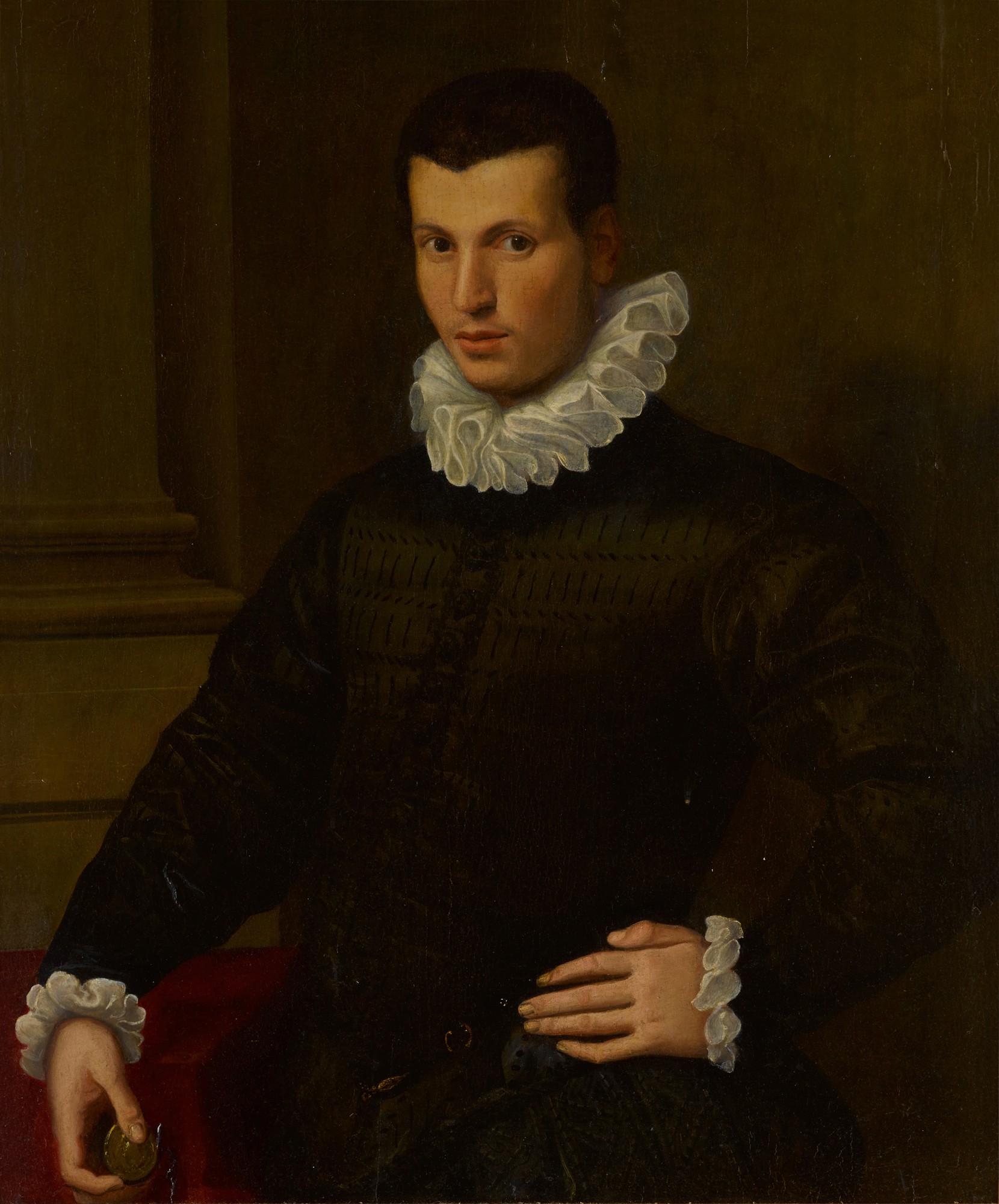
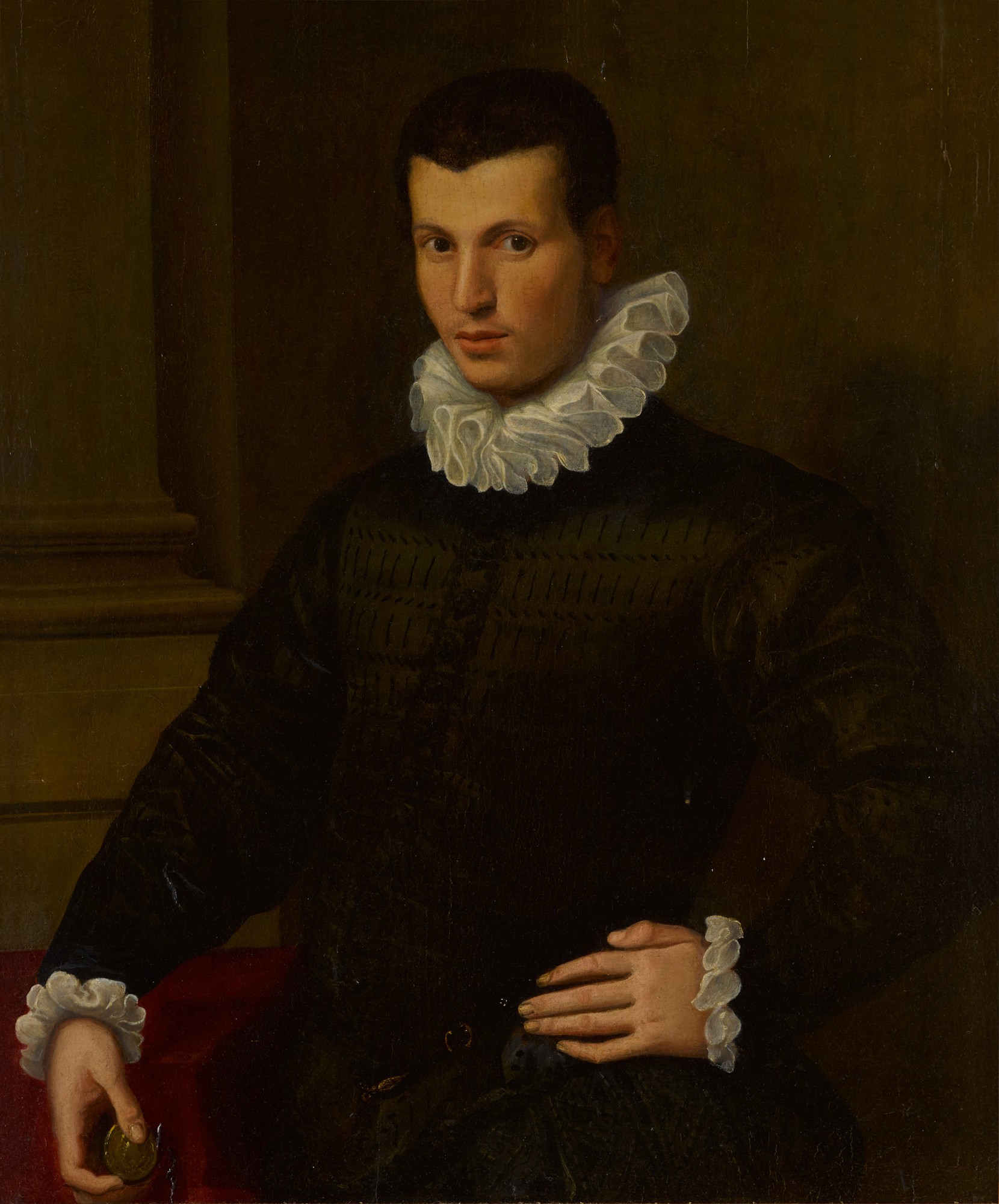
Portrait of a gentleman in black, holding a medallion
To understand the Florentine School of the late 1500s, one must begin in the city itself. Florence in this era was a place of extraordinary cultural pressure. The Medici family, who had bankrolled the Renaissance from its earliest stirrings, now ruled as Grand Dukes of Tuscany under Cosimo I and his successors, and they wielded patronage as both an artistic and political instrument. The workshops and academies of Florence were shaped by this dynamic.
Artists worked within a demanding framework of expectation, measured always against the towering achievements of Leonardo da Vinci, whose notebooks and paintings had already become legendary, Michelangelo, whose Sistine ceiling and Florentine sculptures set an almost impossible standard, and Raphael, whose graceful synthesis of form and feeling defined the High Renaissance ideal. To be a Florentine painter in the late 16th century was to inherit an overwhelming legacy and to find, within it, a voice of one's own. The movement that emerged from this creative tension is known as Mannerism, and Florence was its most fertile ground. Mannerism was not a rejection of Renaissance principles but an intensification of them, a stretching of elegance to its furthest point.
Figures grew longer and more sinuous. Compositions became more complex and intellectually layered. Color palettes shifted toward cooler, more unexpected harmonies. There was a self consciousness to the work, a sense of the artist displaying virtuosity with full awareness of the tradition behind them.
Figures like Giorgio Vasari, Agnolo Bronzino, and Francesco Salviati had already established this language in the earlier decades of the century, and by the late 1500s it had become the defining mode of Florentine visual culture, refined further by a generation of painters who brought to it an even greater delicacy of touch and psychological depth. Among the most celebrated expressions of this tradition is the portrait, and it is here that the Florentine School achieved some of its most enduring and affecting results. The portrait of a gentleman in black, holding a medallion, rendered in oil on panel, exemplifies precisely what made Florentine portraiture of this era so remarkable. The sitter, composed and self possessed, occupies the pictorial space with quiet authority.
The handling of black fabric, that most demanding of subjects for a painter, reveals an extraordinary command of tone and texture, the velvets and silks rendered with a precision that speaks to years of disciplined practice in the Florentine workshop tradition. The medallion, a classical reference and a mark of humanist education, anchors the sitter within a world of learning and status. Such works were not mere likenesses. They were arguments, carefully constructed statements about identity, learning, and social standing, and they were executed with a craft that remains breathtaking to encounter in person.
For collectors, works from the Florentine School of the late 16th century represent an exceptional intersection of historical significance and aesthetic pleasure. The market for Old Master paintings attributed to this school has shown consistent strength at the major auction houses, including Christie's and Sotheby's, where panel paintings and works on canvas from this period regularly attract serious institutional and private interest. What collectors prize above all is that quality of draftsmanship that the Florentines elevated to an art form in itself. Disegno, the Italian word for drawing, was in Florence a near philosophical concept, the foundation of all visual art and the measure of an artist's true ability.
Works from this school carry that discipline in every brushstroke, and the condition and provenance of individual pieces, particularly those on panel, tend to be carefully documented given the age and fragility of the medium. To place the Florentine School within the broader landscape of Italian art is to appreciate the richness of the conversation it was part of. Venetian painters of the same era, figures like Titian, Tintoretto, and Paolo Veronese, pursued a very different approach, privileging color and atmospheric warmth over the structural clarity of Florentine disegno. Roman painters, many of them trained in Florence, carried the Mannerist style to the papal courts.
Northern Italian artists absorbed and transformed these influences in their own regional traditions. The Florentine School stands at the center of this network, its influence radiating outward across the Italian peninsula and eventually across Europe, shaping the Baroque revolution that would follow in the early 17th century through artists like Caravaggio and the Carracci, who both absorbed and reacted against everything Florence had established. The legacy of the Florentine School of the late 16th century is not simply a matter of art history. It speaks to something enduring about the relationship between tradition and innovation, between inherited mastery and individual expression.
These artists worked within the most demanding set of expectations imaginable and produced work of extraordinary refinement and intelligence. For those who collect in this space, there is the particular satisfaction of stewardship, of caring for objects that have survived centuries and that carry within them the aspirations and achievements of one of the greatest artistic cultures the world has ever produced. To live with a work from this tradition is to be in daily conversation with Florence at its most luminous, and that is a privilege of a very rare kind indeed.
Explore books about Florentine School, late 16th Century
The Renaissance in Italy: The Fine Arts
John Addington Symonds
A History of Florentine Painting
Richard Offner
Pontormo, Bronzino and the Medici: The Transformation of the Renaissance Ideal
Janet Cox-Rearick
Federico Zuccari and the Renaissance Workshop
Catherine E. Weeks
The Art of the Renaissance in Northern Europe
Craig Hugh Smyth
Bronzino: Painter and Poet at the Court of the Medici
David Franklin
The Medici: Godfathers of the Renaissance
Paul Strathern