Fernando Botero
Fernando Botero, The World's Most Generous Vision
Artist Spotlight · The Collection Editorial
“An artist is attracted to certain kinds of form without knowing why. You cultivate what you love.”
Fernando Botero
When the Grand Palais in Paris mounted a landmark retrospective of Fernando Botero's work in 1992, crowds lined the cobblestoned streets of the eighth arrondissement to see paintings and sculptures that felt, somehow, both utterly foreign and deeply familiar. That exhibition crystallized something the art world had long suspected: Botero was not merely a popular artist but a genuinely great one, whose commitment to a singular and fully realized aesthetic language had produced one of the twentieth century's most coherent and humanist bodies of work. His death in September 2023 at the age of ninety prompted an outpouring of grief and celebration across Latin America and Europe alike, with museums from Bogotá to Florence dimming their lights in tribute. The conversation around his legacy has only grown more urgent and more admiring since.
Fernando Botero
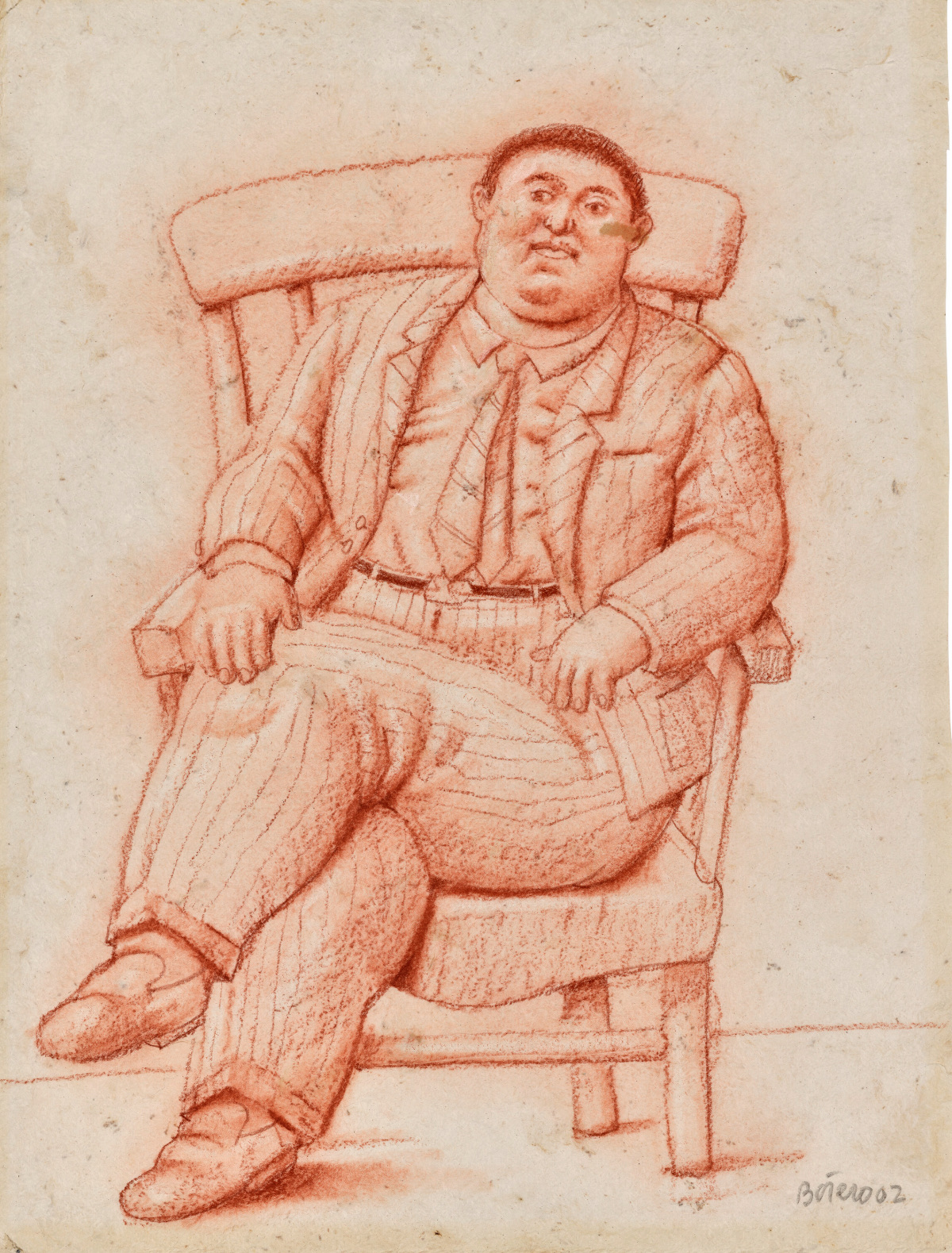
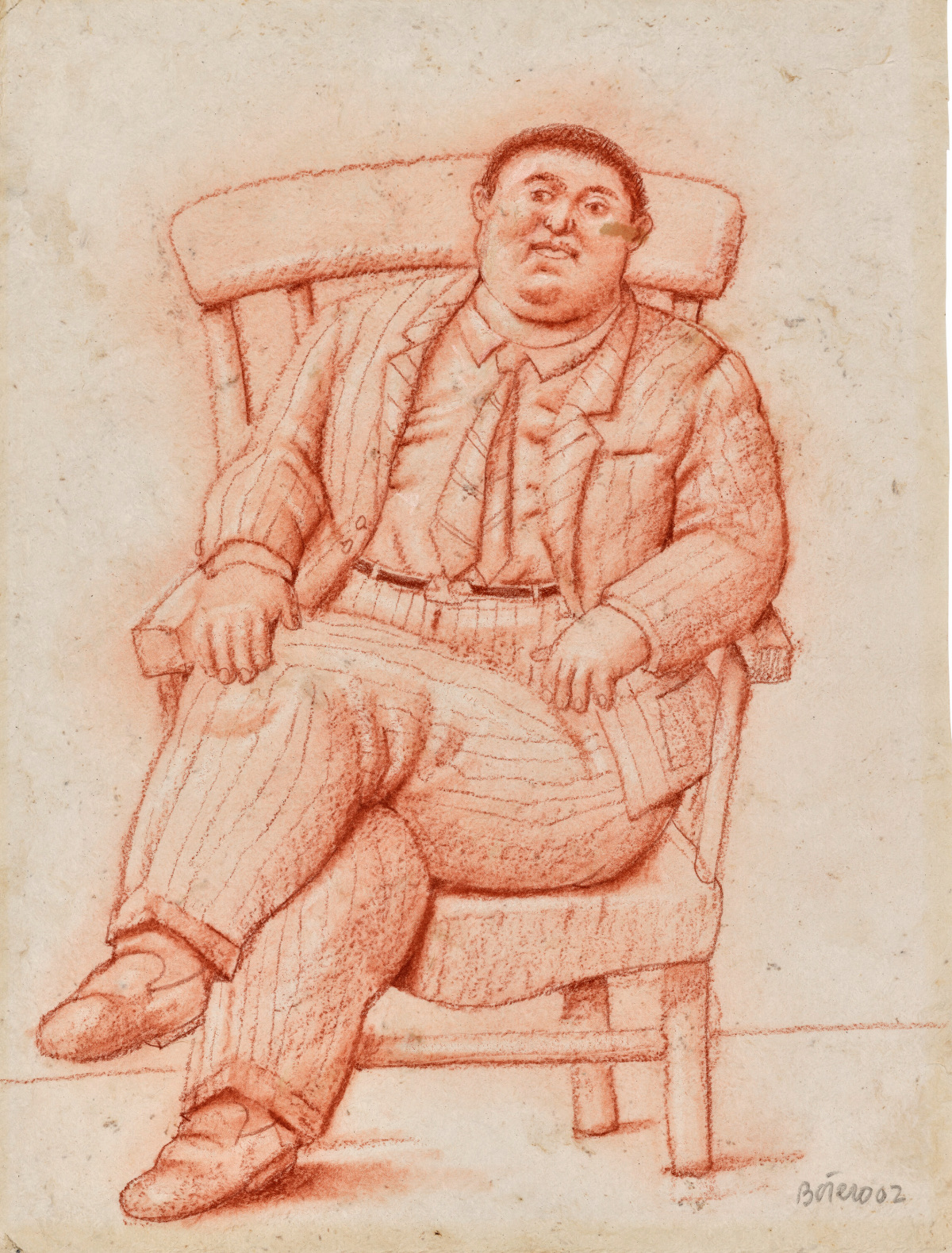
Seated Man, 2002
Fernando Botero was born on April 19, 1932, in Medellín, Colombia, a city then defined by its rugged Andean topography and its deeply Catholic culture. His father died when Botero was four years old, and he was raised by his mother and an uncle who, seeing the boy's restless energy, enrolled him briefly in a school for bullfighters. That early brush with spectacle, pageantry, and the formal rituals of Colombian life would echo throughout his painting for the next seven decades. He sold his first drawings to a local newspaper as a teenager and, at nineteen, moved to Bogotá, where his first solo exhibition at the Galería Leo Matiz in 1951 announced a young painter of striking ambition.
The proceeds from that show funded his passage to Europe, where everything would change. Botero arrived in Spain in 1952, spending months in Madrid studying the collections of the Prado with an almost scholarly devotion. Velázquez, Goya, and above all the monumental figures of Rubens left indelible impressions on his eye. He moved on to Florence in 1953, enrolling at the Accademia di Belle Arti di San Marco and immersing himself in the frescoes of Piero della Francesca and the voluminous gravity of Renaissance painting.
Fernando Botero
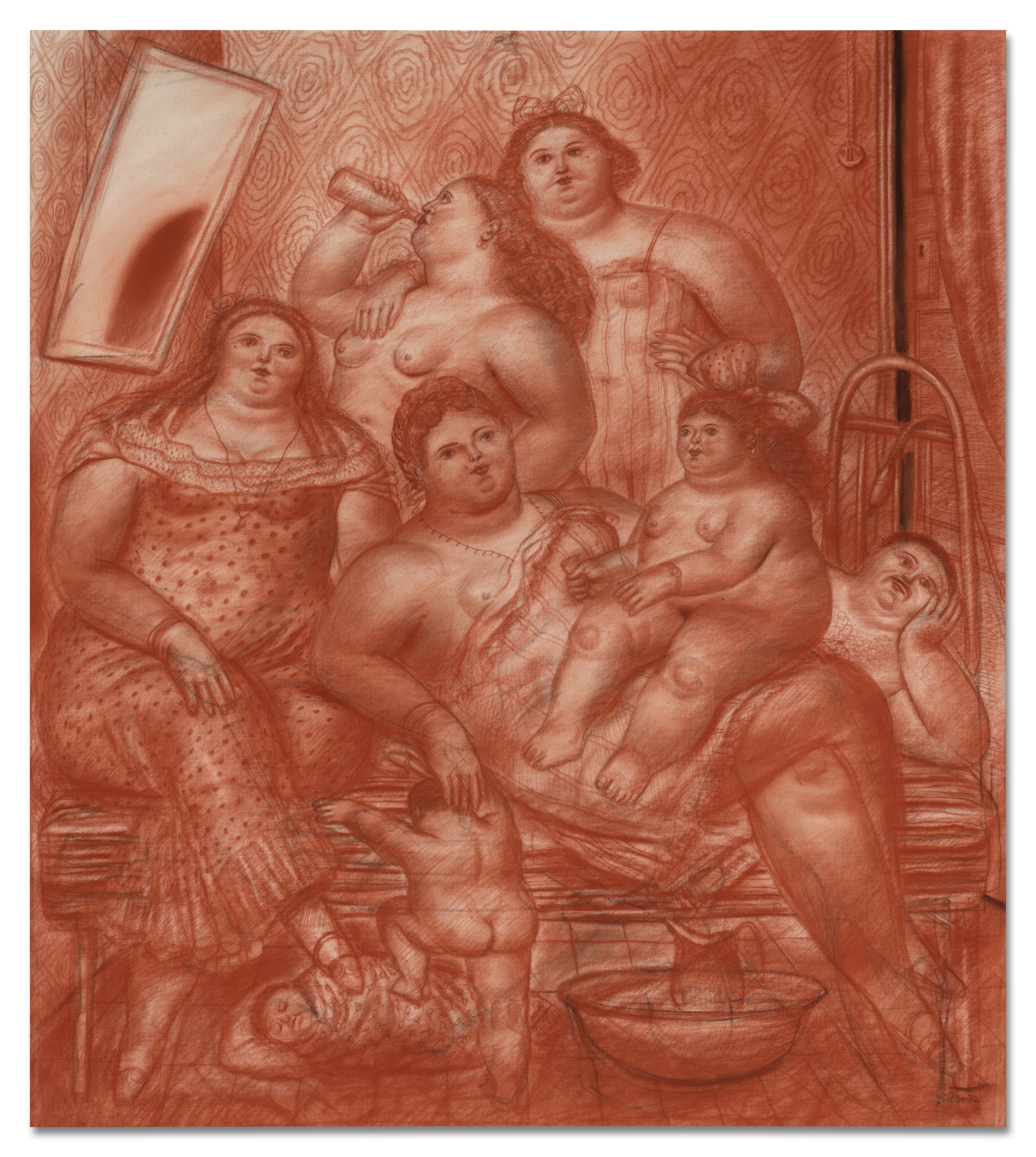
The House of Ana Molina, 1972
It was in Italy that Botero first understood the expressive power of form itself, the way a swelling contour could carry emotional weight independent of narrative. He returned to Colombia in the mid 1950s, won the Premio Guggenheim Colombia in 1958, and then made his decisive move to New York, where he settled and began showing his work to an international audience. The breakthrough came in 1961, when the Museum of Modern Art in New York acquired his painting Mona Lisa, Age Twelve, a work in which Leonardo's icon is reimagined as a plump, moon faced Colombian girl. The acquisition by MoMA was a public validation that announced the full arrival of what would become known as Boterismo, the inflated, rotund figural style that is now among the most recognizable signatures in the history of modern art.
“I paint fat people because it gives me the opportunity to distort the figure in a particular way.”
Interview, The Guardian
Botero always resisted the word "fat," insisting that his figures were not caricatures of weight but explorations of volume, sensuality, and formal abundance. The distinction matters enormously. Where a caricaturist exaggerates to mock, Botero amplified to celebrate, to render the world more tactile, more present, more alive. His paintings across the 1970s and 1980s became richly layered chronicles of Colombian and Latin American life.
Fernando Botero
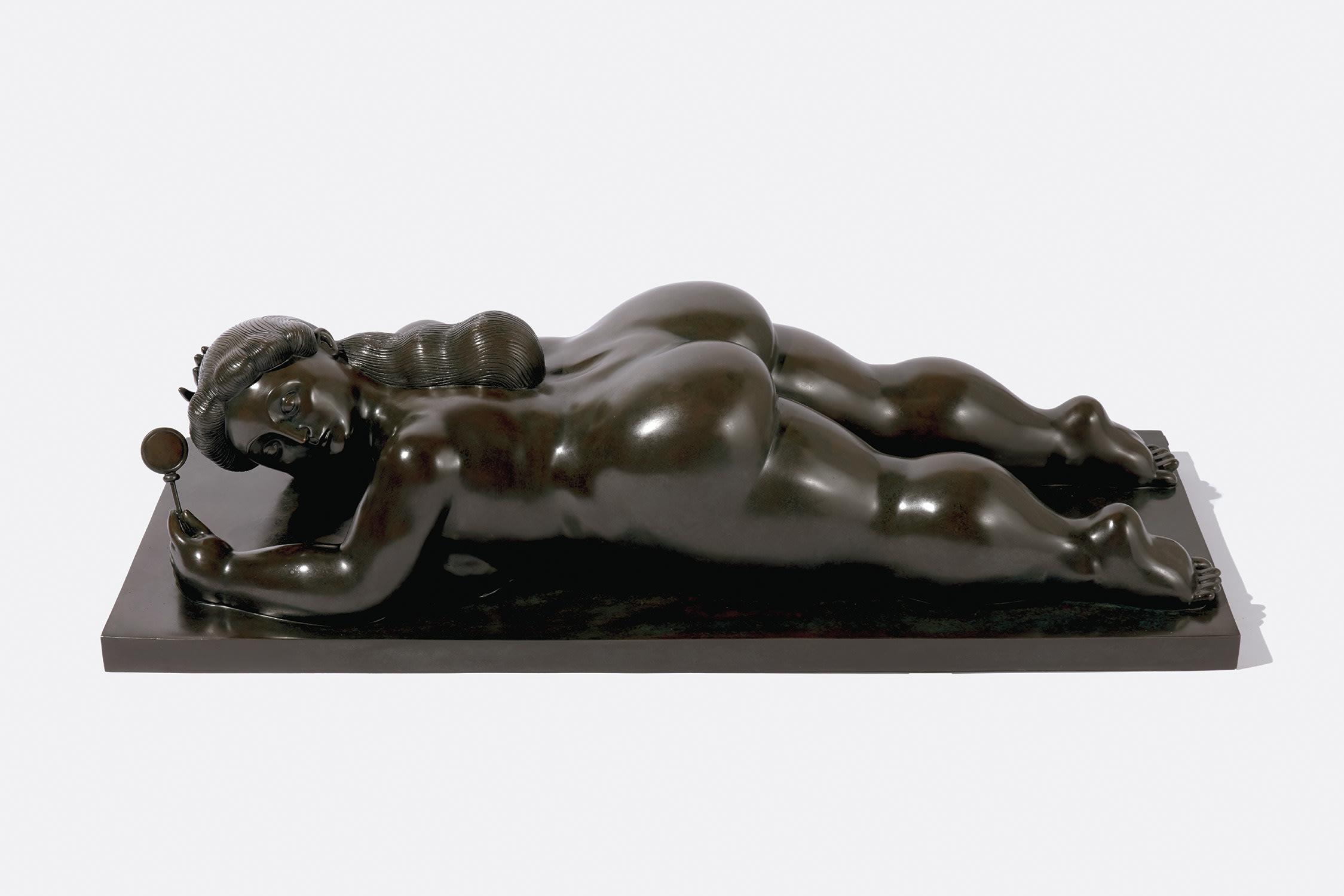
Reclining Woman with Mirror, 1986
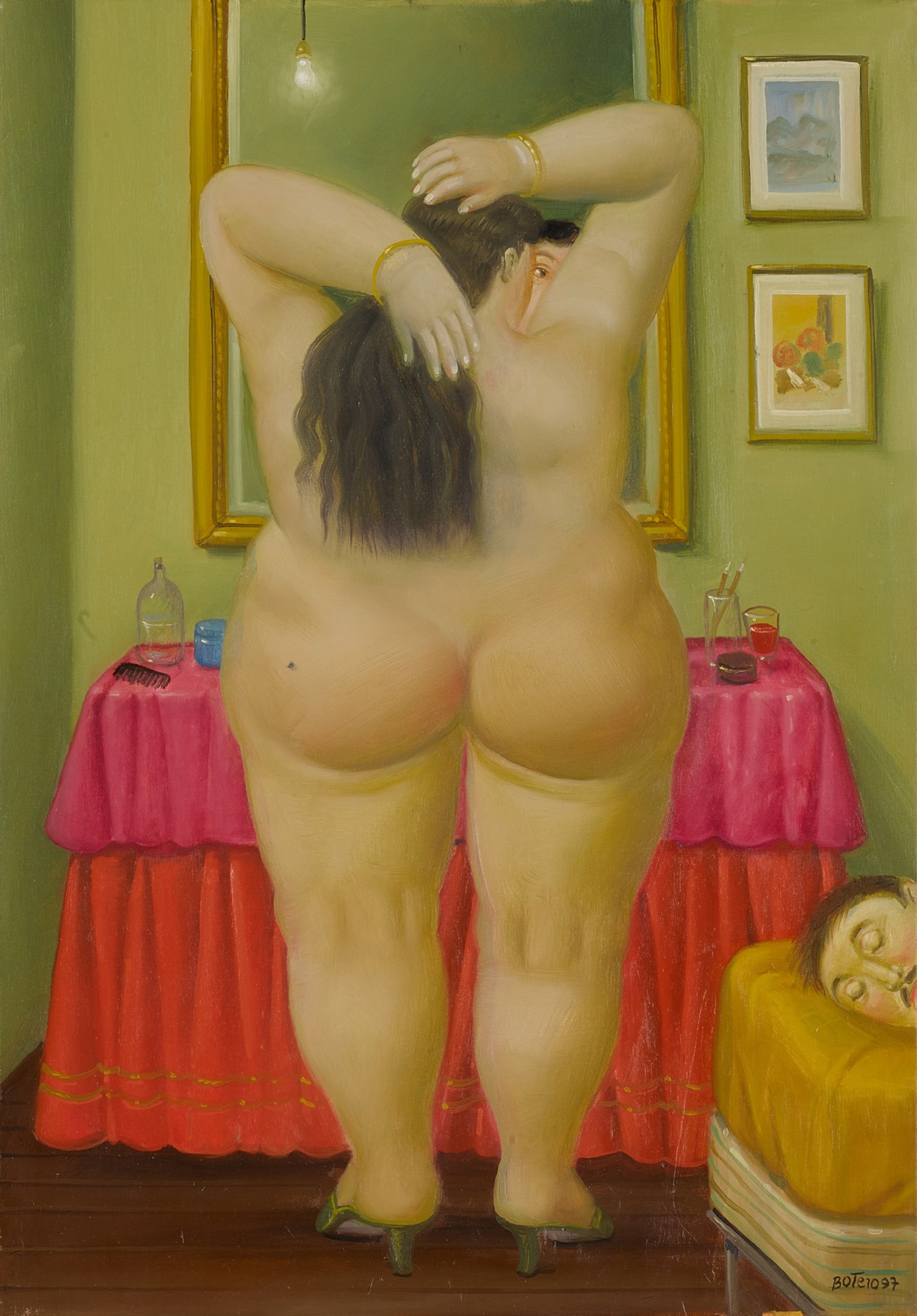
Works like The House of Ana Molina from 1972, rendered in sanguine, charcoal, and pastel on linen, demonstrate his mastery of drawing as a primary mode of expression, not merely preparatory study. El Gran Conquistador from 1981 brings his signature monumentality to the language of colonial history, inflating the iconography of conquest with an irony that is never cruel and never simple. His 1997 oil The Bedroom is a quietly theatrical domestic scene, luminous and stilled, that reveals how seriously Botero engaged with the tradition of interior painting stretching from Vermeer through Bonnard. These are works with deep art historical roots that nonetheless feel entirely original.
Botero's expansion into sculpture, which he began seriously in the 1970s, extended his formal ideas into three dimensions with remarkable success. Works like Reclining Woman with Mirror from 1986 and Donna Seduta from 2003 in bronze translate the billowing volumes of his canvases into objects that command space with extraordinary authority. His monumental bronzes have been installed in public squares from New York's Park Avenue to the Plaza de Botero in Medellín, a dedicated outdoor museum of his sculptures that has become one of the most visited cultural sites in all of South America. The tactile generosity of his forms translates to bronze with a naturalness that feels inevitable in retrospect.
Fernando Botero
The Bedroom, 1997
For collectors, Botero represents one of the most compelling propositions in the secondary market for Latin American art. His works have consistently performed at major international auctions, with significant oils and large format bronzes regularly achieving results in the millions at Christie's, Sotheby's, and Bonhams. Works on paper, including his accomplished sanguine drawings and lithographs such as the 1976 offset lithograph To Amnesty International, offer points of entry that carry the full weight of his aesthetic intelligence at a broader range of price points. Collectors are drawn not only to the visual pleasure of his work but to its remarkable legibility across cultures, a quality that makes Botero one of the few artists of his generation whose appeal is genuinely global.
His self portraits, including the arresting Self Portrait with Flag from 1991, offer a particularly intimate window into his practice and are prized for their directness. In the broader context of art history, Botero occupies a singular position. He is aligned in spirit with the Mexican muralists, particularly Diego Rivera, in his commitment to figuration as a vehicle for cultural identity and political conscience. His engagement with Old Master traditions places him in conversation with artists like Lucian Freud and John Currin, though his sensibility is warmer and more communal than either.
He is sometimes compared to the Colombian writer Gabriel García Márquez, and the parallel is illuminating: both men took European forms and filled them with the heat, color, and magic of Latin American experience until those forms became something entirely new. Fernando Botero leaves behind a legacy of uncommon wholeness. Over seven decades of sustained production, he never abandoned his convictions, never chased fashion, and never stopped finding new ways to astonish within a vocabulary he had chosen young and refined with absolute dedication. His work reminds us that style, when it is the outward expression of a genuine inner vision, is not a limitation but a kind of freedom.
To live with a Botero is to live with an artist who believed, with everything he had, in the beauty of the human form and the richness of human life.
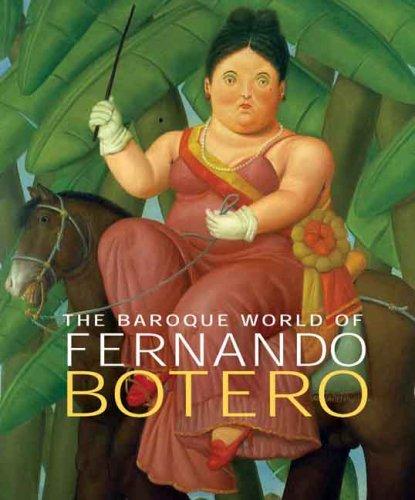
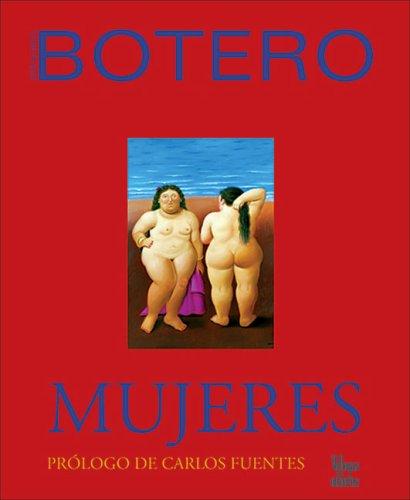
Explore books about Fernando Botero