Fátima de Juan
Fátima de Juan Paints the World Alive
Artist Spotlight · The Collection Editorial
Something is unmistakably alive in the paintings of Fátima de Juan. Her canvases arrive with the energy of a city that never quite quiets down, surfaces layered in acrylic and spray paint that seem to vibrate between control and beautiful abandon. In recent years her work has moved steadily into the secondary market, appearing at auction and finding its way into the hands of collectors who understand that the Spanish contemporary scene is producing some of the most genuinely exciting figurative painting anywhere in the world right now. De Juan is among the most compelling figures of that moment, and her presence in the market continues to grow with each new body of work she releases.
Fátima de Juan
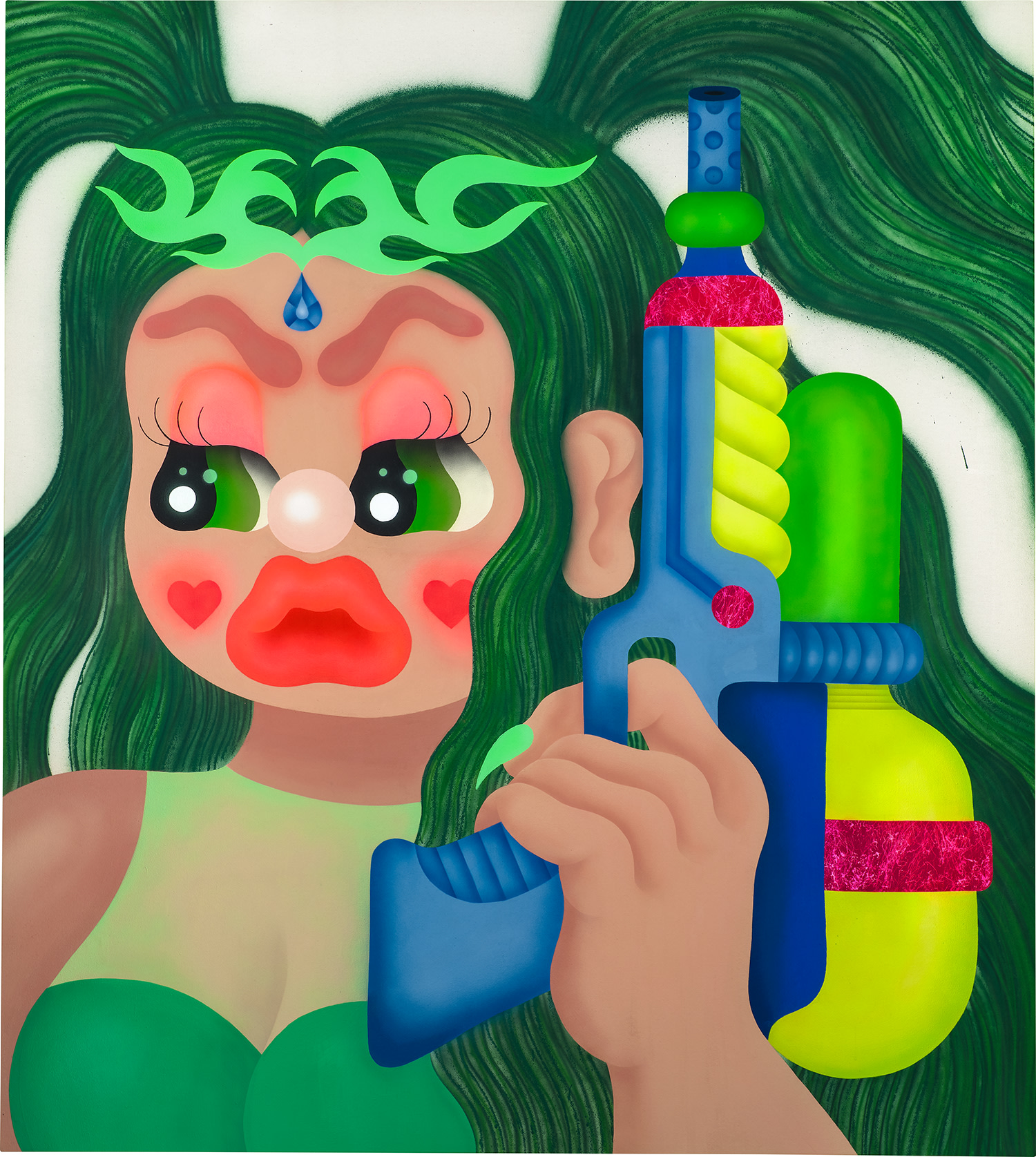
Girls and Guns 2, 2022
De Juan's formation as an artist is rooted in Spain, a country whose visual culture carries centuries of figurative tradition alongside a twentieth century history of rupture, reinvention, and hard won artistic freedom. That inheritance is never a burden in her work; it is more like a foundation she builds on and then deliberately departs from, finding her own grammar in the collision between classical painterly instinct and the visual language of contemporary life. The spray can enters her studio as naturally as the brush, and the result is a practice that feels entirely of this moment while remaining deeply connected to the expressive humanism that has always defined great figurative art. Her artistic development reflects a sensibility that is drawn equally to pleasure and to meaning.
De Juan works within a tradition of artists who take femininity, identity, and the texture of lived experience as primary subjects, but she approaches these themes with a lightness and wit that never diminishes their depth. Her palette tends toward warmth and saturation, colors that feel chosen for their emotional temperature as much as their visual effect. The spray paint element introduces something unpredictable, a looseness that keeps the compositions from ever feeling too resolved or too careful, and that spontaneity is part of what makes her paintings so immediately engaging. Among her most discussed works are those that carry titles with a particular kind of irreverence and poetry.
Fátima de Juan
Chili Pepa, 2021
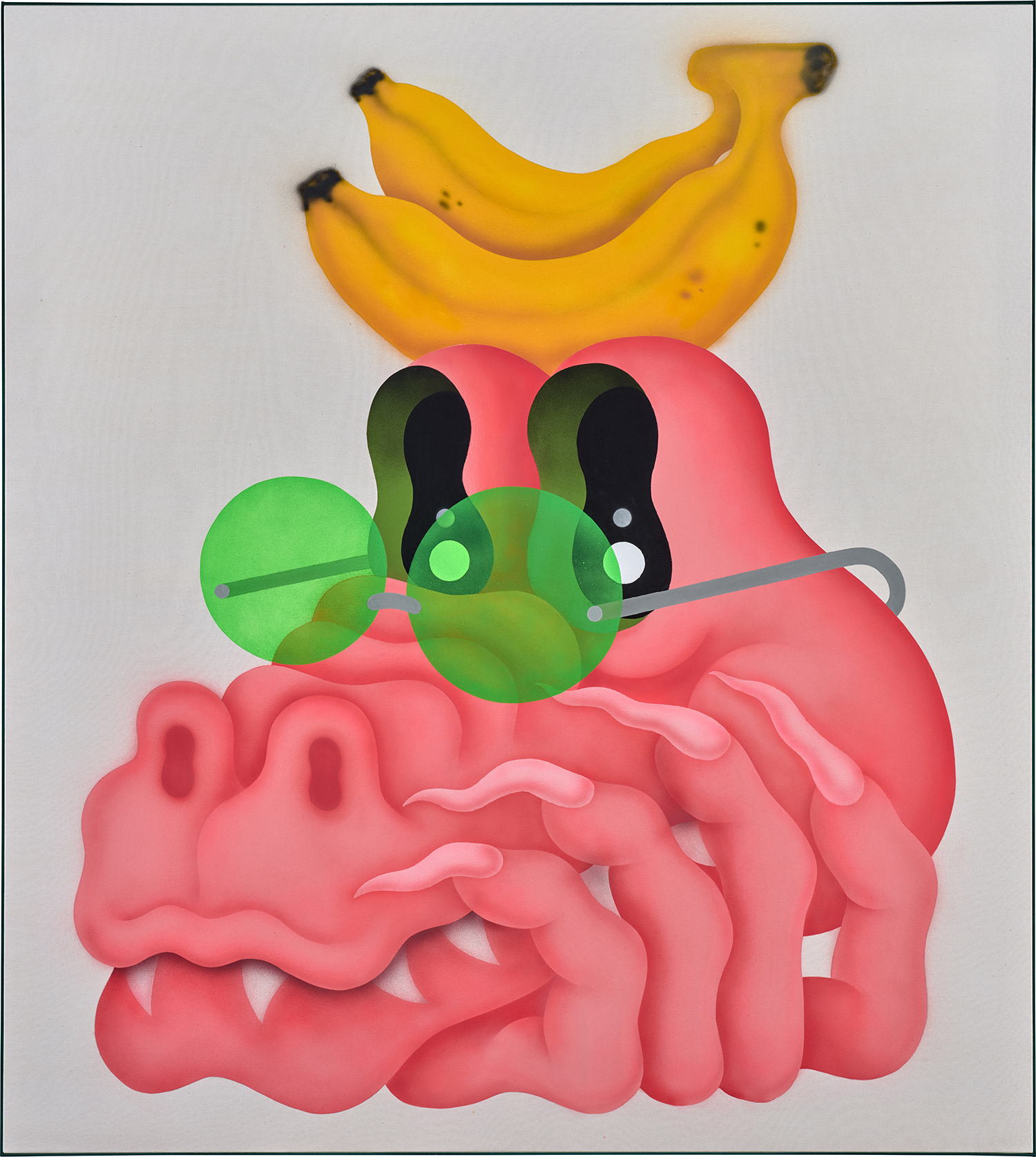
"Girls and Guns 2," completed in 2022 using acrylic and spray paint on canvas, exemplifies the tension she courts so skillfully between the playful and the pointed. The title alone announces a sensibility that is not afraid of contradiction, and the work delivers on that promise with the same mix of visual pleasure and underlying weight. "Banana Baywatch" from 2022, presented in the artist's own frame, demonstrates another dimension of her practice: the decision to frame works herself is not incidental but a statement about the total object, the idea that a painting is not finished at its edges. That curatorial instinct within the studio speaks to an artist who thinks about how work exists in the world, not just how it looks on the canvas.
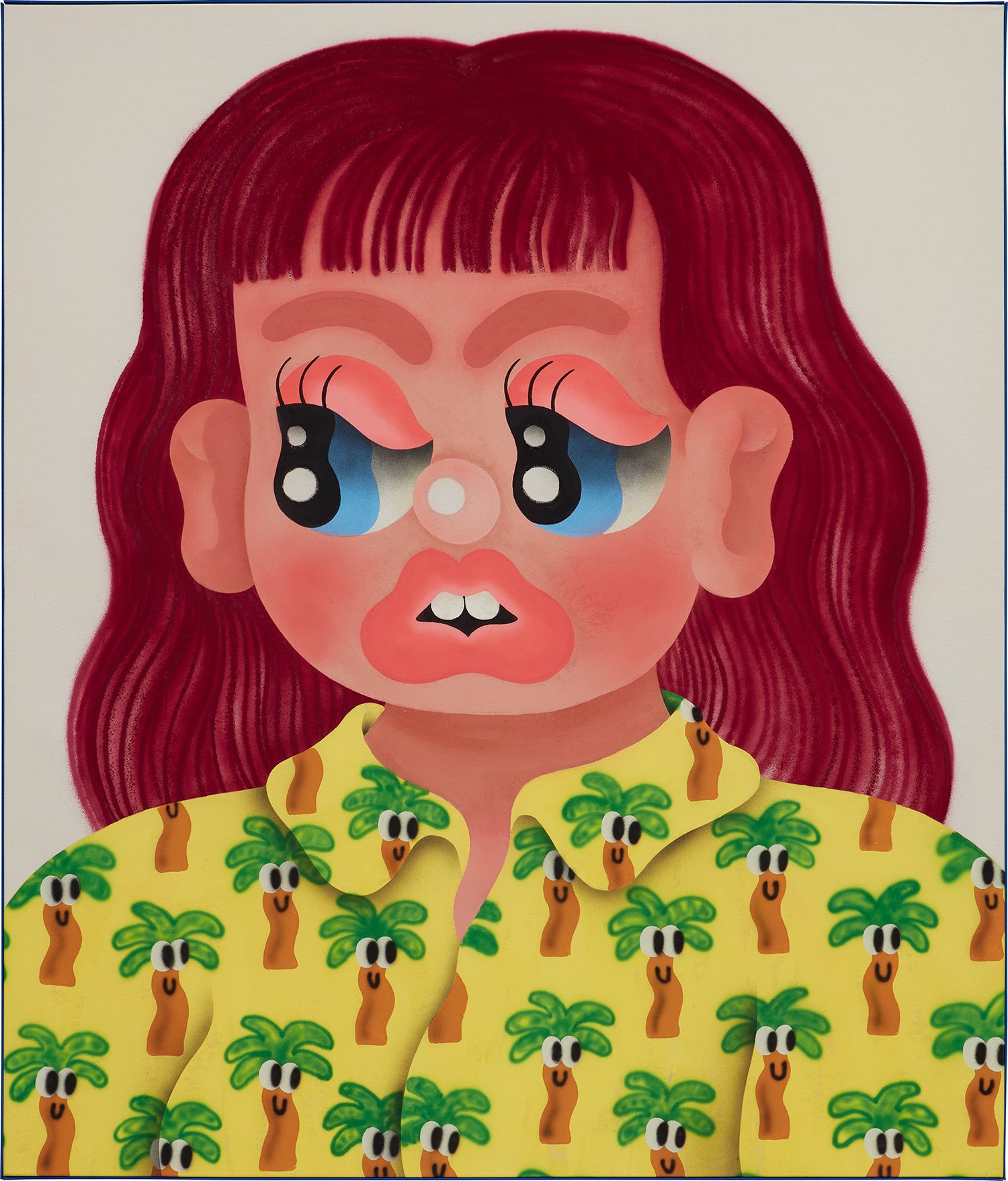
"Chili Pepa" and "Palm Fever," both from 2021, sit together as works that share a kind of lush, almost tropical intensity. There is something in these titles and in the imagery they suggest that recalls the pleasure of color for its own sake, the way certain painters from Matisse onward have understood that joy is a serious subject. De Juan does not shy away from that lineage. She works in a tradition that includes painters who took the decorative impulse and turned it into something genuinely radical, and her best works carry that same conviction.
Fátima de Juan
Palm fever, 2021
"Fruity Loop" extends this sensibility further, and its bilingual title, incorporating Chinese characters alongside the English phrase, signals an awareness of global visual culture that gives her work a contemporary reach well beyond its Spanish origins. "Green Fortress," completed in 2023 and also presented in the artist's own frame, feels like a work that marks a development in her thinking about structure and enclosure. The word fortress implies both protection and isolation, and that ambiguity is characteristic of how De Juan uses language in relation to image. She is not an artist who illustrates her titles; instead, titles and images exist in productive tension, asking the viewer to hold two ideas at once and find the space between them.
This is a sophisticated approach, and it is one of the reasons her work rewards sustained attention rather than simply delivering its pleasures on first glance. From a collecting perspective, De Juan represents exactly the kind of artist whose moment in the primary and secondary markets deserves careful attention. She works in a format, medium scale acrylic and spray paint on canvas, that has proven both critically durable and practically well suited to living with. Her works are not paintings that demand a museum context to function; they bring genuine presence to a private space, and collectors who have acquired her work report that it holds its energy over time.
Fátima de Juan
Banana Baywatch, 2022
The decision to present certain works in the artist's own frame adds a further dimension to the object and a stronger connection to provenance and intentionality, both qualities that matter as her market matures. In the broader context of contemporary figurative painting, De Juan belongs to a generation that includes artists working across Europe and Latin America who have reclaimed the figure and the expressive gesture from a period when conceptual and post conceptual frameworks dominated critical attention. Artists like Cecily Brown, whose work similarly navigates between figuration and abstraction with considerable physical force, or the Spanish painter Miquel Barceló, whose surfaces carry a comparable density of material incident, offer useful points of comparison without fully accounting for what De Juan does. Her particular combination of chromatic intensity, urban material vocabulary, and thematic focus on femininity and identity places her in a conversation that is genuinely her own.
What makes Fátima de Juan matter now, and what will continue to make her matter, is the consistency of her commitment to painting as an act of full engagement. In a period when artists face enormous pressure to produce work that is immediately legible across social media and the global art fair circuit, she continues to make paintings that require a body in front of them, works whose surface and scale and material presence are part of what they communicate. That commitment to the physical, embodied encounter between viewer and work is not old fashioned; it is, in the current moment, quietly radical. Collectors who find their way to her practice now are encountering an artist whose best work may still be ahead of her, and that is precisely the kind of position every serious collection wants to be in.