Evgeny Rukhin
Evgeny Rukhin: Freedom Forged in Paint
Artist Spotlight · The Collection Editorial
In the decades since his tragically brief life ended in a studio fire in Leningrad in 1976, Evgeny Rukhin has emerged as one of the most compelling and quietly radical figures of the Soviet nonconformist art movement. Western institutions and private collectors have steadily deepened their engagement with his work, and recent years have brought renewed scholarly attention to the generation of underground artists he represented. Rukhin stands at the center of that reassessment, a painter whose canvases carried the full weight of political suffocation and human longing without ever announcing themselves as protest. His art speaks in the private language of materials, and that language grows richer with every passing year.
Evgeny Rukhin
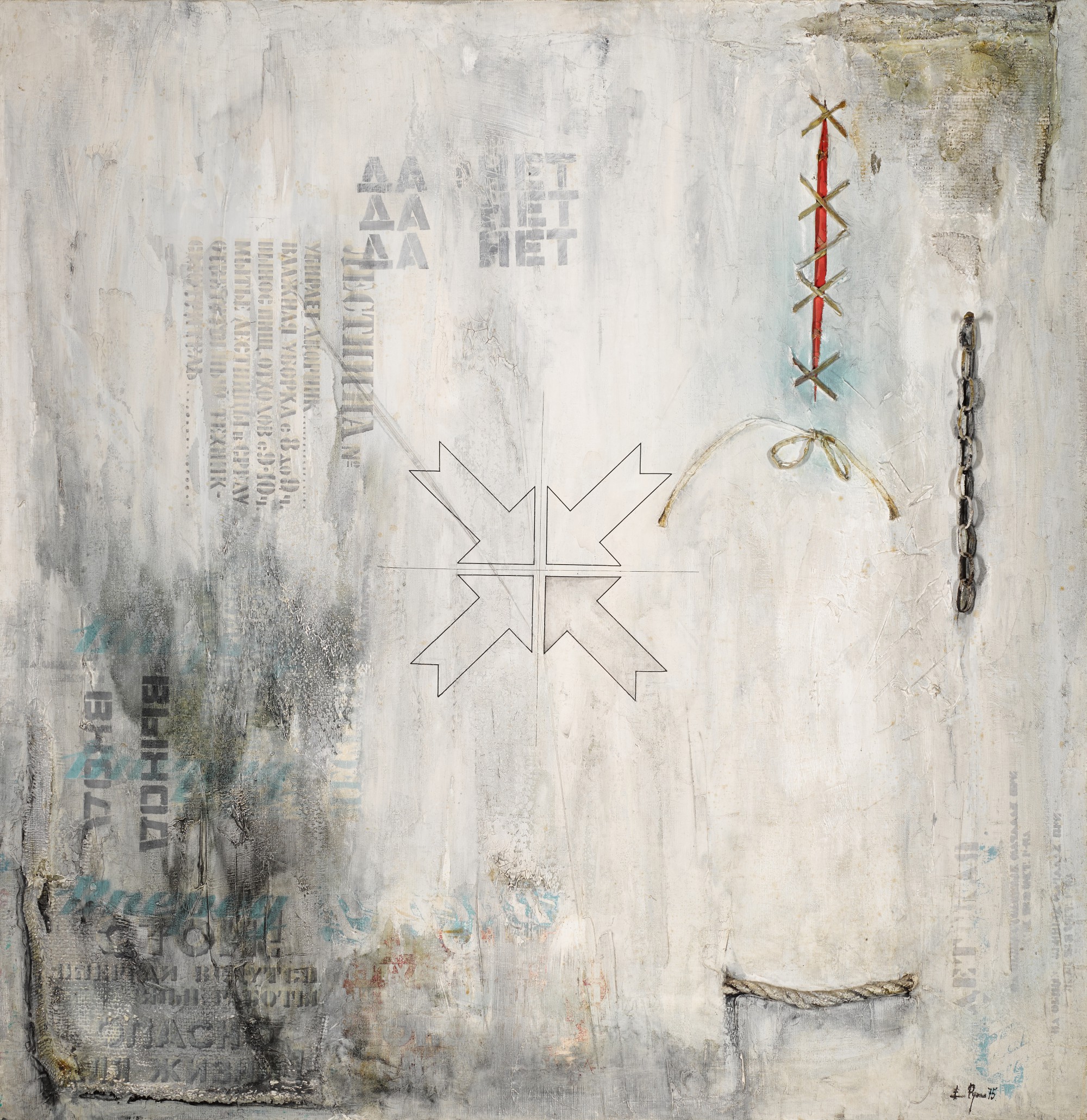
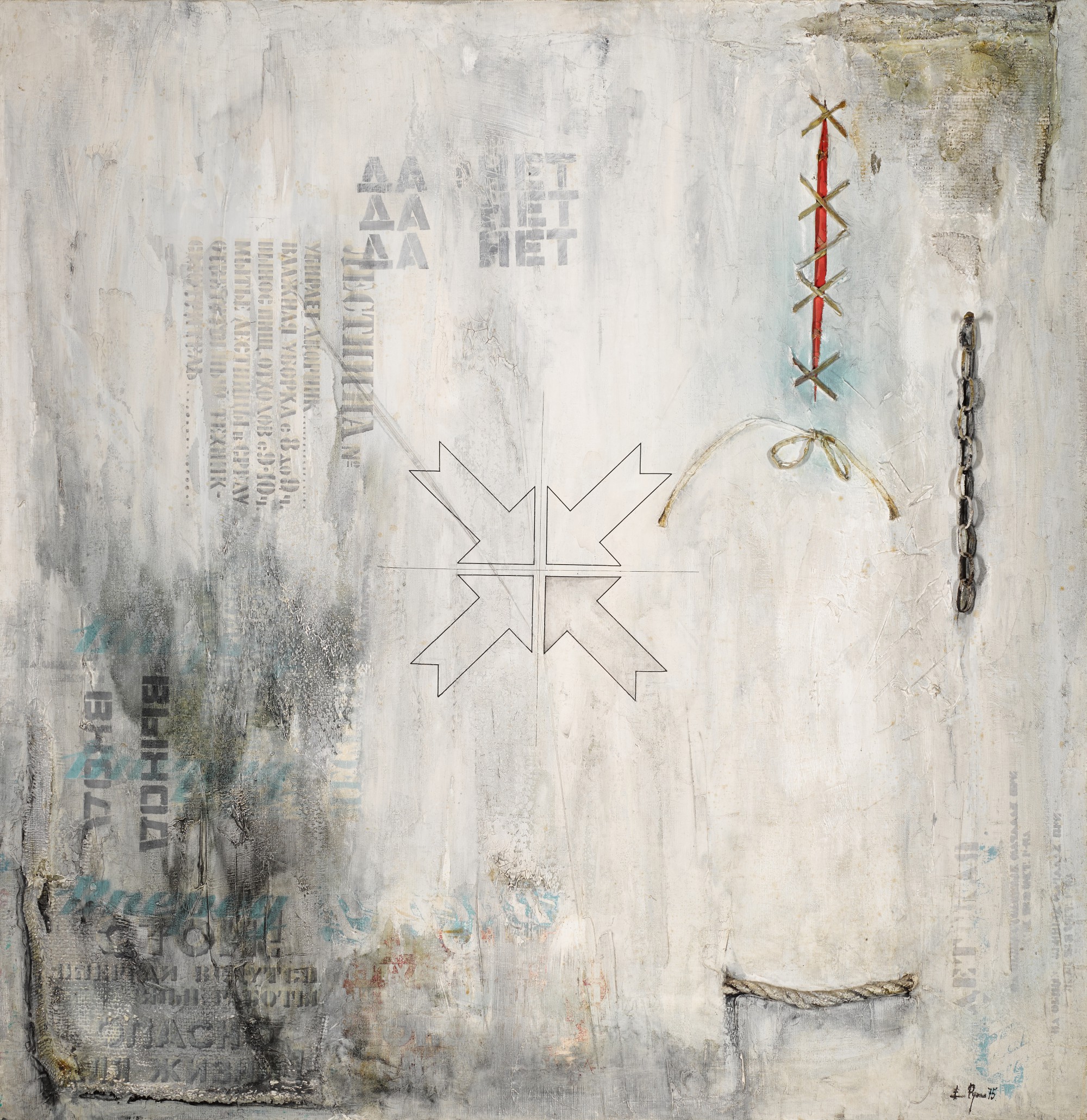
Da Nyet
Rukhin was born in Saratov in 1943, during the darkest years of the Second World War, and came of age in postwar Leningrad, a city whose imperial grandeur coexisted uneasily with Soviet austerity. His father was a geologist, and Rukhin spent portions of his youth in Central Asia, absorbing landscapes and textures far removed from the metropolitan art world he would later inhabit. He studied geology briefly before turning decisively toward art, a shift that speaks to a temperament drawn to the material world in its most elemental forms. Leningrad in the 1960s was a place of intense intellectual ferment beneath the official surface, and Rukhin found his people among poets, philosophers, and painters who passed forbidden literature and ideas through apartment networks that the Soviet state could not fully monitor.
His artistic formation owed something to his encounters with Western modernism encountered through rare books, smuggled catalogues, and the occasional foreign visitor. He absorbed the lessons of Abstract Expressionism and Arte Povera not as doctrines but as permissions, invitations to treat the canvas as a field of accumulated experience rather than a surface for representation. By the late 1960s and early 1970s, Rukhin had developed a practice that placed him in the front rank of the Leningrad underground. He became a central figure in organizing unofficial exhibitions, most notably participating in the legendary Bulldozer Exhibition in Moscow in September 1974, the open air show that Soviet authorities literally demolished with bulldozers and water cannons.
Evgeny Rukhin
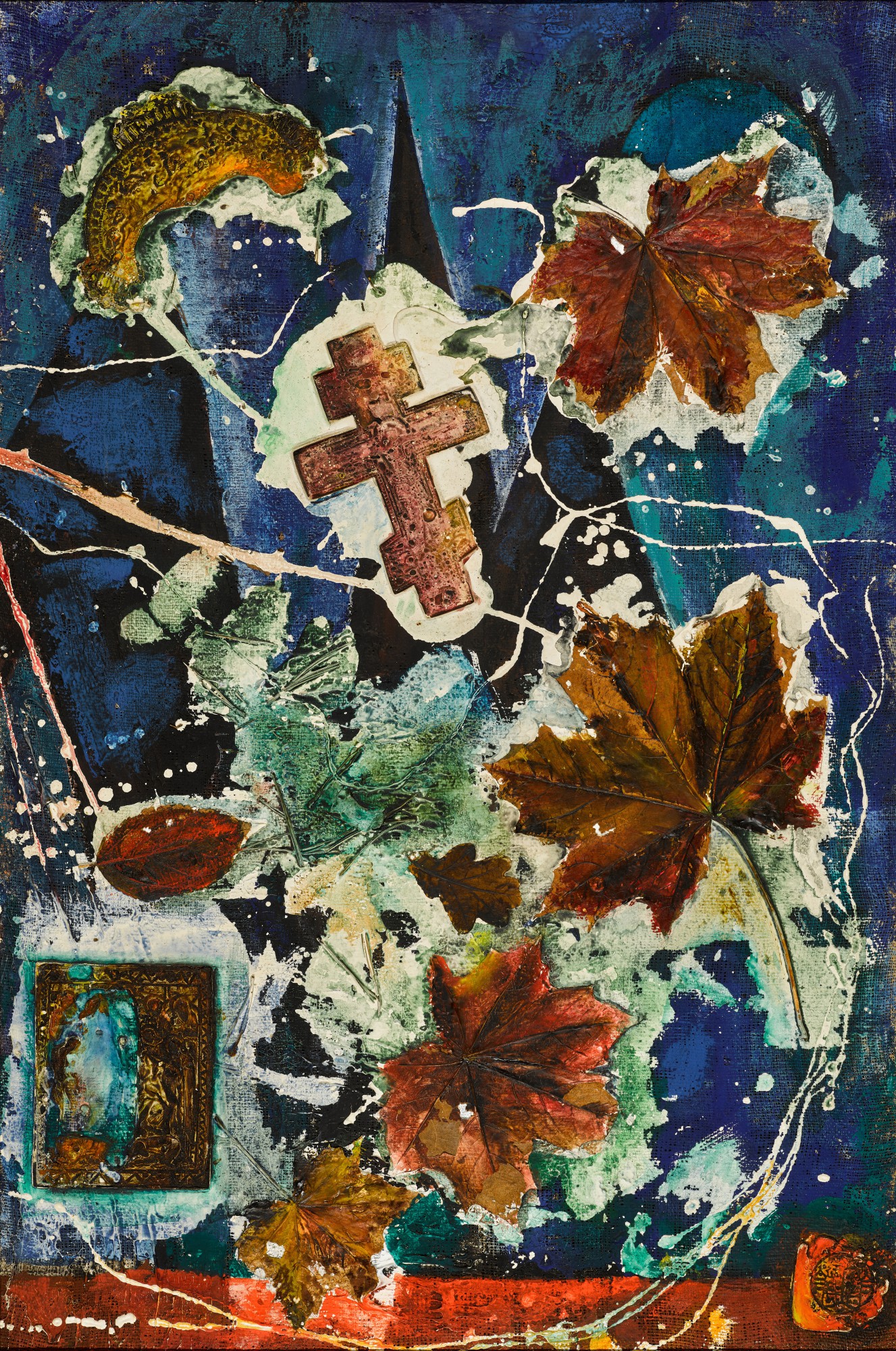
Composition with Leaves and Cross
That event, far from silencing the nonconformists, drew international press coverage and ultimately forced the Soviet cultural establishment into a reluctant series of concessions, including officially sanctioned shows at the Izmailovo Park exhibition the following month. What distinguishes Rukhin's work from that of his contemporaries is the extraordinary physicality of his canvases. Where some nonconformist painters expressed dissent through irony or coded imagery, Rukhin embedded his meanings in the very substance of the painted object. Works such as Da Nyet, whose title translates simply as Yes No, layer oil paint with rope, metal chain, nail, laces, and fabric in a composition that reads as a meditation on constraint and possibility existing simultaneously.
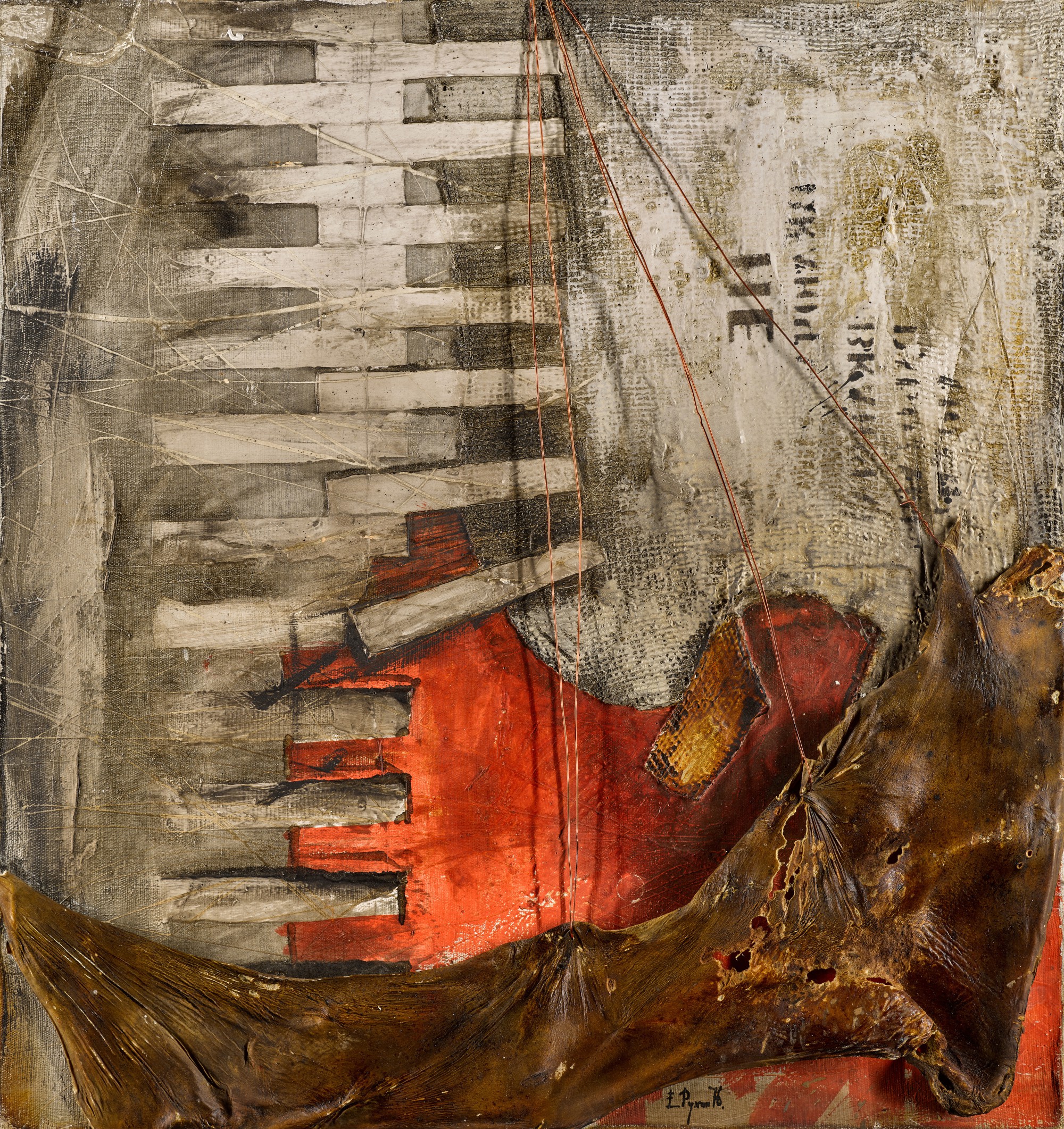
The binary of the title is never resolved. Instead, it vibrates between the two states, held in tension by materials that carry their own histories of use and wear. Composition with Wires extends this logic further, the wires describing invisible boundaries across the canvas surface, suggesting surveillance, connection, and entanglement at once. These are not decorative gestures.
Evgeny Rukhin
Composition with Wires
The embedded objects were chosen with the precision of a poet selecting a particular word. Composition with Leaves and Cross and Composition with Banister reveal the breadth of Rukhin's material imagination. The banister fragment, a piece of architectural salvage, carries the memory of a specific staircase, a specific building, a specific human passage. By incorporating it into paint, Rukhin performs a kind of secular reliquary practice, preserving something ordinary against the erasure that Soviet urban life regularly imposed on the past.
The cross motif that appears in several works is similarly layered: it functions simultaneously as a spiritual symbol, a formal compositional anchor, and a provocation within a state that officially denied the relevance of religious imagery. Rukhin was never dogmatic, but he was never careless either. Every element earned its place. For collectors, Rukhin's work presents a particularly compelling proposition.
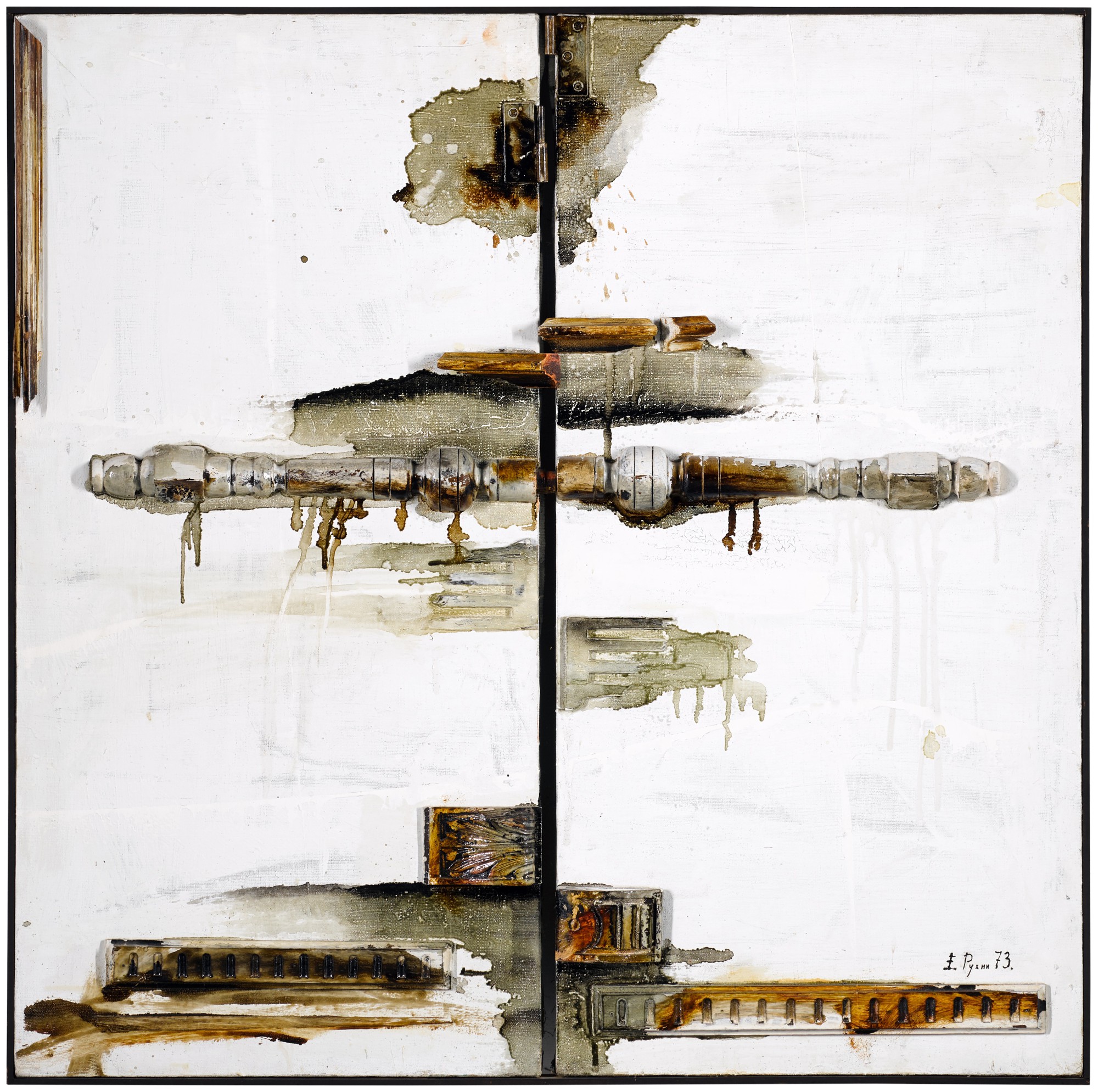
Evgeny Rukhin
Untitled
His output was necessarily limited by the conditions of underground practice, and the events of April 1976, when he died in a fire at his Leningrad studio, curtailed a career that was only beginning to receive international recognition. Works by Rukhin have appeared at major auction houses including MacDougall's, which has long specialized in Russian art and has brought several of his canvases to market, consistently attracting serious bidders. The mixed media works command particular attention because they exemplify the qualities that make his practice irreplaceable: the combination of painterly intelligence with the material testimony of found objects. Collectors drawn to Arte Povera, to the American combine paintings of Robert Rauschenberg, or to the object based practices of Joseph Cornell will find in Rukhin an artist working from a completely distinct cultural vantage point but arriving at related territories of meaning.
The art historical context for Rukhin's work is rich and still being fully mapped. His closest companions in the Leningrad nonconformist scene included Mikhail Shemyakin and Vladimir Ovchinnikov, and his connections extended to the Moscow Conceptualists who were developing their own parallel underground. Internationally, the most illuminating comparisons are with artists who used humble and salvaged materials to register political and existential realities: Jannis Kounellis in Italy, Antoni Tàpies in Spain, and to some degree the early process works of Arte Povera broadly. Rukhin arrived at his solutions independently, working within a system of severe material restriction, which gives his found object choices an urgency and specificity that purely aesthetic motivations rarely produce.
The legacy of Evgeny Rukhin rests on something more durable than the circumstances of his life and death, though those circumstances have rightly become part of how the world understands him. It rests on the objects themselves, canvases that have survived the decades in remarkable condition and continue to generate new readings as the political and cultural context that produced them grows more rather than less relevant to contemporary audiences. In an era when questions about artistic freedom, state power, and the politics of cultural visibility feel freshly urgent, Rukhin's work speaks without strain and without nostalgia. He made art that had to matter because the cost of making it was real, and that necessity is visible in every layer of paint and every embedded fragment of the world he refused to accept on its official terms.