Eugène Delacroix
Delacroix: The Fire That Freed Painting
Artist Spotlight · The Collection Editorial
“I have no love for reasonable painting.”
Journal of Eugène Delacroix
Stand before The Death of Sardanapalus at the Louvre and you will feel it immediately: a heat that has nothing to do with temperature. Eugène Delacroix painted that canvas in 1827 and it remains one of the most audacious gestures in the history of Western art, a swirling, catastrophic vision of color and flesh that seemed to announce, with absolute confidence, that painting had new possibilities and new permissions. More than a century and a half after his death in 1863, Delacroix continues to command the attention of institutions, scholars, and serious collectors worldwide. The Louvre's dedicated Delacroix museum, the Musée National Eugène Delacroix housed in his final Paris studio and apartment on the Place de Furstemberg, draws a devoted audience year after year, a testament to the enduring magnetism of a painter who remade the emotional vocabulary of European art.
Eugène Delacroix
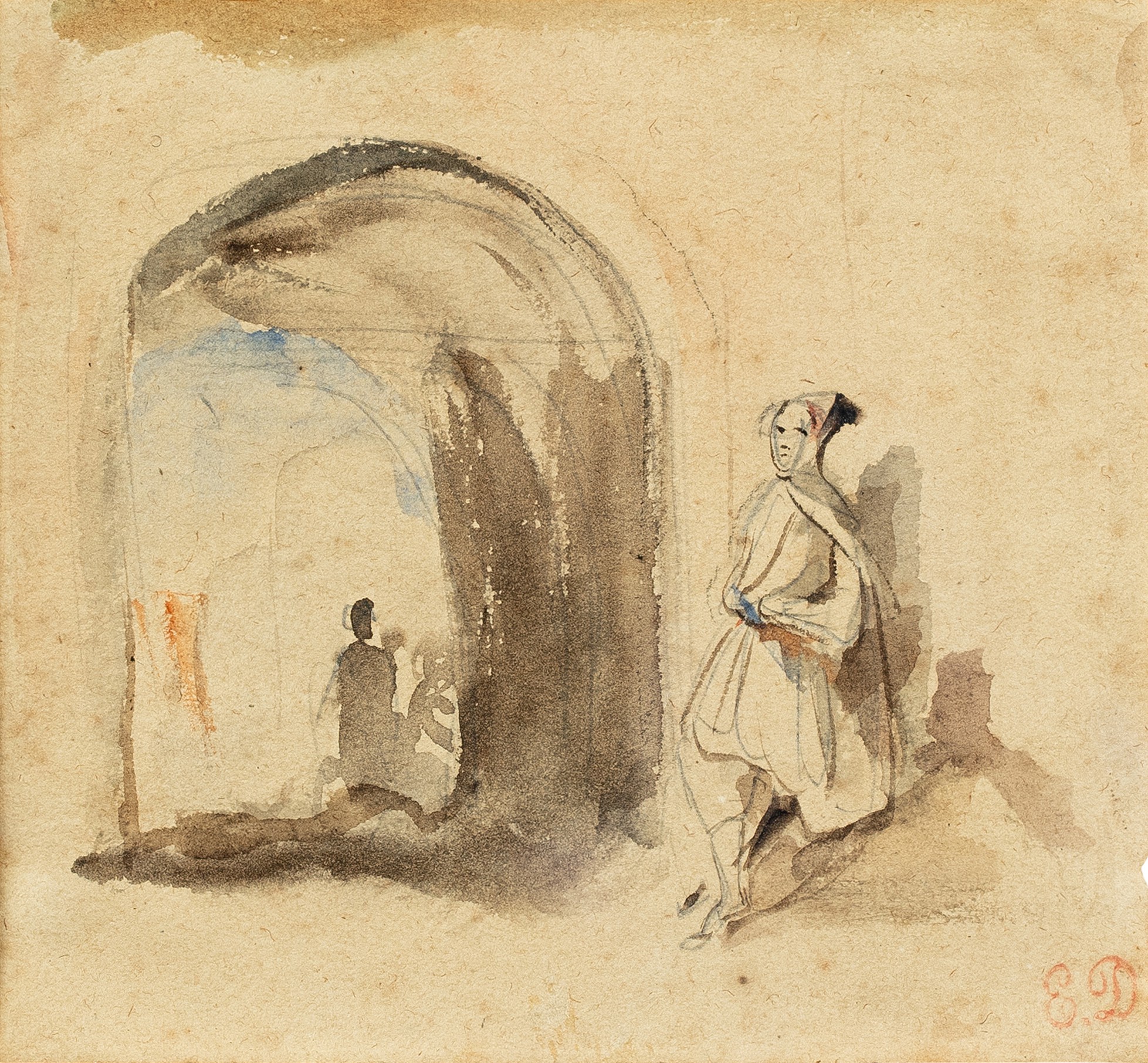
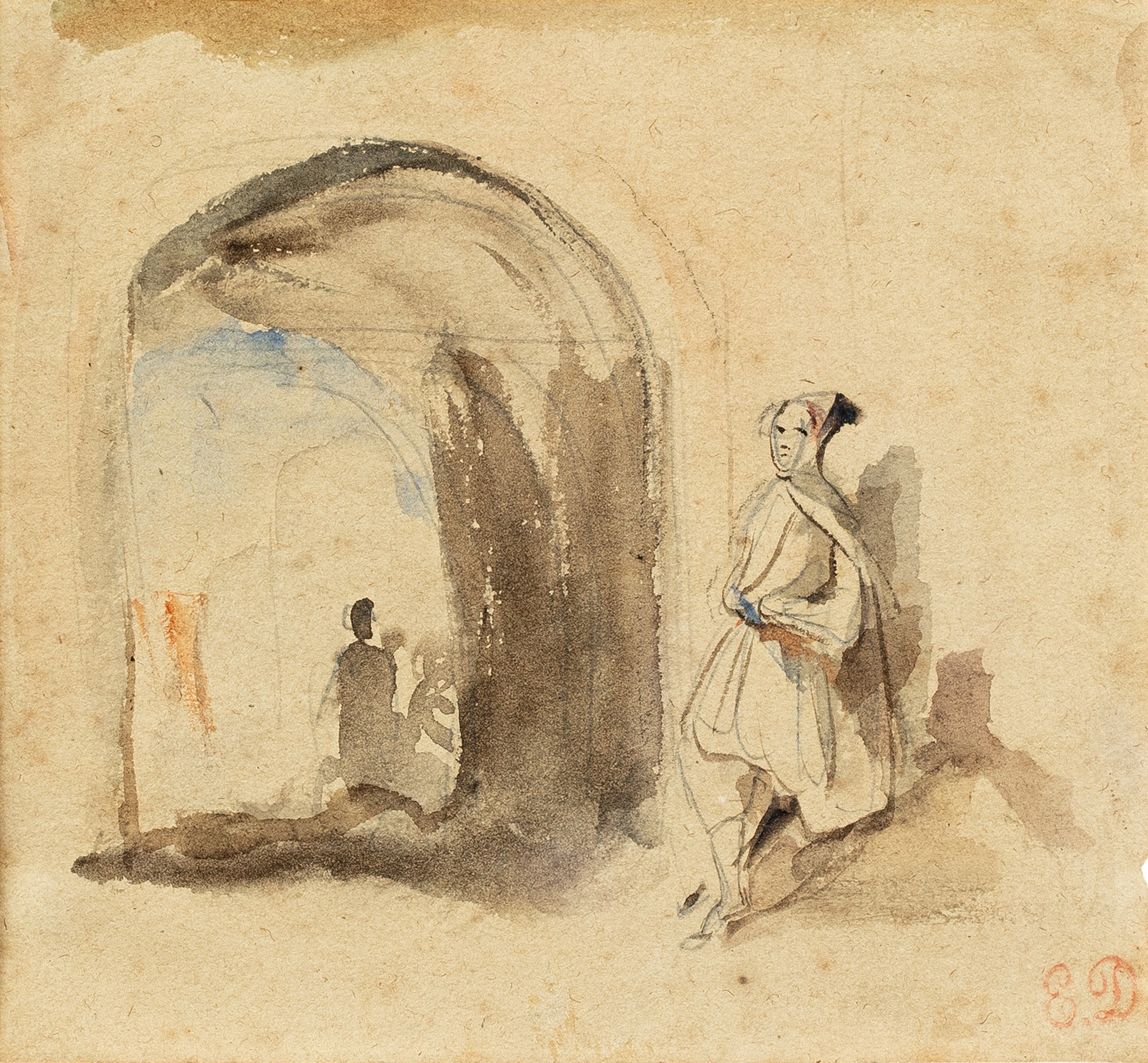
Coin de rue au Maroc
Ferdinand Victor Eugène Delacroix was born on April 26, 1798, in Charenton Saint Maurice, just outside Paris. His early life was shadowed by loss: his father, Charles Delacroix, died when Eugène was only seven, and his mother, Victoire Oeben, herself the daughter of a celebrated cabinetmaker, passed away when he was sixteen. Speculation has long surrounded his true parentage, with some historians suggesting that the diplomat and statesman Charles Maurice de Talleyrand may have been his biological father. Whether or not that theory holds, Delacroix grew up surrounded by culture and intellectual ambition, absorbing the lessons of the Enlightenment even as Romanticism gathered force around him.
He entered the studio of Pierre Narcisse Guérin in 1815 and enrolled at the École des Beaux Arts the following year, where he encountered Théodore Géricault, whose monumental Raft of the Medusa would alter the course of French painting and the trajectory of Delacroix himself. The early relationship between Delacroix and Géricault proved formative in the deepest sense. Delacroix reportedly served as a model for one of the figures on the Raft, and the experience of witnessing that painting's creation instilled in him a belief that art could absorb tragedy, political outrage, and raw physical sensation without flinching. His own debut at the Salon of 1822 with The Barque of Dante announced a painter of uncommon seriousness.
Eugène Delacroix
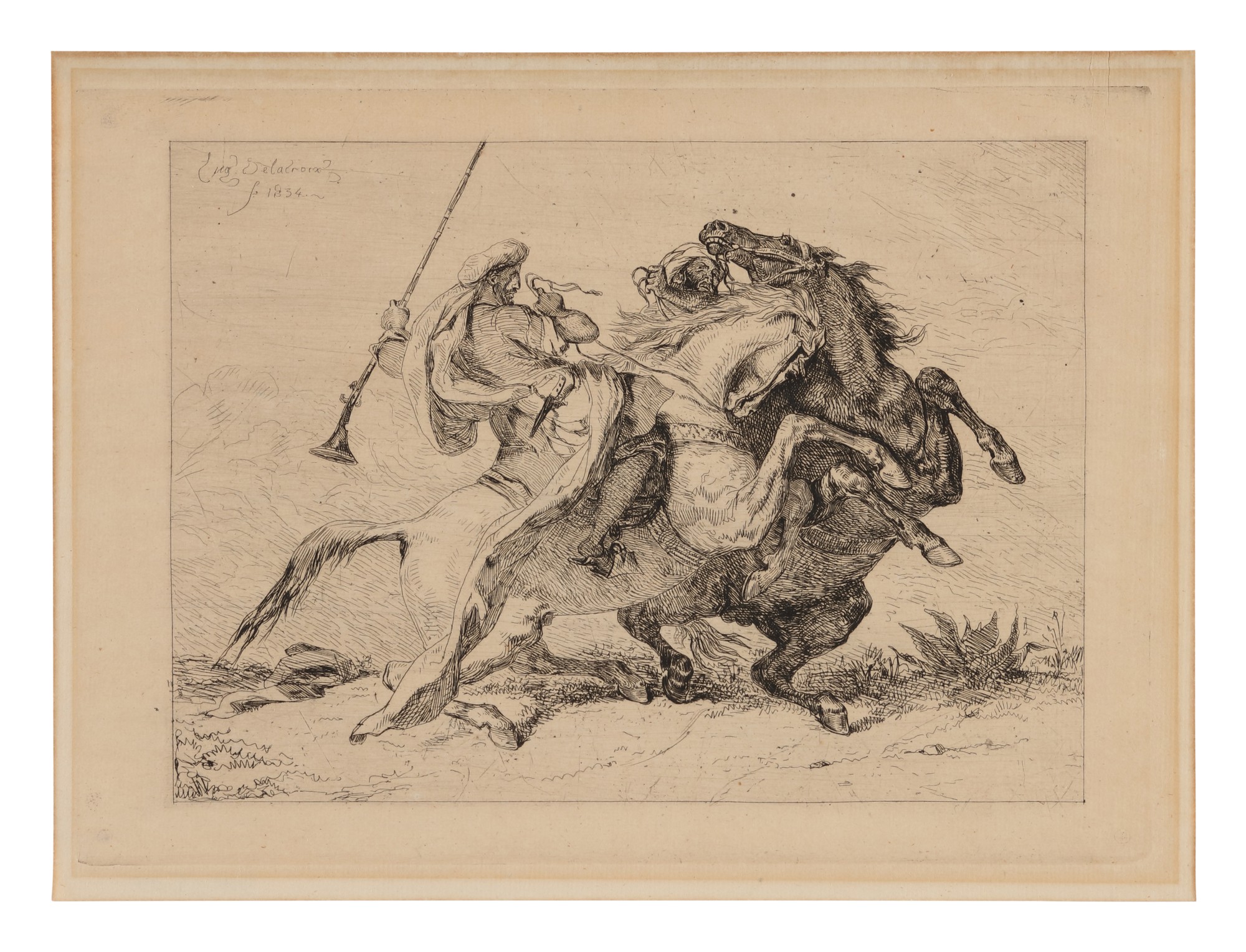
Rencontre de Cavaliers Maures (Delteil 23)
By 1824, his Massacre at Chios drew both scandal and reverence, with the critic and painter Jean Auguste Dominique Ingres famously dismissive but the broader public and a younger generation of artists riveted. These early works established Delacroix as the standard bearer of French Romanticism, a counterweight to the cool Neoclassicism of Ingres and the academy. The pivotal journey of his career came in 1832, when Delacroix traveled to Morocco and Algeria as part of a diplomatic mission led by the Comte de Mornay. The six months he spent in North Africa transformed him.
“The first virtue of a painting is to be a feast for the eyes.”
Journal of Eugène Delacroix
The light was different, the color was different, the human figures moved and dressed in ways that seemed to him almost classical in their natural dignity. He filled notebooks with sketches and watercolors, documenting everything from the souks of Tangier to the faces of soldiers and merchants. The work that emerged from this period, including the luminous Women of Algiers in Their Apartment completed in 1834, revealed a painter who had found a new world that confirmed everything he already believed about color, warmth, and the power of observation. The works on The Collection that reflect this period, including Coin de rue au Maroc in black chalk, wash, and watercolour, and Count Demetrius de Palatiano in Suliot Costume in oil on fabric, capture the documentary intimacy and exotic lyricism that made his orientalist work so beloved and so influential.
Eugène Delacroix
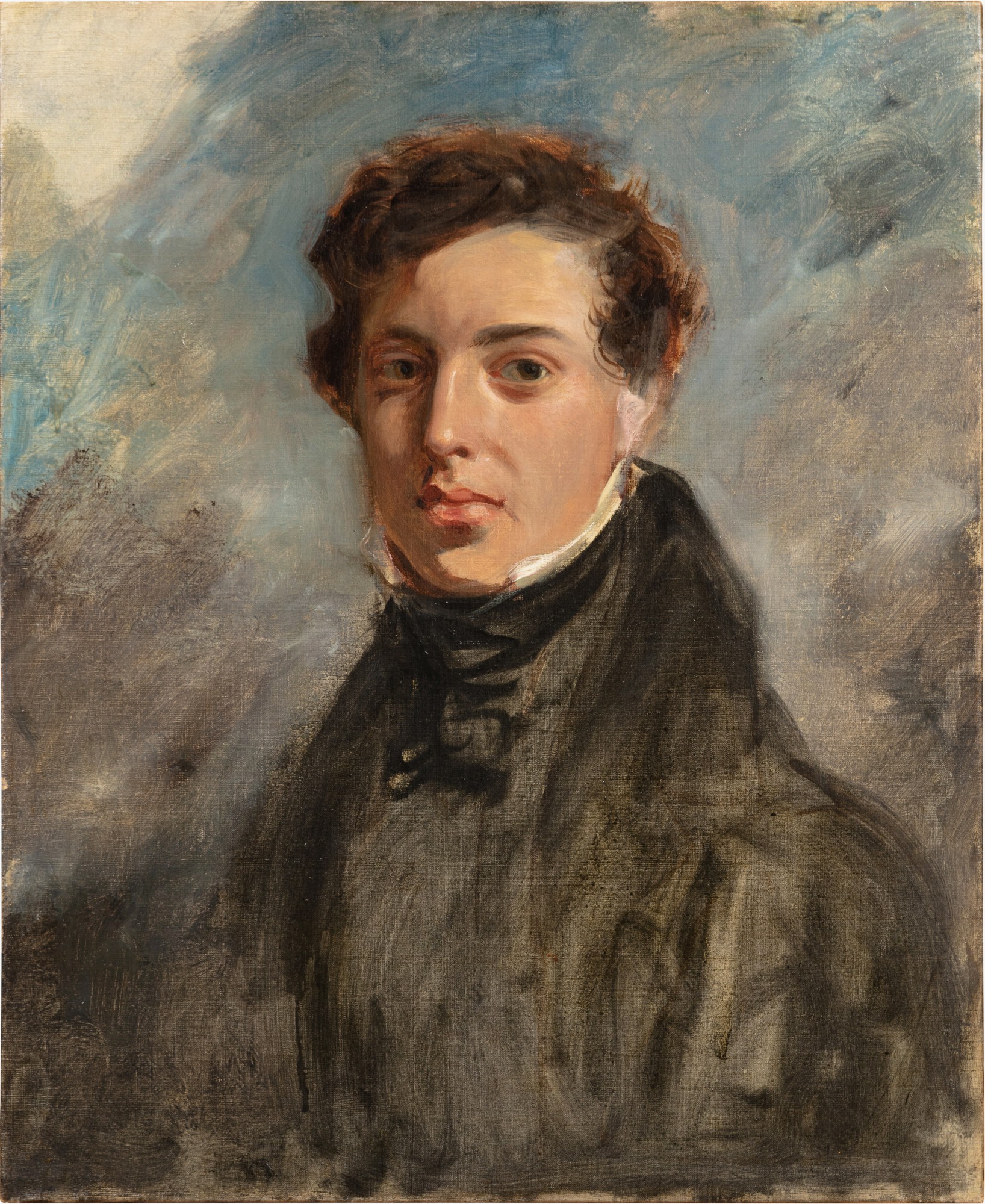
Portrait de Charles de Verninac (1803-1834)
What distinguishes Delacroix as a collecting proposition, beyond the historical importance, is the remarkable range of his output and the intimacy of many surviving works. The large Salon paintings are fixed in national collections and institutional hands, but drawings, prints, watercolors, and smaller oil studies remain in private circulation, and they offer a uniquely close encounter with his thinking. The etching Rencontre de Cavaliers Maures from 1834, from the edition of approximately thirty printed for Le Musée, the review of the Salon of that year, exemplifies the kind of rare, historically grounded print that serious collections prize: small in scale, specific in provenance, and connected directly to a pivotal moment in his career. His portraits, including the tender Marguerite Juliette Pierret from 1827 and the more formal Portrait de Charles de Verninac, demonstrate a psychological attentiveness that his reputation as a colorist sometimes overshadows.
“What moves those of genius is not new ideas, but their obsession with the idea that what has already been said is still not enough.”
Journal of Eugène Delacroix
These are works in which Delacroix is watching, listening, and recording with the same intensity he brought to his history paintings. At auction, Delacroix works across all categories continue to perform with strength and consistency. Major oil studies and finished canvases routinely achieve significant results at Christie's, Sotheby's, and Artcurial in Paris, while drawings and watercolors attract scholarly collectors who understand that works on paper often bring you closer to the artist's unmediated thought than any finished canvas can. Collectors entering this market benefit from a well catalogued body of work and a deep scholarly literature, including Alfred Robaut's foundational catalogue of the paintings and the continuing work of the Société des Amis d'Eugène Delacroix.
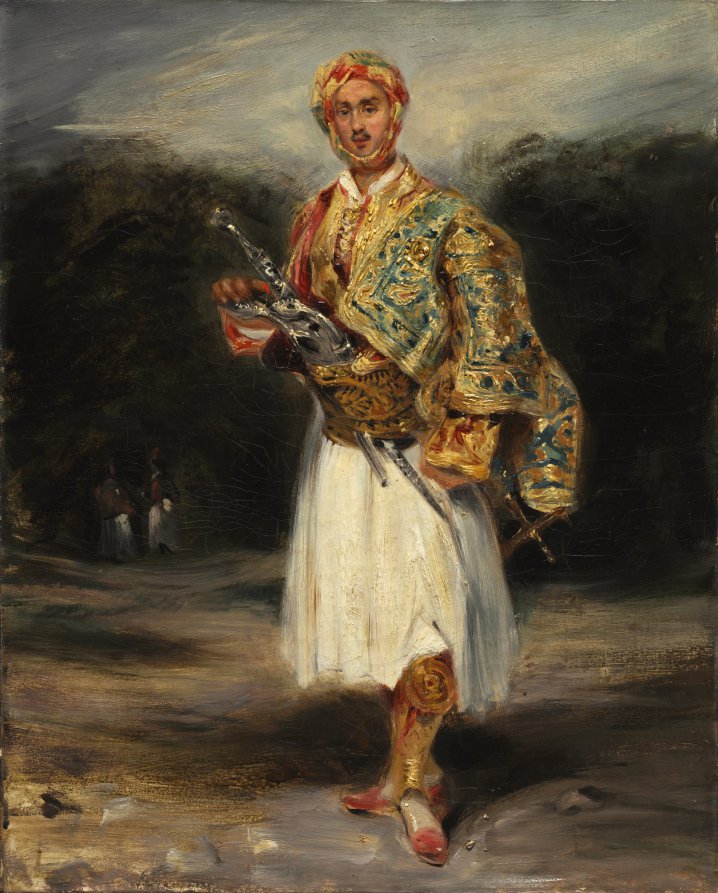
Eugène Delacroix
Count Demetrius de Palatiano in Suliot Costume
Condition, provenance, and connection to documented periods of the artist's biography all matter enormously. A watercolor tied to the Morocco journey or a cliché verre such as A Trapped Tiger, one of only a handful of prints he made using that experimental photographic process, carries both historical rarity and technical novelty that appeals to collectors who think across media. Delacroix's place in art history is not simply that of a Romantic master, though that alone would be sufficient. He is the figure through whom the great colorist tradition of the nineteenth century flows most directly into modernity.
Paul Cézanne famously declared that we all paint through Delacroix, and the evidence is everywhere: in the broken color of the Impressionists, in the expressive heat of Paul Gauguin and Vincent van Gogh, in the structural ambition of Henri Matisse, who copied Delacroix repeatedly at the Louvre and never stopped thinking about him. The connection to Géricault places him at the beginning of Romanticism's boldest ambitions; the shadow he cast forward reaches all the way to abstraction. Related artists in the Romantic and Orientalist tradition, including Jean Léon Gérôme, Alexandre Decamps, and Ary Scheffer, each absorbed and refracted his example in different directions, but none matched the full scope of his achievement. To collect Delacroix today is to participate in one of the most storied and emotionally rewarding traditions in the art market.
These works carry two centuries of history, scholarship, and passion within them, and they continue to reward sustained looking in ways that very few artists of any era can match. Whether the work in question is an intimate oil sketch, a Moroccan watercolor crackling with observed light, or a rare print from a tiny edition, the encounter with Delacroix remains what it has always been: an invitation into a world of extraordinary feeling, made by a hand and mind of the highest order.
Explore books about Eugène Delacroix
Delacroix: A Life
David Britt
The Journal of Eugène Delacroix
Eugène Delacroix (translated by Walter Pach)
Delacroix
Frank Anderson Trapp
Eugène Delacroix and the Representation of History
Peter Toohey
Delacroix: The Death of Sardanapalus
Lee Johnson
The Paintings of Eugène Delacroix: A Critical Catalogue
Lee Johnson
Delacroix: His Life and Work
René Piot
Delacroix and the Rise of Modern Art
William R. Johnston