Eugène Carrière
Eugène Carrière, Master of Tender Light
Artist Spotlight · The Collection Editorial
“Light is the first of painters. There is no object so vile that intense light will not make beautiful.”
Eugène Carrière
There is a moment, standing before a Eugène Carrière canvas, when the eye adjusts and the world comes into focus not with a sharp edge but with a sigh. Forms emerge from warm brown shadow like memories surfacing from sleep. It is an experience unlike almost anything else in nineteenth century French painting, and it is one that collectors and curators are rediscovering with genuine excitement. The Musée d'Orsay, which holds some of the finest examples of his work, has in recent years repositioned Carrière not as a peripheral Symbolist footnote but as a central and necessary voice in the story of modernity's interior life.
Eugène Carrière
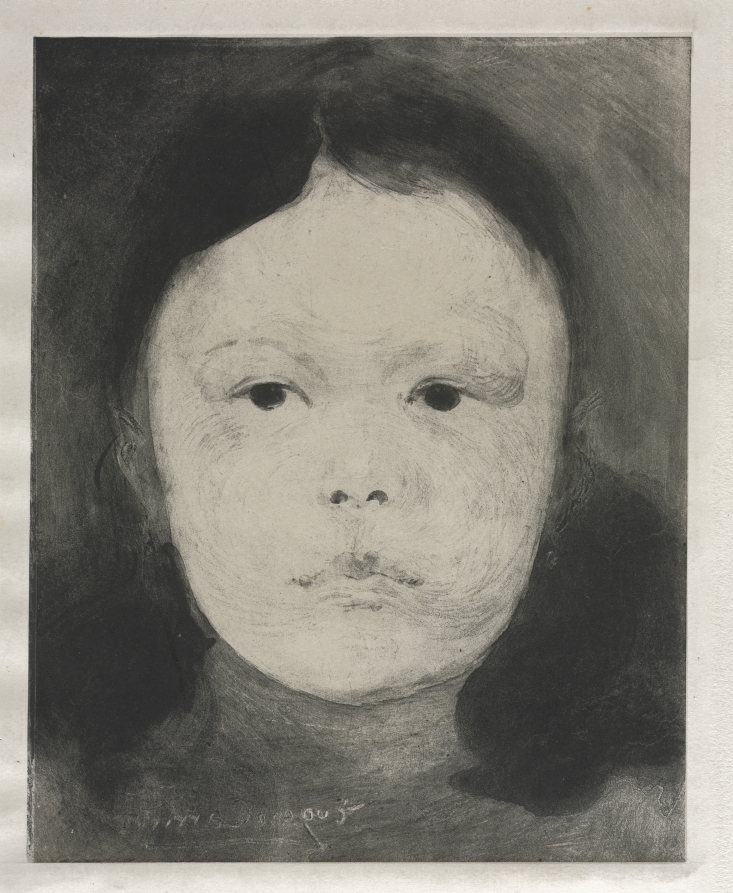
Marguerite Carrière, 1890
Eugène Carrière was born in 1849 in Gournay sur Marne, a small commune east of Paris, the son of a modest family with no particular artistic pedigree. His early years were shaped by the rhythms of provincial French life, and it was only after a period working as a lithographic apprentice in Strasbourg that his path toward fine art became clear. That apprenticeship proved formative in ways that would define his entire career: Carrière developed an extraordinary sensitivity to tone, to the way ink and pigment could breathe on a surface, that never left him. He went on to study at the École des Beaux Arts in Paris under Alexandre Cabanel, though he remained constitutionally resistant to the academic manner Cabanel exemplified.
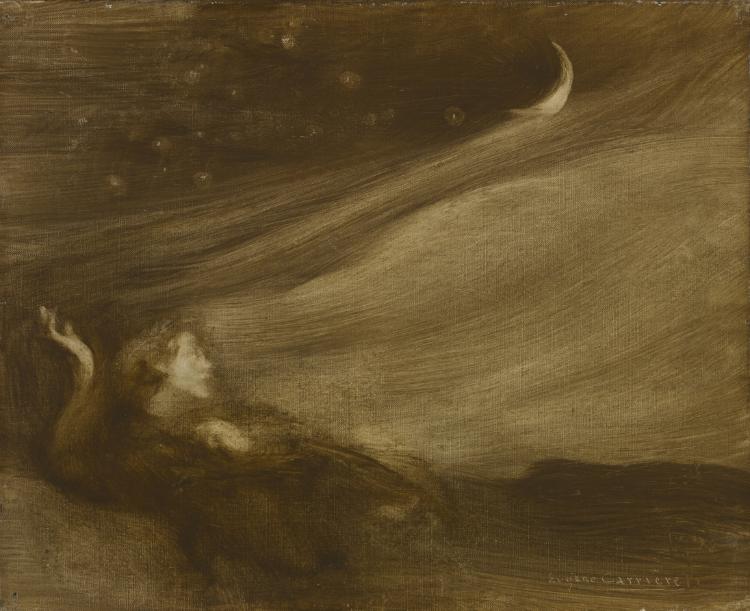
His early career unfolded during one of the most electrically charged periods in the history of French art. The 1870s and 1880s saw Impressionism reshape what painting could be, and while Carrière absorbed something of that movement's attention to sensation and light, he moved in a wholly different direction. Where the Impressionists dissolved form into colour and atmosphere, Carrière dissolved it into darkness, into the intimate glow of a lamp lit room or the warmth of a mother's embrace. His palette narrowed radically: the ochres, umbers, and sienna tones that became his signature were less a stylistic choice than a philosophical one.
Eugène Carrière
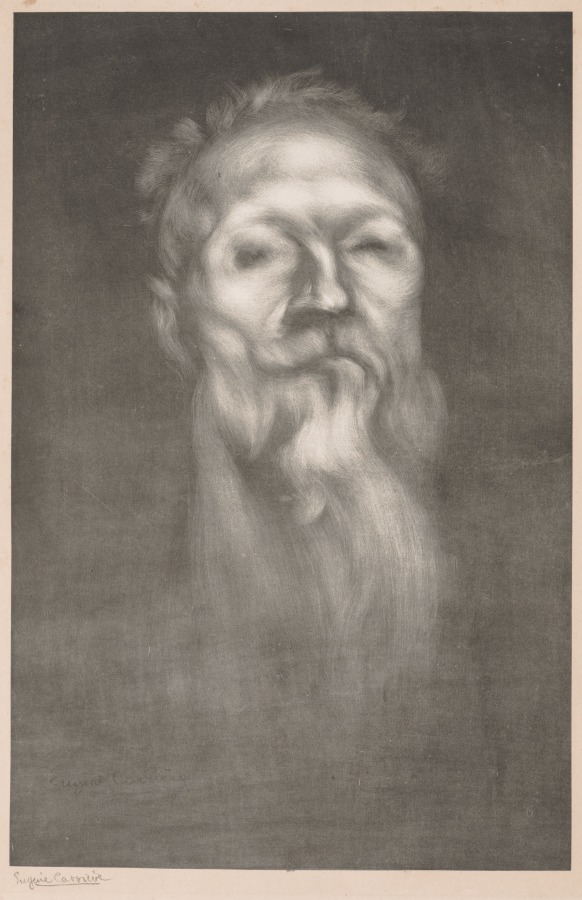
Auguste Rodin, 1897
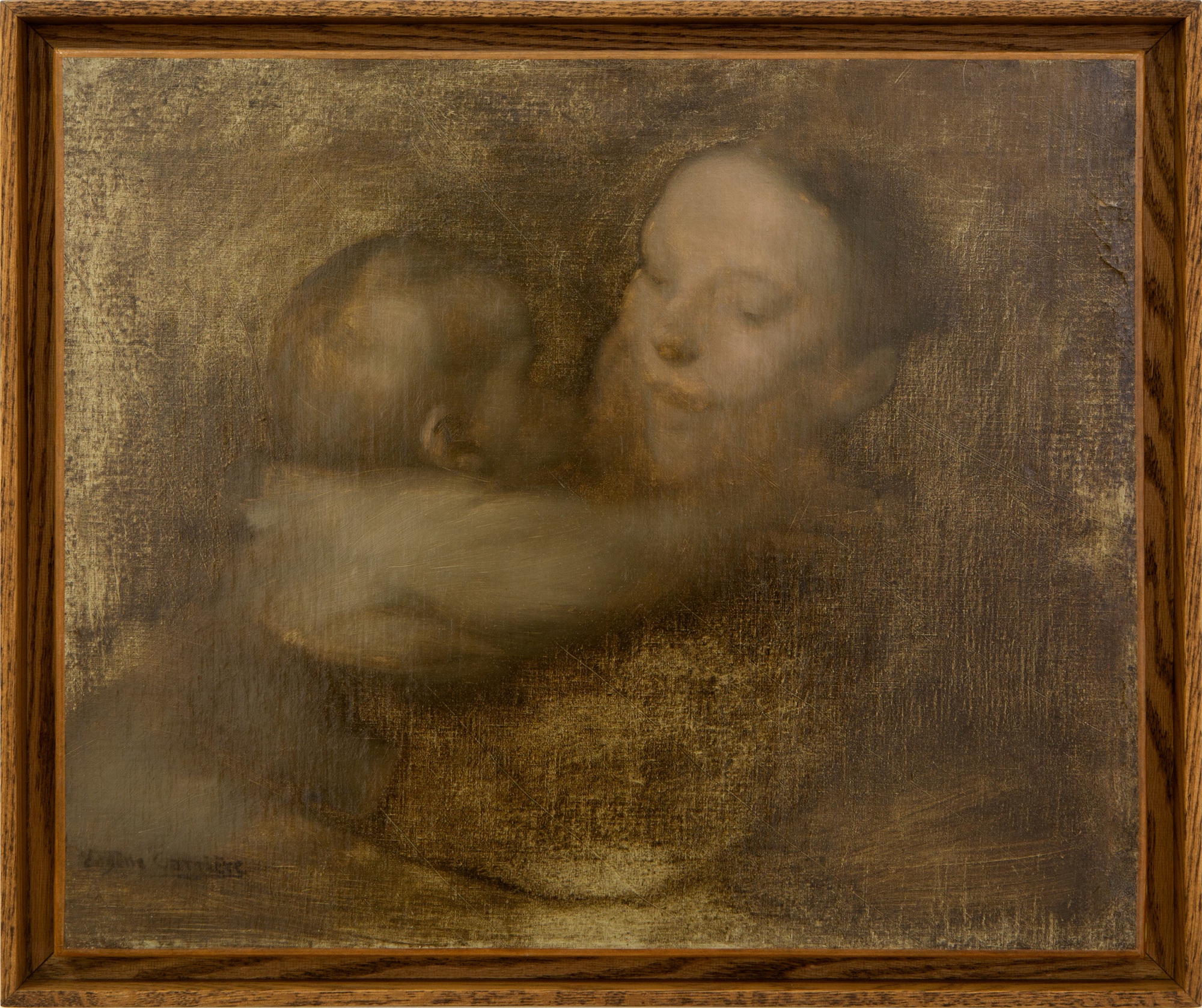
He was after something beneath the visible surface of things. The works that define him are deeply personal. His paintings of maternity and family life, many of which drew directly on his own household and his wife Sophie and their children, carry a tenderness that is almost overwhelming in its restraint. "Caresse," painted in 1894 and one of the most admired works available to collectors today, exemplifies his genius: a mother and child locked in an embrace that seems to dissolve at its edges, as if the emotion itself were too great to be fully contained by paint.
The composition is at once monumental and intimate, a quality that places Carrière in conversation with the great tradition of devotional painting while remaining entirely secular and modern. "The Contemplator" from 1901 shows how this approach carried into his later work, with a figure absorbed in thought, surrounded by the characteristic mist that functions in his hands not as obscurity but as depth. Carrière was also a portraitist of rare distinction, and it is in this area that his social world becomes most vivid. He was a genuine friend and admirer of Paul Verlaine, Paul Gauguin, Auguste Rodin, and the brothers Edmond and Jules de Goncourt.
Eugène Carrière
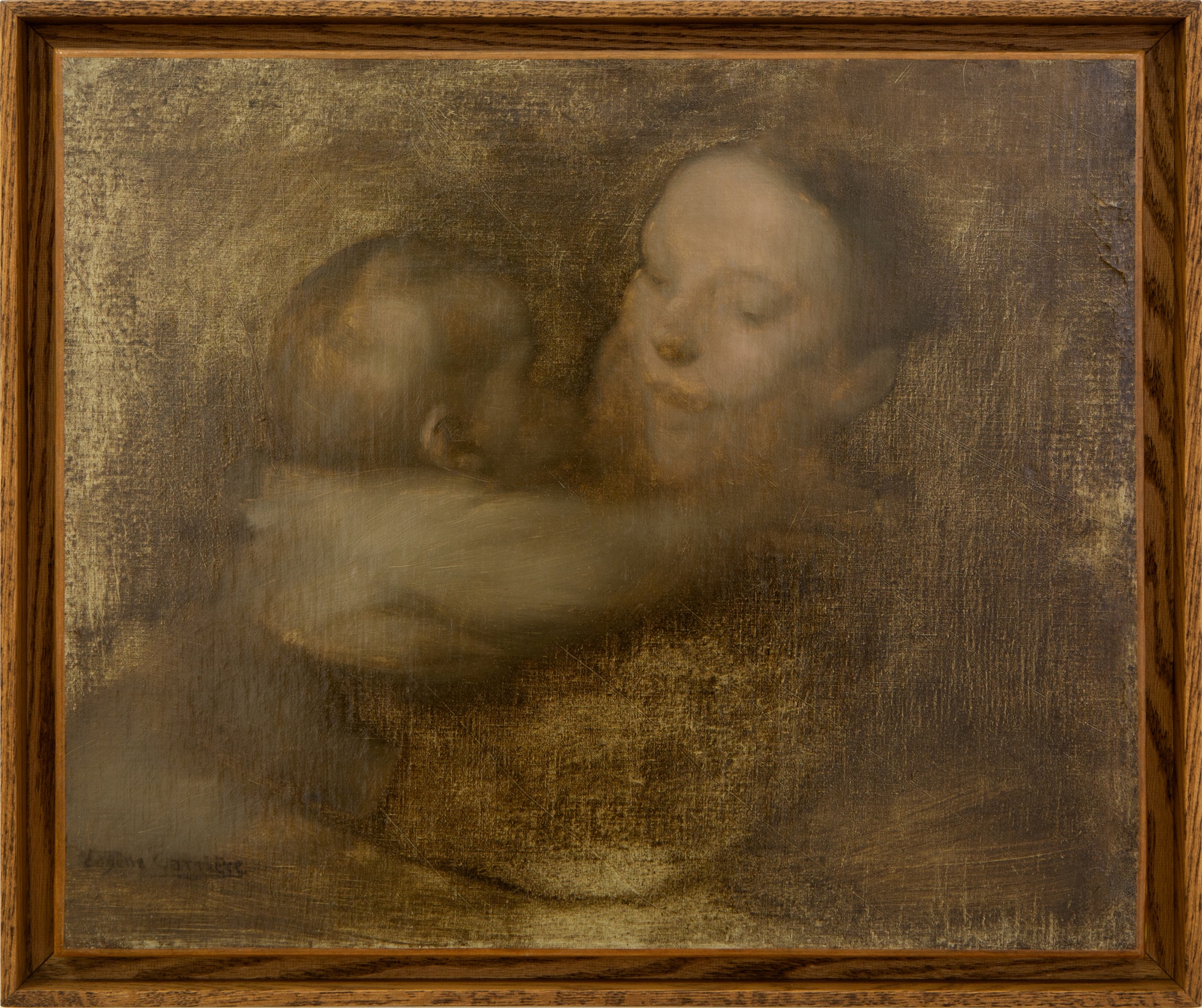
Eugène Carrière 歐仁・卡里埃 | Caresse 撫摸, 1894
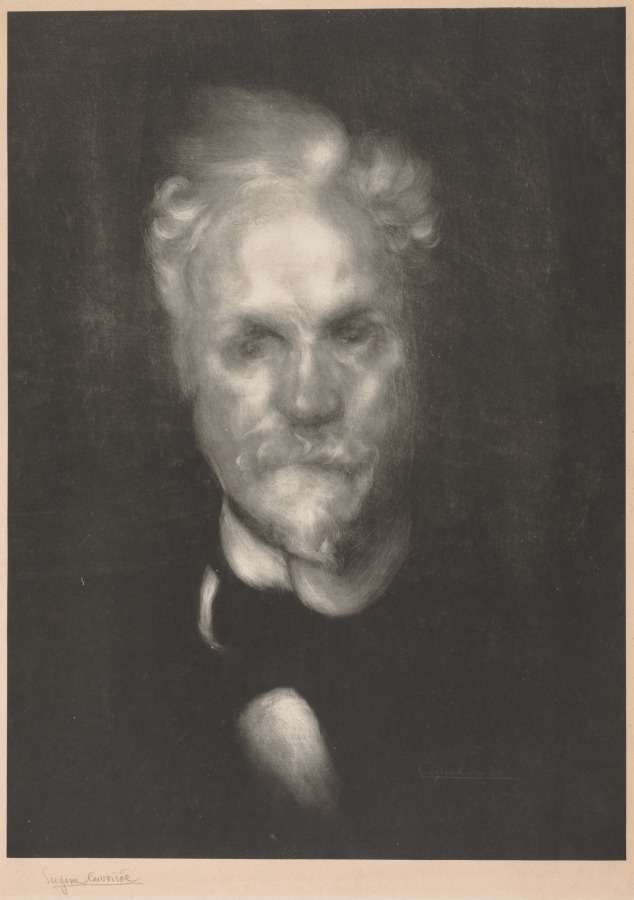
His lithographic portraits of Verlaine, Alphonse Daudet, Edmond de Goncourt, and the radical political journalist Henri Rochefort are among the finest graphic works of the period, possessing the same atmospheric intimacy as his paintings but with an additional directness that the medium demands. The 1896 lithograph of Verlaine in particular captures something of the poet's worn grandeur with an economy of means that is quietly astonishing. His portrait of the painter Puvis de Chavannes, rendered in lithograph in 1897, is a tribute from one master to another, and speaks to the depth of Carrière's engagement with the serious artistic thought of his era. From a collecting perspective, Carrière occupies a fascinating position in the market.
His works appear regularly at Christie's, Sotheby's, and the Paris auction house Drouot, where both his oils and his graphic works attract sustained interest from collectors with a serious eye for Symbolism and late nineteenth century French art. The lithographs, of which he produced a significant and varied body, offer collectors a relatively accessible entry point to a major artistic sensibility: works such as the "Marguerite Carrière" portrait from 1890 and the "Newborn in a Bonnet" from the same year combine technical refinement with a warmth that reads across any interior. For those seeking his oils, patience and vigilance are rewarded: when canvases of real quality come to market, they attract collectors who understand that Carrière sits comfortably alongside Gustave Moreau, Odilon Redon, and Pierre Puvis de Chavannes as one of the defining figures of French Symbolism. That art historical context matters enormously for understanding why Carrière feels so relevant now.
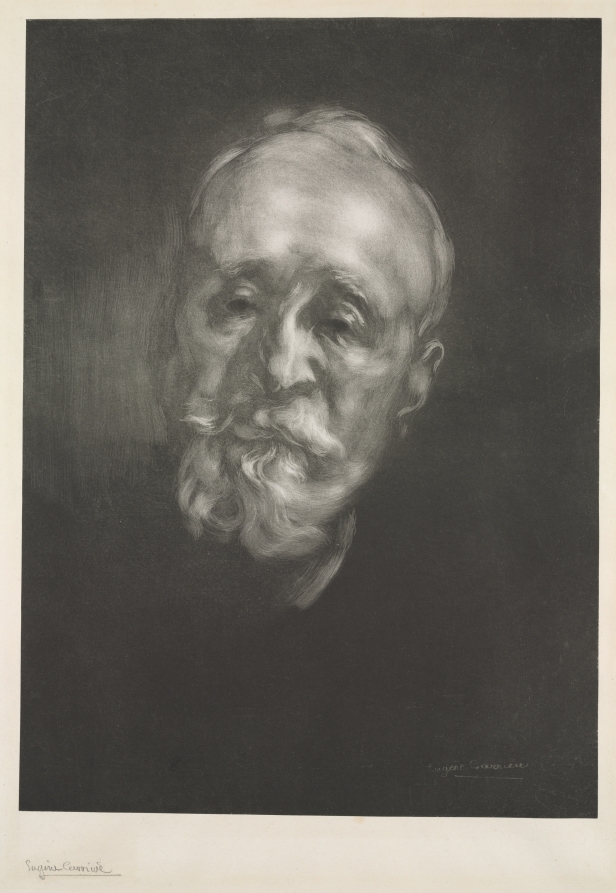
Eugène Carrière
Puvis de Chavannes, 1897
Symbolism, long overshadowed in critical attention by Impressionism and Post Impressionism, has undergone a significant reappraisal over the past two decades. Major institutions have revisited the movement's ambitions and its insistence that painting could address the invisible life of the mind and spirit, not merely the visible world of colour and light. In this reappraisal, Carrière emerges as a figure of surprising radicalism. His rejection of conventional finish, his embrace of process and atmosphere, his insistence on the emotional life of the domestic sphere as worthy of sustained artistic attention: these positions now read as quietly revolutionary rather than sentimental or conservative.
Carrière died in 1906 at the age of fifty six, leaving behind a body of work that spans easel painting, monumental decorative commissions, and one of the most distinctive lithographic practices of his generation. He was mourned genuinely by the artists and writers who had known him, and Rodin in particular spoke of him with something close to reverence. More than a century on, his paintings ask us to slow down, to let our eyes adjust, to find in the warm brown depths of his canvases not obscurity but a kind of seeing that ordinary daylight does not permit. For collectors who believe that art should move as well as impress, that intimacy is its own form of grandeur, Eugène Carrière remains one of the great rewards of looking carefully.
Featured Works
Explore books about Eugène Carrière
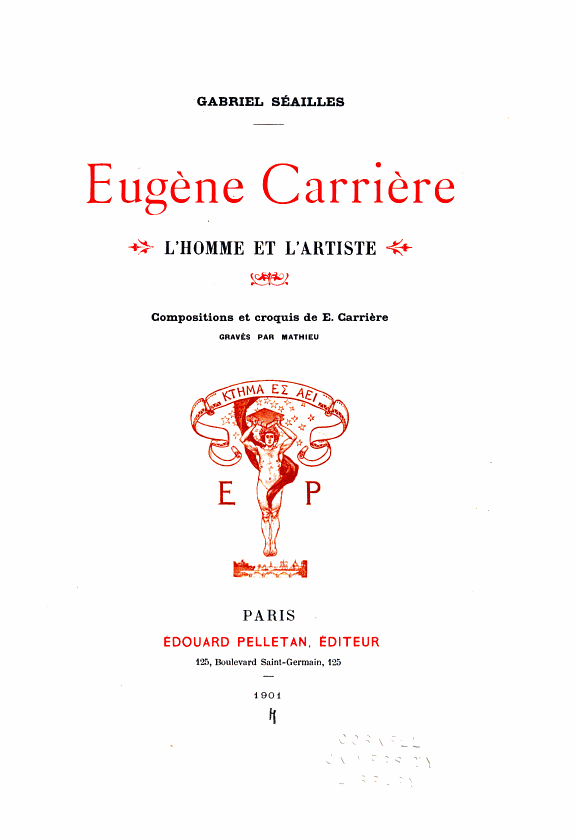
Eugène Carrière: L'homme et l'artiste
Arsène Alexandre
Eugène Carrière
Gabriel Mourey
Eugène Carrière: Catalogue Raisonné de l'Oeuvre Peint
Léon Deshairs
Eugène Carrière 1849-1906
Bernard Dorival
Eugène Carrière: Un artiste de la Belle Époque
Bruno Foucart