Ernest Lawson
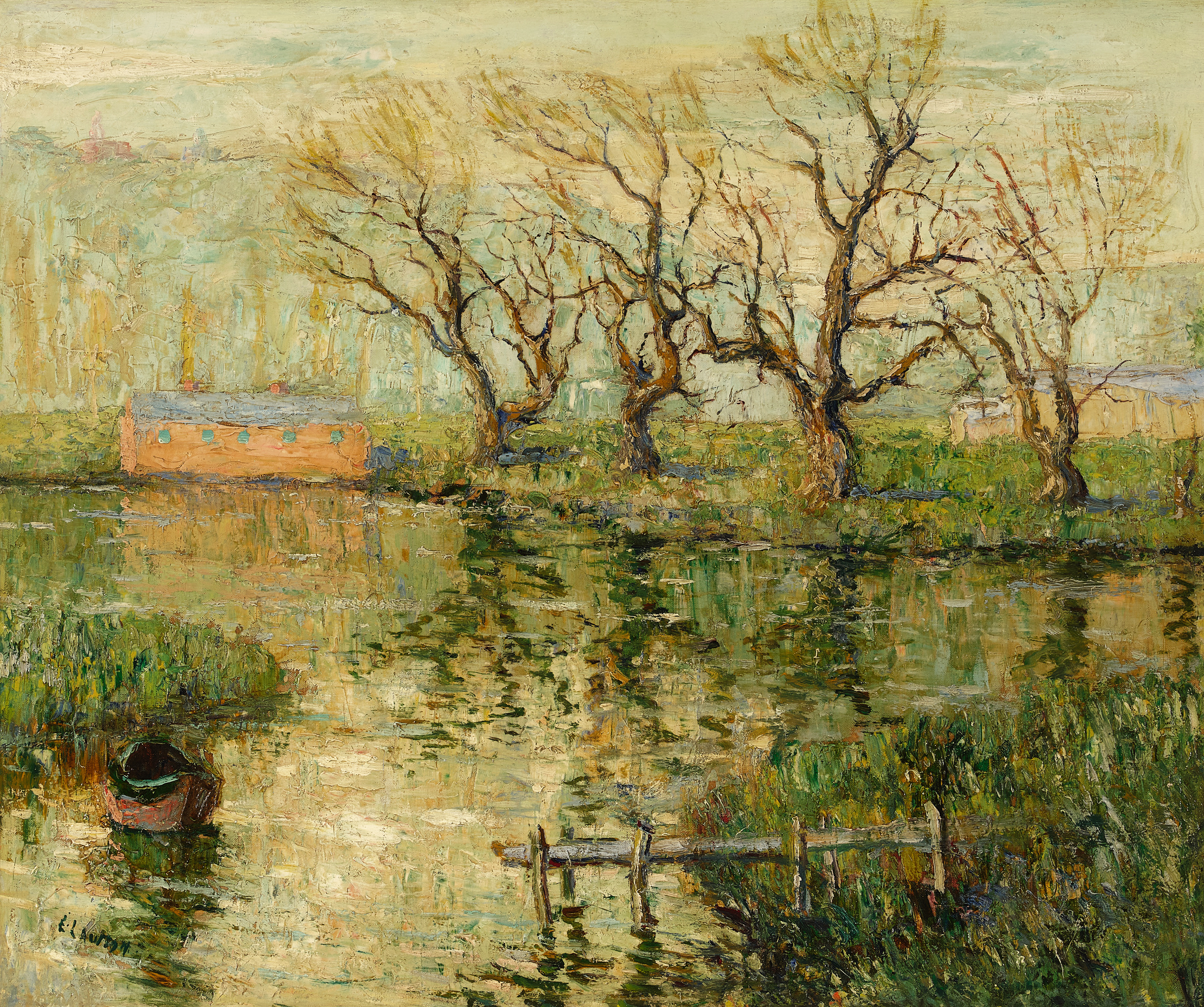
Ernest Lawson, Painting the City Alive
Artist Spotlight · The Collection Editorial
There is a particular kind of magic in standing before an Ernest Lawson canvas and feeling, all at once, the cold bite of a New York winter morning and the strange warmth of a city that never quite sleeps. That sensation has been drawing museum visitors and private collectors back to Lawson's work with renewed intensity in recent years, as institutions across North America reassess the legacy of The Eight, the landmark group of artists whose 1908 exhibition at the Macbeth Gallery in New York permanently altered the course of American art. Lawson stood among those eight painters not as the loudest voice in the room, but as perhaps its most quietly astonishing one, a man who saw the industrial edges of Manhattan and found in them something close to poetry. Ernest Lawson was born in Halifax, Nova Scotia, in 1873, and his Canadian origins matter more to understanding his work than is often acknowledged.
Ernest Lawson
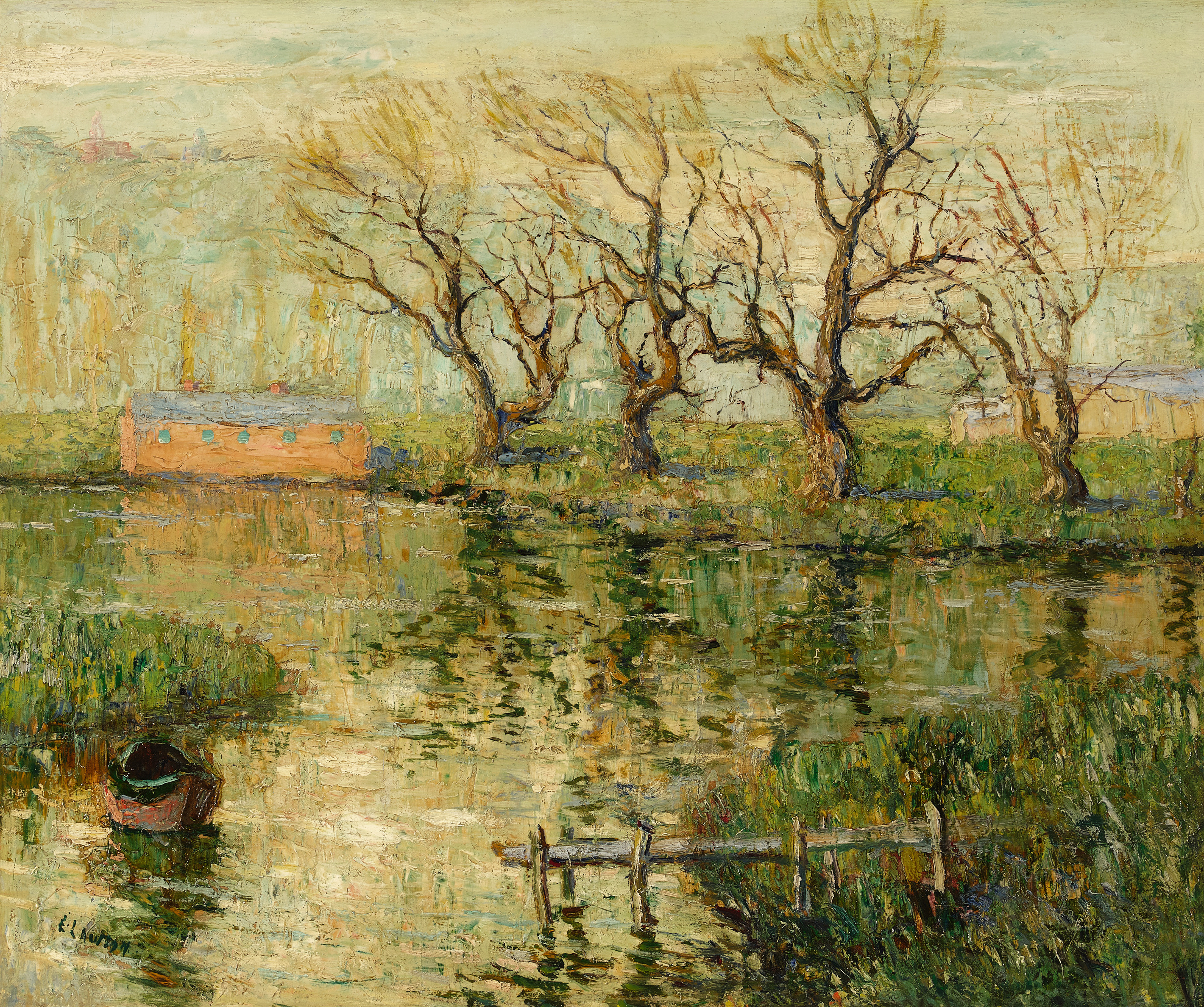
On the Harlem River
He came of age with a northerner's eye, attuned to the quality of flat grey light that falls on water in late autumn, to the way snow softens the outlines of buildings without quite erasing them. He studied in New York at the Art Students League and then, crucially, in Cos Cob, Connecticut, under the guiding influence of John Henry Twachtman and J. Alden Weir, two of the most gifted American Impressionists of their generation. Those years in Connecticut gave Lawson a foundation in tonal sensitivity and painterly touch that would never leave him.
The transformative chapter came when Lawson traveled to Paris and studied at the Académie Julian in the 1890s, where he encountered the full force of French Impressionism firsthand. It was there that Alfred Sisley's landscapes entered his visual vocabulary in a lasting way, lending Lawson a feel for the shimmer and flux of reflected light on river surfaces that would define his mature work. Yet Lawson never became a French Impressionist in the manner of an imitator. He returned to New York with his own vision fully intact, drawn not to the gardens and leisure scenes that preoccupied many of his European contemporaries, but to the gritty, transitional neighborhoods of upper Manhattan, the bridges, the riverbanks, and the half built industrial waterfront that most painters of his era simply ignored.
Ernest Lawson
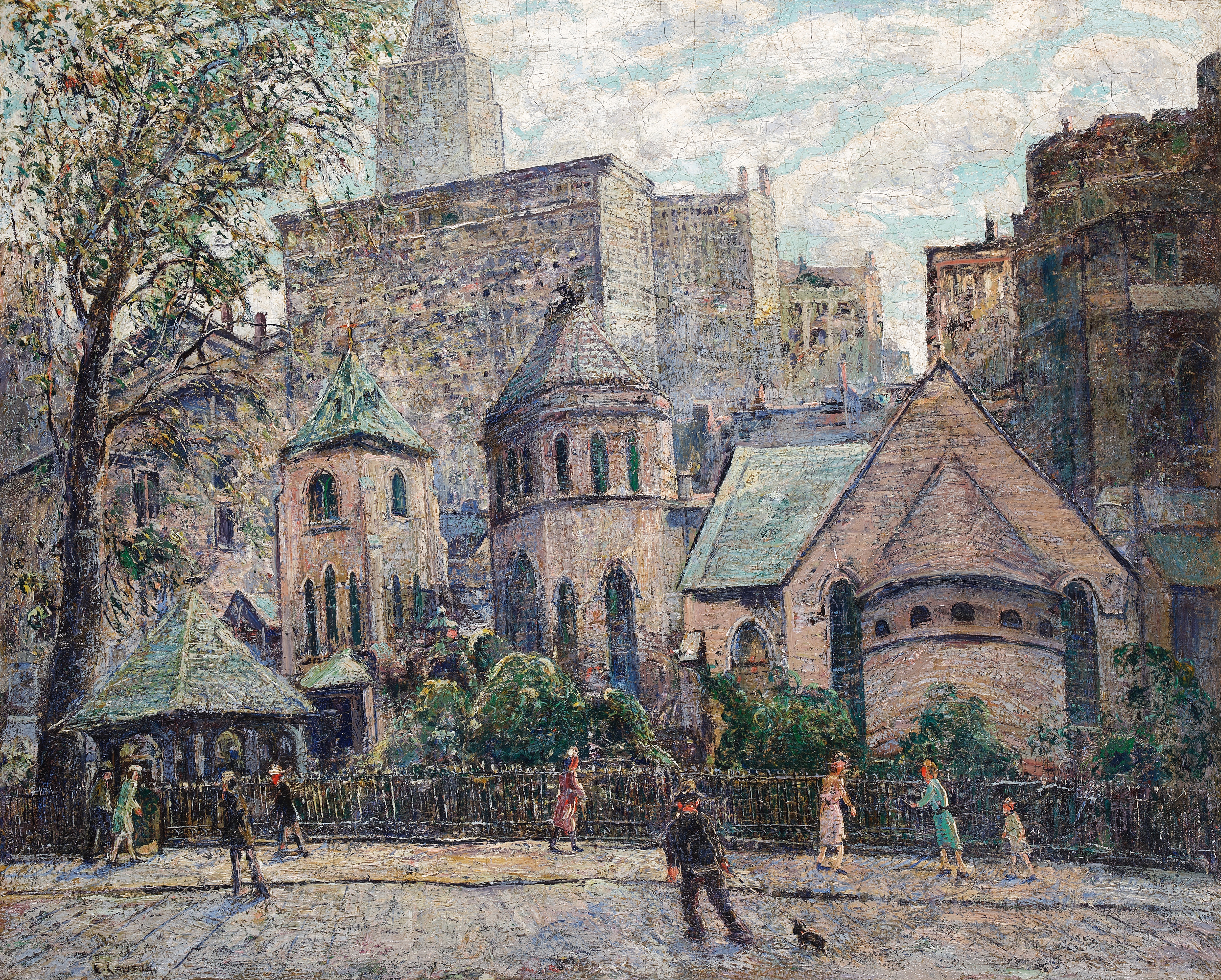
Little Church Around the Corner
By the time Lawson joined Robert Henri, John Sloan, George Luks, William Glackens, Everett Shinn, Arthur B. Davies, and Maurice Prendergast in the historic 1908 Macbeth Gallery show, his approach had fully crystallized. Critics and fellow artists admired what they sometimes called his palette knife impasto, thick ridges of paint laid down with confidence and physicality, colors that were not quite Impressionist in their lightness and not quite realist in their bluntness, but something beautifully in between. The painter and writer Everett Shinn reportedly described Lawson's palette as crushed jewels, a phrase that has followed his reputation ever since.
His surfaces reward close inspection: up near the canvas, a Lawson painting can look almost abstract, a relief map of cobalt and ochre and green, and then, stepping back, the Harlem River resolves itself out of that chromatic richness with astonishing clarity. The work titled On the Harlem River stands as one of the most compelling demonstrations of Lawson's method and vision. The painting captures the industrial riverscape of upper Manhattan during a period of rapid urban transformation, when the landscape Lawson loved was actively being remade by expansion and construction. Rather than mourning that transformation or aestheticizing it into something pleasant, Lawson simply witnessed it, rendering the barges, the distant trestles, and the grey water with a directness that feels entirely modern even now.
Little Church Around the Corner, another signature canvas, shows Lawson's ability to find intimacy and warmth within the urban fabric, centering a small ecclesiastical building against the larger pressures of city life. Both works demonstrate his gift for balancing formal painterly ambition with emotional accessibility, which is a rare combination in any era. From a collecting perspective, Lawson occupies an appealing and still underappreciated position in the American art market. His association with The Eight gives him firm art historical grounding, placing him in the company of artists whose reputations have only grown over the past several decades.
Works by his fellow members of that group, particularly Robert Henri and John Sloan, have commanded substantial attention at auction, and serious collectors who follow the logic of art history have recognized that Lawson's canvases represent exceptional value relative to his significance. His works appear regularly at major American auction houses, and quality examples, particularly those depicting the Harlem River and the landscapes of upper Manhattan, consistently attract spirited bidding. Collectors drawn to American modernism, to the history of New York as a subject in painting, or to the broader dialogue between European Impressionism and American urban realism will find in Lawson a deeply rewarding focus. Within the broader narrative of American art, Lawson connects a remarkable range of influences and movements.
His formation under Twachtman and Weir links him to the American Impressionist tradition centered in Connecticut. His Paris years tie him to Sisley and the French landscape tradition. His membership in The Eight places him at the founding moment of American urban realism, a current that would flow forward through Ashcan painting and on toward the social realism of the 1930s. He was, in other words, a connector, a figure in whom multiple streams of influence met and were synthesized into something personal and original.
Collectors and scholars who follow any one of those threads will eventually arrive at Lawson, and when they do, they tend to stay. The case for Ernest Lawson's enduring importance is finally quite simple. He painted places that no one else thought worthy of paint, and he painted them with a technique of such physical richness and chromatic intelligence that the canvases have never aged into mere documents. They remain experiences.
In an era when American cities are once again being seen and celebrated and fought over as subjects, as places full of meaning and contradiction and beauty, Lawson's vision of the Harlem River and the streets of upper Manhattan feels not historical but immediate. He gave dignity and grandeur to a landscape that the art world of his time largely overlooked, and that act of attention, sustained across a long career, is what makes him not just a figure of art historical interest but a painter of genuine and lasting power.
Featured Works
Explore books about Ernest Lawson
Ernest Lawson: The Man and the Artist
Frederic Newlin Price
Ernest Lawson
Ira Glackens
Ernest Lawson: American Impressionist
Tweed Gallery
Ernest Lawson and the Eight
American Federation of Arts
The Immortal Eight: American Painting from Eakins to the Armory Show
Elizabeth Milroy