Erik Parker
Erik Parker Paints the World Electric
Artist Spotlight · The Collection Editorial
There is a particular kind of painting that refuses to let you look away. It vibrates. It crowds the eye with competing demands, with color that seems to generate its own light, with lettering that shouts and whispers at the same time, with faces that are somehow familiar and deeply strange all at once. That is the experience of standing before an Erik Parker canvas, and it is an experience that has earned him a devoted following among collectors who understand that painting, at its most ambitious, can hold an entire culture inside a single frame.
Erik Parker
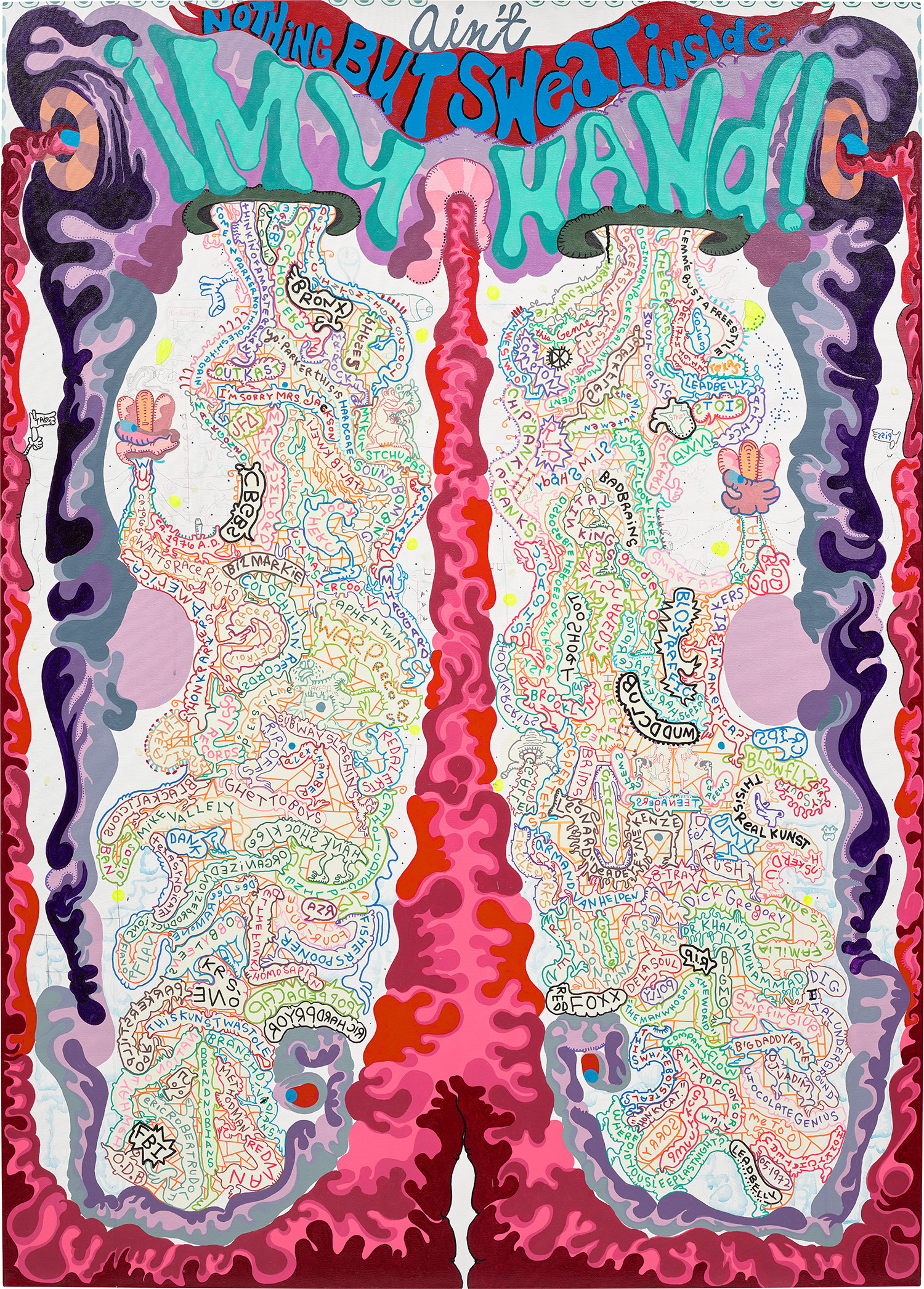
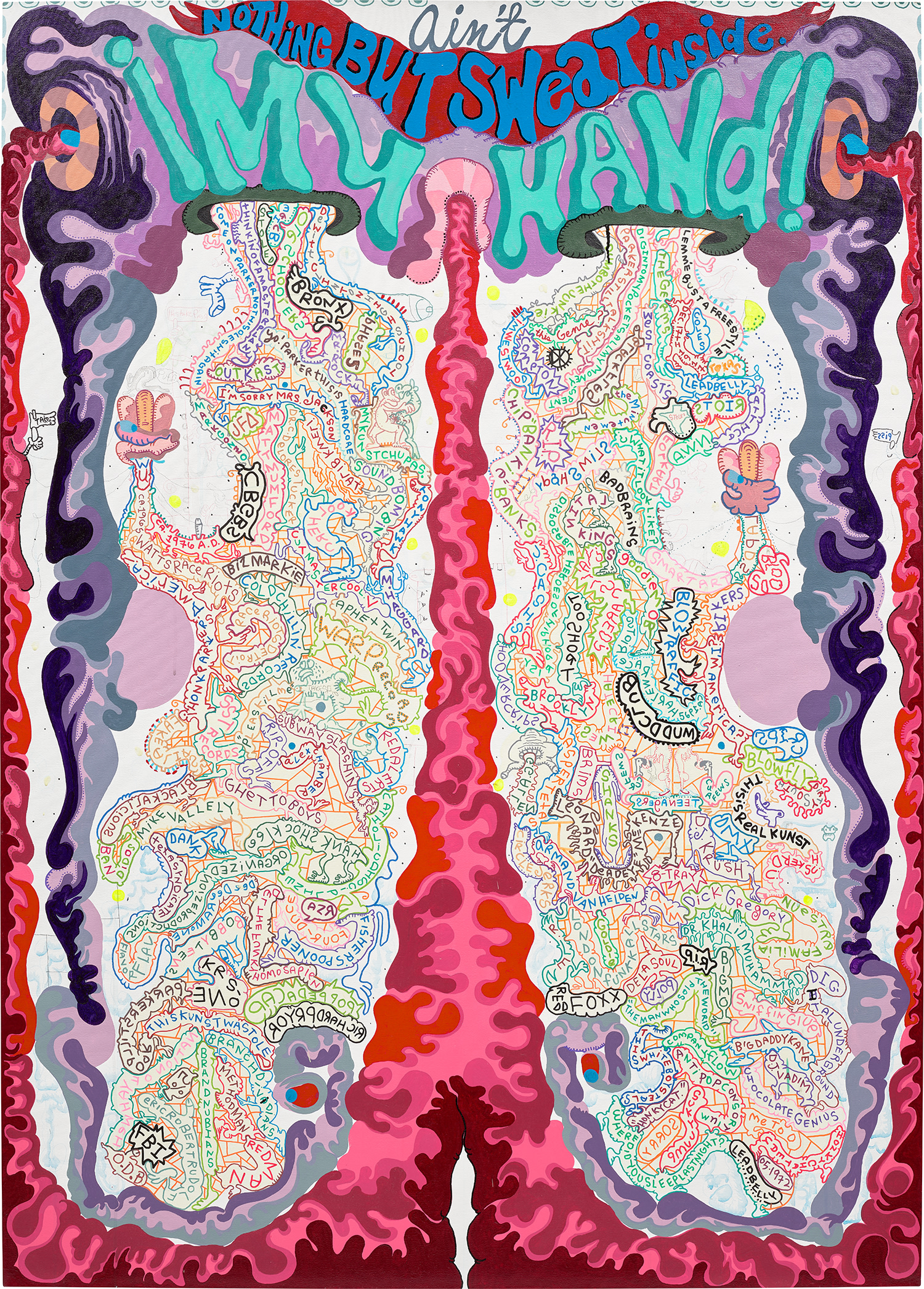
Ain't Nothing But Sweat Inside My Hand, 2000
Parker's work has been exhibited across galleries and institutions in New York, Europe, and Asia, and his reputation as one of the most distinctive voices to emerge from the late 1990s downtown New York scene has only deepened with time. Parker was born in 1968, and his formation as an artist was shaped by the particular cultural richness of a generation that came of age at the intersection of punk, hip hop, graffiti, and the tail end of American pop art's influence on street level visual culture. He studied at the University of Texas at Austin and later at the Hochschule für Bildende Künste in Hamburg, Germany, a period of European immersion that gave him exposure to a rigorous tradition of figurative and expressionist painting. That transatlantic education is visible in his work, which carries both the visceral energy of New York's street culture and a compositional seriousness that belongs to the studio tradition.
The combination is what makes him singular. By the late 1990s, Parker had established himself in downtown Manhattan at the moment when a generation of painters was reasserting the medium's relevance against the dominance of installation and conceptual art. He was associated with a loose constellation of artists who drew on illustration, graffiti, and pop iconography without abandoning painterly ambition. His early works from around 2000 show a practice already fully formed in its essential character: dense, layered surfaces built up through acrylic, colored pencil, felt tip pen, and graphite, media whose combination gives his paintings a quality somewhere between a finished artwork and a working document, as if the thinking were still happening on the surface.
Erik Parker
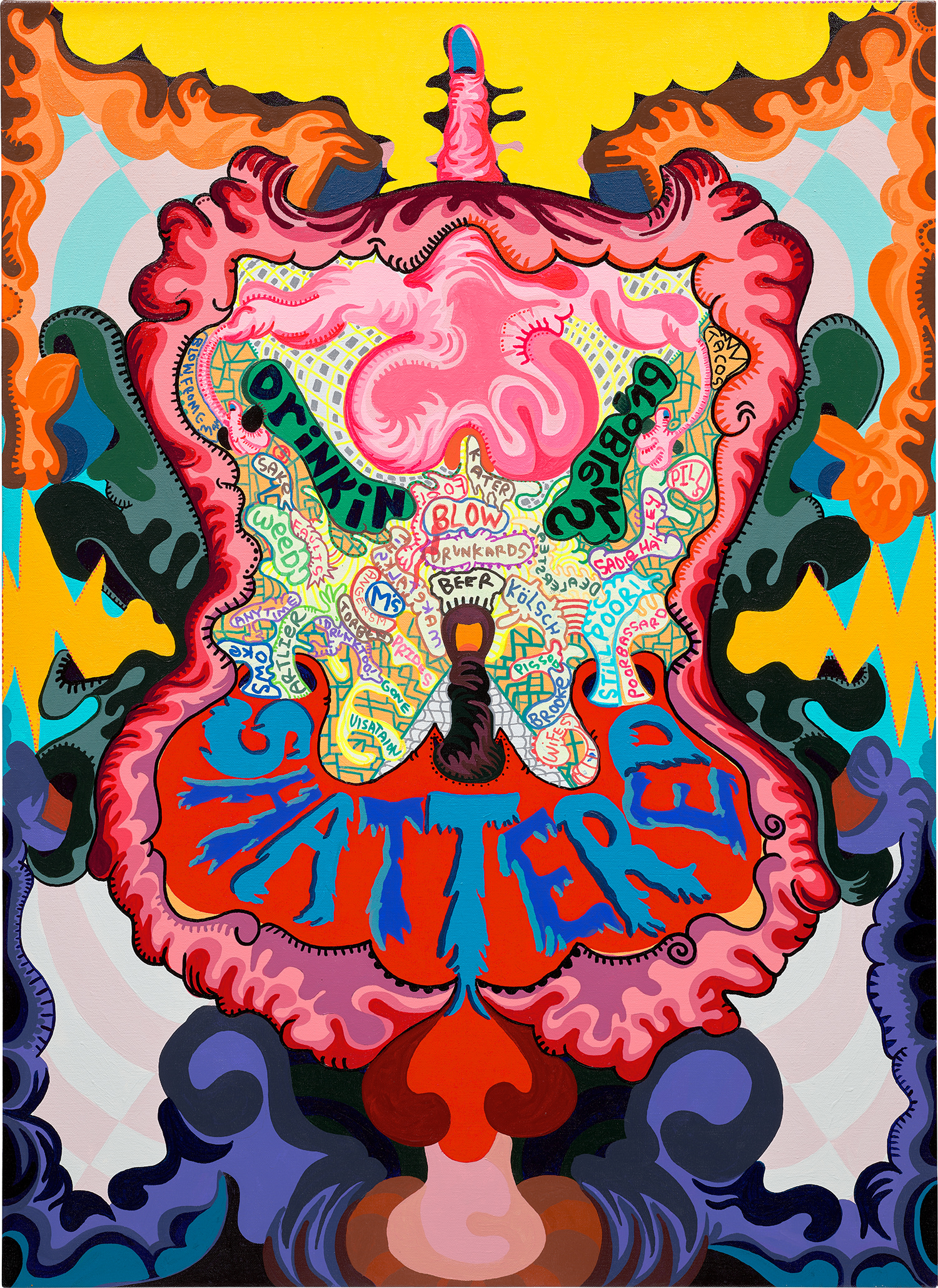
Shattered, 2002
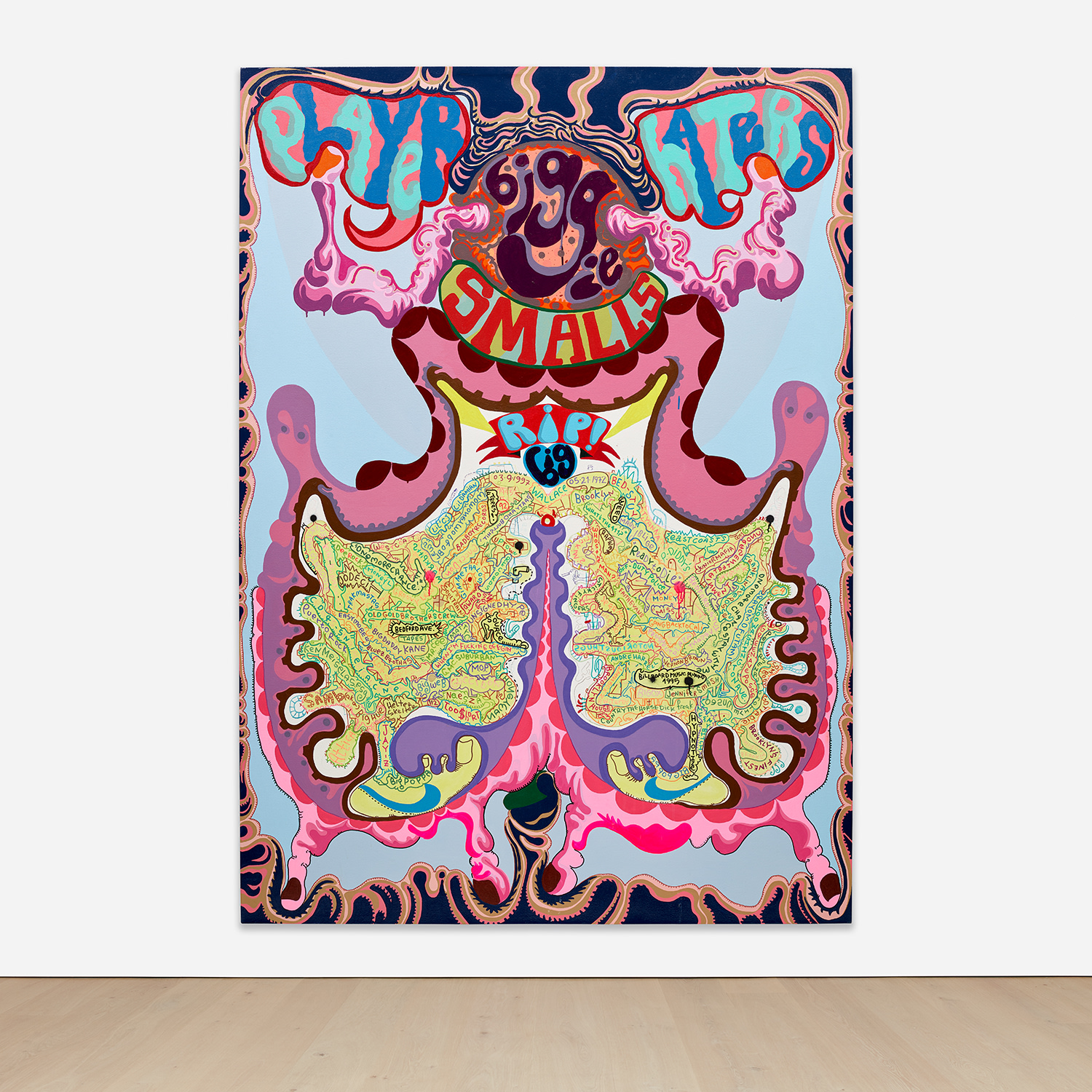
Works like "Ain't Nothing But Sweat Inside My Hand" from 2000 and "Player Haters" from 2001 announced a sensibility that was absorbing the noise of contemporary life and transmuting it into something genuinely pictorial. The paintings that followed through the early and middle 2000s deepened and complicated that initial energy. "Shattered" from 2002 exemplifies the way Parker can use visual fragmentation not as a failure of coherence but as a structural principle, the picture breaking apart and reforming across the surface in a way that mirrors how contemporary experience actually feels: simultaneous, overwhelming, and strangely beautiful. His palette during this period intensified toward the psychedelic, with kaleidoscopic color schemes that owe something to the tradition of visionary painting while remaining unmistakably rooted in the present.
Distorted faces recur across his work, figures whose features are pulled and stretched by the pressure of all the imagery surrounding them, a metaphor for the condition of living inside consumer culture without any obvious outside. Parker's range as an artist becomes clear when you move across different periods and formats. Works on paper, such as the richly layered "(Nasty Boots) In the Company of Monks," which combines acrylic, colored pencil, and foam paint on black wove paper, demonstrate that his approach translates across scale and support without losing its intensity. The screenprint "Mind Revolution," produced for an Exit Art portfolio exploring themes of Tantra, shows his engagement with printmaking as a serious extension of his practice rather than a secondary activity.
Erik Parker
Player Haters, 2001
More recent paintings such as "Triple Crown" from 2018, which incorporates acrylic, enamel, marker, Day Glo paint, and paper collage on canvas, confirm that his commitment to material accumulation has only grown richer and more inventive over the decades. The 2017 canvas "Oh Koh Phi Phi" hints at a lyrical side that emerges when Parker allows landscape and travel to inflect his usual urban vocabulary. For collectors, Parker represents a particular kind of opportunity: an artist whose work has been consistently exhibited at a serious level and whose paintings operate with genuine art historical intelligence, yet who remains meaningfully accessible compared to some peers of similar standing. His works on paper, particularly those early mixed media pieces that combine so many materials in such compressed space, are among the most compelling entry points into his practice.
The density of those surfaces rewards sustained looking and continued living with, which is perhaps the most reliable test of a work's depth. Collectors drawn to artists like Barry McGee, whose background in graffiti and graphic culture overlaps with Parker's territory, or to painters such as Chris Johanson and other figures who emerged from similar late 1990s contexts, will find in Parker a practice that shares certain genealogical roots while arriving at a completely individual visual language. What Parker ultimately offers is a model for how painting can be genuinely contemporary without abandoning any of the qualities that make painting irreplaceable. His canvases are not illustrations of cultural phenomena; they are cultural phenomena in themselves, objects that carry the texture and pressure of the moment in which they were made while remaining open to the future.
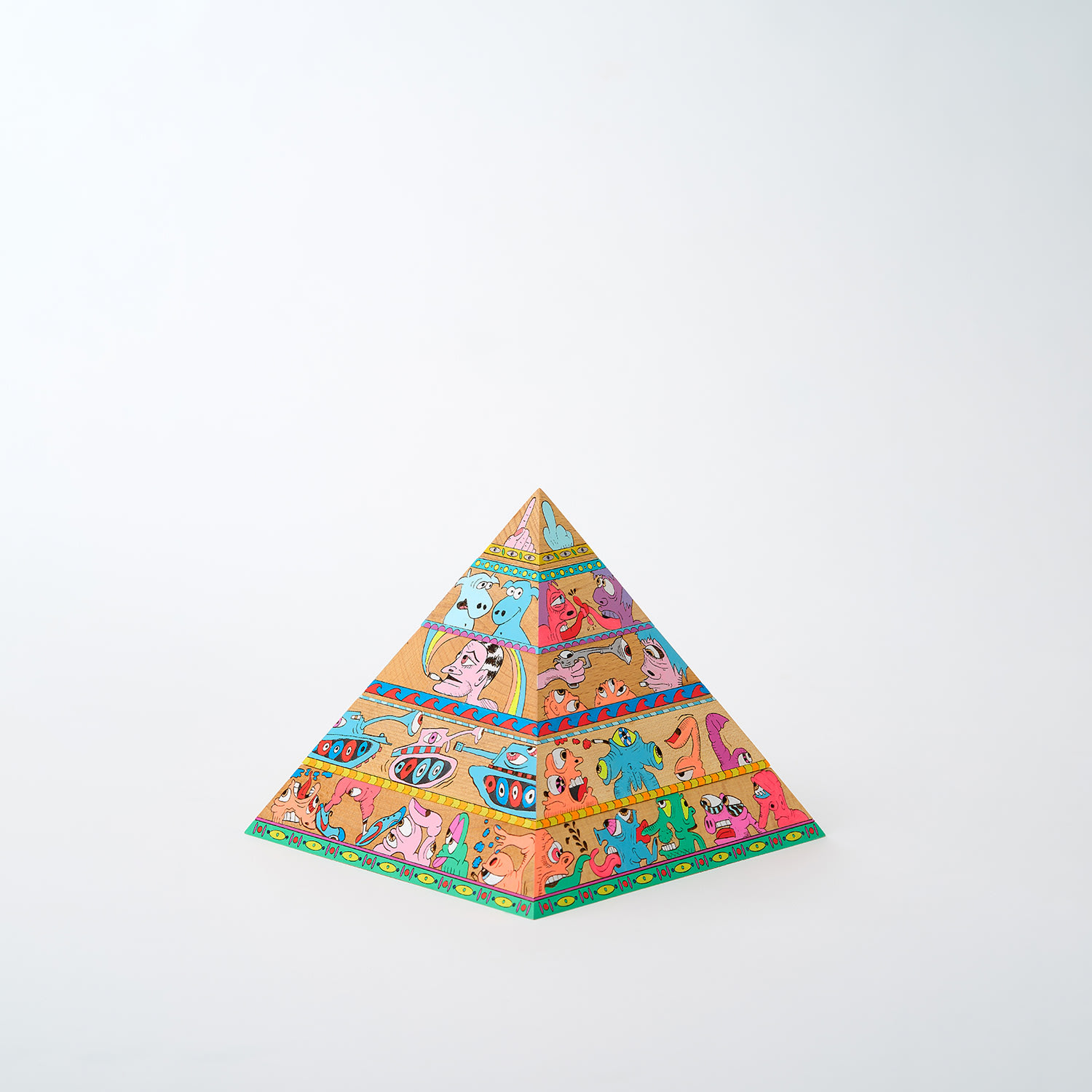
Erik Parker
Woke
As the art world continues to reassess the generation of painters who came to prominence in the years around 2000, figures who were sometimes overshadowed by market trends favoring other mediums, Parker's reputation stands on increasingly firm ground. His paintings are the work of an artist who trusted his obsessions completely, and that trust, sustained across more than two decades, is exactly what collectors and institutions are now recognizing.