Erik Dietman
Erik Dietman, Art's Most Delightful Provocateur
Artist Spotlight · The Collection Editorial
There is a moment, standing before one of Erik Dietman's works, when the seriousness with which we approach art quietly dissolves into something warmer and stranger. It might be the unexpected presence of food, or the sense that the object before you is laughing gently at its own existence. That feeling is not accidental. It is the signature of a mind that spent decades testing the boundaries between art and life, between the profound and the absurd, with a generosity of spirit that few artists of his generation could match.
Erik Dietman
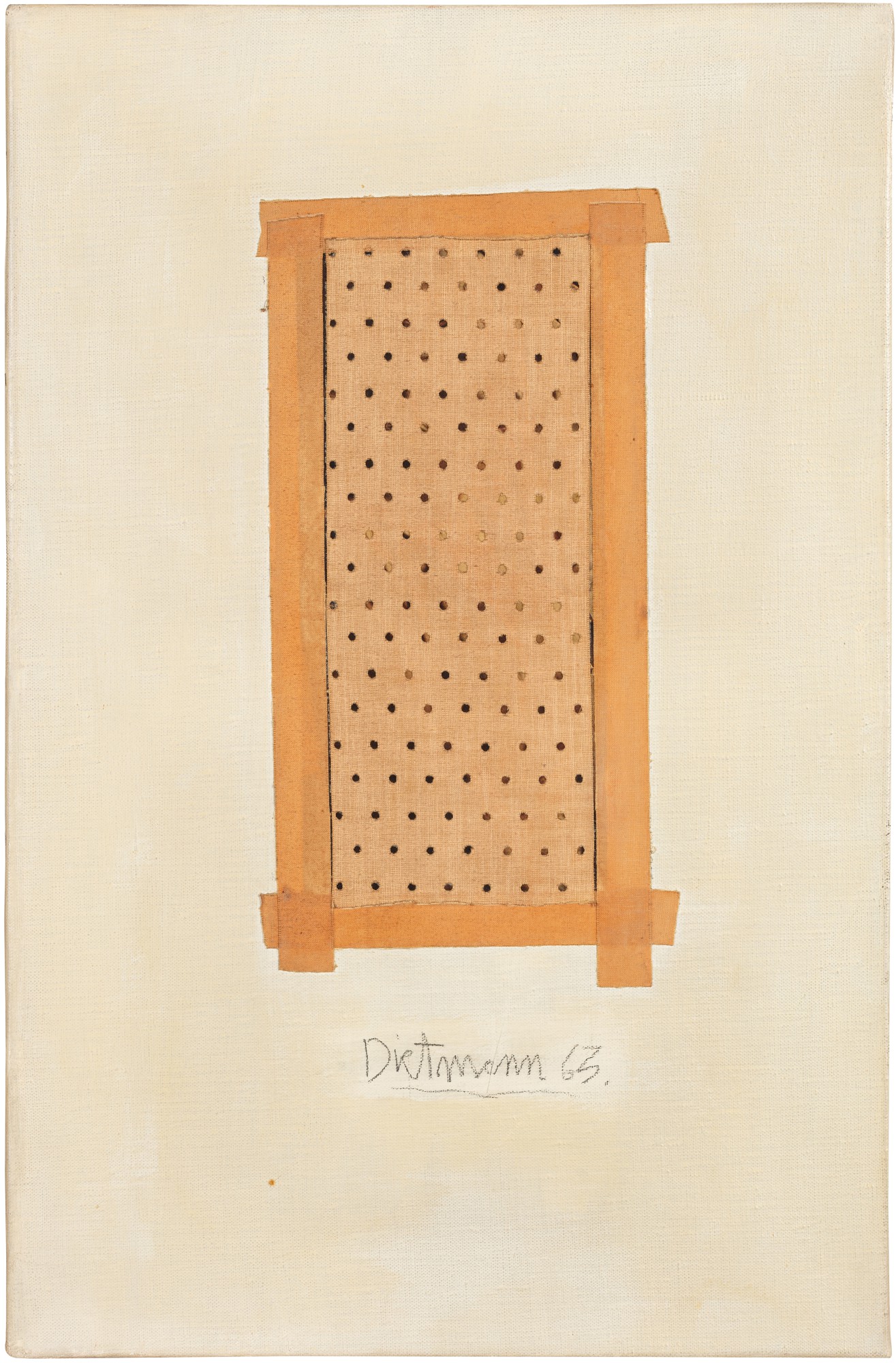
Untitled, 1963
Dietman's work continues to reward rediscovery, and a growing community of collectors and curators are finding in his practice a vitality that feels urgently contemporary. Erik Dietman was born in Jönköping, Sweden, in 1937, and the particular character of Scandinavian culture, its wit, its restraint, its deep relationship with craft and materiality, left a lasting impression on his sensibility. He moved to Paris in the early 1960s, a decision that proved transformative. Paris at that moment was a city alive with artistic experimentation, and Dietman arrived just as the Nouveau Réalisme movement was reshaping ideas about what materials could mean in art.
He absorbed the atmosphere with an appetite that was both intellectual and thoroughly physical, and he began developing a practice that would refuse easy categorization for the rest of his life. In Paris, Dietman found community and friction in equal measure. He became associated with the experimental energy of artists working at the edges of Fluxus and Nouveau Réalisme, though he remained resolutely his own figure, impossible to fully absorb into any single movement. His friendship and dialogue with artists exploring performance, language, and everyday objects helped sharpen his instinct that art could live anywhere, in a wrapped loaf of bread, in a spoken phrase, in the act of sharing a meal.
These early years in Paris were years of formation, and they gave him both a conceptual framework and a stubborn independence that would define everything that followed. The 1963 work titled Untitled, a mixed media piece on canvas, offers a compelling early window into Dietman's thinking. Even at this early stage, the work demonstrates his willingness to treat the canvas not as a sacred surface but as a site of encounter, where materials, ideas, and humor could coexist without hierarchy. This kind of productive irreverence placed him firmly in conversation with the broader conceptual turn happening across Europe and North America during that decade.
Where some artists of his generation approached conceptualism with cool detachment, Dietman brought warmth and an almost theatrical sense of play, qualities that make his early works feel alive in ways that cooler contemporaries sometimes do not. Dietman's engagement with food as an artistic material became one of the most distinctive threads of his practice. He understood food not simply as subject matter but as a carrier of memory, desire, social ritual, and vulnerability. Objects wrapped, preserved, or transformed through his interventions take on a strange double life, recognizable and yet utterly displaced from their ordinary context.
This interest in transformation and in the poetry of everyday things connects him to a lineage that runs from Marcel Duchamp through Daniel Spoerri, whose Table Trap works explored similar territory around eating and social performance. Dietman's contribution to this conversation was his particular brand of Swedish dry wit applied to French existential questioning, a combination that produced objects and gestures of genuine originality. For collectors, Dietman's work presents an opportunity that feels both historically grounded and surprisingly open. His career spanned roughly four decades of active production, and his works appear across institutions and private collections in Europe, particularly in France and Scandinavia, where his reputation has long been firmly established.
Works from his early Paris period, including mixed media pieces from the 1960s, are considered particularly significant by those who follow his practice closely. The intimacy and handmade quality of his objects means that each work carries a strong sense of individual presence, something that translates powerfully in a private collection context. Collectors drawn to Fluxus, Nouveau Réalisme, and the broader conceptual tradition of the 1960s and 1970s will find in Dietman a figure who rewards sustained attention. Within art history, Dietman occupies a position that is at once specific and expansive.
He belongs to the tradition of artists who refused the boundary between art and life, a tradition that includes not only Spoerri and the Nouveaux Réalistes but also figures like Ben Vautier, Robert Filliou, and the broader Fluxus network. What distinguishes him within this company is his persistent commitment to humor as a serious artistic strategy. For Dietman, laughter was not a retreat from meaning but a path toward it. His work suggests that the absurd is not the opposite of the profound but its close companion, and that an art practice built on this understanding is capable of genuine depth.
Erik Dietman died in Paris in 2002, leaving behind a body of work that continues to grow in critical stature and collector interest. His legacy is the legacy of an artist who trusted his instincts completely, who followed curiosity wherever it led, and who never allowed the art world's appetite for gravity to flatten the essential playfulness of his vision. At a moment when contemporary art is increasingly interested in questions of materiality, humor, and the relationship between objects and lived experience, Dietman looks less like a marginal figure and more like a quietly essential one. To encounter his work is to be reminded that art at its best is a form of generous mischief, an invitation to see the world slightly differently and to enjoy the seeing.
Explore books about Erik Dietman
Erik Dietman: Catalogue Raisonné
Pierre Restany
Erik Dietman: Sculptures et Objets
Pontus Hulten
Erik Dietman: 1937-1997
Various authors
Erik Dietman: Poèmes et Sculptures
Erik Dietman, Jean Tardieu