Eric Zammitt
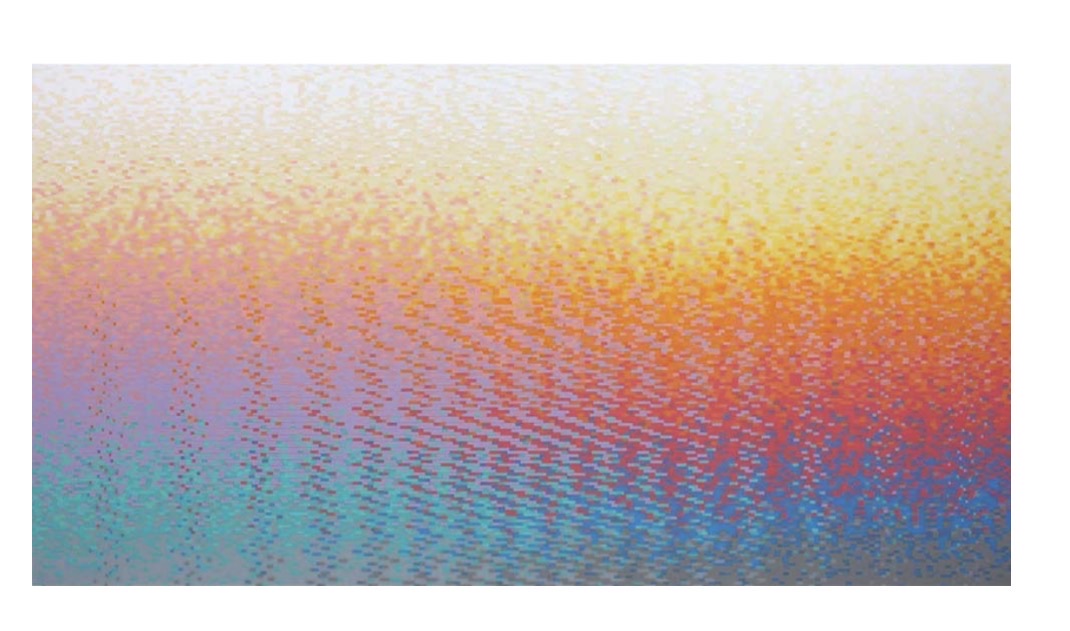
Light Made Solid, Color Made Eternal
Artist Spotlight · The Collection Editorial
There is a moment, standing before an Eric Zammitt sculpture, when the eye loses its bearings in the most pleasurable way imaginable. The work does not simply reflect light or absorb it. It holds light inside itself, suspending it within layers of laminated acrylic like a memory trapped in amber. This quality, at once scientific and deeply poetic, has made Zammitt one of the most quietly essential figures in American sculpture, and in recent years a new generation of collectors and curators has begun to recognize what those closest to the Light and Space movement have long understood: his work is irreplaceable.
Eric Zammitt
East West Twilight, 2014
Zammitt was born in 1940, coming of age in a postwar America that was rapidly reinventing itself. The cultural and technological optimism of midcentury life found its artistic expression in Southern California, where the flat, luminous light and the proximity to aerospace and industrial manufacturing created a uniquely fertile environment for artists interested in materials, perception, and the physics of seeing. It was here that Zammitt developed his artistic sensibility, drawing on a regional tradition that prized direct perceptual experience over representation or narrative. The California sun was not a backdrop for these artists.
It was a collaborator. The Light and Space movement that emerged from Southern California in the 1960s and 1970s brought together a remarkable constellation of artists, among them James Turrell, Robert Irwin, Larry Bell, and DeWain Valentine, each of whom pushed the boundaries of what sculpture and installation could mean by centering the viewer's sensory experience as the primary subject of the work. Zammitt found his place within this community by pursuing a distinctly material approach to immateriality. Where Turrell worked with pure light and Valentine cast enormous discs of colored resin, Zammitt turned to a painstaking process of layering and laminating acrylic to build forms that contain color rather than simply display it.
The result is an art that feels both constructed and discovered. His process is labor intensive in ways that do not announce themselves. Zammitt builds up his sculptures through the careful stacking and bonding of acrylic sheets, embedding color in gradients, bands, and fields that interact differently depending on the viewer's position and the quality of surrounding light. The geometric precision of his forms, often rectangular blocks or planar constructions, belies the organic warmth of the chromatic experience within.
This tension between the rigorously ordered and the sensuously felt is the engine of his work, and it connects him not only to the Light and Space tradition but also to the broader concerns of Minimalism and Op Art that defined serious sculptural inquiry in the latter half of the twentieth century. Among the works that best illustrate Zammitt's achievement is East West Twilight, a laminated acrylic piece from 2014 that demonstrates his mature command of color and form. The title alone signals his preoccupations: the movement of light across time and geography, the moment of transition between states, the threshold where one thing becomes another. In the work, layers of color shift from warm to cool registers in a progression that feels both inevitable and surprising.
Collectors who live with pieces like this report that the work changes throughout the day as ambient light shifts, making it a genuinely dynamic presence in any space. This temporal dimension, the sense that the sculpture is never quite the same twice, is one of the qualities that distinguishes Zammitt's practice from that of artists working in more static traditions. From a collecting perspective, Zammitt represents a compelling proposition. His work occupies a meaningful position at the intersection of several highly regarded movements, and the artists adjacent to him, figures like Larry Bell and DeWain Valentine, have seen significant institutional and market attention in recent decades.
Bell's mirrored glass cubes now command strong prices at auction, and Valentine's monumental resins have entered the permanent collections of major American museums. Zammitt's work, characterized by the same commitment to material experimentation and perceptual inquiry, rewards the collector who approaches it with patience and genuine curiosity. The pieces are not designed to shout across a room. They invite sustained looking, and they reward it.
The art historical context around Zammitt also connects his work to broader international conversations about phenomenological art, the kind of practice that takes seriously the question of how we experience the world through our senses. In this respect his work shares affinities with European artists like James Turrell's counterpart Olafur Eliasson, though Zammitt's roots are firmly Californian and his materials are those of American industrial modernity repurposed for contemplative ends. The scholarly literature on Light and Space has grown considerably since the movement's first major survey exhibitions, and Zammitt figures as an important contributor to a tradition that critics now recognize as one of the most original contributions American art has made to postwar global culture. What makes Zammitt matter today is precisely what made him important in the 1960s and 1970s: a belief that the act of seeing is itself profound, that art can slow us down and make us conscious of our own perceptual experience in ways that are genuinely transformative.
In an era saturated with images that demand immediate reaction, his work proposes something different. It asks for time. It rewards attention. It reminds collectors and viewers alike that the most sophisticated thing art can do is make us more awake to the world we actually inhabit.
For those fortunate enough to own a Zammitt, that reminder arrives every time the light in the room changes and the sculpture shifts, quietly and without drama, into something new.