Enrico Castellani
Enrico Castellani: Space, Light, Infinite Possibility
Artist Spotlight · The Collection Editorial
“I want to take possession of space through the instrument of light.”
Enrico Castellani
Stand in front of a Castellani surface and something quietly extraordinary happens. The wall seems to breathe. Light moves across the canvas as though it has its own agenda, pooling in valleys and cresting over peaks in a rhythm that feels almost biological. For an artist who spent decades working in apparent silence, without the brash promotional machinery that surrounded so many of his contemporaries, Enrico Castellani produced a body of work that now stands as one of the most radical and quietly influential contributions to postwar European art.
Enrico Castellani
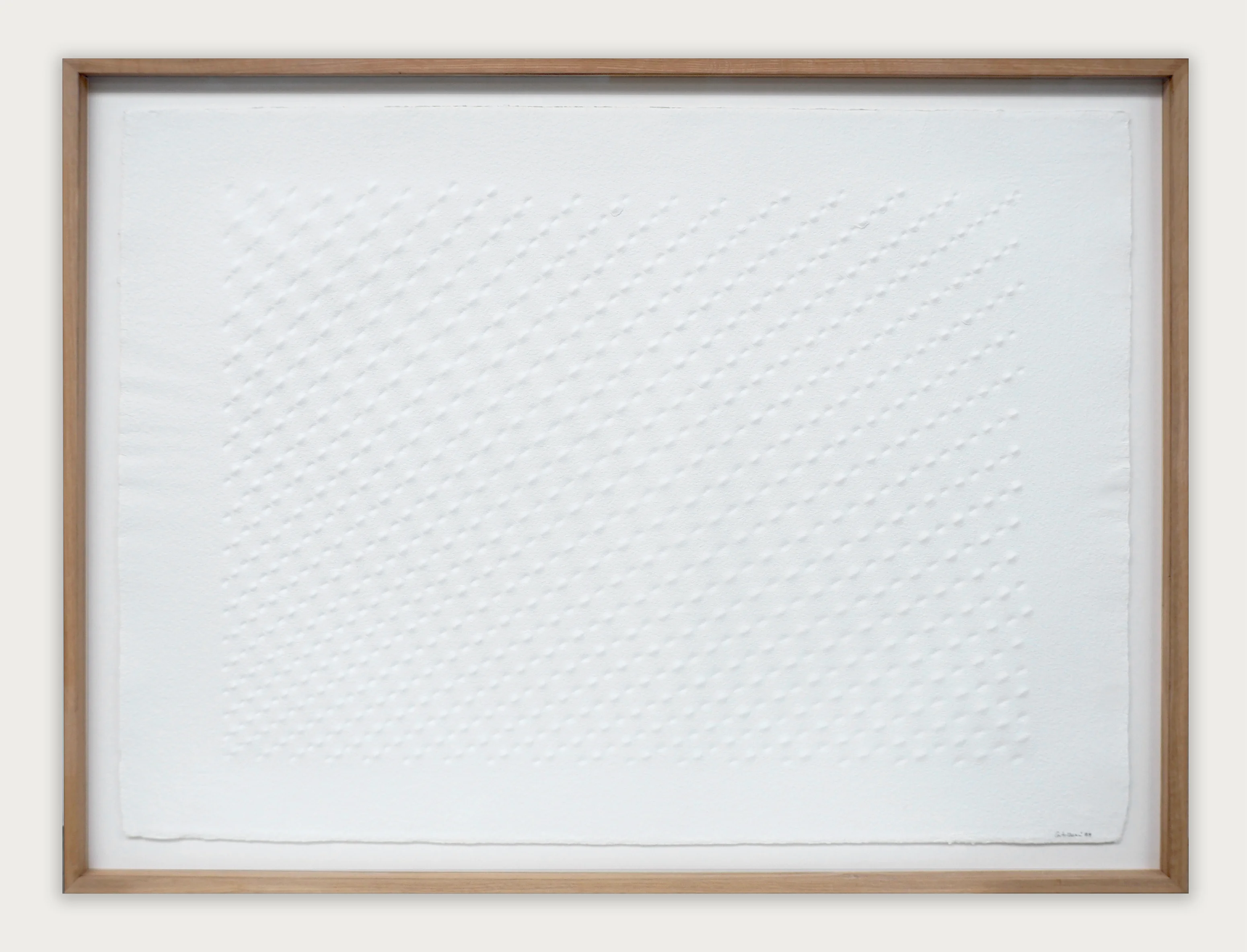
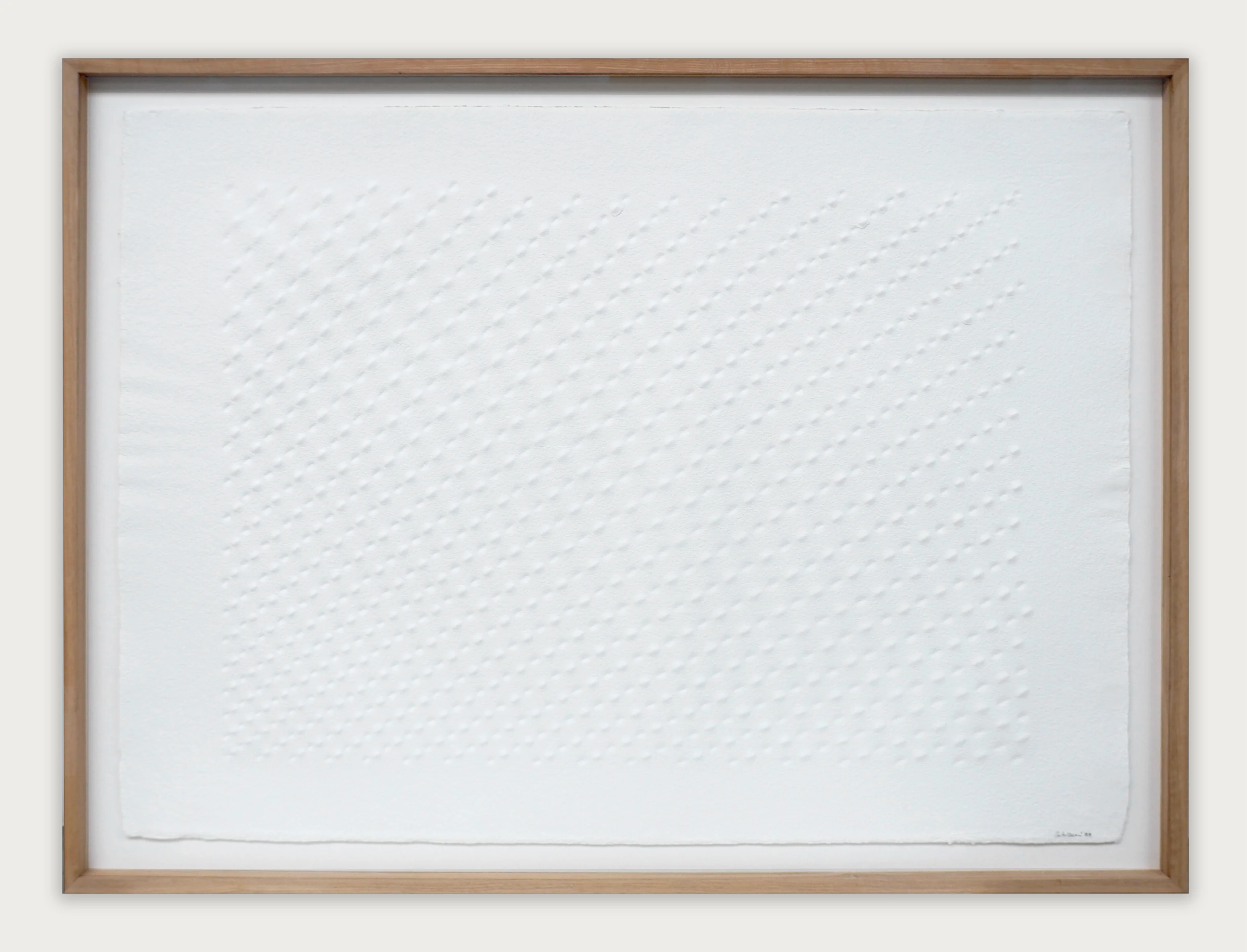
Senza Titolo, 1988
His reputation has grown steadily since his death in 2017, and major retrospectives and auction results in recent years have confirmed what a devoted circle of collectors and curators always knew: this was a master of the highest order. Castellani was born in Castelmassa, in the Veneto region of northern Italy, in 1930. He studied at the Académie Royale des Beaux Arts in Brussels and later at the Brera Academy in Milan, where the intellectual and artistic energy of the postwar city would prove formative. Milan in the late 1950s was a city in ferment, rebuilding itself economically and culturally after the devastation of the war, and its art scene attracted some of the most ambitious and restless minds in Europe.
It was here that Castellani formed the friendship and creative partnership that would define the first chapter of his mature career. In 1959, Castellani co founded the journal and gallery Azimuth alongside Piero Manzoni, one of the great conceptual provocateurs of the twentieth century. The venture lasted only two years, but its impact was enormous. Azimuth brought together European artists who were pushing against the emotional excess of Art Informel and Abstract Expressionism, seeking instead a cooler, more systematic and philosophically rigorous approach to the painted surface.
Enrico Castellani
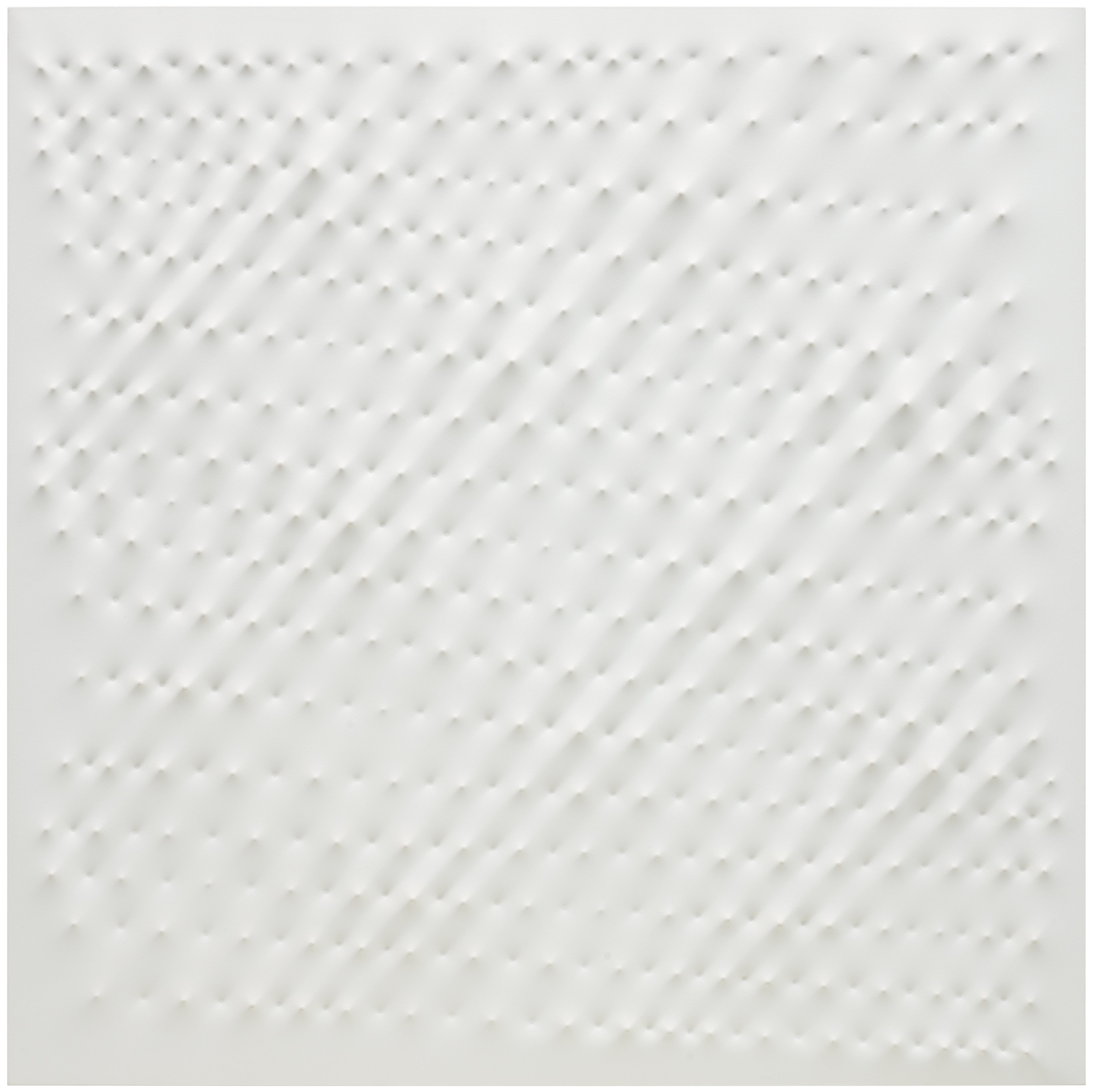
Superficie Bianca, 1996
Castellani contributed the theoretical backbone and the formal discipline that balanced Manzoni's more performative instincts. The two men pushed each other toward increasingly radical positions, and though their paths diverged after Azimuth closed, the conversations of those years echo throughout Castellani's subsequent decades of work. The signature gesture that would define Castellani's entire practice emerged in the early 1960s and remained his lifelong obsession: the estroflessione, or eversion. Working on canvas stretched over a grid of nails, Castellani pushed and pulled the surface from behind, creating rhythmic fields of raised and recessed points that transformed the canvas from a flat support for paint into a three dimensional object that existed in genuine dialogue with the space around it.
Works such as Superficie rossa from 1963, painted in aniline on shaped canvas, show this language in its exhilarating early form. The color is almost secondary to the relief, a pulsing field of light and shadow that changes with every shift in illumination or the viewer's position. He was not painting on a surface. He was making the surface itself the subject.
Enrico Castellani
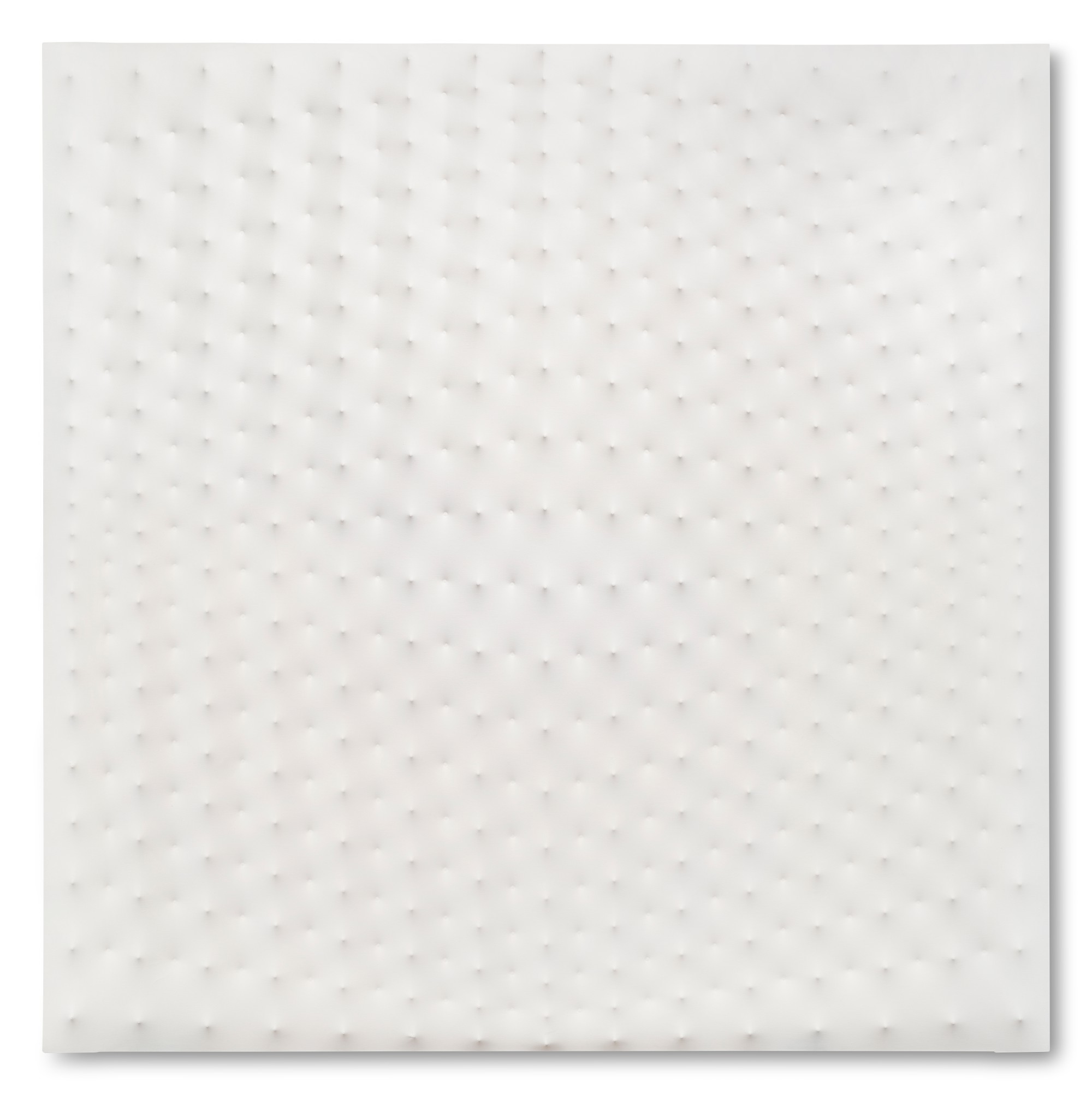
Utile Verifica, 1971
Over the following decades, Castellani refined and extended this vocabulary with extraordinary consistency and depth. His Superficie Bianca series, of which the 1996 work on the platform is a distinguished example, stripped the practice to its most essential form: white acrylic on shaped canvas, all color variation arising purely from the behavior of light across the embossed terrain. These are among the most meditative objects in postwar art, works that reward sustained attention in a way that few things do. The Superficie Blu from 1993 and the Superficie Gialla Tokyo no.
2 from 1967 demonstrate how Castellani explored the way different colors interact with the relief, the blue deepening in shadow and lifting to near luminescence at the crests, the yellow vibrating with an almost solar intensity. His relief works on aluminium, such as the Senza titolo from 1966, translate the same logic into a more industrial material vocabulary, anticipating conversations about sculpture and object hood that would occupy artists for generations. Castellani's relationship to the broader movements of his time was always one of productive adjacency rather than full membership. He was close to the Zero movement in Germany, whose central figures Heinz Mack, Otto Piene, and Günther Uecker shared his interest in light, surface, and the liberation of art from pictorial representation.
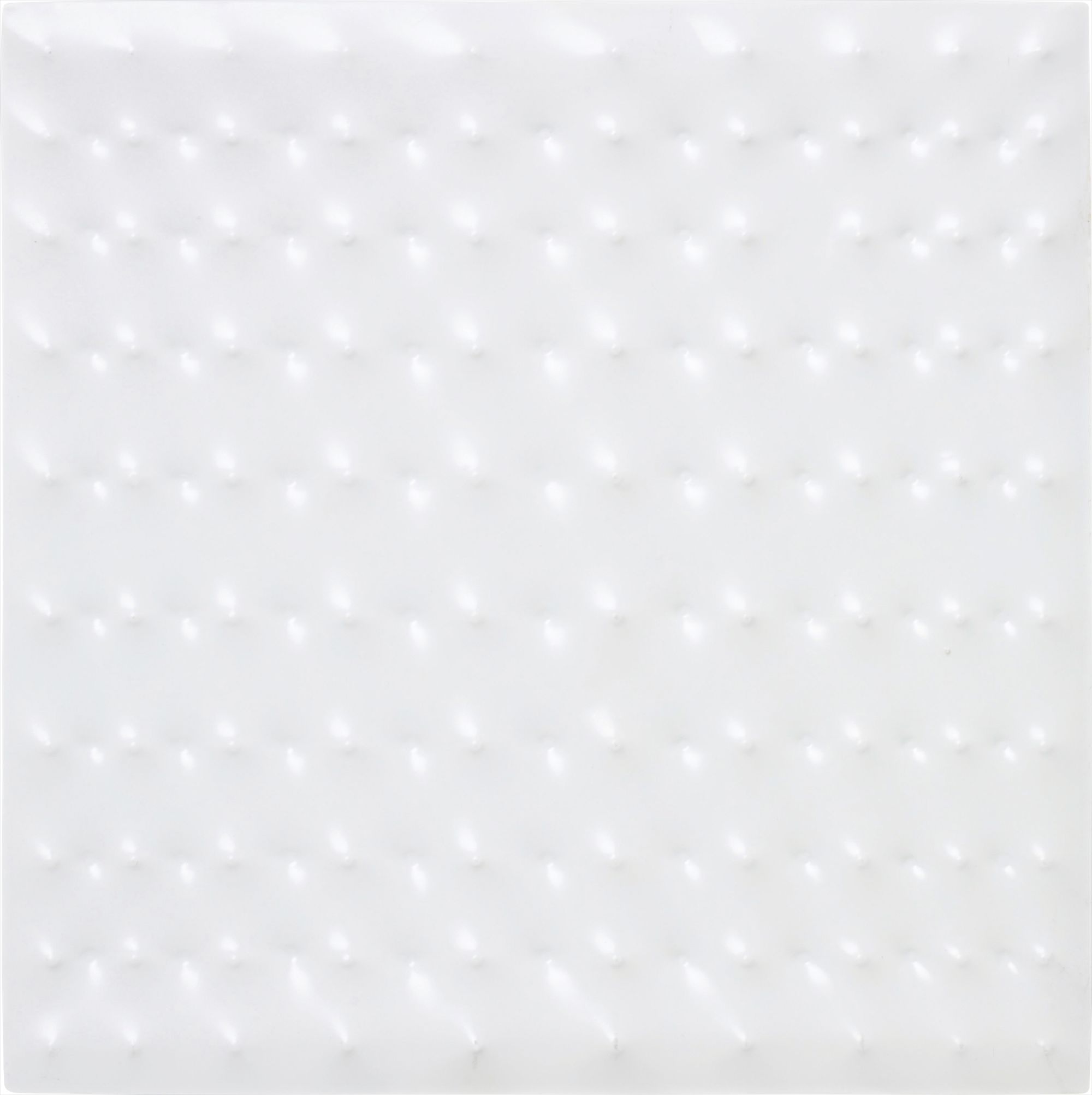
Enrico Castellani
Estroflessione
He was also deeply connected to the Italian Gruppo T and Gruppo N, which explored kinetic and programmatic art. His work is meaningfully in conversation with that of Lucio Fontana, his great Italian predecessor and sometime colleague, who had established the philosophical permission to treat the canvas as a physical object rather than an illusionistic window. But Castellani's approach was distinct from Fontana's slashes and perforations. Where Fontana enacted violence upon the surface, Castellani coaxed and persuaded it, creating ordered fields of gentle topography that feel closer to landscape or music than to confrontation.
For collectors, Castellani represents one of the most compelling propositions in the postwar Italian market. His work has appeared consistently at the major international auction houses, with significant results at Christie's, Sotheby's, and Bonhams, where his Superficie works have attracted serious international bidding from collectors in Europe, Asia, and the Americas. The market for his work has matured and deepened since his death, with institutional interest from museums including the Tate Modern, the Museum of Modern Art, and major Italian public collections reinforcing the scholarly consensus around his importance. Collectors who came to his work early, drawn by the quiet authority of the surfaces and the intellectual rigor of the practice, have seen their conviction rewarded.
What to look for: the early 1960s works in aniline carry particular historical significance as documents of the practice at its most experimental. The Superficie Bianca works across several decades represent the purest expression of his mature language. Works on paper and aluminium offer entry points into the practice and demonstrate the breadth of his material thinking. Enrico Castellani's legacy is still being fully understood, which is part of what makes this moment in his posthumous reception so rewarding to observe.
His work anticipated so much: the phenomenological concerns of artists who came after him, the interest in process and repetition, the understanding that a work of art is not a picture of something but a physical event in space. He worked with extraordinary dedication for more than five decades, maintaining the integrity of his vision without compromise or distraction. The surfaces he made are not relics of a historical moment. They are alive in the rooms where they hang, responsive to natural light, to the season, to the hour of day.
To collect Castellani is to bring something genuinely animate into your space, something that will continue to reveal itself over time. That is a rare and precious thing.
Explore books about Enrico Castellani
Enrico Castellani
Pierre Restany
Enrico Castellani: Opere 1958-1974
Luciano Caramel
Enrico Castellani
Germano Celant
Enrico Castellani: Katalog der Werke
Luciano Caramel
Enrico Castellani
Germano Celant
Enrico Castellani: Catalogue Raisonné 1956-2016
Luciano Caramel