Émile Gallé
Émile Gallé: Nature Transformed Into Pure Wonder
Artist Spotlight · The Collection Editorial
“My roots are deep in the woods.”
Émile Gallé
When the Musée d'Orsay devoted a landmark retrospective to the decorative arts of the Belle Époque, the rooms dedicated to Émile Gallé drew the longest lines. Visitors pressed close to his luminous vessels, their faces lit by the amber and violet glow passing through layers of molten glass, as though standing before stained glass windows in a cathedral built to celebrate the natural world. That moment of collective reverence speaks to something enduring about Gallé: more than a century after his death in 1904, his work continues to stop people in their tracks, to make them feel that glass is not a material but a language. Émile Gallé was born in Nancy, in the Lorraine region of northeastern France, in 1846.
Émile Gallé
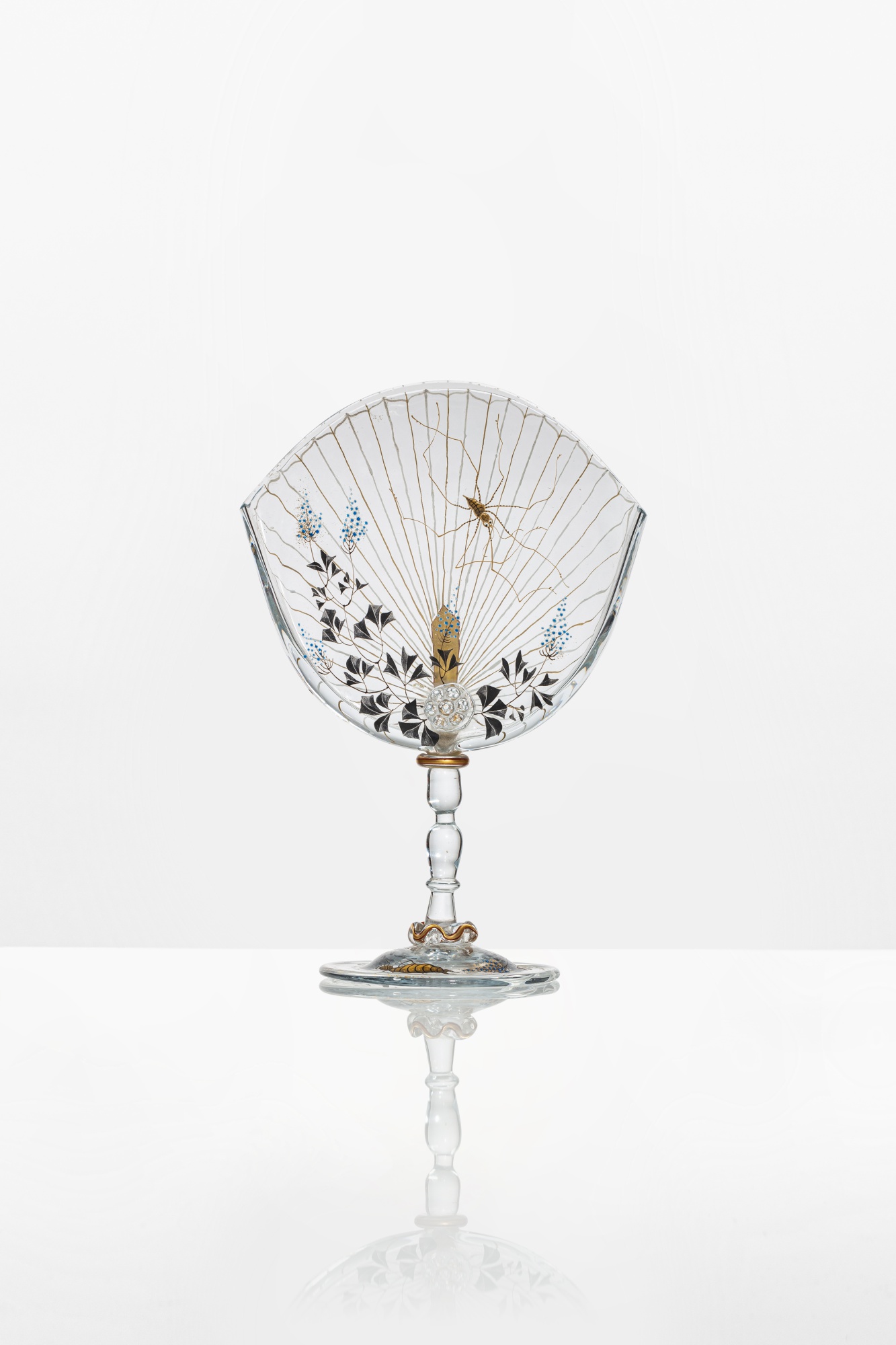
Éventail vase, circa 1877-1880
His father, Charles Gallé, ran a successful workshop producing decorative glassware and ceramics, and the young Émile grew up surrounded by craft at its most purposeful. He studied philosophy, botany, and drawing before traveling to Weimar and Meisenthal, absorbing the rich traditions of German glassmaking. Time spent in London introduced him to Japanese art, then flooding into European consciousness through the enthusiasm of the Aestheticism movement, and that encounter would prove transformative. Gallé returned to Nancy not simply as a craftsman but as an artist with a philosophy, one who believed that beauty and meaning were inseparable.
The 1878 Paris Exposition Universelle marked Gallé's first major public triumph. He exhibited glasswork and ceramics that stunned visitors and critics alike, earning a gold medal and establishing his reputation across France and beyond. His early work showed remarkable command of historical styles, drawing on Islamic glass, Renaissance enameling, and East Asian lacquerwork, but even in those formative pieces one could sense an artist straining toward something more personal. By the 1880s that personal vision had crystallized entirely.
Émile Gallé
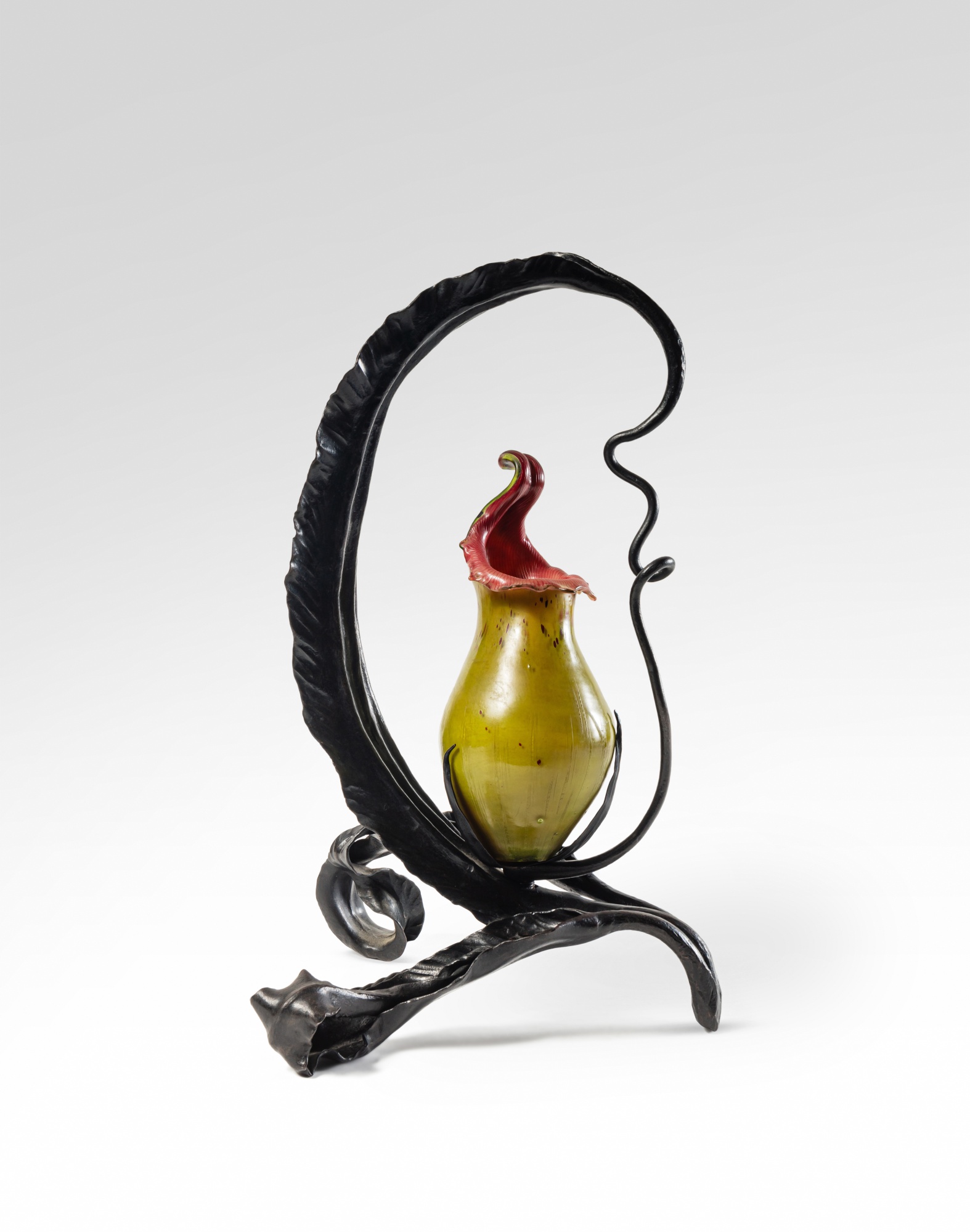
Brûle parfum
Gallé had begun his experiments with cameo glass, a technique involving multiple layers of colored glass fused together and then carved or acid etched to reveal forms beneath the surface. The effect was unprecedented: flowers, insects, seedpods, and waterways appeared to float within the glass itself, suspended in perpetual twilight. What made Gallé's mature work so revolutionary was the integration of poetry and natural science into a single decorative object. An avid botanist, he was precise about his subjects: the chrysanthemums on a vase were not generic blossoms but accurately observed specimens, rendered with the care of an illustrator and the feeling of a symbolist poet.
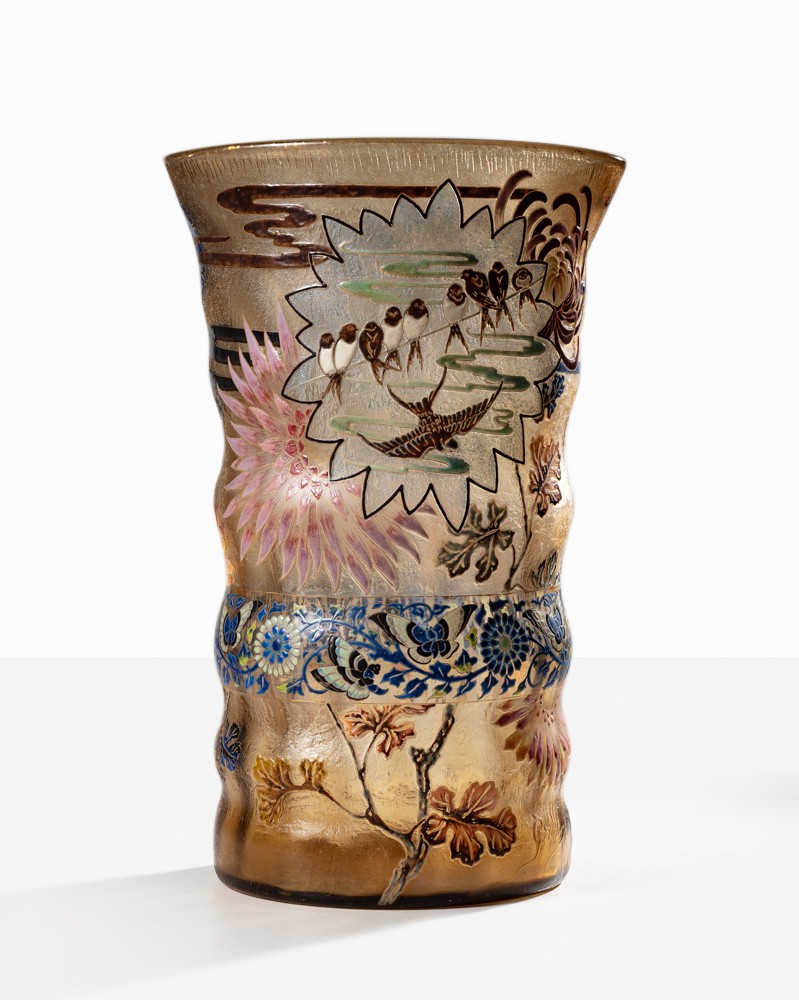
Works such as the Vase Aux Chrysanthèmes et Hirondelles capture swallows in flight above flowering branches with a delicacy that seems almost impossible given the intractability of the medium. His Nénuphars vases, inspired by water lilies and aquatic life, achieve a quality of submersion, as though the glass itself has become water. The Vase Crocus ou Veilleuse d'Automne carries the melancholy beauty of seasonal change into its very structure, its colors shifting from pale dawn to deep amber in a single form. These were not merely decorative objects.
Émile Gallé
Vase Aux Chrysanthèmes et Hirondelles
They were meditations. Gallé was also deeply engaged with the symbolic and literary dimensions of his art. He was a devoted reader of Baudelaire, Verlaine, and Mallarmé, and he frequently inscribed lines of verse onto his pieces, making the glass itself a bearer of text as well as image. He called these works his verres parlants, or speaking glasses, and the term captures precisely what he intended: objects that address the viewer, that carry interior lives.
His friendship with the critic Roger Marx and his correspondence with leading intellectuals of the day placed him at the center of French cultural life, not as a craftsman working in the margins of fine art but as a full participant in its most important conversations. In 1901 he founded the École de Nancy, formally establishing the alliance of artists, architects, and designers in Lorraine who together defined the French Art Nouveau movement. The school counted Louis Majorelle, Victor Prouvé, and the Daum brothers among its members, creating a regional creative ecosystem of extraordinary vitality. For collectors, Gallé's work occupies a position that is both historically significant and viscerally pleasurable to live with.
Émile Gallé
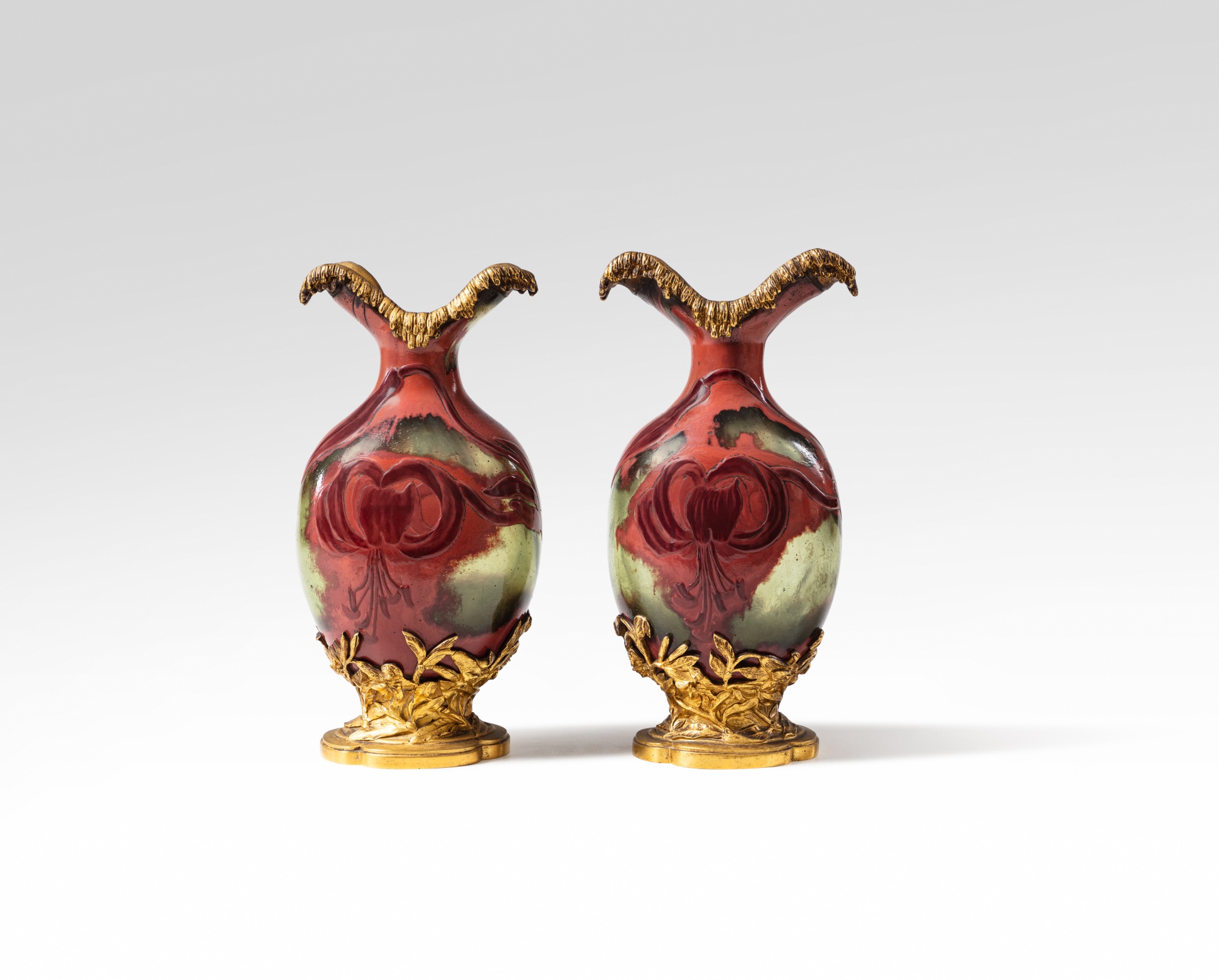
Pair de vases montés
Major auction houses including Christie's and Sotheby's regularly present his pieces at the highest levels of their decorative arts sales, and exceptional examples in rare techniques or with documented exhibition histories can achieve prices well into six figures. Collectors are wise to pay close attention to the distinction between works produced entirely under Gallé's personal supervision and those made in larger quantities by his atelier after his death in 1904, which bear his signature with a star added beneath. Both categories have their admirers, but the pre death works, particularly those from the 1890s through 1904, represent the fullest expression of his genius. Among the most prized are the clair de lune pieces with their ethereal blue tones, the marqueterie de verre works in which fragments of contrasting glass were embedded into the molten body, and the intricately mounted pieces pairing his glass with gilded bronze, such as the remarkable Pair de vases montés with their engraved fleur de lis decoration.
To understand Gallé fully is to understand the whole constellation of artists who surrounded and inspired him. His closest parallels are the Daum brothers, whose Nancy glassworks produced work of comparable ambition, and René Lalique, who brought a similar instinct for nature and luxury to jewelry before turning to glass in the twentieth century. Looking beyond France, Gallé's achievements rhyme with those of Louis Comfort Tiffany in America, who was pursuing his own luminous synthesis of glass and nature at precisely the same moment, and with the Viennese designers of the Wiener Werkstätte, who shared his conviction that the decorative arts deserved the same seriousness as painting or sculpture. Gallé belongs to an international moment of radical ambition in the applied arts, a moment when the boundary between fine art and craft was not merely questioned but dissolved.
The legacy Gallé left is impossible to overstate. He demonstrated that glass could bear the full weight of human feeling, that a vase could be as profound as a painting, that craft carried to its highest pitch becomes indistinguishable from art. His influence flows forward through twentieth century studio glass, through the work of Dale Chihuly and Bertil Vallien, and through every designer who has looked to the natural world as the most generous source of formal inspiration available. The pieces that survive him, glowing on museum plinths and in the careful hands of private collectors, remain as alive as the day they emerged from the furnace: patient, luminous, and entirely themselves.
Explore books about Émile Gallé
Émile Gallé
Peter Verzijl
Gallé
Philippe Thiébaut
Émile Gallé and His Contemporaries
Alastair Duncan
Gallé: Master of Glass
Helmut Ricke
The Glass of Émile Gallé
Museum of Modern Art (publisher)
Émile Gallé: 1846-1904
Françoise Thiébaut
Gallé and Daum: Master Glassmakers of Lorraine
Alastair Duncan