Elmgreen & Dragset

Elmgreen and Dragset Make the World Wonder
Artist Spotlight · The Collection Editorial
“We want to create situations where people feel like they are trespassing into somebody else's private space.”
Elmgreen and Dragset, interview with The Guardian
In the spring of 2023, visitors to the Nationalgalerie in Berlin encountered something quietly astonishing: an exhibition by Elmgreen and Dragset that transformed the institution's soaring modernist halls into a meditation on longing, domesticity, and the strangeness of public life. The duo, who have spent three decades rerouting the expectations of architecture and social space, arrived at one of Europe's most storied venues with their characteristic blend of deadpan wit and emotional precision. That a collaborative pair working in sculpture and installation has become one of the most discussed artistic forces of their generation is itself a kind of provocation, a gentle refusal of the solitary genius myth that still haunts much of the art world's storytelling. Michael Elmgreen was born in Copenhagen in 1961, and Ingar Dragset grew up in Trondheim, Norway.

Elmgreen & Dragset
The Agony And The Ecstasy, Fig. 1, 2010
The two met in the mid 1990s in Copenhagen, where Elmgreen had been active in the poetry scene and Dragset had trained in theatre. Their backgrounds were literary and performative before they were visual, and this remains one of the most generative tensions in their practice. They began working together as both romantic and creative partners, a dual intimacy that gave their early work a kind of compressed energy, an awareness of how private relationships are always being shaped and surveilled by the structures around them. The partnership has since evolved, remaining a collaboration of singular imaginative depth even as their personal relationship changed.
Their emergence in the late 1990s came at a moment when institutional critique was being reinvented by a younger generation unwilling to treat it as purely cerebral exercise. Where earlier artists like Michael Asher or Hans Haacke had approached the museum and gallery as sites of ideological analysis, Elmgreen and Dragset brought a more carnivalesque sensibility to the project. Their early Powerless Structures series, begun in 1997, subjected the white cube gallery to a series of gentle deformations: tilted walls, warped floors, displaced architectural elements. The series gave the appearance of casual intervention while concealing a rigorous conceptual architecture beneath.

Elmgreen & Dragset
The Real Money Behind, 2010
Works such as Powerless Structures, Fig 80 from this period remain among the clearest demonstrations of how the duo could make institutional assumptions feel suddenly fragile and absurd. The breakthrough into international visibility came with Prada Marfa, completed in 2005 in the high desert of Valentine, Texas. Designed as a pristine replica of a Prada boutique and installed without any road access in a remote stretch of landscape, the work staged an encounter between luxury branding and the sublime indifference of nature. It was simultaneously a critique of consumerism, a love letter to minimalist sculpture, and an act of pure mischief.
“Humour can be a very efficient tool to make people think about things they would otherwise not want to address.”
Elmgreen and Dragset, Tate interview
The work attracted enormous media attention and has become one of the most photographed art installations of the twenty first century, a rare case of conceptual art achieving genuine popular reach without sacrificing its intellectual seriousness. Its continued presence in the Texas landscape, weathering slowly with time, only deepens the meditation it proposes. In 2009, Elmgreen and Dragset represented Denmark and the Nordic countries at the Venice Biennale in a celebrated pavilion project titled The Collectors. Transforming the Danish and Nordic pavilions into the connected homes of two fictional collectors, one recently deceased and one absent, the installation invited visitors to piece together narratives of desire, status, and solitude from the objects left behind.

Elmgreen & Dragset
Boy Scout
The work won the Golden Lion for Best National Participation and remains one of the most discussed Biennale presentations of its era. It demonstrated the duo's remarkable ability to operate at the scale of architecture while maintaining an intimacy that feels novelistic, almost confessional. Among their works available on The Collection, several reveal the full range of their conceptual vocabulary. Second Marriage from 2008 brings together mirrors, porcelain sinks, stainless steel pipework, taps and soap dispensers into a configuration that is at once familiar and quietly unsettling.
The bathroom as a site of private ritual becomes, in Elmgreen and Dragset's hands, a charged social theatre. Top and Bottom, with its stainless steel taps and black rubber hose, extends this interest in plumbing and domestic infrastructure as a language of power and vulnerability. The Agony and the Ecstasy, Fig. 1 from 2010 uses plaster, acrylic and steel cables to conjure an almost devotional quality, while The Real Money Behind from the same year embeds a stainless steel safe door and combination lock into a painted canvas surface, turning the picture plane itself into a site of concealment and suspicion.
Elmgreen & Dragset
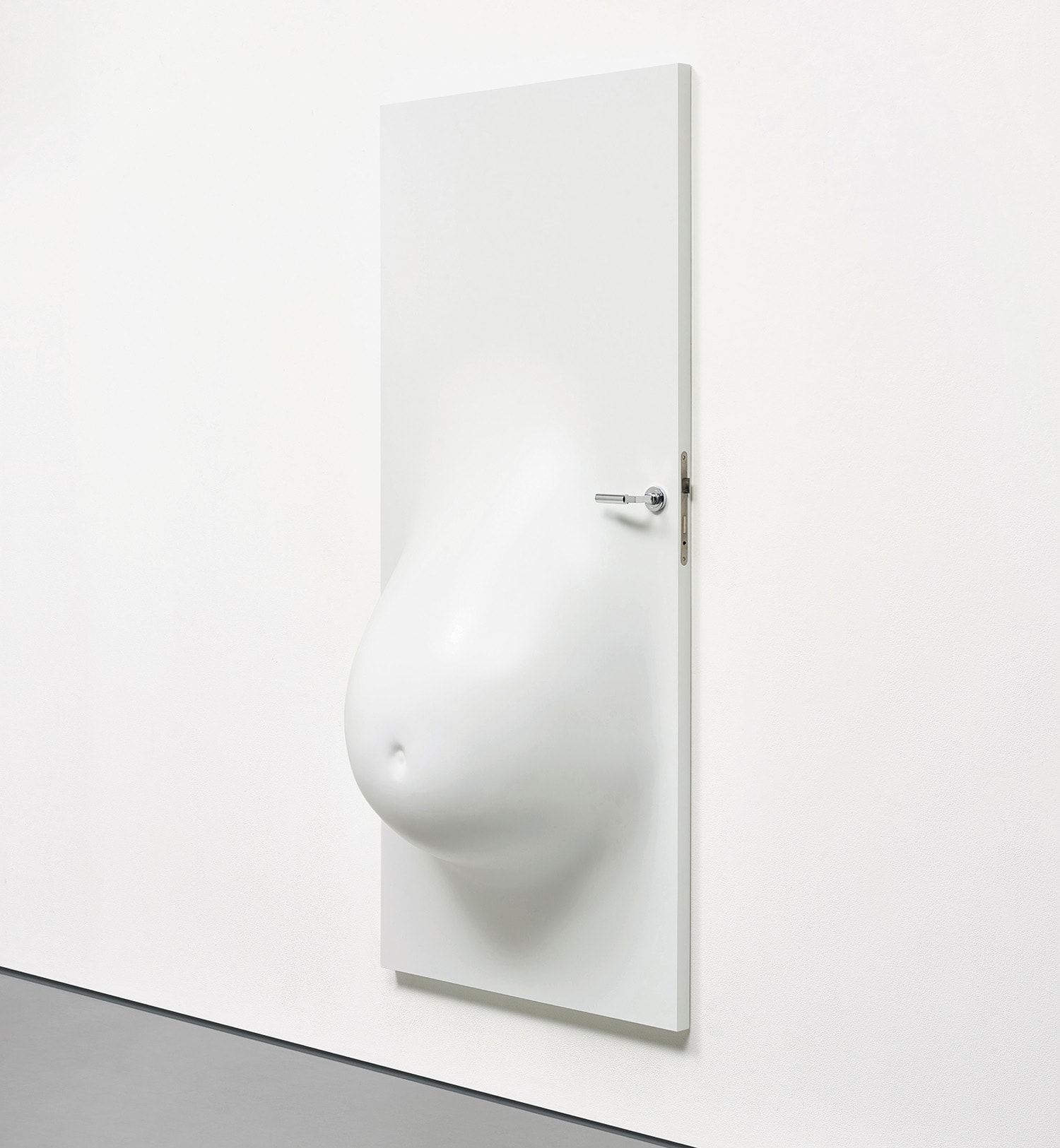
Belly Door, from Door Cycle
For collectors, Elmgreen and Dragset offer something genuinely rare: work that functions at the level of both spectacle and intimacy. Their sculptures and installations reward sustained attention, revealing new layers of meaning as the viewer's relationship with a work deepens over time. The Photo Booth of 2004, a complete mixed media structure, or Belly Door from the Door Cycle series, with its fibreglass resin and polyurethane foam surface painted in white acrylic, demonstrate how the duo can transform the most familiar architectural elements into objects of contemplative strangeness. Right into Wrong, also known as Powerless Structures, from 2003 offers the collector a direct entry point into the foundational vocabulary of their practice, combining wood, ink and a metal trolley into a deceptively simple object charged with institutional wit.
The Private Museum of 2003, in steel, aluminium, Perspex, brass profile lettering and fluorescent light, is among the most self aware and layered of their works, a miniature critique of the very context in which art is legitimised and displayed. In terms of critical and market context, Elmgreen and Dragset occupy a position of sustained prestige rather than speculative heat. Their work has been acquired by major institutions including the Tate in London, the Museum of Modern Art in New York, and numerous significant private collections across Europe and North America. Collectors drawn to artists working at the intersection of conceptual rigour and emotional resonance, those who collect alongside names like Maurizio Cattelan, Carsten Höller, or Dominique Gonzalez Foerster, will find natural affinities here.
Like those artists, Elmgreen and Dragset use humour not as a retreat from seriousness but as a precision instrument for reaching truths that direct statement cannot access. What ultimately makes Elmgreen and Dragset matter, and matter increasingly as the years accumulate, is their fidelity to the human body and its social circumstances. Their work never loses sight of the person standing, sitting, swimming, or simply existing within the spaces and structures that culture builds around us. At a moment when so much contemporary art tends toward either pure spectacle or hermetic theory, their practice holds open a space for genuine feeling and genuine questioning.
They remind us that the most radical thing art can do is make us look carefully at what we have agreed to take for granted, and find it, suddenly, inexhaustible in its strangeness.
Explore books about Elmgreen & Dragset