Elliott Hundley
Elliott Hundley Weaves Worlds From Everything
Artist Spotlight · The Collection Editorial
Something remarkable happens when you stand before an Elliott Hundley assemblage for the first time. The initial impression is one of overwhelming abundance, a wall of color and texture and seemingly chaotic material that slowly, almost hypnotically, begins to resolve itself into something deeply human. Hundley has been building toward this kind of encounter for more than two decades, and his continued presence in major institutional and gallery exhibitions across Los Angeles, New York, and Europe confirms what those who have followed his practice long suspected: he is among the most genuinely ambitious artists working in America today. His 2023 exhibition at Regen Projects in Los Angeles drew significant critical attention, reaffirming his place at the center of contemporary discourse around collage, mythology, and the nature of storytelling in visual form.
Elliott Hundley
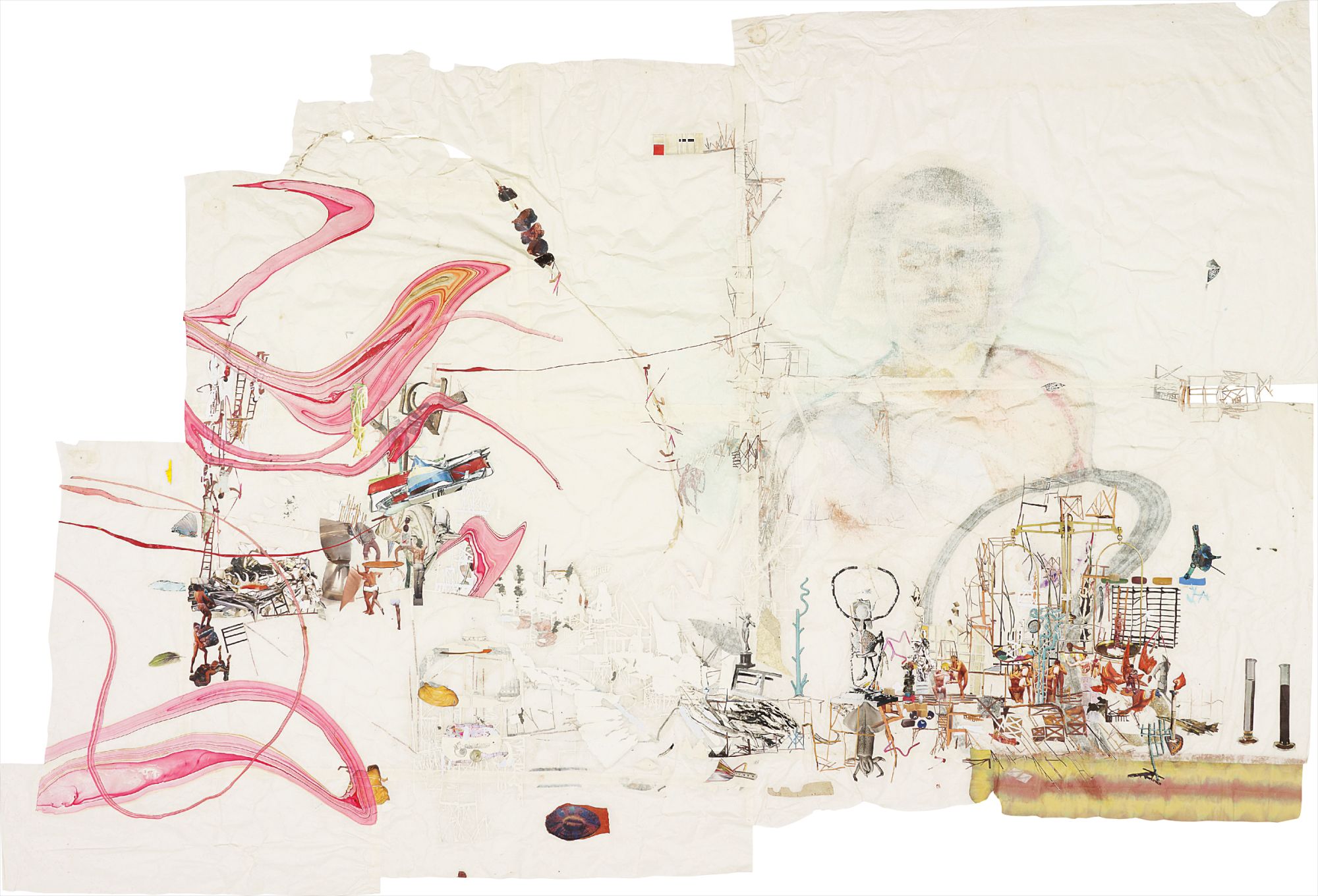
The Hanging Garden, The Invention of Drawing
Hundley was born in 1975 and grew up shaped by the particular cultural richness of American life in the late twentieth century, a period when the boundaries between high and low culture were dissolving in productive and energizing ways. Los Angeles, where he has long been based, proved to be an ideal environment for his sensibility: a city of surfaces and depths, of classical aspiration and vernacular abundance, of theater and artifice and genuine emotional weight. He studied at the Rhode Island School of Design and later at UCLA, where he earned his MFA, and it was during those years that the foundational elements of his practice began to crystallize. The proximity to the film industry, to performance culture, and to the extraordinary diversity of Los Angeles street life gave his emerging work a texture that was always more than purely academic.
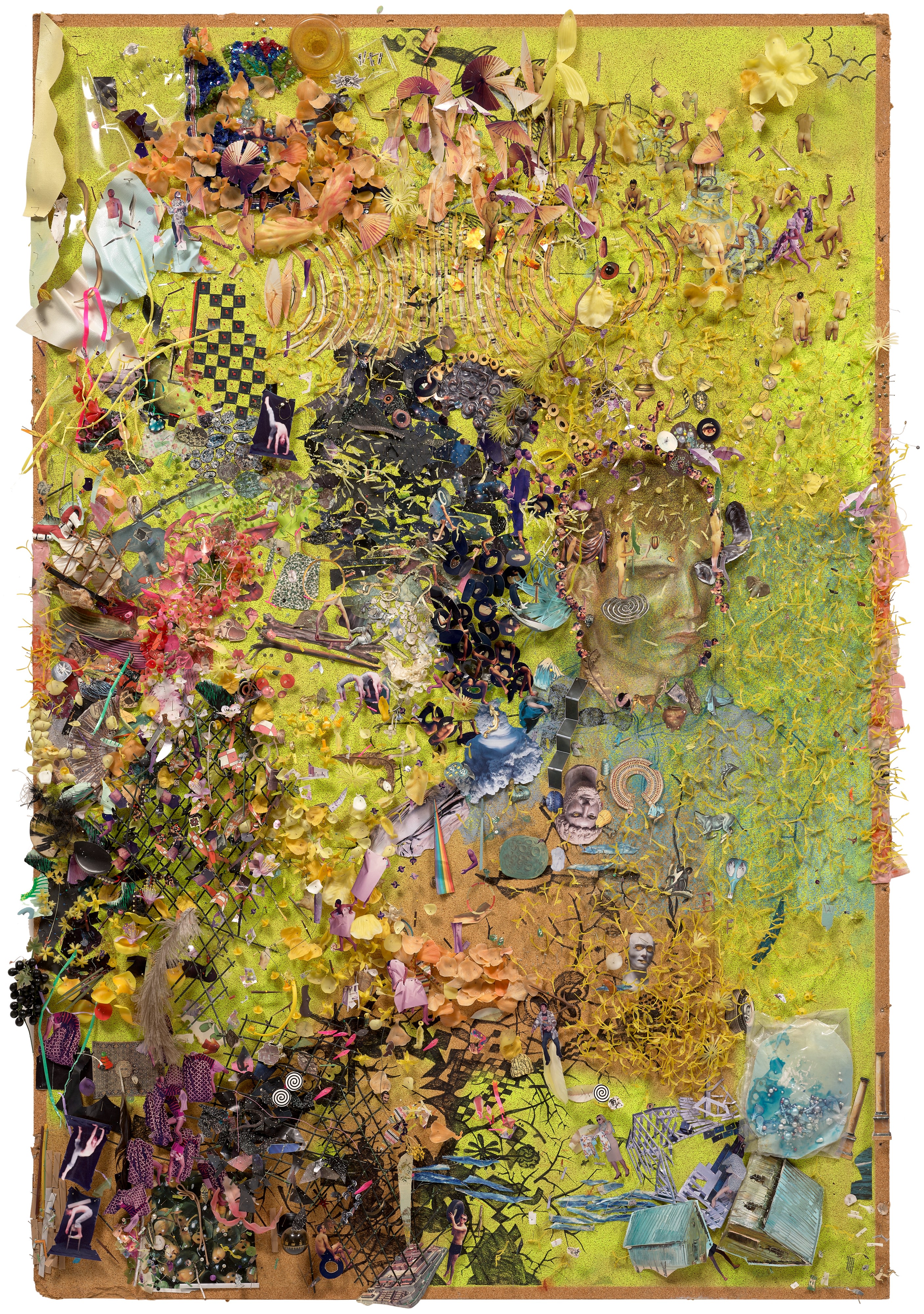
The development of Hundley's practice has followed a logic that is entirely his own. Where many artists trained in the conceptual traditions of the late twentieth century turned toward reduction and restraint, Hundley moved in the opposite direction, toward accumulation and density and an almost baroque faith in the power of material abundance to carry emotional meaning. His early works from the early 2000s already showed the directional pull of his mature practice, incorporating found objects, photography, pins, paper, and mixed media into surfaces that invited prolonged looking. The work titled Jasw from 2003, a layered composition of found objects, photo collage, pins, canvas, sequins, pastel, marker, and mixed media mounted to cork on foamcore, is a remarkable document of these early instincts already fully alive.
Elliott Hundley
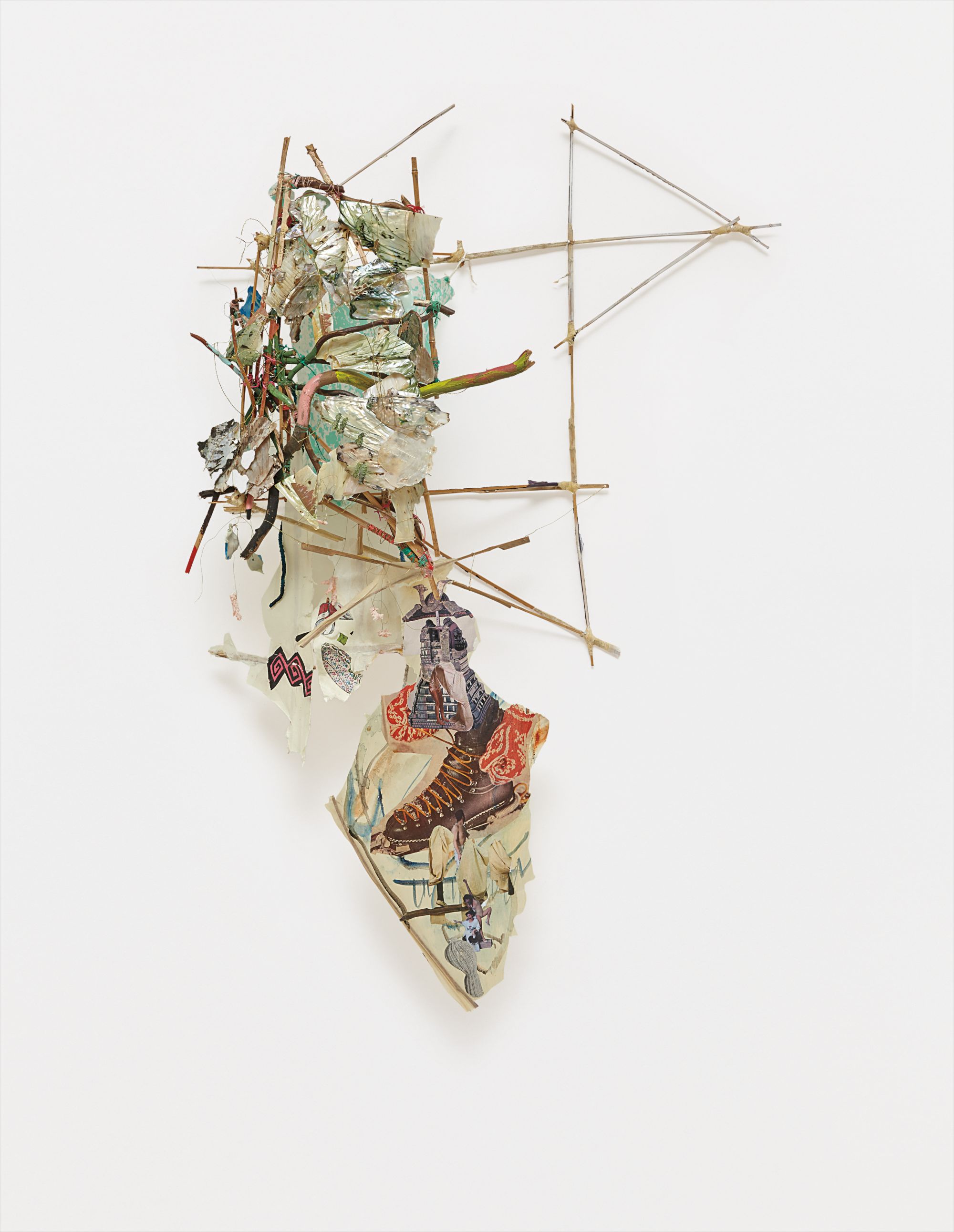
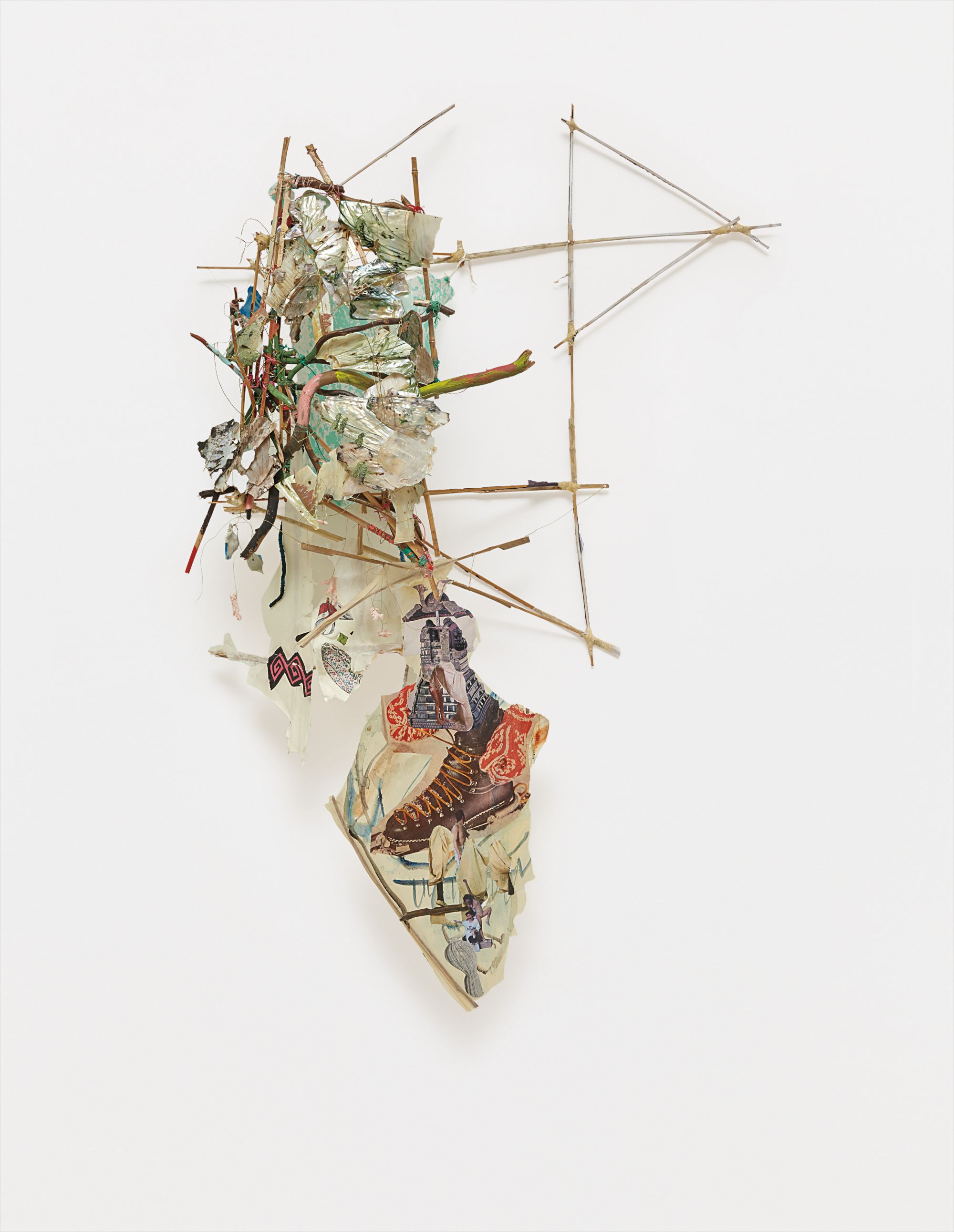
Armor
There is nothing tentative about it; the ambition is present from the beginning. The classical world became increasingly central to Hundley's work as his practice deepened, and this is perhaps the most distinctive and intellectually generative aspect of his artistic identity. Greek tragedy in particular, the work of Euripides above all, provided him with a framework for thinking about desire, fate, transformation, and the relationship between individual experience and collective storytelling. Works like Agave of the Bacchae Paste Up from 2010 and Stained Cithairon from the same year draw directly from the Bacchae, one of the most psychologically ferocious plays in the Western tradition, and they do so without simplifying its complexities.
The Hanging Garden, The Invention of Drawing and Euripides after de Chirico Obscured by Flowers No. II demonstrate how Hundley moves fluidly between literary source material, art historical reference, and his own invented visual language. The nod to Giorgio de Chirico in that latter title is telling: like de Chirico, Hundley is fascinated by the dreamlike persistence of antiquity in the modern imagination. To collect Hundley is to commit to a particular kind of looking, one that rewards patience and returns something new with each encounter.
Elliott Hundley
Jasw, 2003
His large scale works like O Dika, an extraordinary assemblage combining wood, sound board, Styrofoam, plastic, wax, paper, string, glitter, wire, silk, acrylic paint, canvas, tin, pins, feathers, animal claws, and metal brackets into a single unified object, are genuinely challenging to live with in the sense that they demand space and attention. But this is precisely what draws serious collectors to his work. There is no passive relationship with a Hundley piece; it insists on engagement. Works on a more intimate scale, including pieces like Garland, with its layered photographs, plastic silk, pins, needles, watercolor, and aluminum, offer collectors a slightly different register of his practice while retaining the essential qualities of material richness and narrative density that define everything he makes.
His oils on linen, including Stained Cithairon with its four panel structure, reveal a painter of considerable sensitivity working alongside and through the assemblage tradition. Within the broader landscape of contemporary art, Hundley occupies a position that is genuinely difficult to categorize, which is itself a mark of significance. He shares with Thomas Houseago and Sterling Ruby a commitment to the sculptural and material possibilities of art made in Los Angeles, though his practice is more overtly literary than either. His relationship to collage places him in conversation with the legacies of Joseph Cornell and Hannah Höch, and his use of photography and found imagery connects him to the traditions of Robert Rauschenberg and the combine paintings that redrew the boundaries of what painting could be in the postwar period.
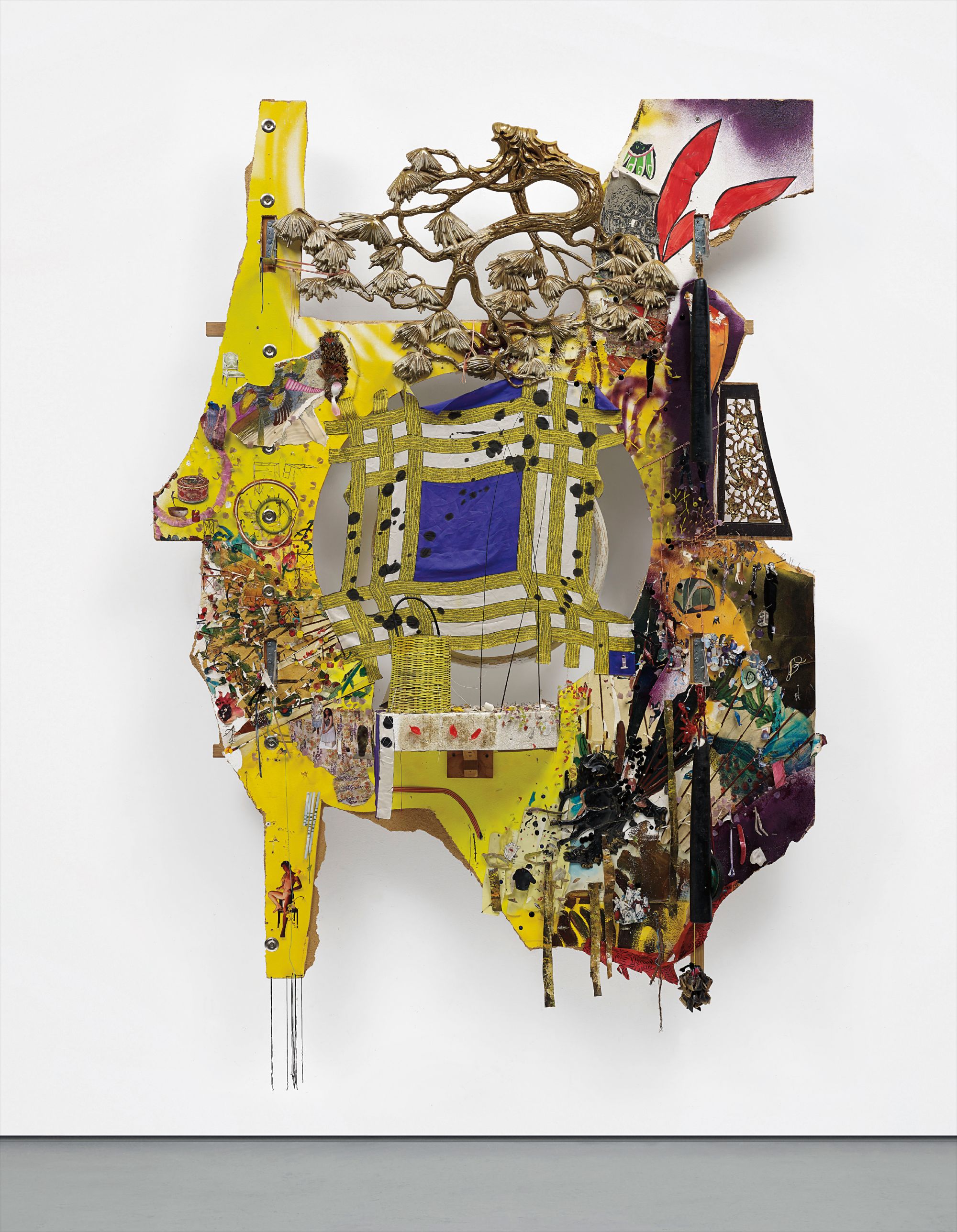
Elliott Hundley
O Dika
Yet Hundley is not a pasticheur; his synthesis produces something that belongs entirely to the present tense, to this particular cultural moment with its simultaneous hunger for narrative and its suspicion of easy resolution. The ongoing relevance of Hundley's work in the mid 2020s has everything to do with its refusal to simplify. At a moment when visual culture tends toward the immediate, the shareable, and the instantly legible, his densely layered compositions insist on the value of complexity and on the rewards of sustained attention. His engagement with Greek tragedy is not an escape into the past but a way of thinking about what remains permanent in human experience: the entanglement of love and violence, the fragility of identity, the stories we tell to make sense of what we cannot otherwise bear.
For collectors, for institutions, and for anyone who takes seriously the question of what art is for, Elliott Hundley offers one of the most compelling answers currently being made anywhere in the world.