Ellen Gallagher
Ellen Gallagher: Beauty, History, and Boundless Vision
Artist Spotlight · The Collection Editorial
“I am interested in the way abstraction can be a vehicle for something very specific, very loaded.”
Ellen Gallagher, interview with Tate Modern
Few artists working today command the kind of sustained critical and institutional attention that Ellen Gallagher has earned over three decades of practice. Her recent years have seen a consolidation of her reputation as one of the most intellectually rigorous and visually arresting artists of her generation, with major presentations at Tate Modern in London cementing her place in the permanent conversation around contemporary painting and print. Institutions that once championed her early career now treat her work as canonical, and a new generation of collectors is discovering what devoted admirers have long known: Gallagher's practice rewards patience, close looking, and genuine curiosity. Gallagher was born in Providence, Rhode Island in 1965, of Irish and African American heritage, a biographical fact that resonates throughout a body of work preoccupied with questions of mixed identity, belonging, and the layered sediment of cultural history.
Ellen Gallagher
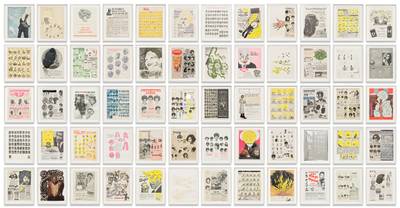
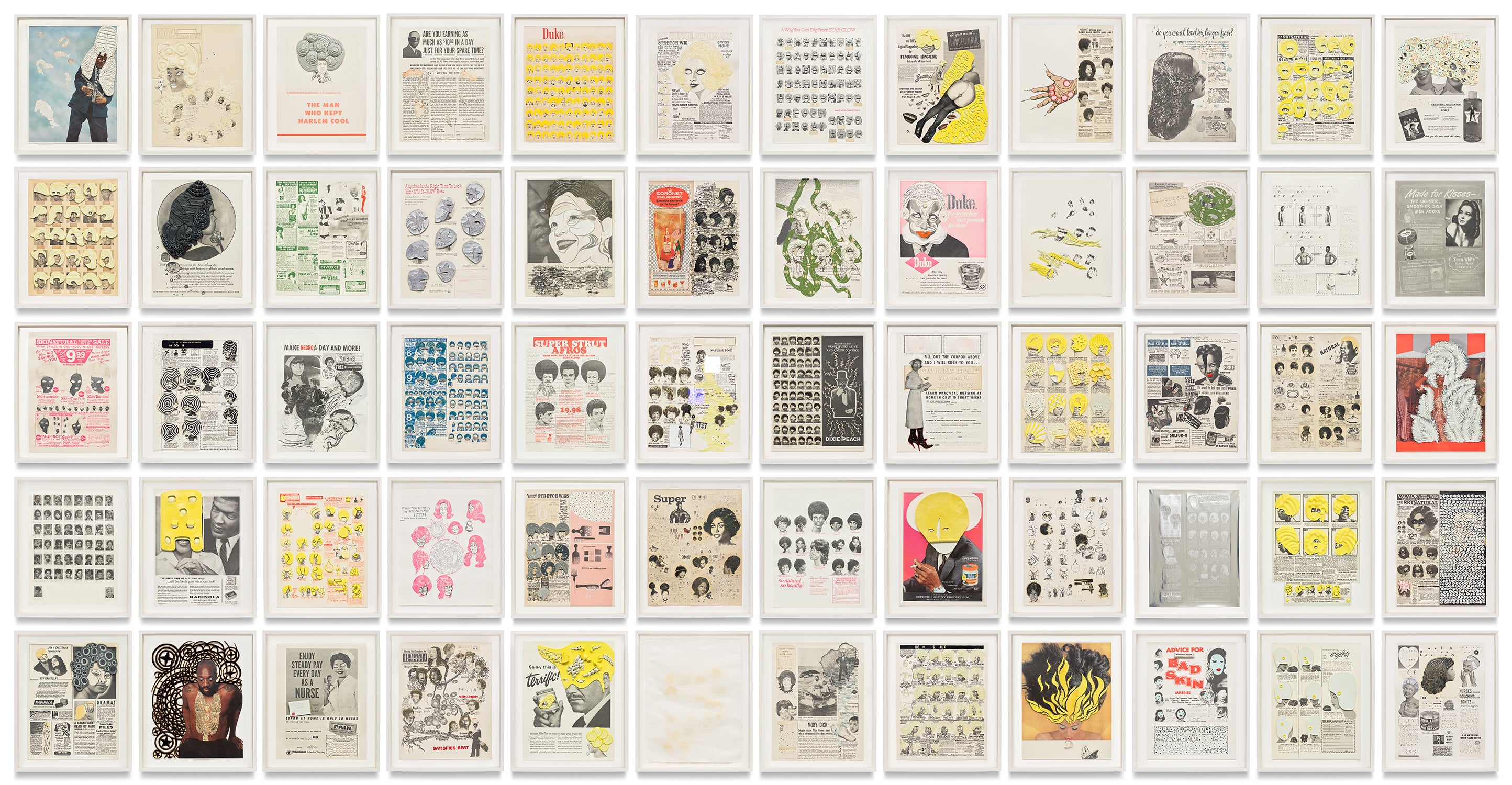
DeLuxe
She studied at the School of the Museum of Fine Arts in Boston and later at Skowhegan School of Painting and Sculpture in Maine, two formative experiences that grounded her in the rigorous tradition of American painting while leaving ample room for the conceptual ambitions that would define her mature work. Providence and Boston shaped her sensibility, but it was her eventual move to Rotterdam, where she has long maintained a studio alongside her work in New York, that gave her practice a genuinely transatlantic perspective. Her early paintings from the late 1980s and early 1990s drew immediately on the formal language of American abstraction, particularly the cool, systematic approaches associated with Agnes Martin and Brice Marden, but Gallagher was always layering something more charged beneath the surface. She began incorporating penmanship paper, the kind used to teach schoolchildren handwriting, as both a literal and metaphorical ground.
The lined paper, with its implicit promise of discipline and correct formation, became a site onto which she applied her signature motifs: tiny rendered eyes, lips abstracted into near illegibility, subtle markings that accumulated into something deeply personal and politically alive. The grid, that most neutral of modernist devices, was quietly colonized by history. The development of her print practice represents one of the most significant chapters in her artistic evolution. The complete portfolio known as DeLuxe, a monumental set of 60 printed objects produced with extraordinary technical range including aquatint, drypoint, photogravure, spit bite, lithography, screenprint, embossing, tattoo machine engraving, and laser cutting, alongside collage, crystals, cut paper, gold leaf, pomade, toy eyeballs, watercolor, and velvet, stands as one of the landmark achievements in contemporary printmaking.
Ellen Gallagher
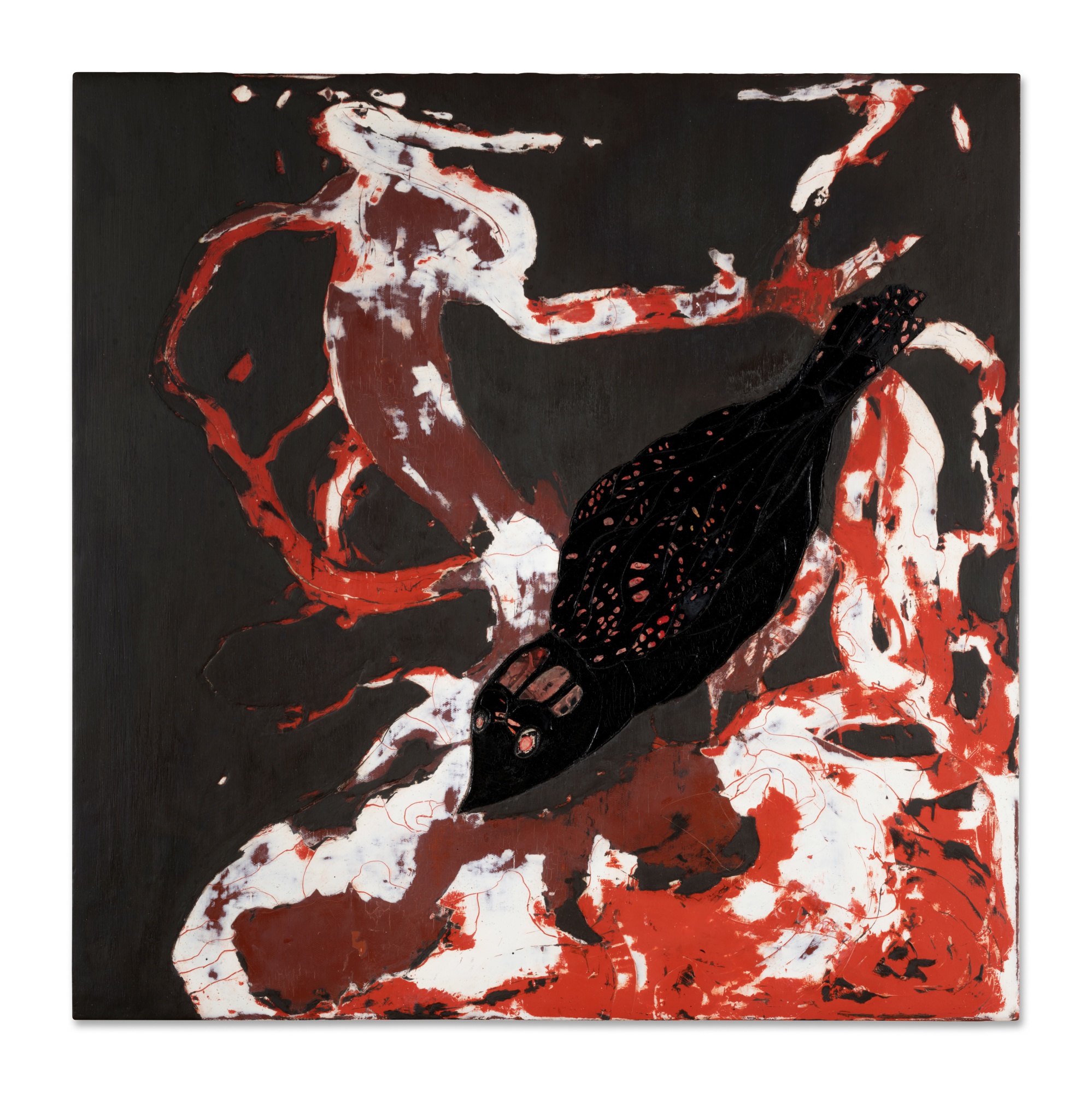
Racketeer, 2013
Each sheet in DeLuxe reworks imagery sourced from mid century African American beauty and lifestyle publications, transforming advertisements for hair pomades, wigs, and cosmetics into something luminous, strange, and profoundly moving. The portfolio holds together as a unified meditation on aspiration, transformation, and the beauty culture that both constrained and sustained Black communities in postwar America. Individual works within this broader body demonstrate Gallagher's remarkable range. Abu Simbel, from 2005, combines photogravure with watercolor, color pencil, varnish, pomade, blue fur, gold leaf, and crystals, invoking the ancient Egyptian monuments while tethering that reach toward antiquity to the intimate, bodily materials of her recurring visual language.
Works like Bouffant Pride, Duke, and Ruby Dee carry names that resonate with cultural specificity and affection, treating their subjects with a tenderness that never collapses into nostalgia. Racketeer, from 2013, demonstrates her continued commitment to painting as a medium, layering oil, ink, and paper collage on canvas in compositions that feel both urgently present and sedimented with time. Eclipse, an earlier work from 1999 in oil, ink, and graphite on paper, reveals how long she has sustained this conversation between the physical and the conceptual, the abstract and the deeply particular. For collectors, Gallagher's work occupies a genuinely distinctive position in the market.
Ellen Gallagher
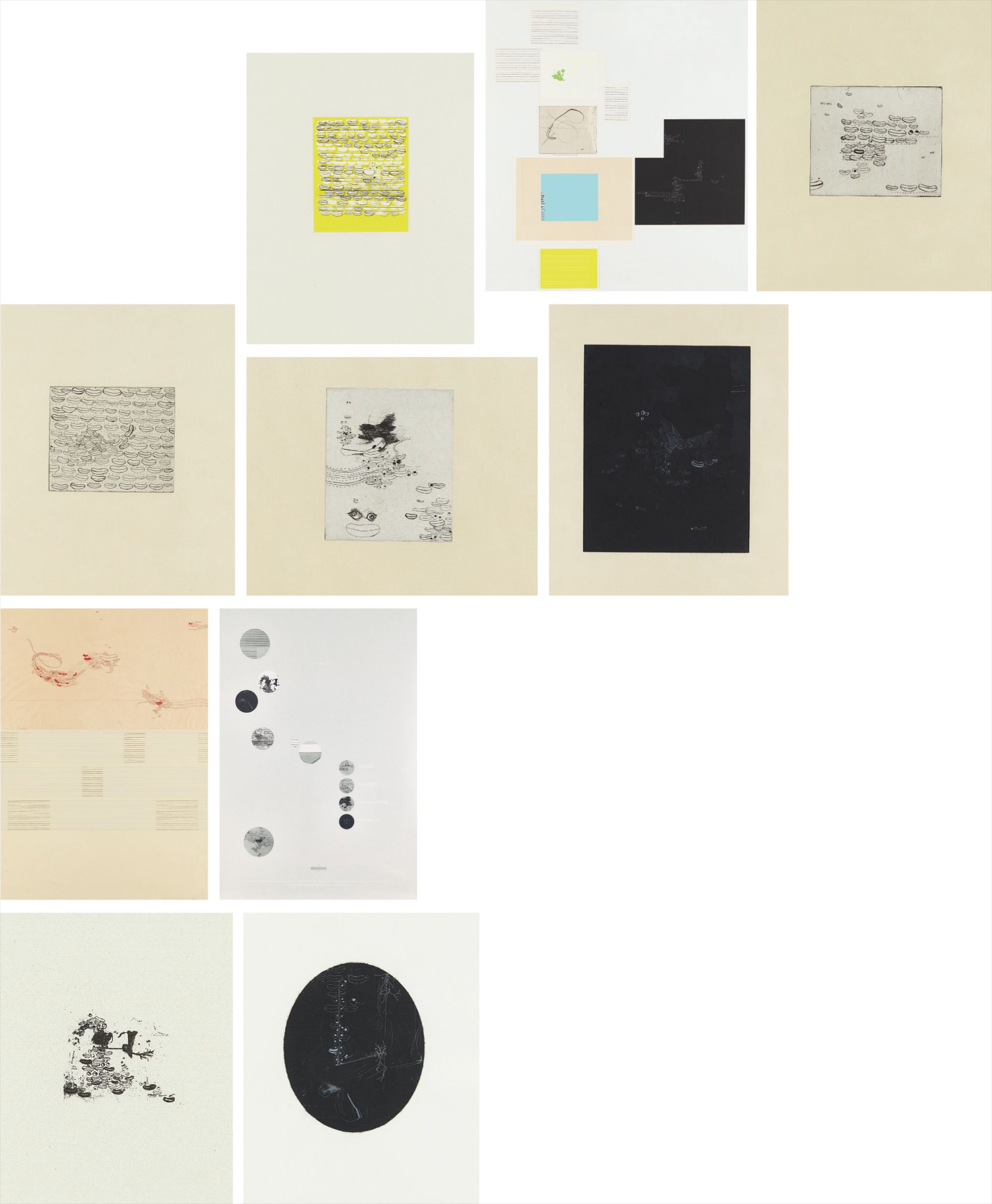
Ssblak!Ssblak!!Ssblakallblak!Wonder#9
Her prints, particularly those from the DeLuxe portfolio and related photogravure works, offer an accessible point of entry into a practice whose painted works command significant attention at auction and in the primary market. Works from the DeLuxe series have appeared at major auction houses including Christie's and Sotheby's, where they have attracted serious collector interest. What distinguishes Gallagher in a collecting context is the sheer material richness of even her works on paper: the addition of pomade, plasticine, toy eyeballs, or hand shaped elements means that each object carries a physical specificity that photographic reproduction cannot fully convey. Seeing the work in person, understanding how gold leaf sits against velvet or how plasticine forms are hand shaped by the artist herself, transforms the experience entirely.
Collectors who engage with Gallagher's practice on those terms tend to become deeply committed. In the broader context of art history, Gallagher belongs to a generation of artists who fundamentally expanded what abstract painting could carry. She is frequently discussed alongside artists such as Kara Walker, whose engagement with silhouette and the antebellum archive shares something of Gallagher's approach to historical material, and Glenn Ligon, whose text based paintings similarly inhabit the space between formal austerity and charged content. She is also in productive conversation with artists working in the expanded field of printmaking, and her sustained engagement with Afrofuturism as a conceptual framework connects her to a broader cultural moment in which those ideas have moved from the margins to the center of serious critical discourse.
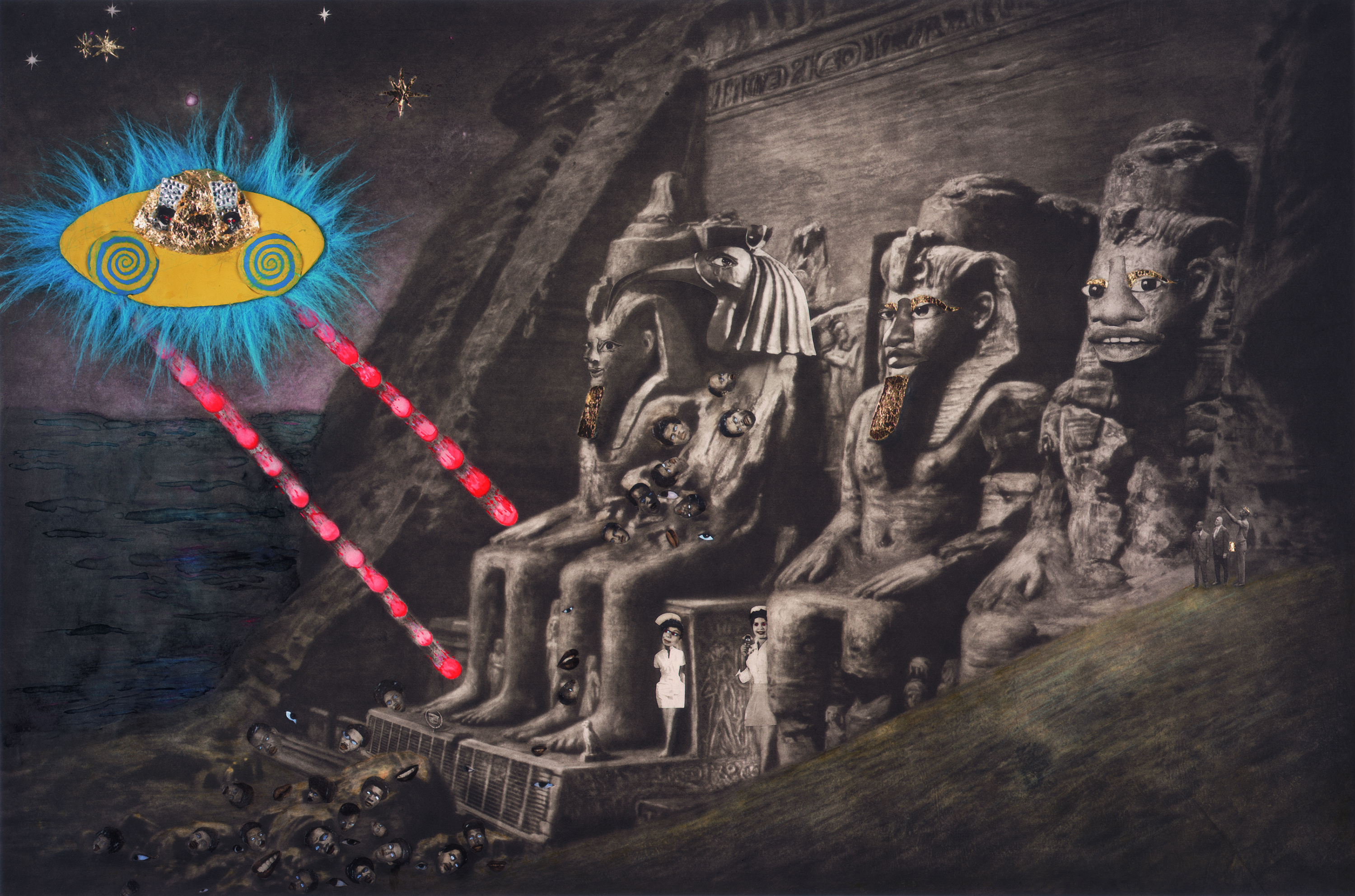
Ellen Gallagher
Abu Simbel, 2005
Gallagher's legacy is already secure, but it continues to grow. The richness of her archive, the technical ambition of her print practice, and the sustained intellectual coherence of a body of work that encompasses painting, drawing, video, and works on paper across more than three decades make her an essential figure for any serious engagement with contemporary art. She has shown at the Whitney Museum of American Art, the New Museum in New York, and Tate Modern in London, among many other institutions, and her work has entered significant public and private collections worldwide. What feels most important, looking across the full sweep of her practice, is the quality of attention she asks of us: the invitation to look slowly, to follow a thread of imagery across decades, and to understand that beauty and history are not opposites but collaborators.
Explore books about Ellen Gallagher