Ella Kruglyanskaya
Ella Kruglyanskaya Makes Womanhood Magnificently Visible
Artist Spotlight · The Collection Editorial
In recent seasons, Ella Kruglyanskaya has arrived at something close to a cultural crescendo. Her solo exhibitions at Gavin Brown's Enterprise in New York and Galerie Buchholz have drawn sustained critical attention, and her paintings now hold prominent positions in museum collections and significant private holdings across Europe and the United States. The art world has caught up with what her most devoted admirers have long understood: that Kruglyanskaya is one of the most original and intellectually rigorous painters working today, and that her particular vision of feminine experience is not a footnote to contemporary figuration but one of its defining chapters. Kruglyanskaya was born in 1978 in Latvia, then still part of the Soviet Union, and emigrated to the United States as a young woman, eventually settling in New York.
Ella Kruglyanskaya
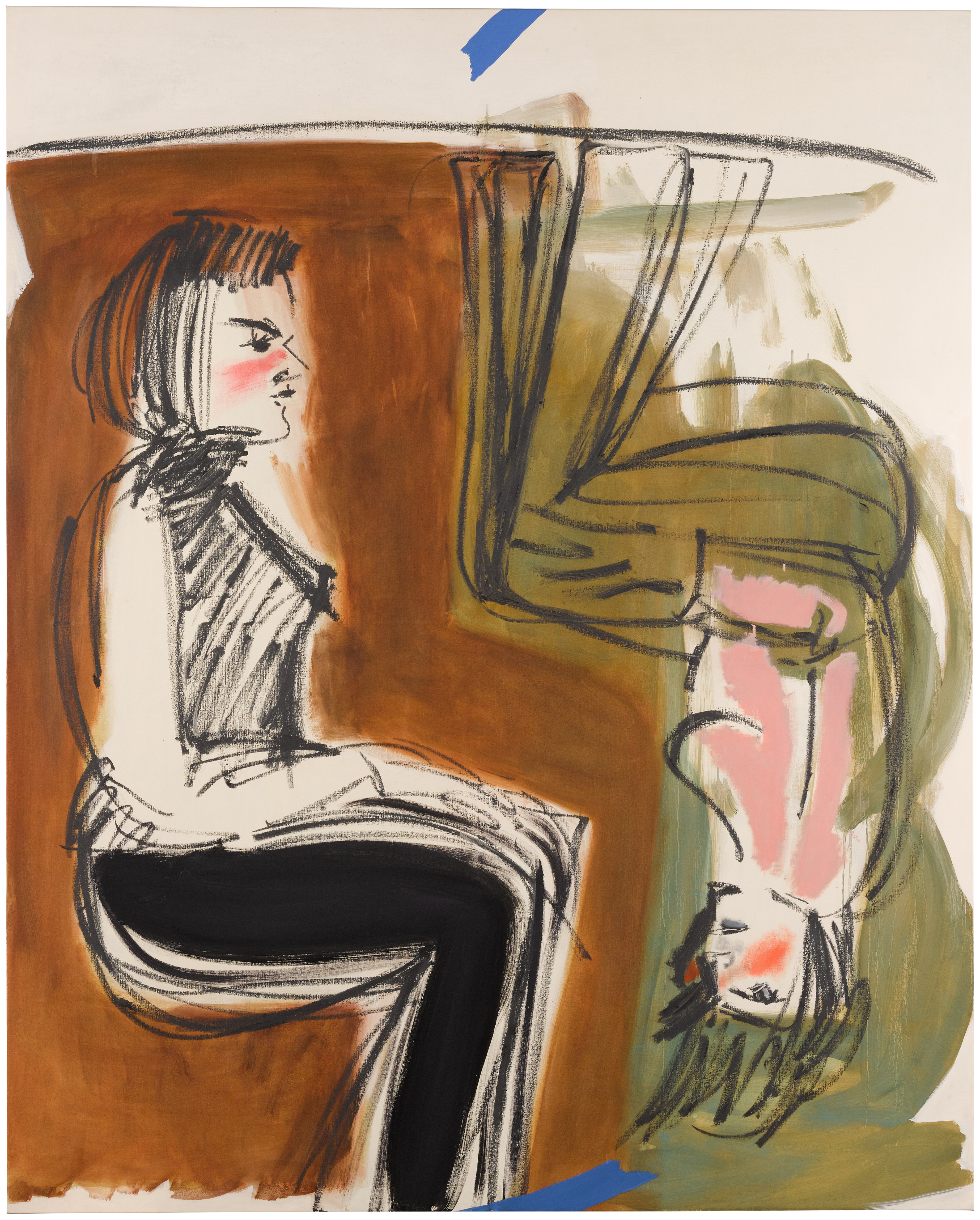
Upside Down
That biographical arc, from the Baltic to Brooklyn, carries real weight in understanding her practice. Growing up surrounded by Soviet graphic design, propaganda posters, and the flattened visual rhetoric of state imagery gave her an early education in the power of simplified form and declarative color. When she encountered the traditions of Western modernism and the long lineage of fashion illustration, she had the tools to synthesize rather than simply absorb. The result is a sensibility that feels genuinely singular: knowing about visual history without being imprisoned by it.
She studied at the Rhode Island School of Design and later at Yale School of Art, where she completed her MFA. Yale in particular sharpened her thinking about painting as a critical practice, a place where formal decisions carry conceptual consequences. Her peers and instructors there were engaged in urgent conversations about representation, the body, and the politics of looking, and Kruglyanskaya absorbed those conversations without surrendering her instinct for pleasure and visual wit. From early in her career she was unafraid of beauty, and unafraid of the decorative, treating both not as concessions but as instruments of inquiry.
Ella Kruglyanskaya
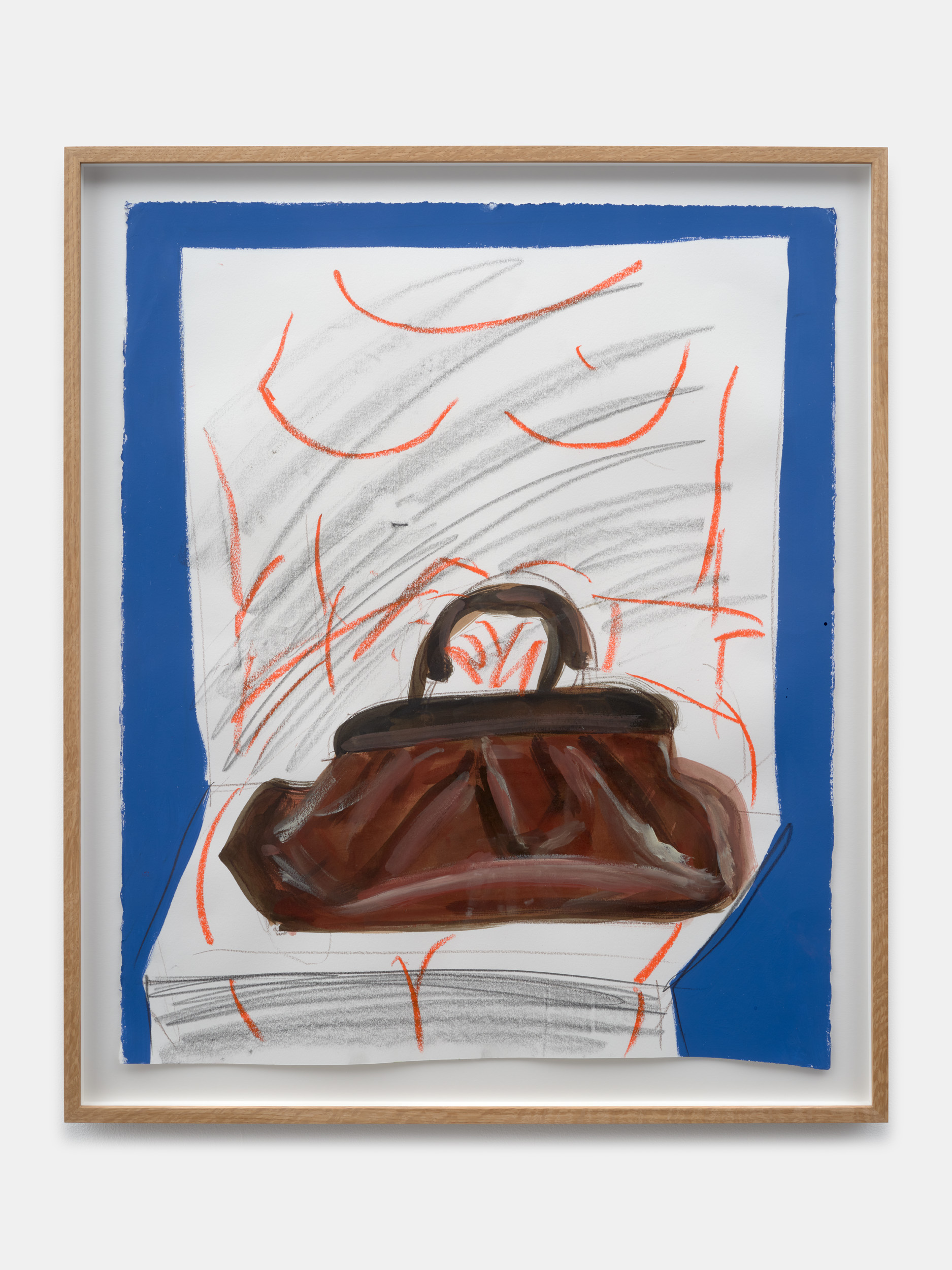
Untitled (Purse on Torso in Red), 2023
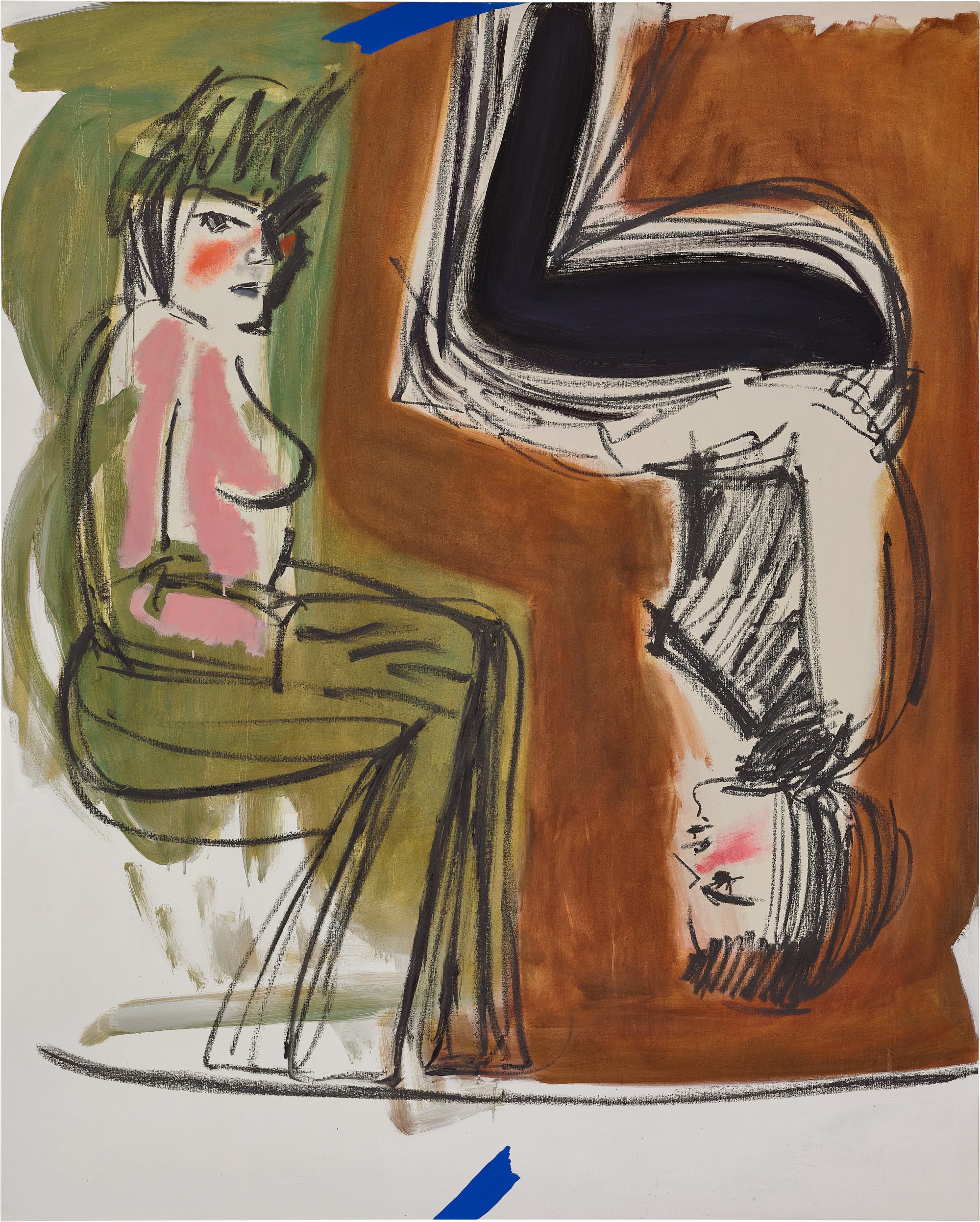
The development of her signature style across the 2010s marked a breakthrough moment in contemporary painting more broadly. Her figures, almost exclusively women, are rendered with thick, confident outlines and compressed pictorial space. Color operates at a near maximum in her canvases: acid yellows, deep teals, burning reds, flesh tones that tip into the theatrical. These are not portraits in any conventional sense.
The women in her paintings perform, lounge, labor, pose, and stare back. They are aware of being looked at, and that awareness is not passive. Works from this period such as Peeking Bather from 2012 and Menu from 2012, executed in oil and oilstick on canvas, demonstrate how early she had arrived at a fully formed visual language. The bather peeks from behind a barrier with an expression that manages to be both coy and confrontational, encapsulating Kruglyanskaya's abiding interest in the theater of feminine self presentation.
Ella Kruglyanskaya
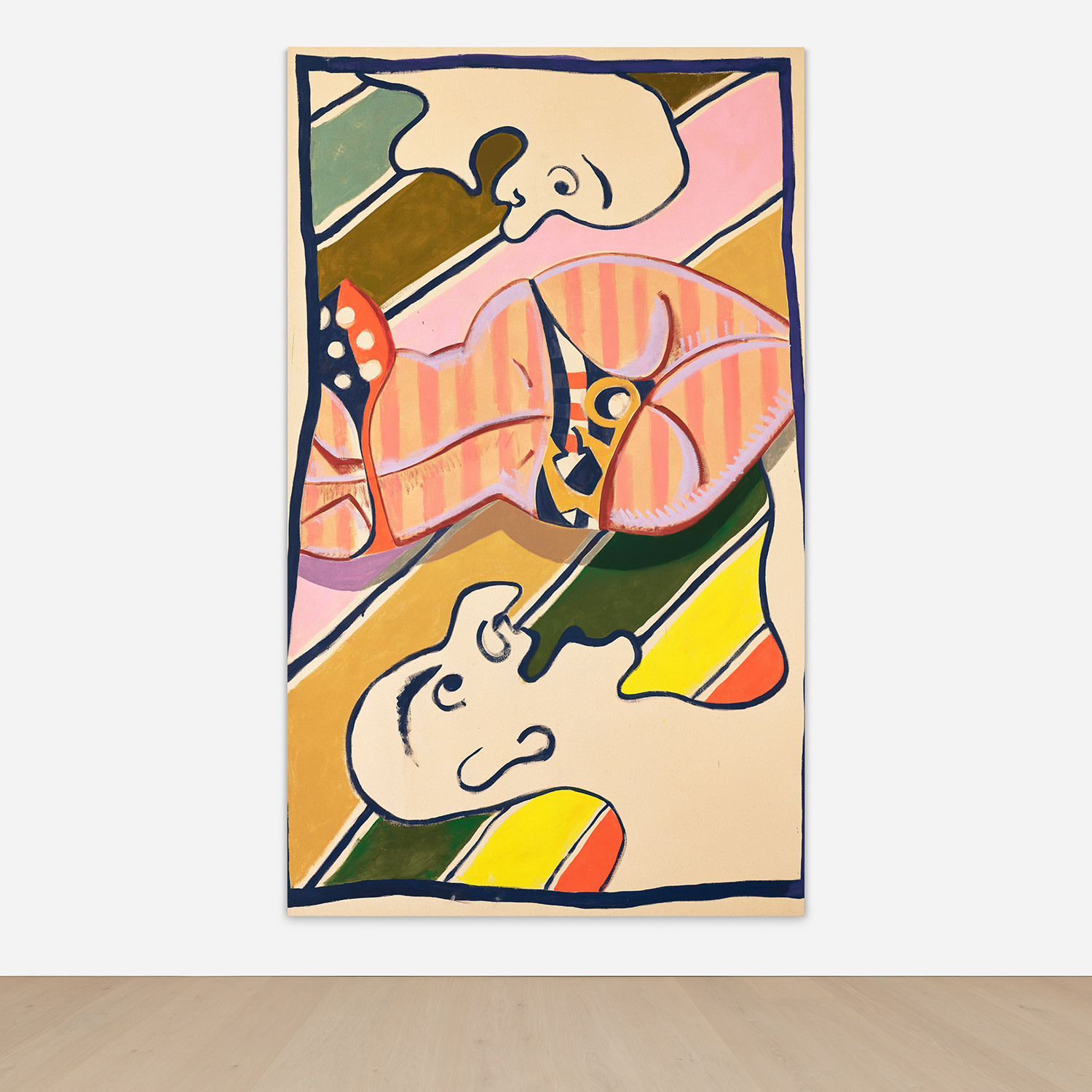
Staring Contest, 2014
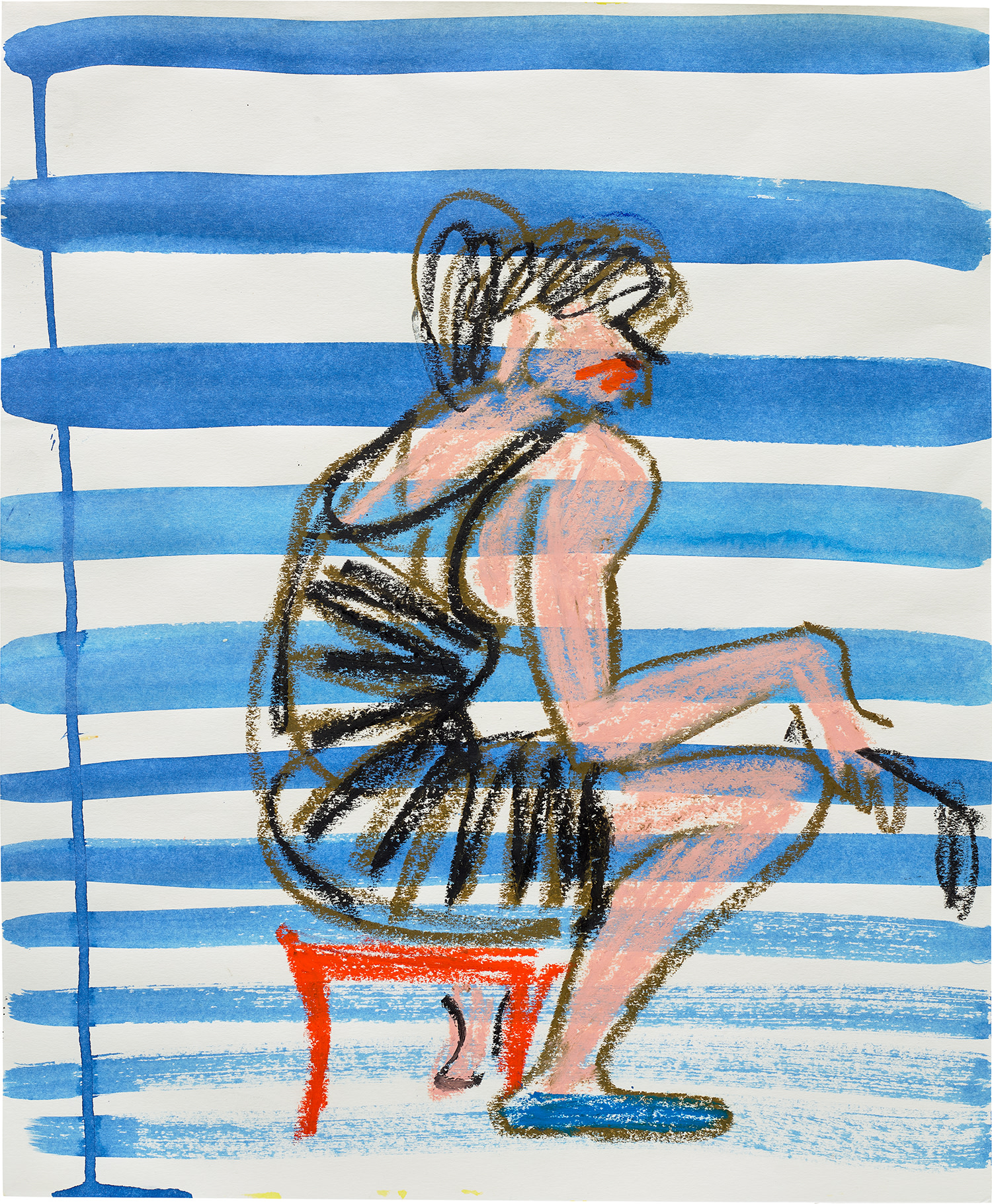
The Staring Contest from 2014 is among her most discussed works and offers an especially clear window into her method. Two figures face one another and, by extension, face the viewer, in an arrangement that turns looking into a kind of standoff. The flatness of the image is not a limitation but a rhetorical strategy: it strips away the atmospheric depth that traditionally draws a viewer into a painting and replaces it with a frontal address that is almost confrontational. By 2018, works like Painter, Blue Stripes and Fish, Yellow, Bikini showed a continued willingness to move between media, with water based paint and oil pastel on paper sitting comfortably alongside her larger canvases and demonstrating that her draftsmanship was as commanding as her ability to command a large surface.
Woman in Purse from 2020 continued this thread, playing with scale and surrealist spatial logic in ways that feel simultaneously funny and genuinely strange. For collectors, Kruglyanskaya occupies a compelling position in the current market. Her works on paper offer a point of entry into a practice whose larger canvases have become increasingly sought after, and the range of scale and medium in her output means there is genuine depth to explore across a collection. Works like Untitled (Purse on Torso in Red) from 2023, rendered in water based paint and pastel on paper, demonstrate that her smaller works carry the full force of her ideas.
Ella Kruglyanskaya
Painter, Blue Stripes, 2018
Auction results over recent years have reflected a growing consensus that her primary market prices, which climbed steadily through the 2010s, were not speculative but grounded in real critical substance. Collectors who came to her early, drawn by the wit and the graphic confidence of the work, have found that the paintings reward sustained living with in a way that more fashionable painters sometimes do not. In the broader landscape of contemporary figuration, Kruglyanskaya belongs to a generation that includes painters like Nicole Eisenman, Dana Schutz, and Cecily Brown, artists who have reclaimed figuration as a site of genuine critical ambition rather than mere reaction against abstraction. But her specific debts are perhaps more eclectic: she has spoken about her admiration for the mid century illustrators who filled the pages of American magazines, for Fernand Léger's hard edged figuration, and for the propagandistic clarity of Soviet poster art.
Those references coexist without friction in her canvases because she has fully metabolized rather than simply quoted them. She is in conversation with the history of how women have been pictured, and she is firmly on the side of the women doing the picturing. What Kruglyanskaya offers the culture right now is something genuinely valuable: a vision of femininity that is neither victimized nor sanitized, that is loud and knowing and fully at home in its own visual pleasure. Her women want things, occupy space, and sometimes look back with an expression that suggests they find the whole situation slightly amusing.
In a moment when painting continues to assert its relevance, she makes an argument not through theory but through the undeniable fact of the canvases themselves. To encounter her work in person, whether a large oil on linen or a small but vivid work on paper, is to feel the full force of a practice built on both deep seriousness and an infectious joy in the act of making images.