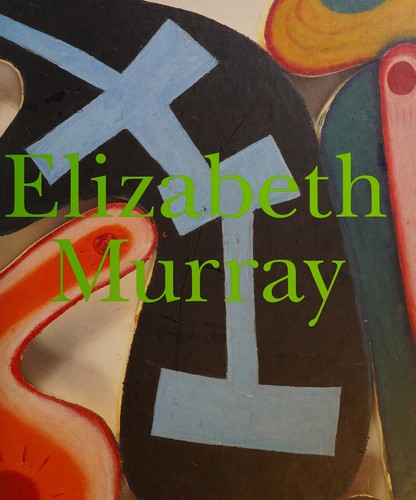
Elizabeth Murray
Elizabeth Murray: Shape, Joy, and Reinvention
Artist Spotlight · The Collection Editorial
“I want the painting to be something you feel is almost alive, something that has a presence, like a person in the room.”
Elizabeth Murray, interview with Robert Storr
When the Museum of Modern Art mounted its major retrospective of Elizabeth Murray's work in 2005, the art world was reminded of something it had perhaps taken for granted: that one artist could hold abstraction and emotion, humor and formal rigor, all at once, and make it feel completely natural. The exhibition, titled "Elizabeth Murray," traveled with the weight of a career that had spent four decades defying easy categorization. Curated by Robert Storr, it gathered paintings, prints, and works on paper that together told the story of an artist who had pushed the physical boundaries of the canvas itself, folding and fragmenting and reassembling the picture plane until it became something altogether new. Standing in those galleries, viewers encountered not just paintings but presences, objects that seemed to lean into the room with a kind of irrepressible energy.
Elizabeth Murray
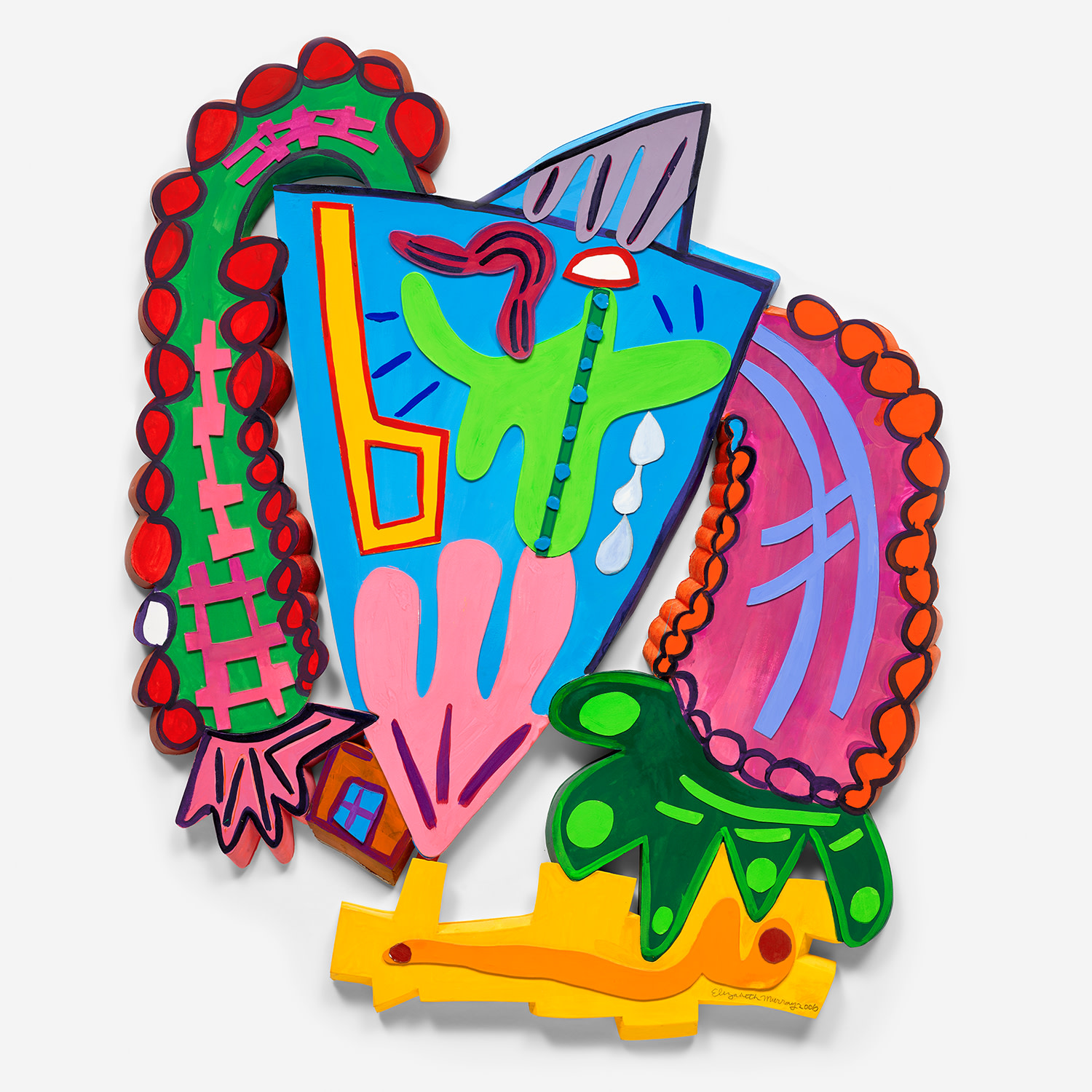
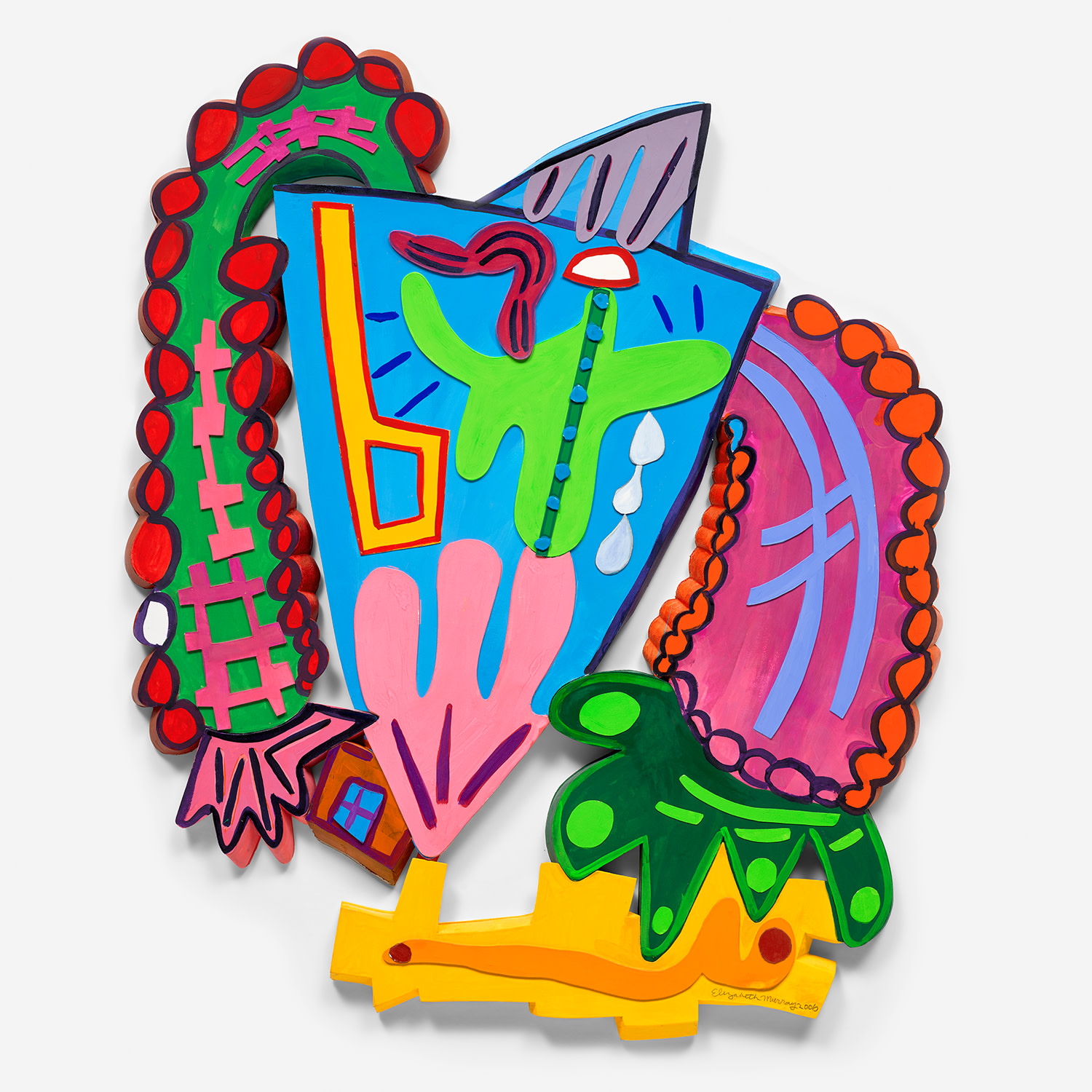
Pico, 2006
Murray was born in Chicago in 1940 and grew up in a working class household where art was not a given but became, for her, an early and urgent necessity. She studied at the School of the Art Institute of Chicago, where she encountered the legacy of American modernism and began to understand painting as a discipline with its own rigorous internal logic. She later attended Mills College in Oakland, California, earning her MFA in 1964, a formative period during which the tensions between abstraction and representation, between the painted surface and the physical object, were very much alive in the culture around her. She moved to New York City in 1967, and the city became both her subject and her sustaining environment for the rest of her life.
New York in the late 1960s and early 1970s was a crucible for painters willing to question the premises of painting itself. Minimalism had stripped the canvas down to its essential conditions, and Conceptual art was asking whether the object was necessary at all. Murray absorbed these arguments but arrived at a different conclusion: that painting was worth saving, and that saving it required breaking it open. Through the 1970s she developed a vocabulary of fragmented, interlocking shapes, domestic objects rendered in bold, cartoonish outlines, coffee cups, tables, hands, shoes, that arrived at the picture plane as if caught mid transformation.
Elizabeth Murray
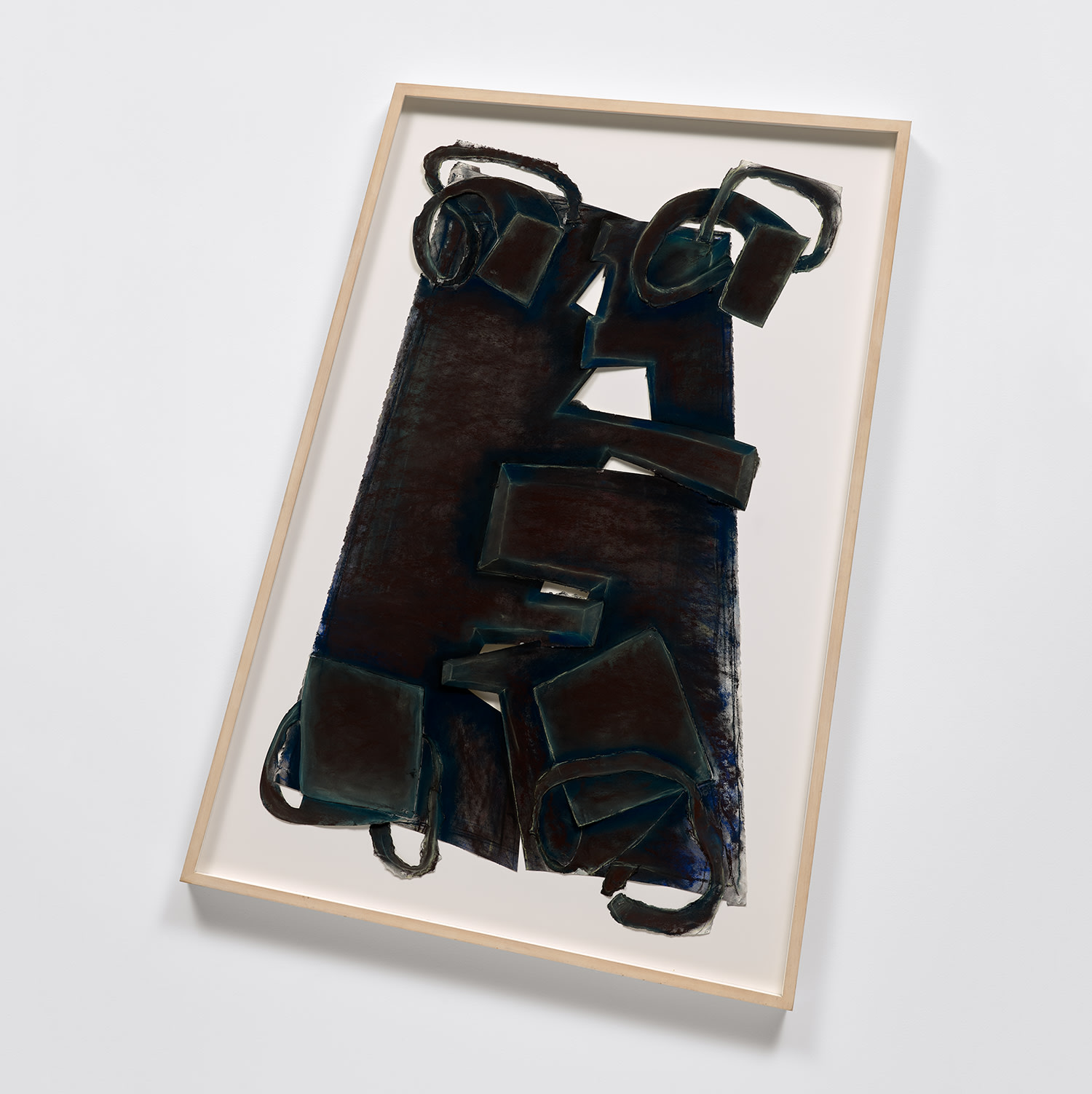
Crumpled Table, 1988
Her palette was fearless, built from unexpected color combinations that owed something to comics, something to Matisse, and everything to her own instincts. The shaped canvas became Murray's signature contribution to the history of painting, and she pursued it with increasing ambition through the 1980s and 1990s. Rather than working within a rectangular frame, she constructed canvases that billowed and jutted, that overlapped and interlocked across the wall in multi panel configurations. "2.
“I am trying to make paintings that show how confused and tangled up feelings are.”
Elizabeth Murray
B.!," her oil on canvas work executed on an artist constructed stretcher, exemplifies this approach: the canvas itself is an argument, a proposition about what a painting can occupy in space. "Crumpled Table" from 1988, rendered in pastel on paper and presented in a frame of her own making, demonstrates that even her works on paper refused the passive role of documentation. They were finished, fully realized objects with opinions about their own presentation.
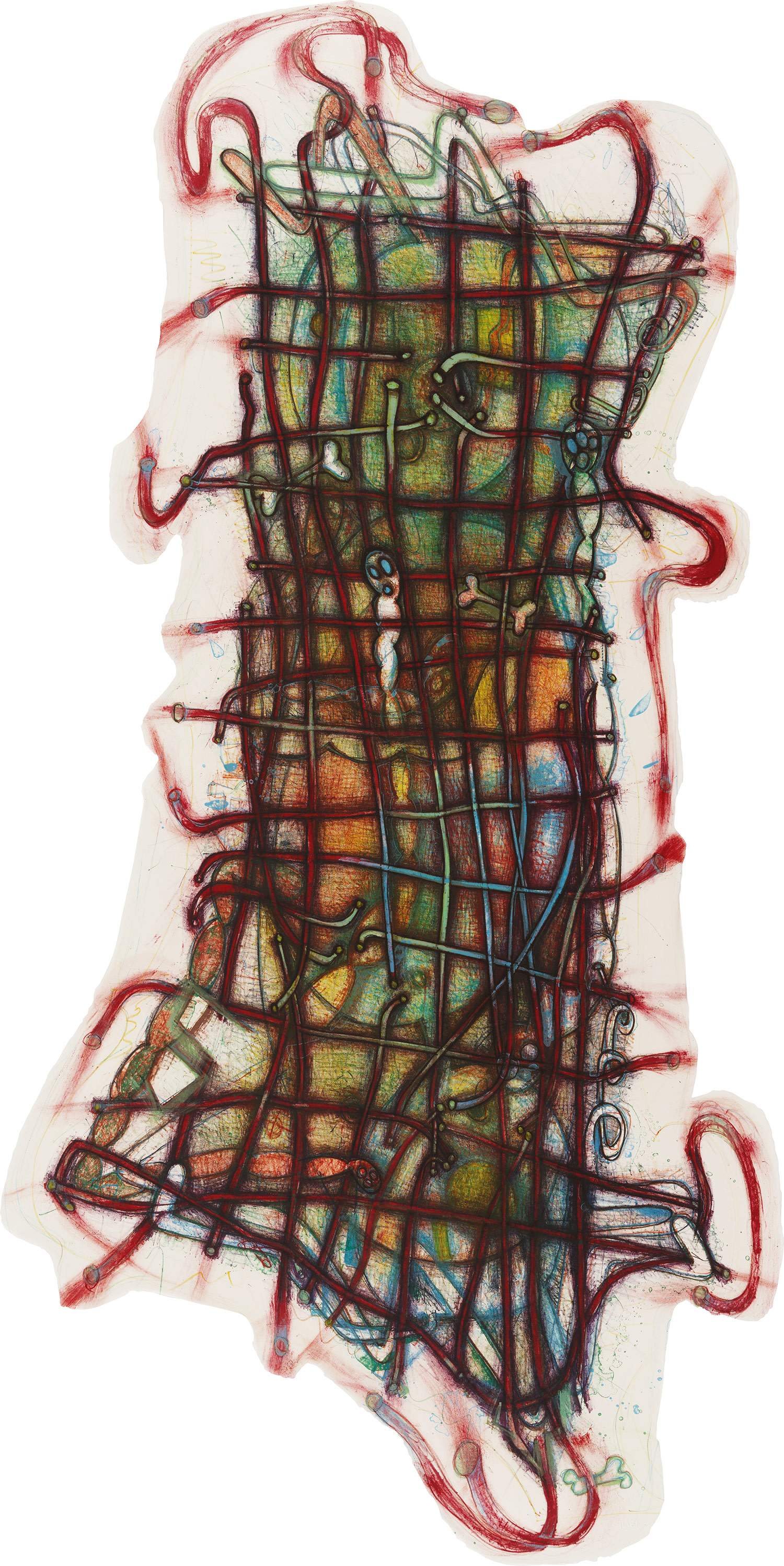
Elizabeth Murray
Wiggle Manhattan
By the late 1980s her work was being acquired by major institutions including the Whitney Museum of American Art, the Art Institute of Chicago, and the Carnegie Museum of Art, affirming what her admirers had long felt: that she was among the essential painters of her generation. Murray's printmaking practice deserves particular attention from collectors, because it represents one of the most sustained and inventive engagements with the medium by any painter of her era. Working with the print publisher Universal Limited Art Editions, known as ULAE, she produced a body of lithographs, etchings, and aquatints that extended her painted ideas into new technical territory. Works like "Undoing (K.
24)," a lithograph, etching and aquatint printed in colors on three sheets of shaped Somerset paper, and "Up Dog (K. 18)," a lithograph on fourteen sheets of wove paper mounted to support, demonstrate the extraordinary lengths to which she took the medium. The shaped paper, the multi sheet compositions, the layers of color achieved through painstaking registration: these are not reproductions of paintings but independent achievements, and they reward close study. "Snake Cup (K.
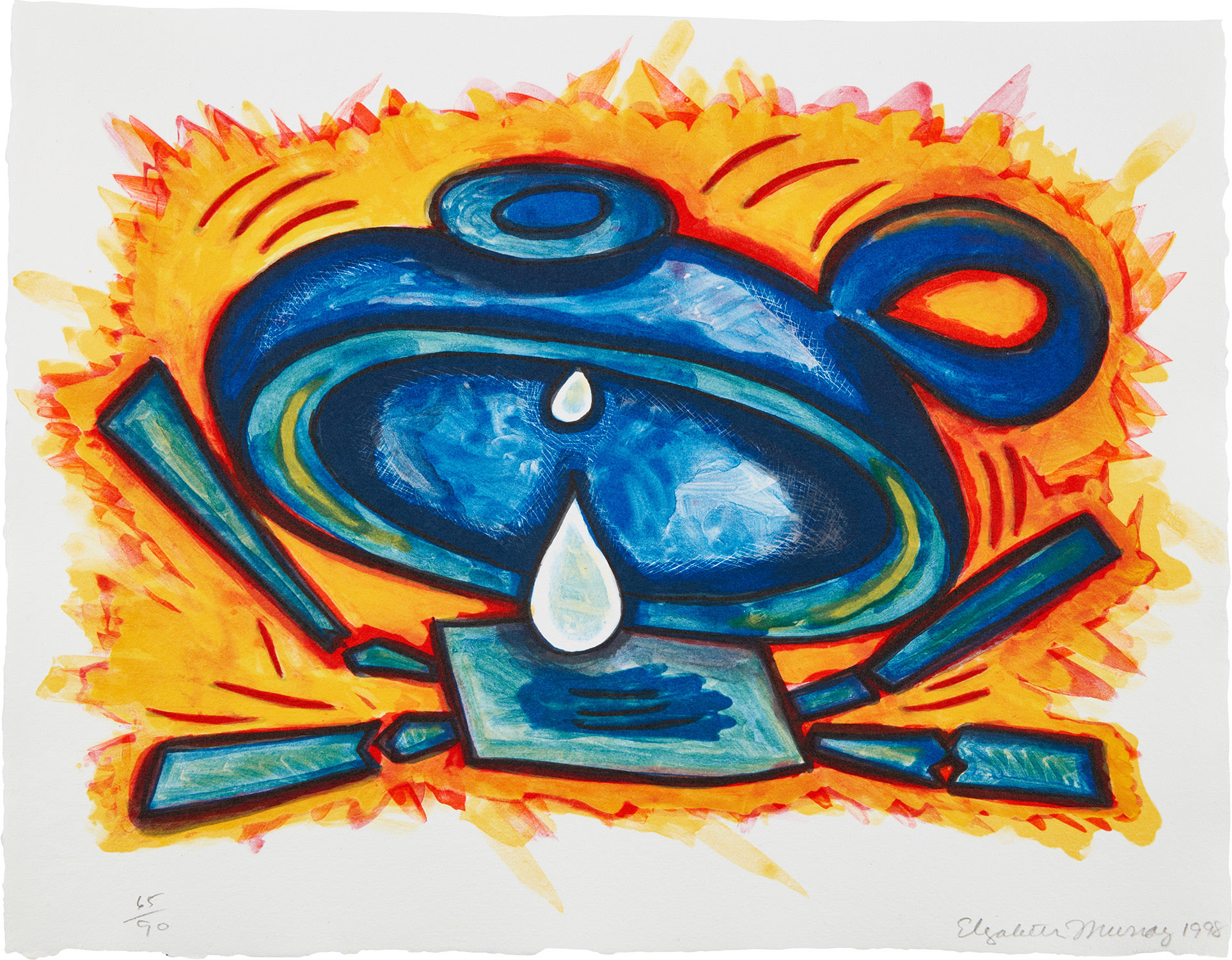
Elizabeth Murray
Charlotte (Poetry Project Print)
11)" and "Charlotte (Poetry Project Print)" each carry the full force of her vision in a format that collectors at various levels of the market can engage with seriously. The market for Murray's work has strengthened considerably since her death in 2007, reflecting both the critical reassessment of painting from the 1980s and a broader recognition of her singular place in that history. Her major paintings have achieved significant results at auction, with institutions and serious private collectors competing for works that rarely come to market. For collectors approaching her practice, the prints and works on paper offer an accessible and genuinely important entry point.
The shaped prints in particular, works like "Wiggle Manhattan" on its formed handmade Torinoko paper, are not peripheral to her achievement but central to it. Her late work, including the three dimensional assemblage "Pico" from 2006, constructed from hand carved and hand painted foam in the final year of her life, shows an artist still expanding her sense of what a made object could be and do. Collectors who seek works that sit at the intersection of art historical significance and genuine daily pleasure will find Murray consistently rewarding. In terms of her art historical context, Murray occupies a position alongside painters who similarly refused the false choice between feeling and form.
Her work invites comparison with that of Jennifer Bartlett, whose systematic but emotionally loaded paintings were also reshaping what painting could mean in the 1970s and 1980s. She shares something with Carroll Dunham in her embrace of cartoon imagery as a vehicle for genuine psychological content, and with Frank Stella in her insistence that the physical structure of the painting was itself a subject. But Murray remains irreducibly herself, an artist whose humor was never a deflection and whose formal inventions always served an expressive rather than a theoretical end. She was a painter who loved painting, and it showed in every decision she made.
The legacy of Elizabeth Murray is still being written, which is part of what makes collecting her work feel urgent rather than retrospective. Younger painters working today in shaped canvas, in bold color, in imagery that moves between the domestic and the abstract, are working in a space she helped open. Museums continue to look at her prints and paintings with fresh eyes, and scholars are deepening the account of her contribution to postwar American art. To live with a Murray is to live with an artist who was genuinely alive in the making of the work, who brought wit and seriousness and a kind of joyful stubbornness to every surface she touched.
That quality does not diminish over time. It accumulates.
Explore books about Elizabeth Murray