Edward Hopper
Edward Hopper: America's Poet of Light
Artist Spotlight · The Collection Editorial
“If I could say it in words, there would be no reason to paint.”
Edward Hopper
There is a moment, standing before Edward Hopper's work, when the world goes quiet. It happened most powerfully in 2023 when the Museum Fine Arts Boston mounted a celebrated survey of Hopper's works on paper, drawing record attendance and reminding a new generation that this artist's vision is not merely historical but urgently, almost uncomfortably, alive. His paintings and prints speak to something permanent in the American experience, that particular texture of solitude that exists even in the middle of a crowd, even in broad daylight, even in a diner full of strangers. Hopper did not invent loneliness.
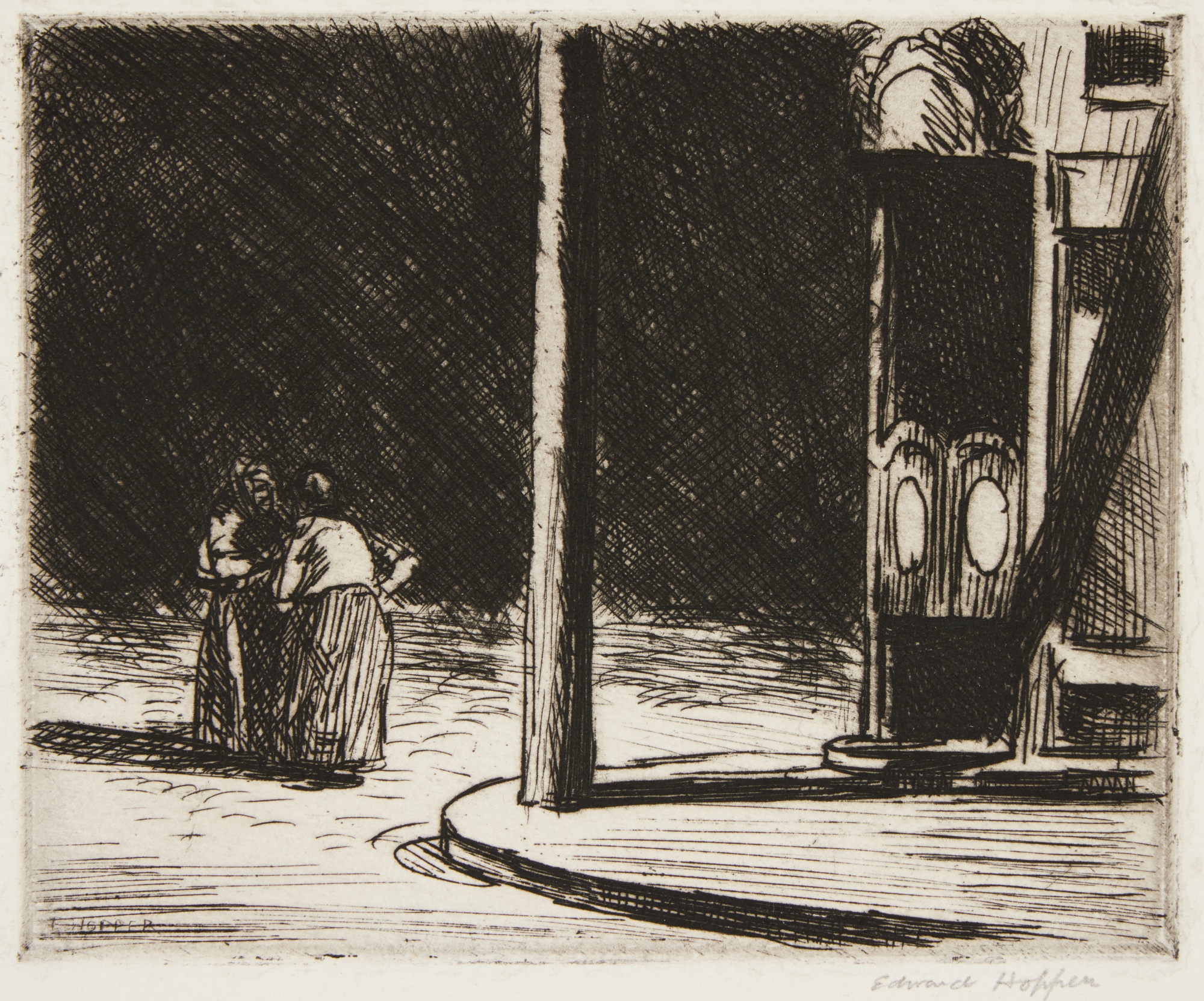
Edward Hopper
A Corner (Zigrosser 5; Levin 60), 1919
He simply made it beautiful, and in doing so, changed the way we see the world around us. Edward Hopper was born on July 22, 1882, in Nyack, New York, a small Hudson River town about thirty miles north of Manhattan. Nyack was a working community of sailors and merchants, and the landscape of the river, the quality of light off the water, the architecture of clapboard houses sitting against open sky, entered Hopper's visual memory early and never left. He showed talent as a draftsman from childhood, and his parents, supportive rather than dismissive of artistic ambition, enrolled him in the New York Correspondence School of Illustrating in 1899 before he transferred to the New York School of Art, where he studied under the legendary Robert Henri.
Henri was a galvanizing teacher, a painter of the Ashcan tradition who encouraged his students to look at real life rather than academic convention. Hopper absorbed that lesson fully and spent the rest of his career perfecting what it meant in practice. Hopper traveled to Europe three times between 1906 and 1910, spending extended periods in Paris at a moment when the city was electrified by modernism. He encountered Impressionism, Post Impressionism, and the bold experiments being made in light and color by artists working across France.
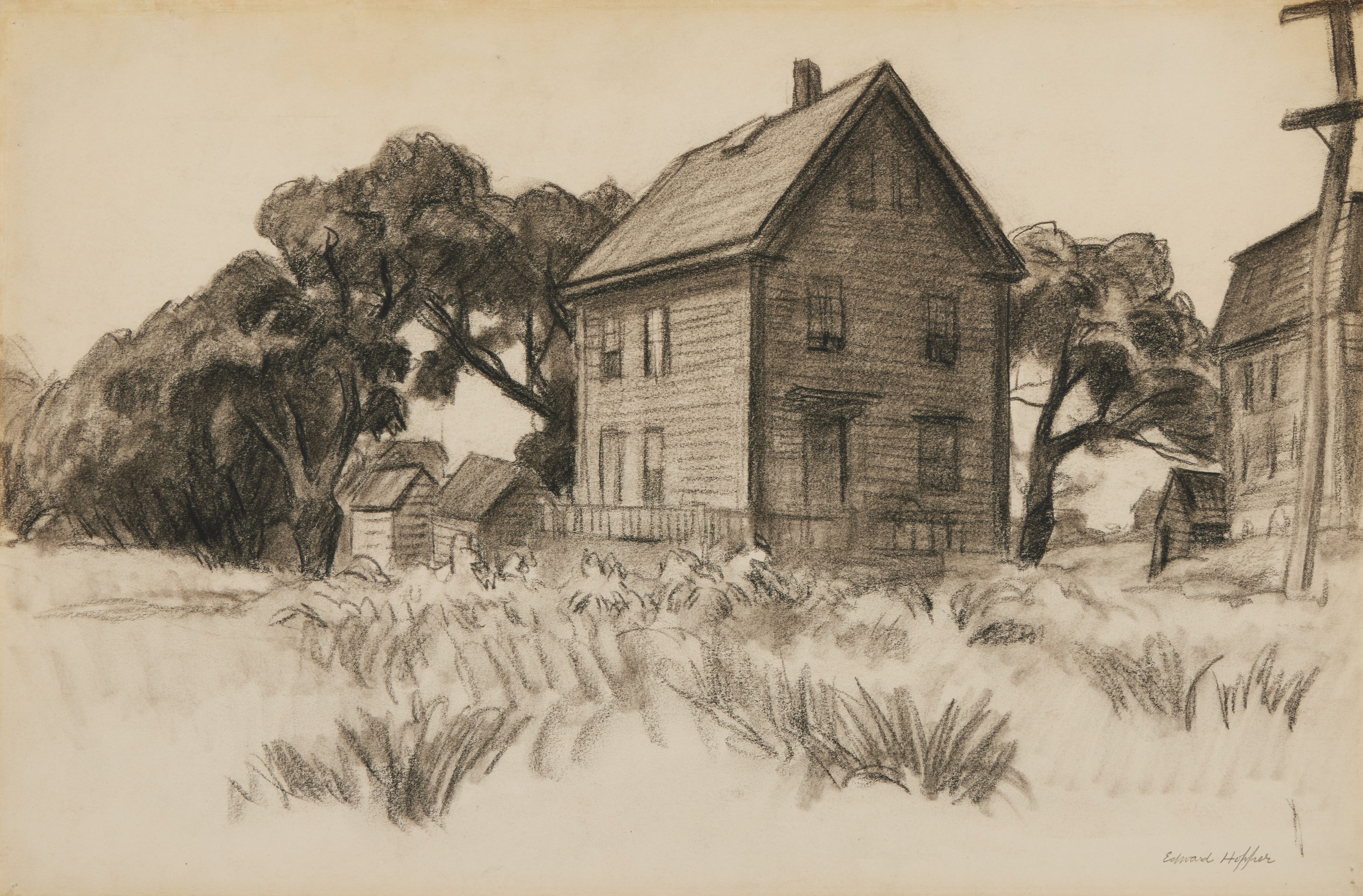
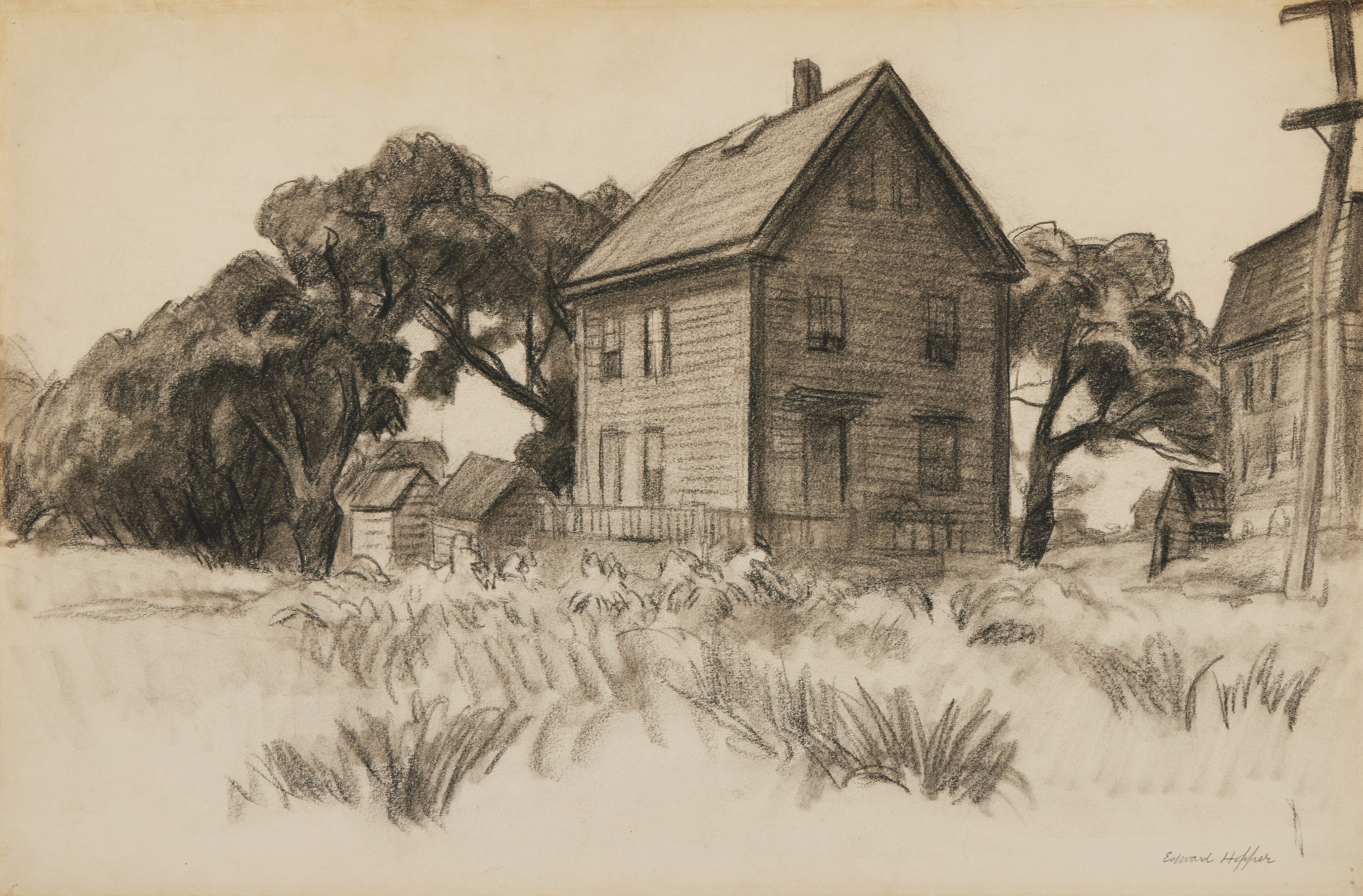
Edward Hopper
House and Field
Yet Hopper remained, by temperament and inclination, distinctly American. He admired the French painters for their command of light, particularly their understanding of how it falls across architecture and open space, but he was not seduced into adopting their idioms wholesale. He returned to New York and began forging something of his own, a style rooted in the particular quality of American light, American streets, and American psychological experience. It was a slower path to recognition than some of his peers enjoyed, but it was the right path.
“Great art is the outward expression of an inner life in the artist.”
Edward Hopper, Reality magazine, 1953
The years between his return from Europe and his breakthrough in the 1920s were spent largely as an illustrator, commercial work he tolerated but never loved. His printmaking during this period, however, reveals a serious artist at full creative pressure. The etchings and drypoints he produced in the late 1910s and early 1920s, many of which are represented among the works available on The Collection, show a mastery of tone, shadow, and architectural form that is remarkable. Works such as Night Shadows from around 1921 demonstrate his ability to transform an ordinary street corner, viewed from above, into a study in geometric drama and psychological unease.
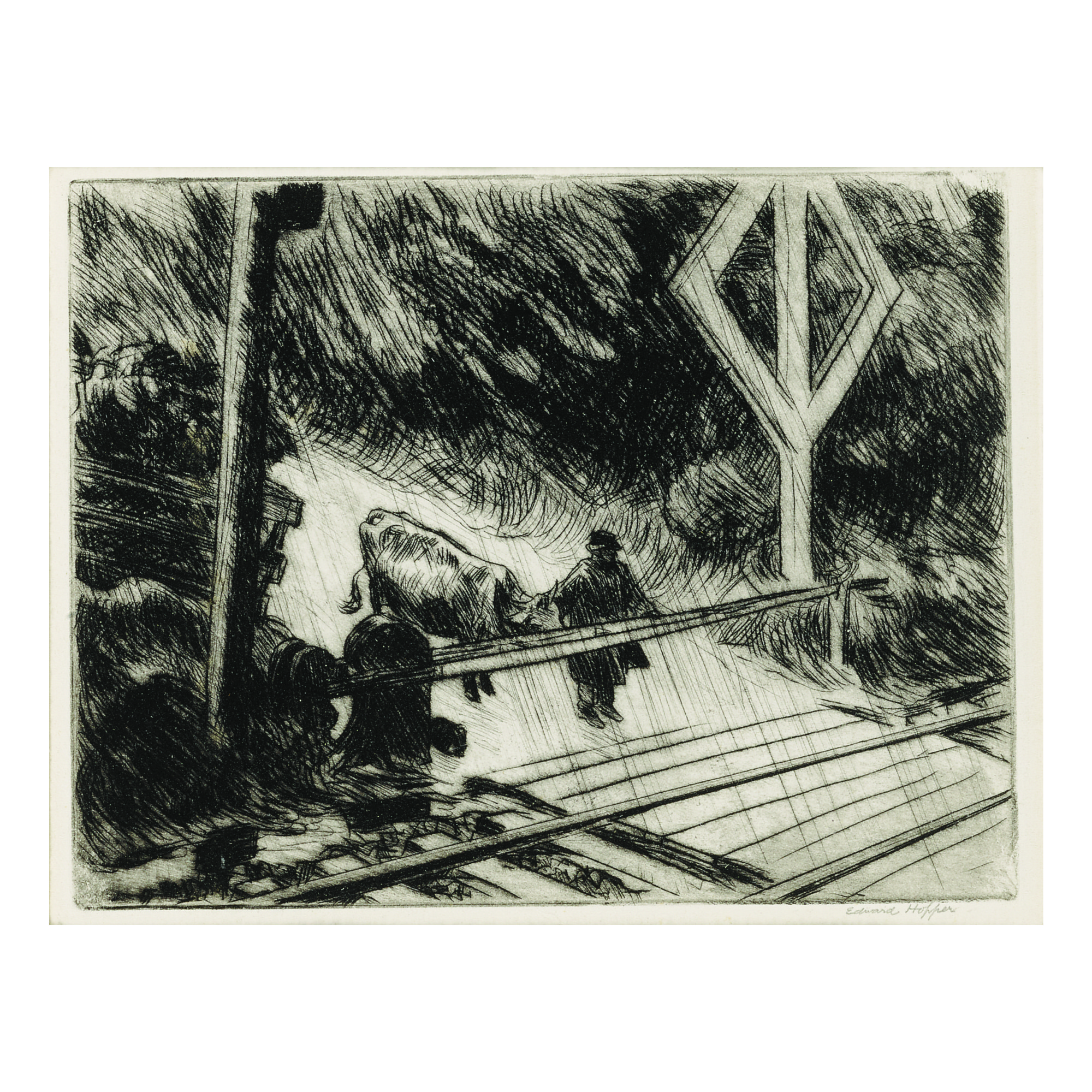
Edward Hopper
Railroad Crossing (l. 103; Z. 23)
Railroad Crossing, one of his most celebrated prints produced in 1923 and catalogued by both Zigrosser and Levin, uses the stark geometry of tracks, gates, and a solitary building to evoke the sense of a landscape that is both mundane and mysteriously charged. His etchings Les Deux Pigeons and A Corner from the same era show the full range of his printmaking sensibility, from the lyrical intimacy of Parisian scenes to the hard clarity of American observation. Hopper's painting career accelerated after his first solo exhibition at the Rehn Gallery in New York in 1924, when every work sold. By the 1930s and 1940s he was recognized as one of the most significant American painters alive.
“What I wanted to do was to paint sunlight on the side of a house.”
Edward Hopper
Nighthawks, completed in 1942 and now housed at the Art Institute of Chicago, became perhaps the single most recognizable American painting of the twentieth century, an image of four figures in a late night diner that has been referenced, quoted, and reimagined in popular culture so many times it risks being taken for granted. What makes Hopper's achievement permanent is not any single canvas but the coherence of his vision across media and across decades. Whether working in oil, watercolor, charcoal, or etching, he was always pursuing the same quality of truth, that sense of light arriving at an angle that reveals rather than flatters, that sense of space that contains as much feeling as any figure could. For collectors, Hopper represents one of the most compelling propositions in American art.
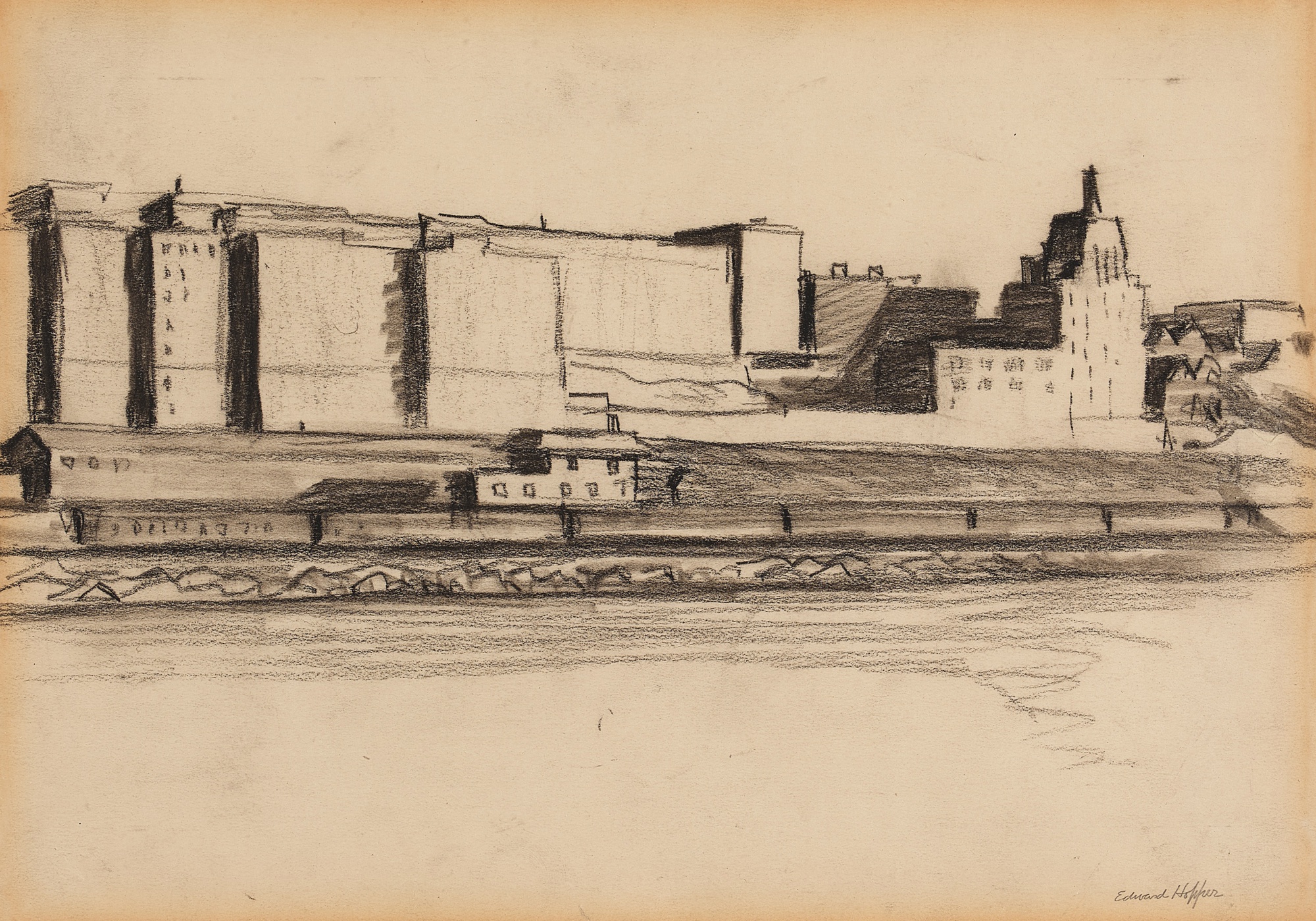
Edward Hopper
New York Train Yard
His works on paper and prints, such as those available through The Collection, offer serious engagement with his vision at a range of price points. His etchings and drypoints are particularly valued for their technical precision and their intimacy, they reveal a working mind in ways that large finished paintings sometimes conceal. Collectors and institutions including the Whitney Museum of American Art, which holds the largest collection of his work thanks to the bequest of his estate, and the National Gallery of Art in Washington have long understood Hopper's importance. At auction, his paintings have achieved significant results, with works regularly drawing intense competition at the major houses.
But the prints and works on paper carry their own authority, and demand for them among serious collectors has grown steadily as the market for American modernism has matured and deepened. Within the broader context of American art history, Hopper sits at a fascinating intersection. He was shaped by the Ashcan School realism of Robert Henri and George Bellows, and he was a contemporary of Charles Sheeler and Charles Burchfield, whose own approaches to American landscape and light offer instructive comparisons. He has sometimes been grouped with the Precisionist movement for his interest in architecture and clean formal structure, though his work carries an emotional weight that pure Precisionism deliberately avoids.
Internationally, his closest spiritual kin might be found among the Northern European realists, painters for whom silence and interior life are as important as surface description. His influence on later generations has been vast, reaching into film, photography, and contemporary painting in ways that confirm his status not as a period figure but as a genuinely foundational one. Edward Hopper died on May 15, 1967, in his Washington Square studio in New York, the city he had inhabited and studied for decades. His wife Josephine, his constant companion and creative partner, followed him less than a year later.
Their joint bequest to the Whitney ensured that his legacy would be preserved and studied, and the decades since have only deepened appreciation for what he accomplished. We live, many of us, in Hopper's world without quite knowing it, in the specific angle of afternoon light through an office window, in the geometry of an empty gas station at dusk, in the beauty that arrives when you look at ordinary life with total attention and absolute honesty. That is his gift, and it has not diminished by a single degree.
Explore books about Edward Hopper
Edward Hopper: A Catalogue Raisonné
Gail Levin
Edward Hopper
Gail Levin

Nighthawks and Other Paintings by Edward Hopper
various
Edward Hopper: An American Master
Barbara Haskell
Edward Hopper: Light and Shadow
Michael Glover
Hopper Drawing
Gail Levin
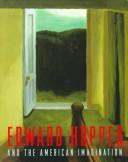
Edward Hopper and the American Imagination
Debra Bricker Balken