Edmund de Waal
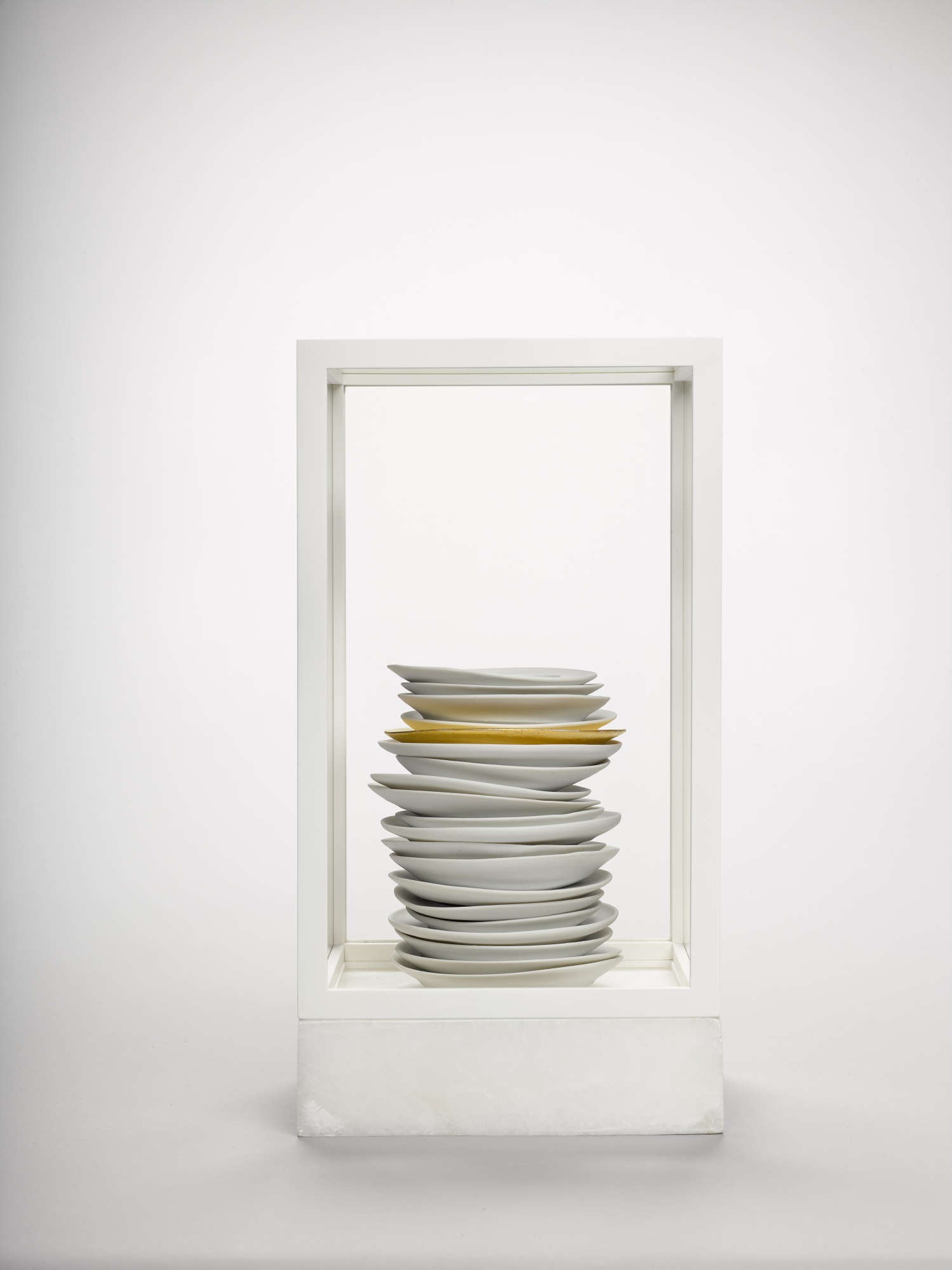
Edmund de Waal, Vessels Full of Wonder
Artist Spotlight · The Collection Editorial
“I make pots to slow things down. I want someone to stop and look and then look again.”
Edmund de Waal, The Guardian
In the spring of 2024, Edmund de Waal brought his meditative practice to one of its most ambitious expressions yet, continuing a sustained conversation with institutions and collectors across Europe and North America that has made him one of the most intellectually compelling artists working today. His porcelain vessels, gathered in hushed vitrines or arranged along library shelves, have come to feel like essential objects of our cultural moment: things that hold silence, that ask us to slow down, that insist on the value of making by hand. Galleries including Gagosian, which has represented his work to a global audience, have helped place de Waal's practice at the centre of contemporary collecting. Few artists working in ceramics have achieved such sustained critical and commercial momentum, and fewer still have managed to make their materials carry the weight of literature, history, and philosophy with such apparent ease.
Edmund de Waal
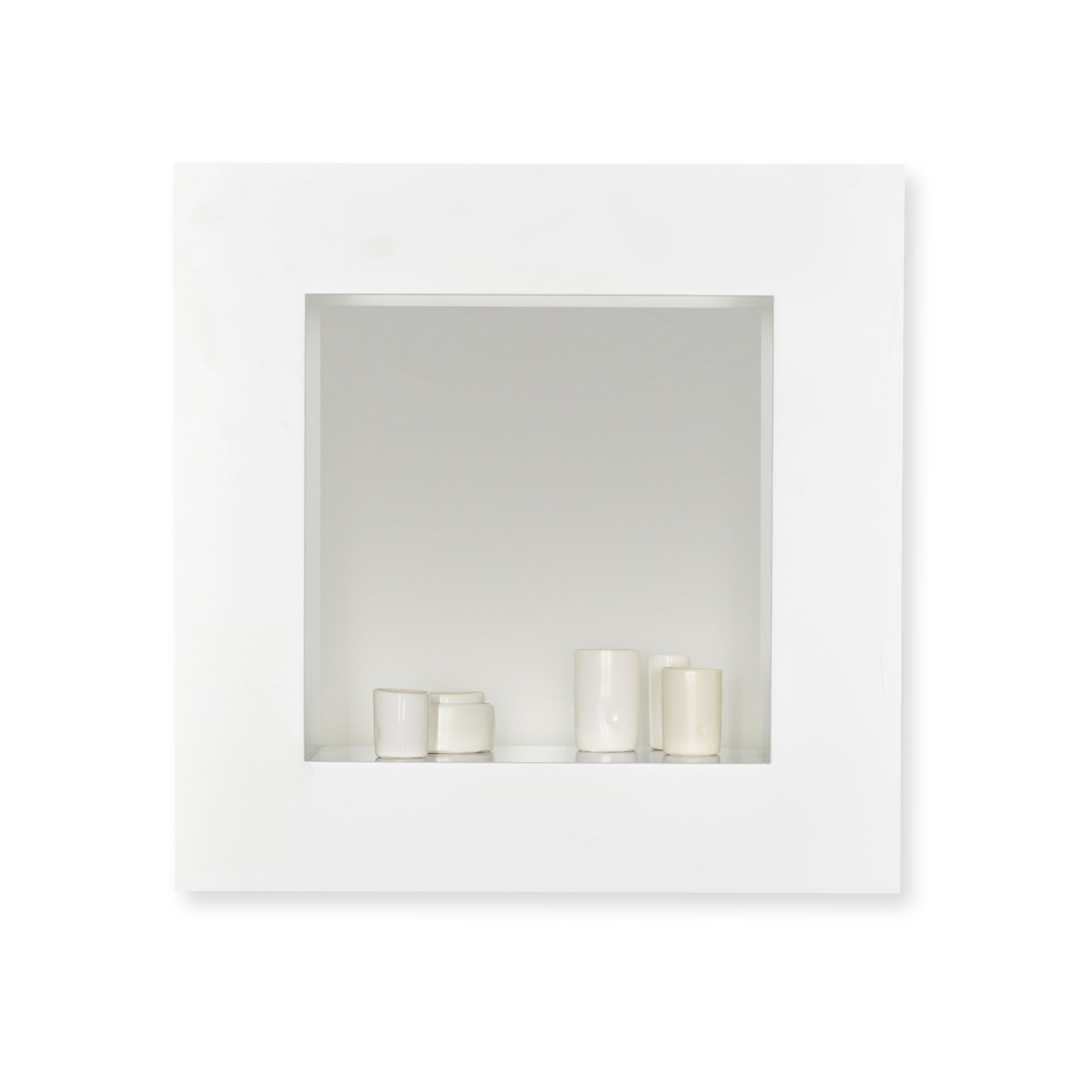
The White Road II, 2013
Edmund de Waal was born in Canterbury, England, in 1964, into a family with deep roots in intellectual and religious life. His father was a theologian and his upbringing was steeped in the kind of attentive, contemplative atmosphere that would later find expression in his work. He encountered ceramics as a teenager, studying under the Japanese potter Geoffrey Whiting in Canterbury, an apprenticeship that introduced him to the discipline of the wheel and to the East Asian aesthetic traditions that would become central to his vision. He went on to study English Literature at Magdalene College, Cambridge, and later completed a degree in ceramics, a combination that speaks to the essential duality of his practice: he has always been as much a thinker and a writer as he is a maker.
His artistic development unfolded across decades of patient, disciplined work. Through the 1990s and into the 2000s, de Waal refined a vocabulary of thrown porcelain vessels, predominantly in white and celadon glazes, that drew on the traditions of Song Dynasty Chinese ceramics and Japanese tea culture while remaining resolutely contemporary in their restrained minimalism. He became a professor of ceramics at the University of Westminster, and his 2003 book on the twentieth century potter Bernard Leach cemented his reputation as a serious scholar of his field. But it was the combination of a growing exhibition profile and the extraordinary success of his 2010 memoir that transformed his reach entirely.
Edmund de Waal
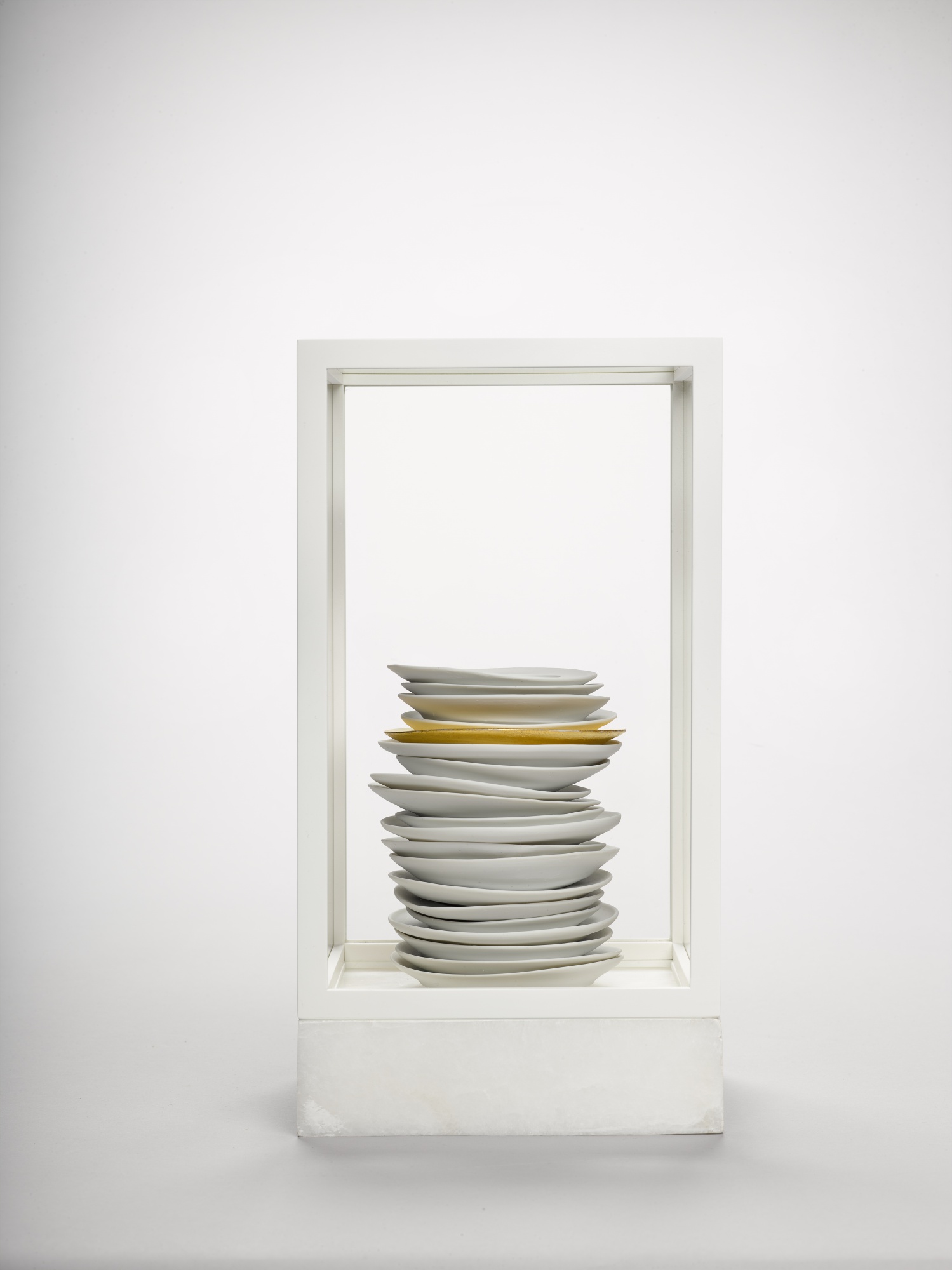
a wilde civility, 2019
The Hare with Amber Eyes, which traces the history of his family and a collection of Japanese netsuke across Vienna, Paris, and Tokyo, became an international bestseller and introduced his sensibility to an audience well beyond the ceramics world. The signature works that appear across serious collections today are remarkable for the way they transform modest materials into vessels of almost architectural presence. The White Road II, made in 2013, gathers six porcelain vessels within a wood and plexiglass cabinet, the forms cool and spare against the geometry of their housing. Velocity or Pause from 2014 extends this logic across thirteen vessels arranged in a pair of vitrines, inviting the eye to move between forms and find rhythm in their spacing.
“Objects are places where stories accumulate. They are archives of touch and memory.”
Edmund de Waal, The Hare with Amber Eyes
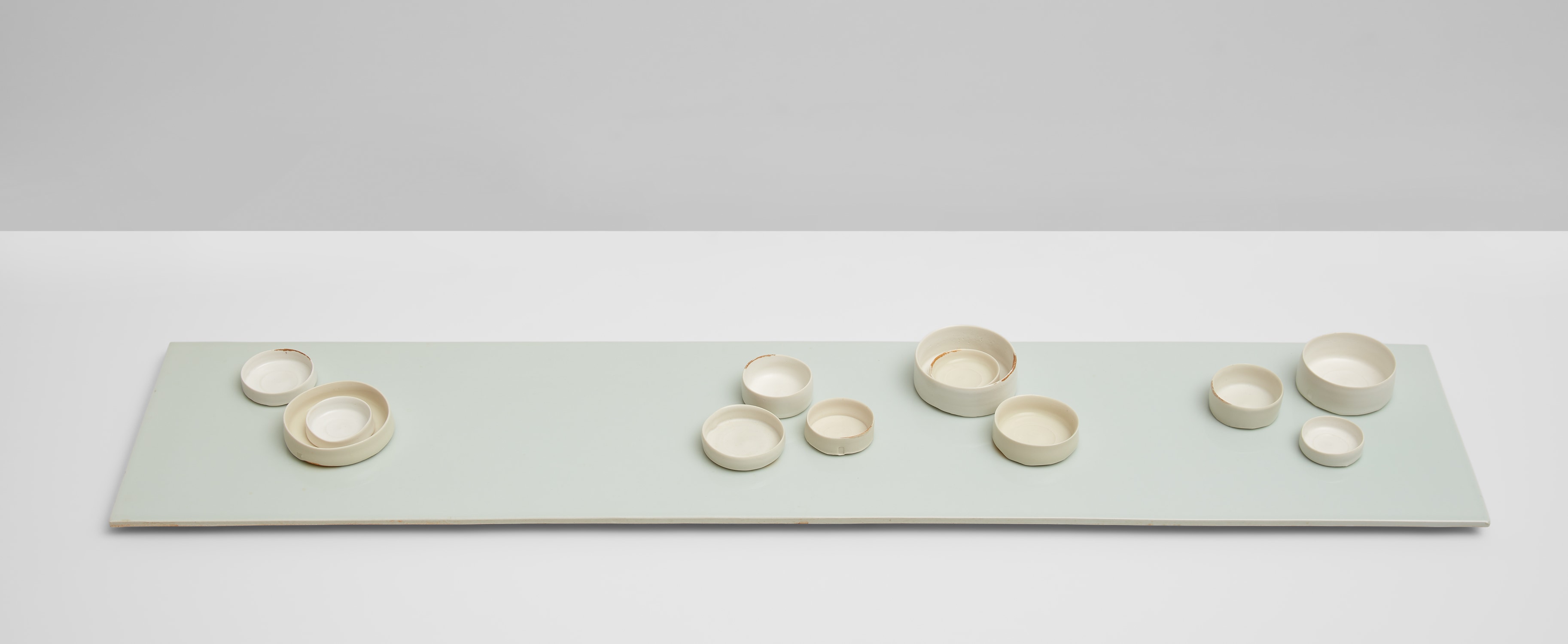
Three short walks, II from 2012 presents twelve thrown porcelain dishes in white and cream glazes with gilding, arranged on a hand pressed porcelain tile in celadon glaze and displayed on two white lacquer felted stands. Each of these works functions as a kind of score or poem: the arrangement is deliberate and the meaning accumulates slowly, through looking rather than reading. His Rescript series, with its celadon and red glazes over impressed designs in the body, adds a textual dimension that connects directly to his literary concerns. The reference to John Cage in Ryoan ji (for John Cage), VII from 2017 points to the wider intellectual framework that gives de Waal's practice its distinctive depth.
Edmund de Waal
three short walks, II, 2012
He is an artist who thinks seriously about music, about Zen Buddhism, about the philosophy of attention. His installations at cultural institutions including the Victoria and Albert Museum, the Fitzwilliam Museum in Cambridge, and the Kunsthistorisches Museum in Vienna have used libraries and historic interiors as settings, placing his vessels in dialogue with centuries of collected objects. A wilde civility, made in 2019, takes its title from the poet Robert Herrick and exemplifies his ability to charge a seemingly simple arrangement of forms with literary and historical resonance. The tile for migrate art from 2018, a porcelain tile with platinum gilding made in solidarity with displaced people, demonstrates a social conscience that extends his practice beyond the purely aesthetic.
For collectors, de Waal's work offers something genuinely rare: a practice that is intellectually rigorous, materially exquisite, and historically rooted, yet alive to the present moment. His pieces hold their value and their meaning over time because they are grounded in a coherent and deeply felt vision rather than in the movements of fashion. Collectors who come to his work often describe a process of gradual immersion: one piece opens into another, and into the books, the essays, and the installations, until the whole practice feels like a world one wants to inhabit. His works on paper and tiles offer accessible entry points alongside the more substantial vitrine installations.
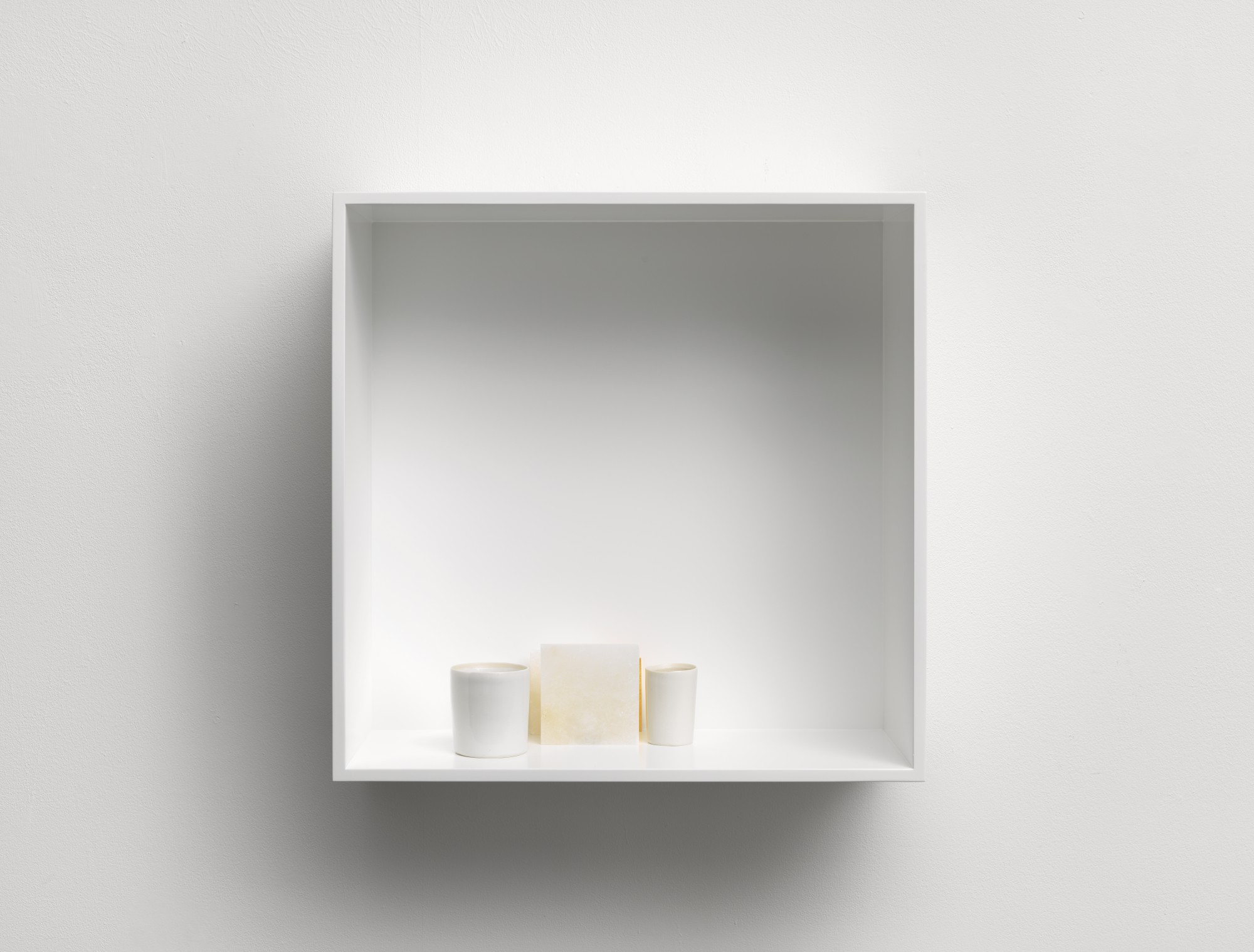
Edmund de Waal
Ryōan-ji (for John Cage), VII, 2017
The international reach of his gallery relationships and the enduring attention of museum curators ensure that his market remains robust and his institutional profile continues to grow. Within art history, de Waal occupies a position that is genuinely singular. He is in conversation with the traditions of the Leach Pottery and the mingei movement, with the rigorous minimalism of Donald Judd, and with the poetic installation work of artists such as Cy Twombly, whose use of text and surface resonates with de Waal's own. Collectors who admire the quiet intensity of Lucie Rie, whose work de Waal has written about with great feeling, often find their way to his practice as a natural extension of those interests.
The craft lineage is present and honoured, but it is never allowed to constrain what the work can say or do. Edmund de Waal matters today because he has made the case, with extraordinary eloquence and consistency, that a thrown porcelain vessel can carry as much meaning as a painting or a novel. In an art world that often prizes spectacle and scale, his work insists on the value of the hand, the quiet room, and the slow accumulation of attention. His legacy is already visible in the way a generation of makers and collectors has come to understand ceramics as a serious medium for serious thought.
To live with his work is to accept an ongoing invitation to look more carefully, to think more slowly, and to find in the simplest forms something close to grace.
Explore books about Edmund de Waal