Eadweard Muybridge
The Man Who Unlocked Motion Itself
Artist Spotlight · The Collection Editorial
“I have been able to photograph a horse in motion, and the results are astonishing.”
Eadweard Muybridge
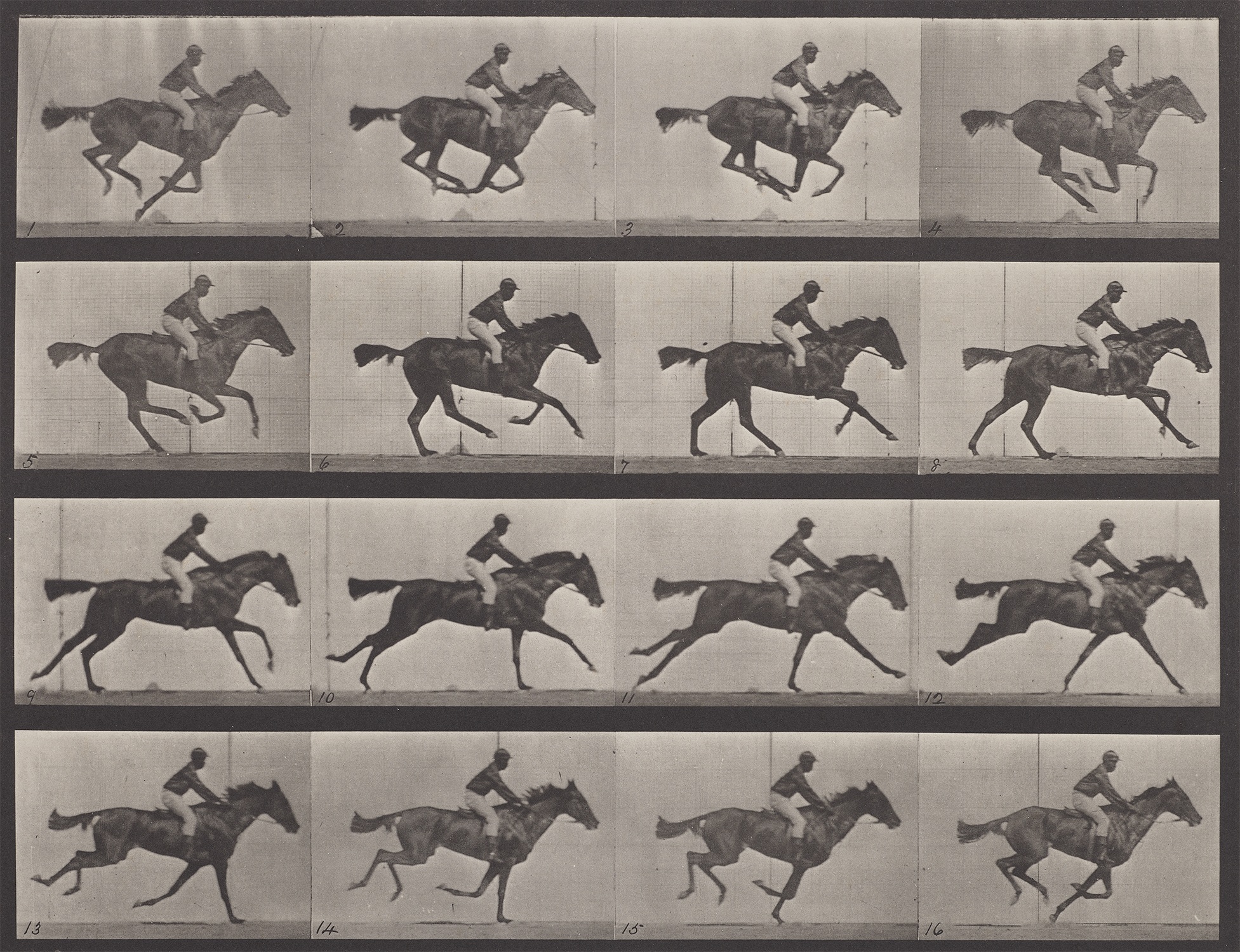
Imagine a California racetrack in the late 1870s, the air thick with the smell of dust and horse sweat, and a photographer crouching behind a row of trip wire cameras he has strung across the track like a kind of scientific altar. When the horse gallops through, each wire triggers a shutter in sequence, and for the first time in human history, the invisible becomes visible: all four hooves leave the ground at once. That moment, achieved by Eadweard Muybridge sometime around 1877 and 1878 at the Sacramento and Palo Alto tracks, did not merely answer a question about equine locomotion. It changed the way the human species understands movement, time, and the nature of seeing itself.
Eadweard Muybridge
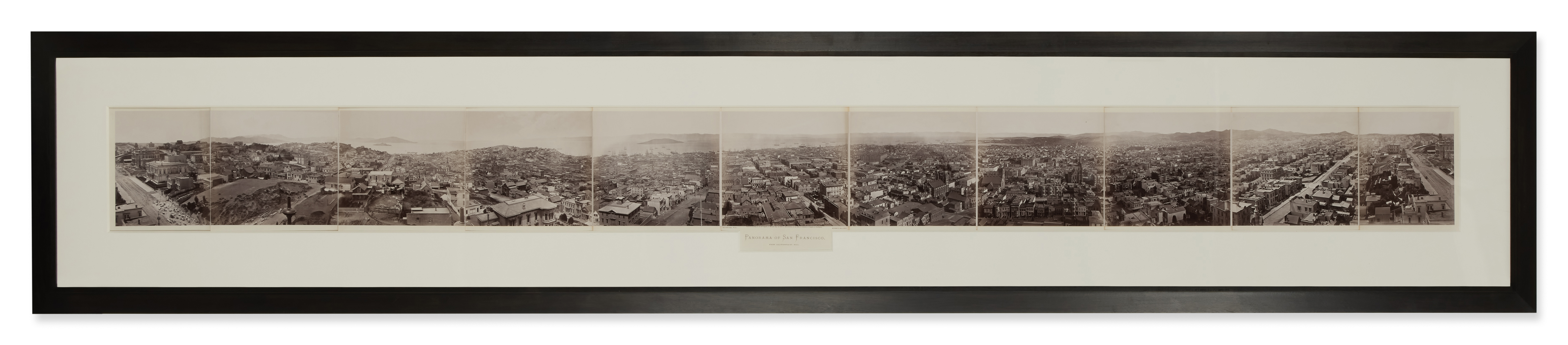
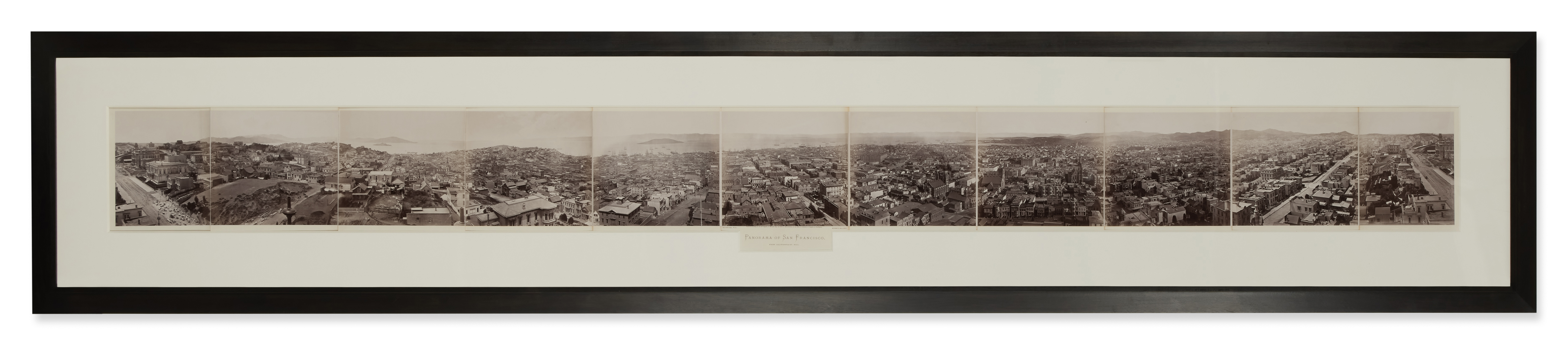
'Panorama of San Francisco, from California-St. Hill'
Edward James Muggeridge was born in Kingston upon Thames, England, in 1830, into a modest merchant family. He emigrated to the United States as a young man in the early 1850s, arriving in New York before making his way westward to San Francisco, where the city was still electric with Gold Rush ambition and the sense that anything was possible. He reinvented himself entirely, adopting the Anglo Saxon spelling Eadweard Muybridge, a name that carried the weight of old England even as he became one of the most distinctly Californian figures of the nineteenth century. San Francisco gave him both his subject matter and his professional identity, and he would spend decades in a deeply productive relationship with the American West.
Muybridge trained as a bookseller but taught himself photography, and by the 1860s he had become one of the most accomplished landscape photographers working in the American West. His early work documenting Yosemite Valley and the Pacific coast showed a genuine artistic sensibility, a feel for dramatic scale and the sublime that owed something to the Hudson River School painters he would have known through reproductions. He worked for the United States government photographing Alaska and Oregon, and these commissions sharpened both his technical precision and his instinct for the monumental image. It was in this period that Muybridge established himself not merely as a craftsman but as a visual thinker.
Eadweard Muybridge
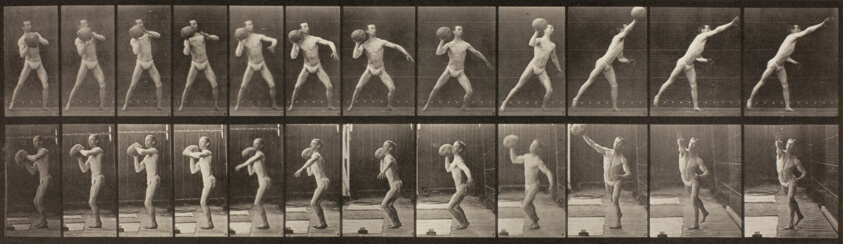
Animal Locomotion, Plate 319, 1887
The breakthrough that would define his legacy came through his association with Leland Stanford, the railroad magnate and former governor of California who was also a passionate breeder of racehorses. Stanford wanted empirical proof that a horse at full gallop becomes fully airborne, a question that had occupied artists and scientists for centuries. Muybridge devised an ingenious system of multiple cameras and triggered shutters to capture sequential images at speeds no single camera could achieve. The resulting photographs, first published and exhibited in the late 1870s, were a sensation on both sides of the Atlantic.
Thomas Edison cited Muybridge as a direct inspiration for his development of motion picture technology, and the French physiologist Etienne Jules Marey corresponded with him extensively, developing his own chronophotographic methods partly in dialogue with Muybridge's discoveries. The culmination of Muybridge's scientific and artistic ambitions was his monumental project Animal Locomotion, published in 1887 through the University of Pennsylvania. The work comprised 781 collotype plates documenting the movement of humans and animals across an enormous range of activities, from athletes running and wrestlers grappling to women descending staircases and birds taking flight. The plates from Animal Locomotion are the works most associated with Muybridge today, and for good reason: they are simultaneously rigorous scientific documents and images of arresting visual power.
Eadweard Muybridge
Motion Study, Horse and Rider
The grid structure that organizes each plate, with its sequential frames running left to right and top to bottom, anticipates the visual language of film, comic strips, and contemporary video art in ways that feel almost uncanny. Works from this series, including Plate 319, Plate 469, Plate 535, Plate 758, and Plate 174, represent the full range of his investigative passion and remain the touchstone objects for serious collectors. Also among the most celebrated of his works is the extraordinary Panorama of San Francisco, from California Street Hill, created in 1877 and published through Morse's Gallery in San Francisco. This panorama of eleven albumen prints, mounted together on linen, is a jaw dropping feat of both technical ambition and compositional intelligence.
San Francisco in 1877 was a city of extraordinary energy and physical drama, and Muybridge captured it from above with the eye of someone who genuinely loved the place. The work belongs to a tradition of grand urban panoramas but transcends that tradition through the sheer quality of its observation. When it comes to auction, the panorama commands serious attention from collectors of both photography and Americana, and examples in strong condition are increasingly rare. For collectors, Muybridge occupies a particularly compelling position in the market for nineteenth century photography.
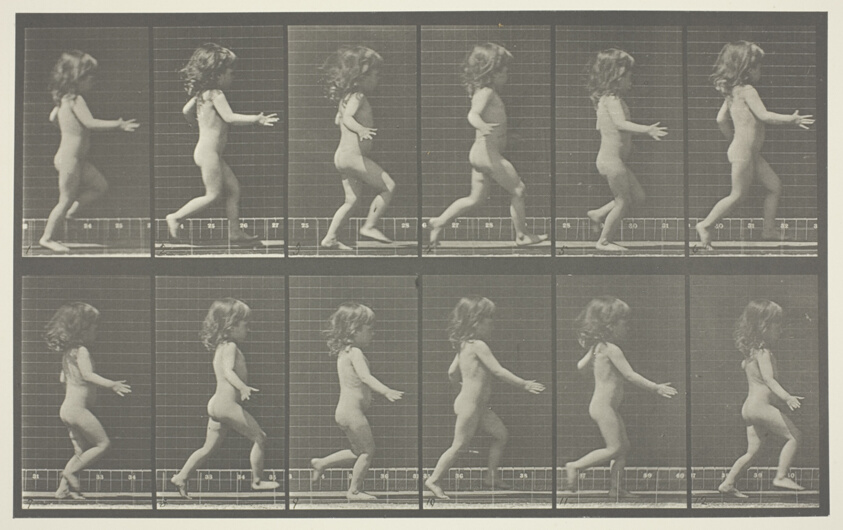
Eadweard Muybridge
Animal Locomotion, Plate 469, 1887
His work sits at the intersection of art history, the history of science, and the prehistory of cinema, which gives it an unusually broad appeal. Institutions including the George Eastman Museum, the Kingston Museum in his birthplace, and the Stanford University Libraries hold significant holdings, which means that fine examples reaching the private market are genuinely noteworthy events. Collectors who respond to artists such as Thomas Eakins, whose own interest in movement and the body paralleled Muybridge's (the two men collaborated briefly at the University of Pennsylvania in the 1880s), or to later figures like Man Ray and László Moholy Nagy who drew on the sequencing logic Muybridge pioneered, will find his work intellectually and aesthetically rewarding in equal measure. The collotype prints from Animal Locomotion vary in condition and impression quality, and informed collectors focus on the clarity of the sequential frames and the overall tonal richness of individual plates.
The legacy of Eadweard Muybridge is essentially impossible to overstate. Francis Bacon cited the Animal Locomotion plates as a direct source for his figurative paintings, and the influence ripples outward through a vast range of twentieth and twenty first century art. Every filmmaker who cuts between two images of the same body in motion, every video artist who loops a gesture, every sculptor who captures a body mid stride is working in a tradition that Muybridge created almost single handedly. His panorama of San Francisco stands as one of the great documents of nineteenth century American urban life, and his motion studies remain objects of genuine wonder more than a century after they were made.
To collect Muybridge is to own a piece of the moment when human beings first learned to truly see themselves in motion, which is to say, to own a piece of the origin of modern visual culture.
Explore books about Eadweard Muybridge
Eadweard Muybridge: The Father of the Motion Picture
Anita Ventura Mozley
Muybridge and the Body in Motion
Marta Braun
The Complete Photography of Eadweard Muybridge
Eadweard Muybridge
Eadweard Muybridge: A Life
Kevin MacDonnell
The Zoopraxiscope of Eadweard Muybridge
Anita Ventura Mozley
Animals in Motion
Eadweard Muybridge
The Human Figure in Motion
Eadweard Muybridge
Muybridge: The Stanford Years, 1872-1882
Martha Sandweiss