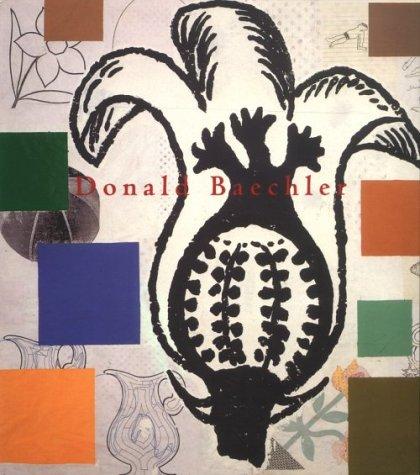
Donald Baechler
Donald Baechler: The Joy of Looking
Artist Spotlight · The Collection Editorial
There is a particular kind of pleasure that arrives when you stand before a Donald Baechler painting and realize, slowly, that what first appeared simple is in fact profoundly considered. In the years since his death in 2022, that pleasure has only deepened. Museum curators, private collectors, and a new generation of artists have returned to his work with fresh appreciation, recognizing in its layered surfaces and recurring motifs something that resists easy categorization while feeling immediately, warmly human. Baechler belongs to a lineage of American painters who trusted the vernacular, who believed that a flower drawn by a child carried as much weight as one rendered by an old master, and his legacy grows more assured with each passing season.
Donald Baechler
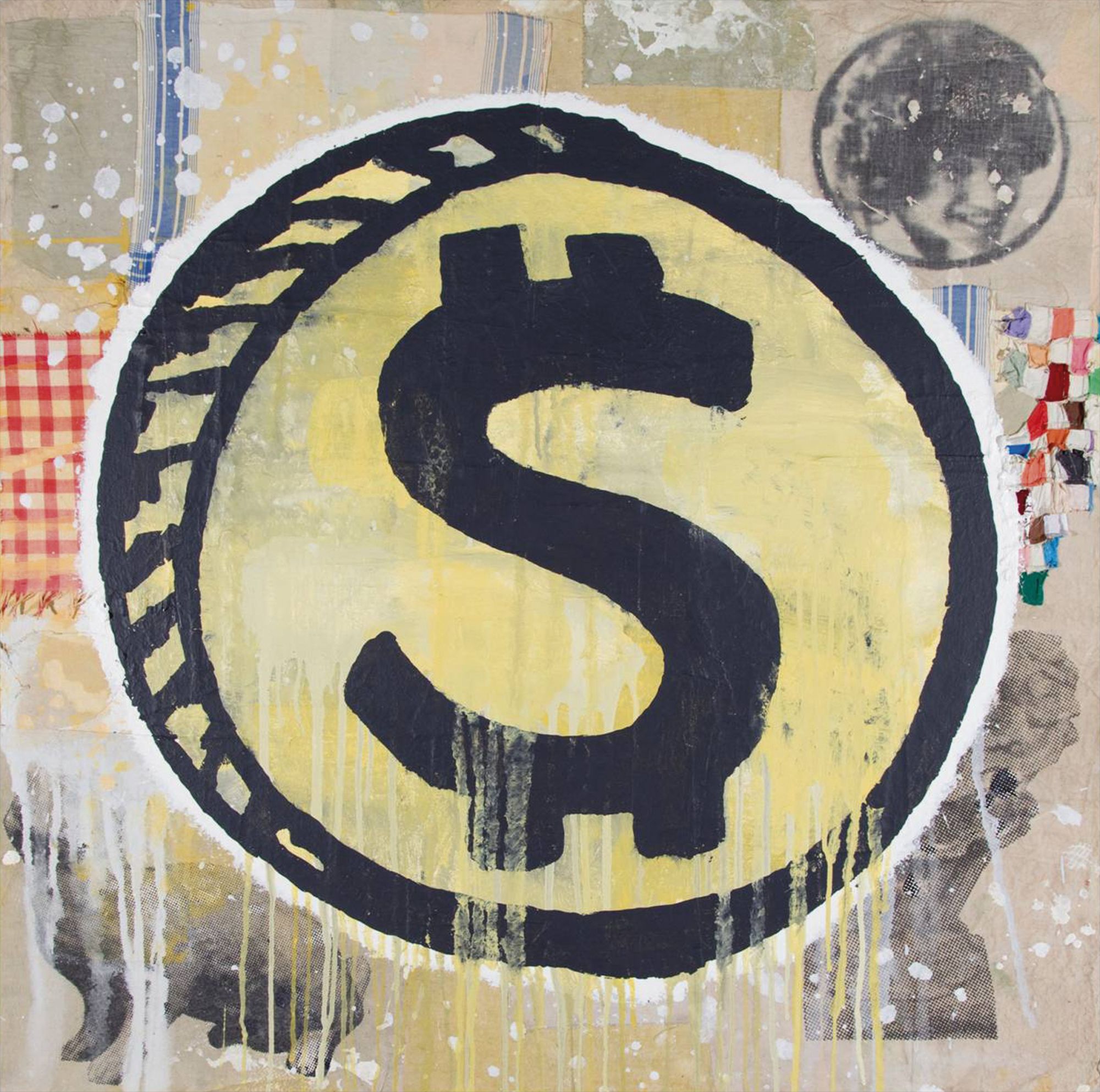
Dollar Painting #2
Donald Baechler was born in Hartford, Connecticut, in 1956, and his path to becoming one of the defining voices in late twentieth century American painting was shaped by an unusually wide education. He studied at the Maryland Institute College of Art and later at the Frankfurt Städelschule in Germany, where exposure to European conceptualism tempered what might otherwise have become a purely intuitive practice. He returned to New York in the early 1980s, arriving at precisely the moment when the city's art world was electrified by a new expressionist energy, a generation of painters determined to rescue figuration from the grip of minimalism and conceptual art. Baechler fit into this world and also stood apart from it, his sensibility too playful and too structurally rigorous to be contained by any single movement.
His early years in New York placed him in orbit around some of the most consequential figures of that era. He exhibited alongside Jean Michel Basquiat and Keith Haring, and his work shared with theirs a rootedness in street culture, in mark making that felt urgent and unpolished in the best sense. Yet Baechler was always operating on a different frequency. Where Basquiat channeled fury and Haring channeled kinetic optimism, Baechler was engaged in something quieter and more archaeological.
Donald Baechler
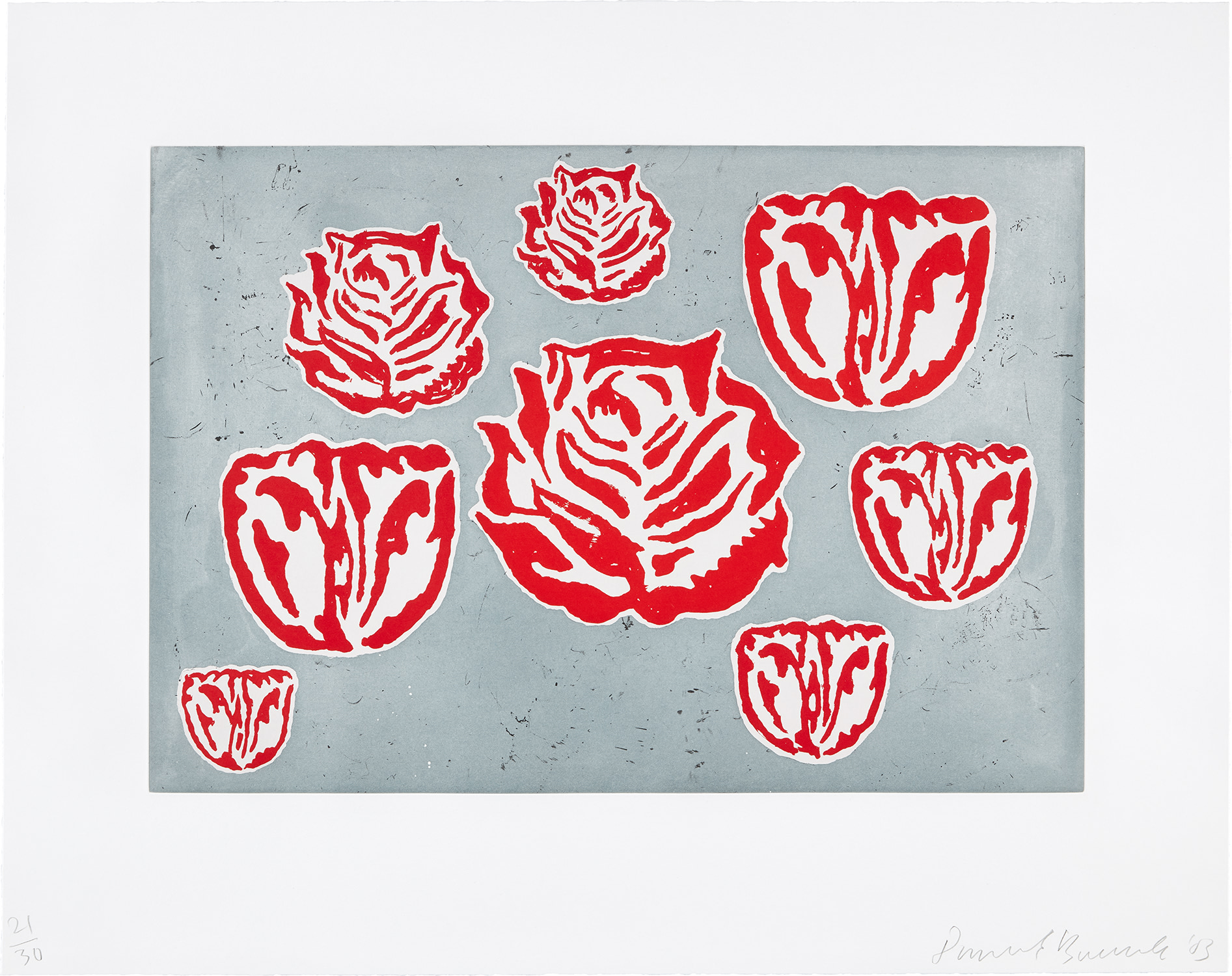
Szechuan Garden
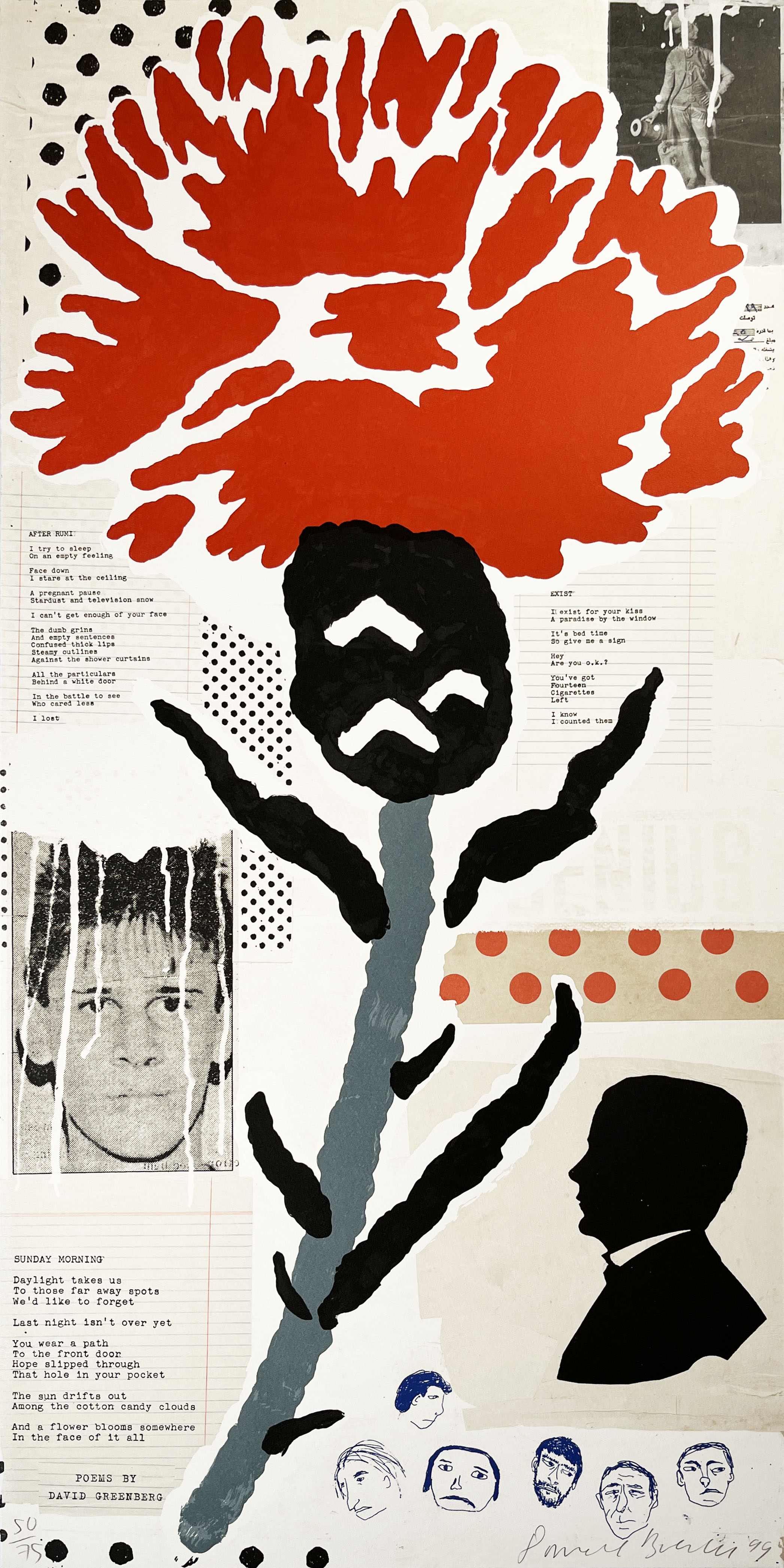
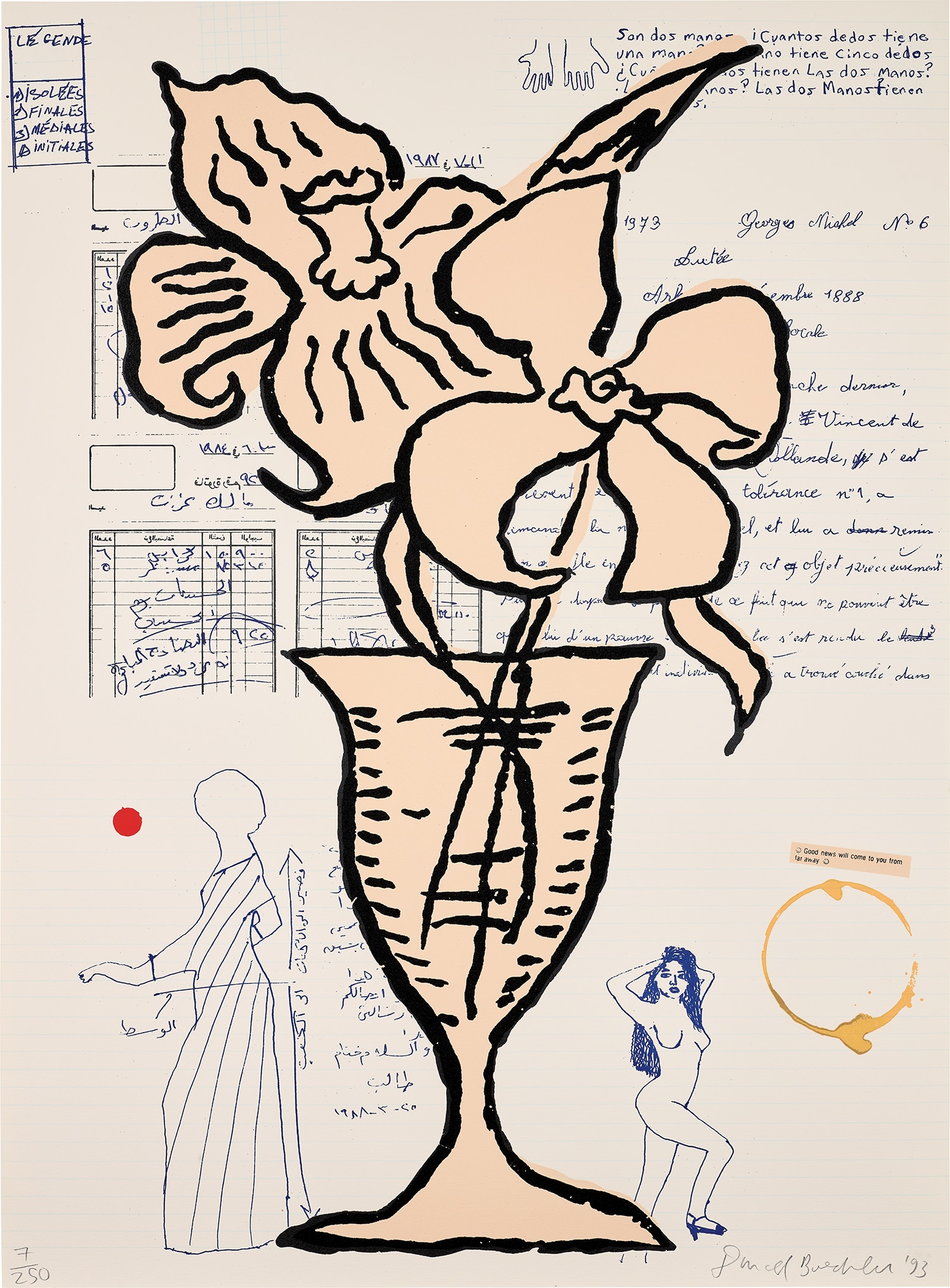
He collected images obsessively, amassing archives of found photographs, illustrated books, children's drawings, and printed ephemera, and these became the raw material for paintings that functioned as accumulations rather than singular statements. The surface of a Baechler canvas is a record of time, of decisions made and revised, of images buried beneath layers of paint and then partially retrieved. The motifs that came to define his practice are deceptively modest: flowers, skulls, figures rendered with the economy of a child's drawing, geometric forms, and everyday objects that carry the weight of accumulated memory. His flowers are perhaps the most recognized, blooming across canvases and works on paper with a frankness that recalls both Pop Art's love of the commonplace and folk art's directness.
These were not decorative gestures. Baechler was deeply interested in what happens when an image is repeated, when it becomes a kind of mantra or a test, and his flower paintings carry that conceptual underpinning beneath their cheerful surfaces. Works such as Flower Study I, rendered in screenprint with black flocking on wove paper, demonstrate how his sensibility translated across media, the tactile richness of the flocking adding a dimension that pure painting could not achieve. Similarly, works like Thistle and the prints published under his name reveal an artist who took printmaking as seriously as painting, understanding that each medium offered its own form of truth.
Donald Baechler
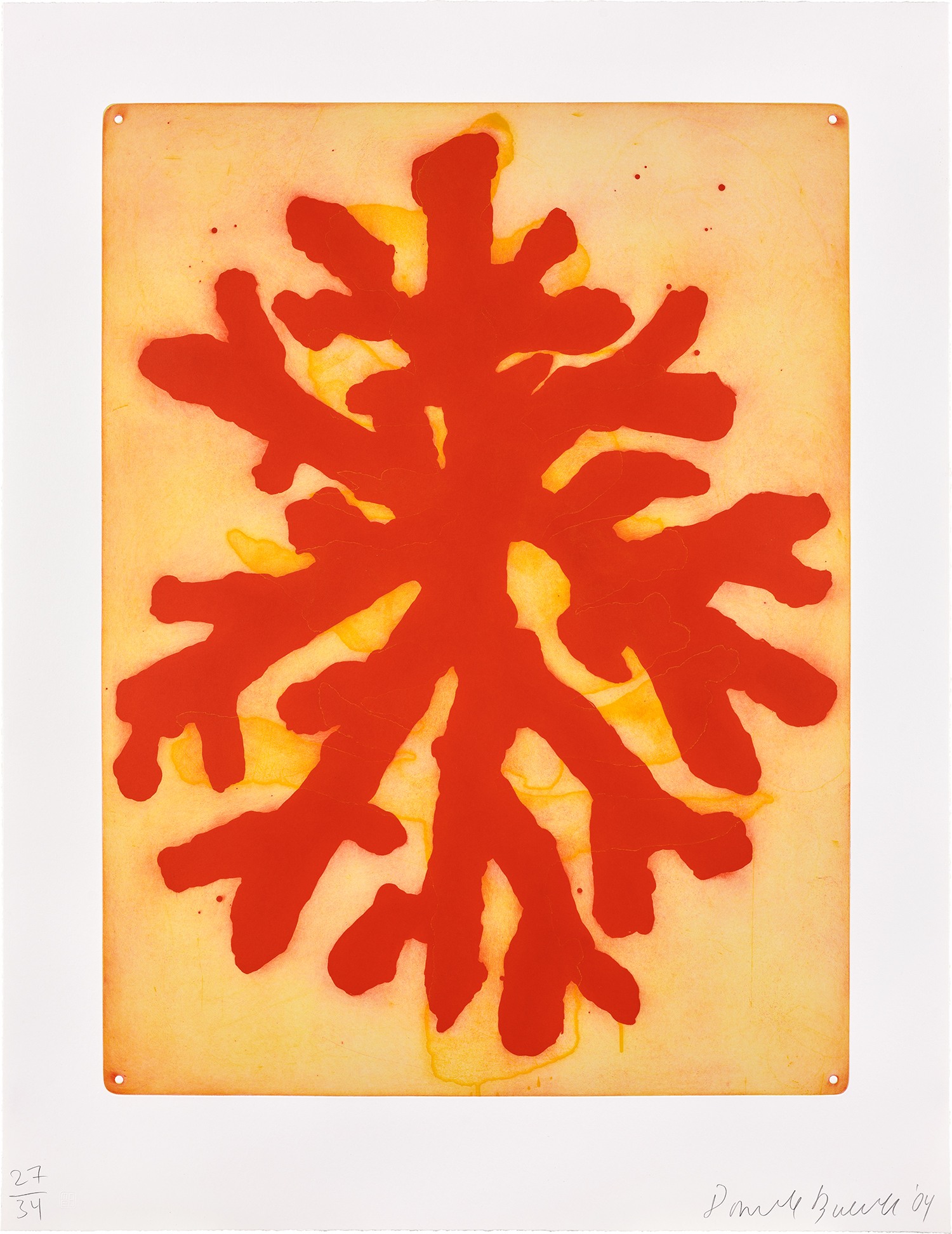
Red Coral
Among the highlights of his output are pieces that demonstrate the full range of his formal intelligence. Dollar Painting No. 2, executed in acrylic and mixed media collage on canvas, brings together his interest in found imagery and monetary iconography in a composition that is simultaneously funny and unsettling, a meditation on value and representation that feels no less relevant today. Rush to Justice, a unique work combining pencil, ballpoint pen, acrylic paint, and paper collage with industrial varnish on canvas panel, shows Baechler at his most uninhibited, layering materials with the confidence of an artist who has made peace with contradiction.
The Counterfeiters, a signed and numbered edition published by Baron and Boisante in New York, and works from collaborations with Hedenius Editions in Stockholm, including Blue Pitcher, Yellow House, and Beachball from the portfolio Some of My Subjects, speak to an artist who engaged generously with the print world, making his vision accessible without diluting it. For collectors, Baechler's work presents a particularly rewarding field of inquiry. His output spanned painting, printmaking, and works on paper, and the range of scale and material means that there are meaningful points of entry at various price levels. The prints, including etchings and aquatints on Hahnemühle paper such as Szechuan Garden and Red Coral, offer the same image vocabulary as his large canvases but in a form that rewards close, intimate looking.
Donald Baechler
Donald Baechler
The mixed media works are especially prized for their layered complexity, and collectors who have lived with them report that new details continue to surface years after acquisition. Auction results in recent years have confirmed sustained and growing interest, with his paintings and unique works on paper attracting competition from both established collections and younger buyers encountering his work for the first time. To understand Baechler fully, it helps to place him within a constellation of artists who shared his preoccupations. His work invites comparison with that of Christopher Wool, whose engagement with language and repetition parallels Baechler's interrogation of imagery, and with Carroll Dunham, another painter who found high conceptual stakes in apparently simple forms.
His relationship to Pop Art is clear but not straightforward: where Warhol used repetition to drain images of feeling, Baechler used it to accumulate feeling, to make images resonate rather than recede. He was also in conversation with the tradition of outsider art and art brut, genuinely moved by the drawings of untrained makers and willing to let that influence show without condescension. What endures most powerfully in Baechler's legacy is his insistence that accessibility and seriousness are not opposites. He made work that welcomed the viewer rather than testing them, that offered pleasure as a form of meaning rather than an evasion of it.
In an art world that has sometimes privileged difficulty, that commitment reads now as both generous and radical. Institutions including the Solomon R. Guggenheim Museum and the Brooklyn Museum recognized his significance during his lifetime, and the critical reassessment now underway is confirming what his most attentive admirers always knew: that Donald Baechler made paintings that need to be lived with, and that reward that living abundantly.
Explore books about Donald Baechler