Dmitri Plavinsky
Dmitri Plavinsky: Matter, Memory, and Wonder
Artist Spotlight · The Collection Editorial
There are artists who paint the surface of the world, and there are artists who excavate it. Dmitri Plavinsky belonged firmly to the second company. Born in Moscow in 1937, he spent decades building an artistic practice so rooted in the physical substance of existence that his canvases feel less like pictures and more like geological events, strata of meaning pressed together under enormous creative pressure. To encounter his work for the first time is to feel the uncanny sensation that you have touched something very old and very alive at once.
Dmitri Plavinsky
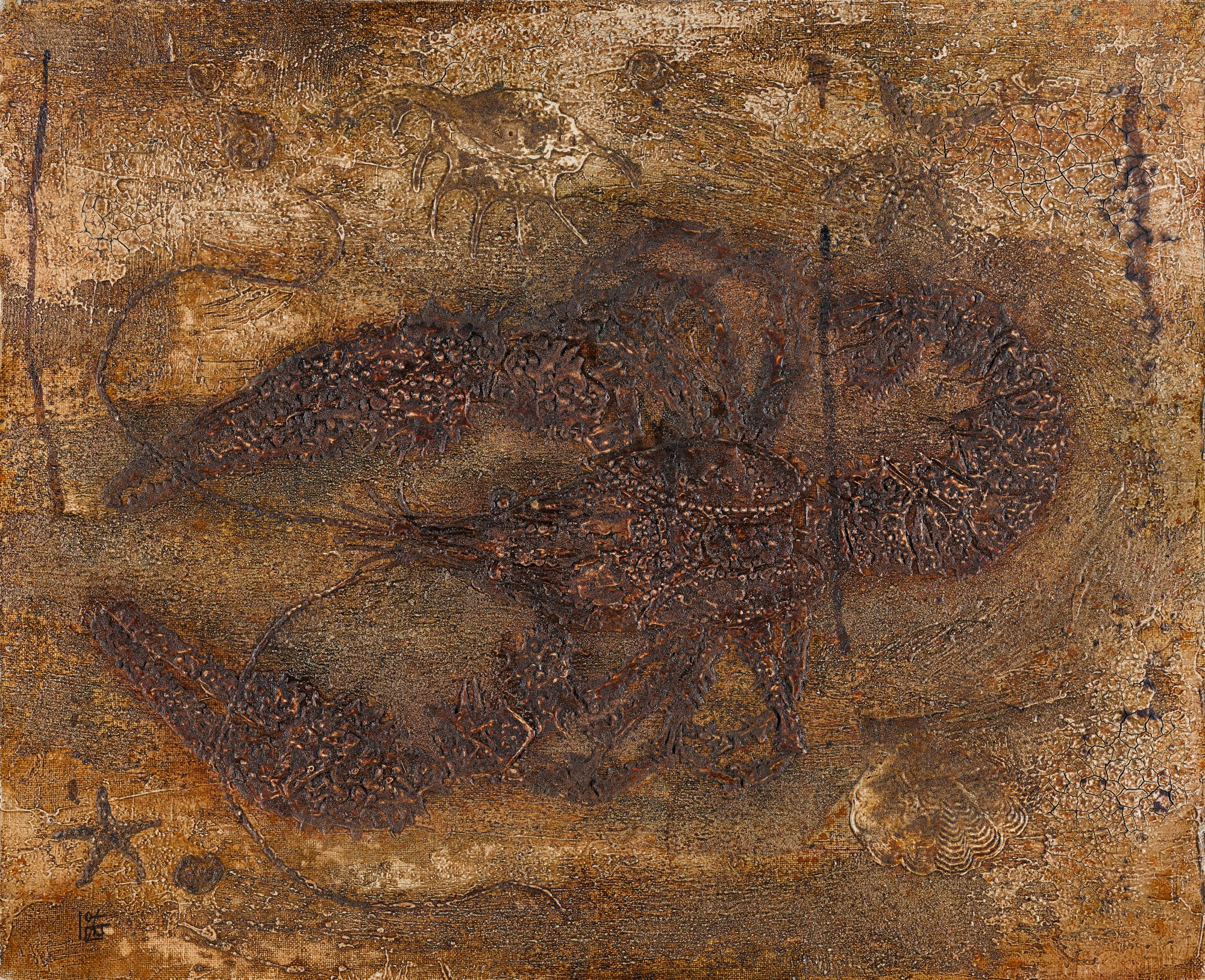
Little Crayfish
Plavinsky came of age in the Soviet Union at a moment of profound cultural tension. The postwar decades were years of official artistic doctrine, when Socialist Realism dominated institutional life and the experimental impulse was forced underground or into private apartments. Plavinsky became part of the remarkable generation of Soviet nonconformist artists who refused those terms entirely. He was connected to the unofficial art scene that flourished in Moscow from the late 1950s onward, a community that gathered beyond the reach of state approval and built its own lineage of ideas in relative isolation from the Western avant garde, yet arrived at positions of comparable sophistication and originality.
This context is essential: Plavinsky was not reacting to the New York School or to Arte Povera. He was constructing his own grammar from scratch, drawing on Russian Orthodox iconography, on the textures of natural science, on the layered surfaces of ancient manuscripts and Byzantine mosaic. His early formation was shaped as much by the library as by the studio. Plavinsky was deeply read in theology, natural history, and philosophy, and his paintings bear the marks of that wide intellectual curiosity.
Dmitri Plavinsky
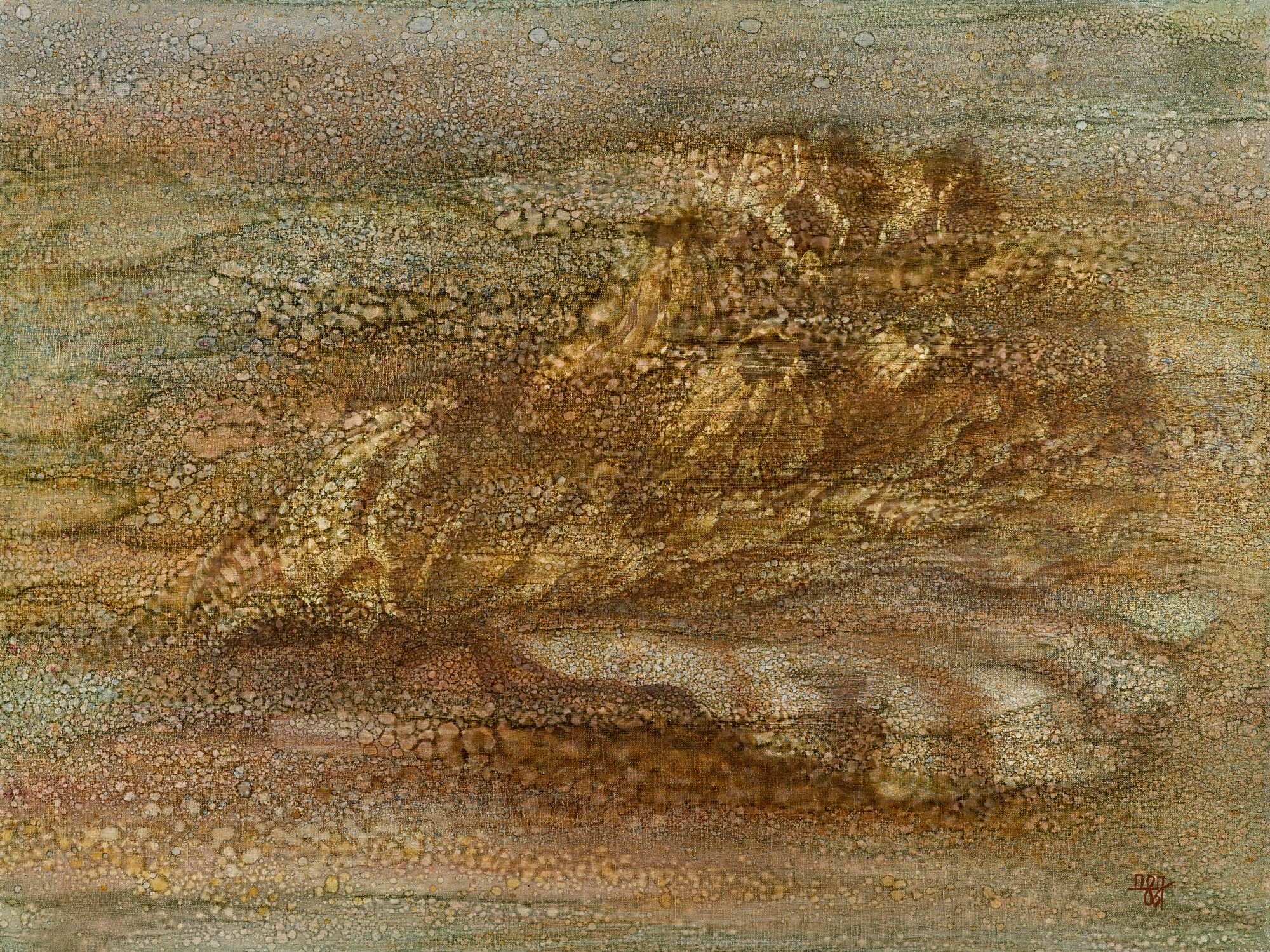
Shell
Where many of his peers gravitated toward gestural abstraction or conceptual strategies, Plavinsky developed what might be called an archaeology of the image. He was fascinated by the moment when a symbol becomes a texture, when writing becomes pattern, when the organic world and the world of human meaning collapse into one another. His signature use of mixed media, combining plaster, sand, varnish, oil, and found material directly onto his supports, was not a stylistic choice so much as a philosophical one. The surface of a Plavinsky work is itself the argument.
The body of work available through The Collection offers a generous cross section of his concerns and his formal range. "Little Crayfish," executed in plaster, sand, and varnish on canvas, is a perfect introduction to his method. The creature is rendered with scientific precision and embedded simultaneously in a field of raw, mineral texture, so that the biological and the geological become indistinguishable. "Shell" in oil on canvas pursues a related theme: the spiral form as both natural fact and cosmic diagram, a shape that recurs across Plavinsky's career as a kind of personal glyph.
Dmitri Plavinsky
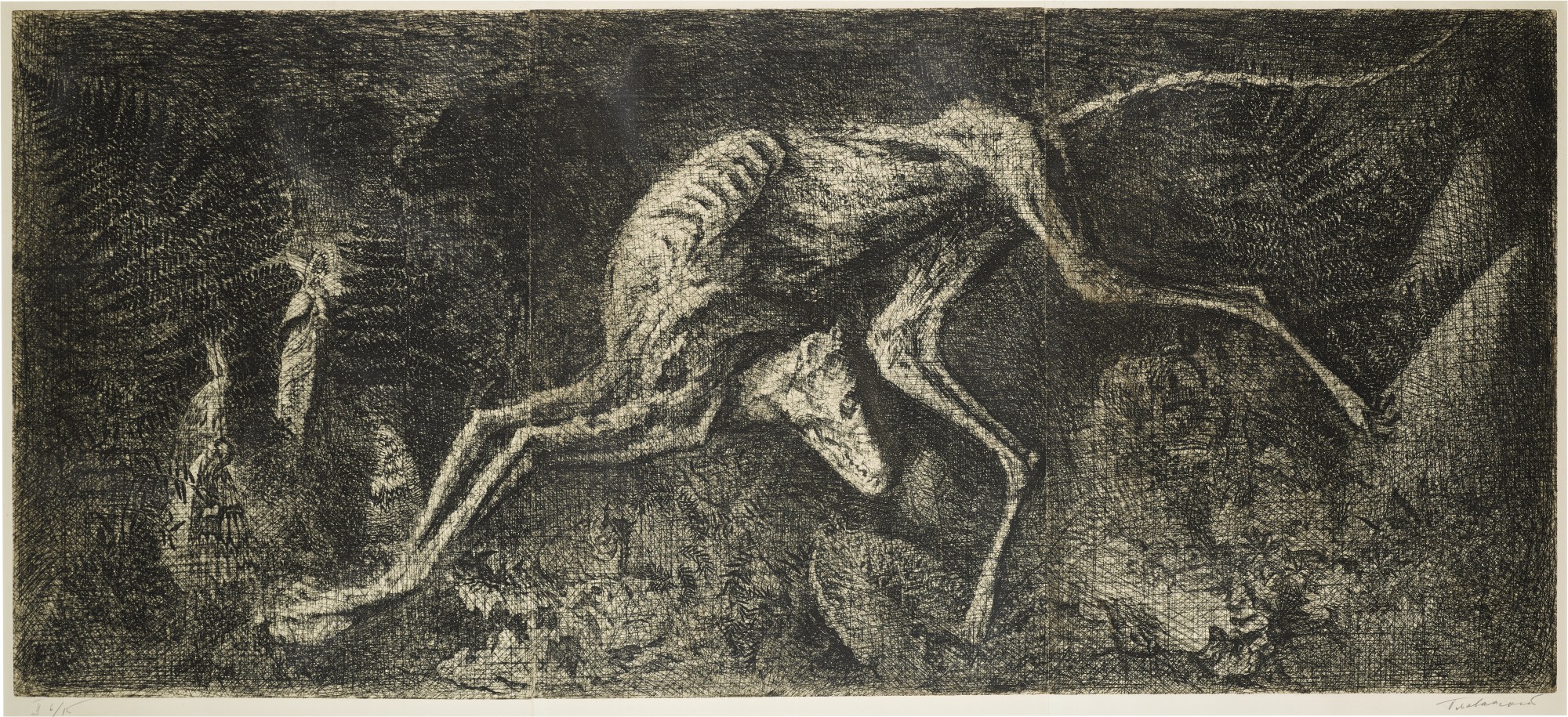
Dog, Minerals and Architectural Landscape (three works)
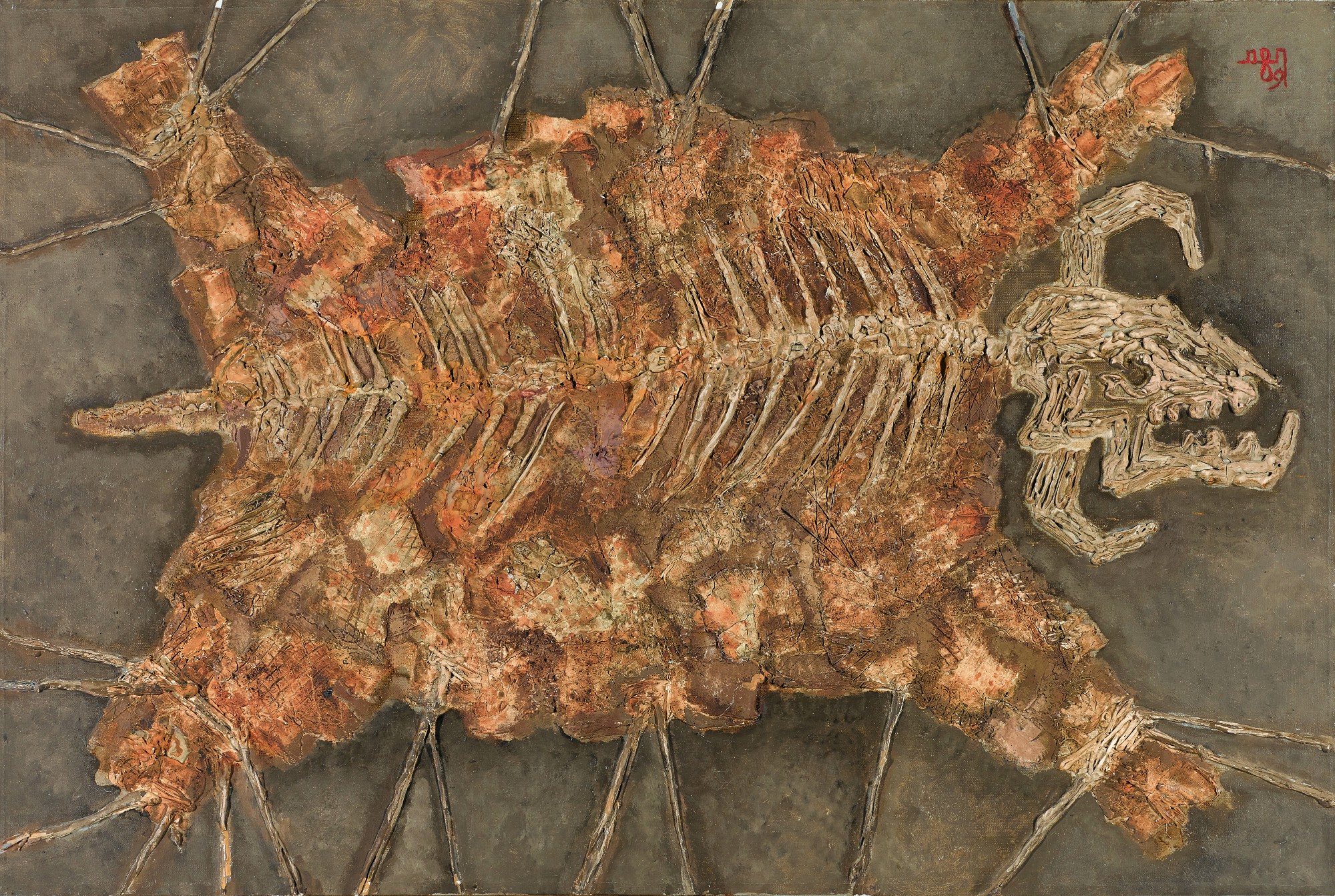
"Cosmic Leaf" extends this vocabulary into something almost mystical, the leaf rendered as a universe in miniature, its veins branching like river systems or constellations. These are not still lifes in any conventional sense. They are meditations on the deep structures of living matter. "Composition with Bull Hide" represents another register of his practice entirely.
Here the material presence of an animal skin enters the composition not as representation but as something closer to relic. The work carries the weight of mortality and the dignity of the physical world with equal measure. "Fire in the Village," executed in pyrography and oil on plywood, demonstrates his willingness to treat the support itself as an expressive medium: the burning of the wood is both technique and subject, destruction and creation held in a single gesture. "Composition with Notes" brings his interest in text and musical notation into play, the marks of human communication dissolving into pure visual rhythm.
Dmitri Plavinsky
Composition with Bull Hide
And the etchings grouped under "Dog, Minerals and Architectural Landscape" show a draftsman of exceptional sensitivity, able to conjure layered worlds of image and sign within the compressed space of the print. For collectors, Plavinsky represents a genuinely compelling proposition. His work sits at the intersection of several major currents in twentieth century art history: Soviet nonconformism, which has attracted serious institutional attention in recent decades; the broader international conversation around Arte Povera and materialist abstraction; and the specific Russian tradition of icon painting and manuscript illumination, which gives his surfaces their peculiar spiritual charge. Works by his contemporaries in the nonconformist circle, including Ilya Kabakov, Erik Bulatov, and Oscar Rabin, have established strong market precedents at major international auction houses, and Plavinsky's reputation continues to grow as scholars and curators deepen their engagement with this generation.
His mixed media works in particular reward close looking: the more time you spend with them, the more their internal logic reveals itself, which is precisely the quality that sustains a collection over years and decades. Within art history, Plavinsky occupies a position that rewards comparison with a number of significant figures. His layered surfaces and interest in organic form connect him to the work of Jean Dubuffet, who similarly sought to dissolve the boundary between painting and raw material. His engagement with signs, texts, and symbolic systems places him in dialogue with Cy Twombly, whose mark making also moved restlessly between language and image.
His Russian Orthodox inheritance links him to the larger tradition of Kandinsky and Goncharova, artists for whom the spiritual dimension of abstraction was not decorative but essential. Yet Plavinsky remains genuinely singular. His voice is not derivative of any of these affiliations. It emerged from a specific place and a specific pressure, and it carries the integrity of that origin in every work.
Plavinsky lived and worked in the United States for a significant period after emigrating in the 1990s, and his late career brought him wider international recognition. He exhibited in galleries in New York and his work entered significant private collections on both sides of the Atlantic. He passed away in 2012, leaving a body of work that continues to grow in critical estimation. The distance of time has only clarified what was always true: that Plavinsky was one of the genuinely original artists of his generation, a man who found a way to make painting feel like memory, like geology, like prayer.
To collect his work is to bring something irreplaceable into the life of a home.