Diego Giacometti
Diego Giacometti, Where Nature Comes Alive
Artist Spotlight · The Collection Editorial
There is a particular kind of magic that settles over a room furnished with the work of Diego Giacometti. Cats curl around table legs. Birds perch on lamp stems. Frogs crouch at the edges of bronze surfaces as though they have simply wandered in from the garden.
Diego Giacometti
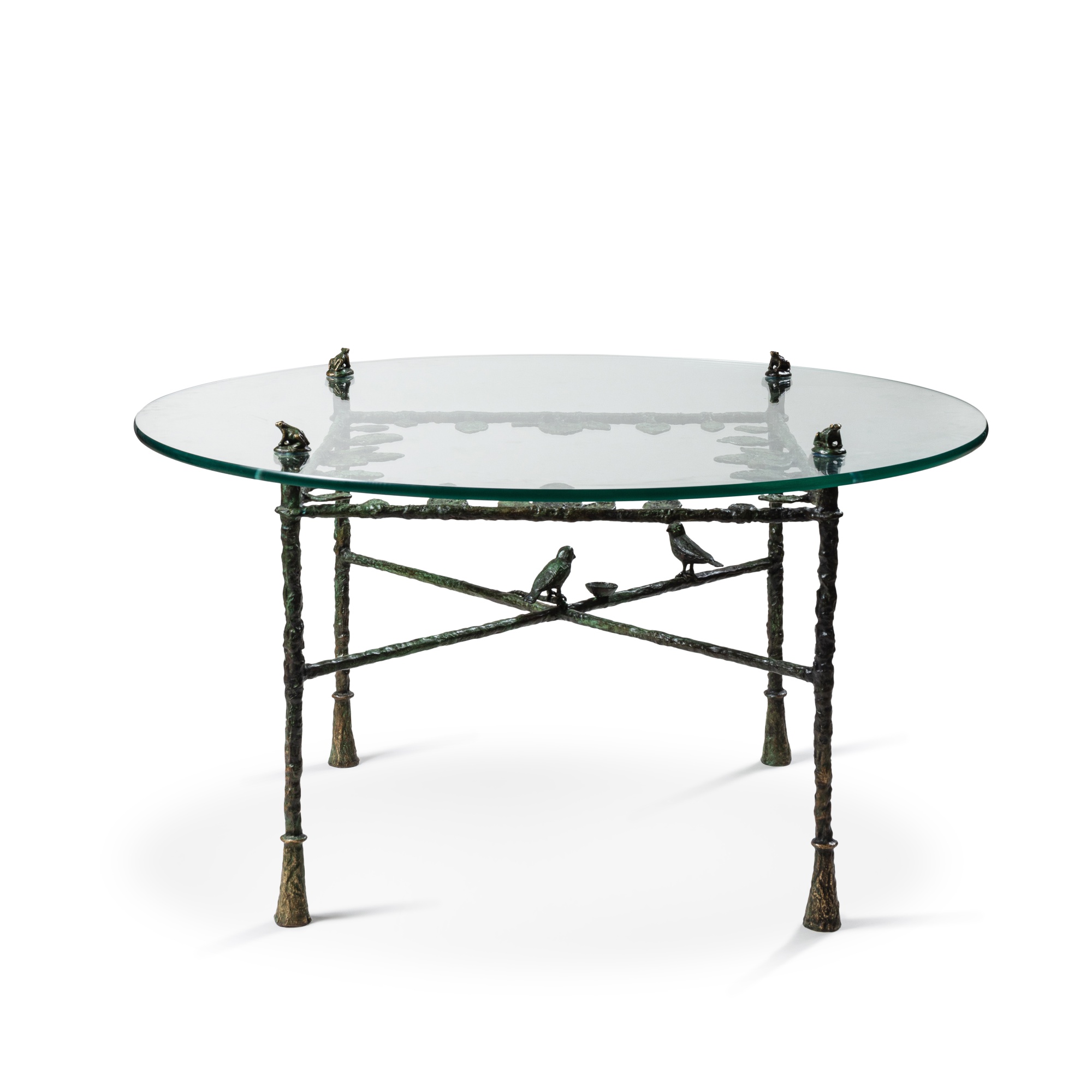
Table-feuilles, modèle bas aux grenouilles, 1980
When Christie's Paris offered a significant group of his furniture and decorative works in recent years, the rooms fell quiet with the specific attention of people who recognize something rare: objects that feel simultaneously ancient and completely alive. That quality, an animism so natural it seems effortless, is the defining achievement of one of the twentieth century's most singular artistic minds. Diego Giacometti was born in 1902 in the mountain village of Borgonovo, in the Italian speaking canton of Graubünden in Switzerland. He was the younger brother of Alberto Giacometti, whose towering reputation as a sculptor would come to define an entire existential moment in postwar art.
Growing up in a household shaped by their father Giovanni, a Post Impressionist painter of genuine accomplishment, all four Giacometti children were immersed in art from the beginning. Diego moved to Paris in 1925 to join Alberto, and what began as a practical arrangement became a lifelong creative partnership. For decades, Diego served as Alberto's chief assistant, model, and collaborator, casting his brother's sculptures, maintaining the studio, and providing the kind of steady, devoted presence that allowed Alberto's volatile genius to function. It is a role that has historically overshadowed Diego's own achievements, but that overshadowing has steadily and deservedly lifted.
Diego Giacometti
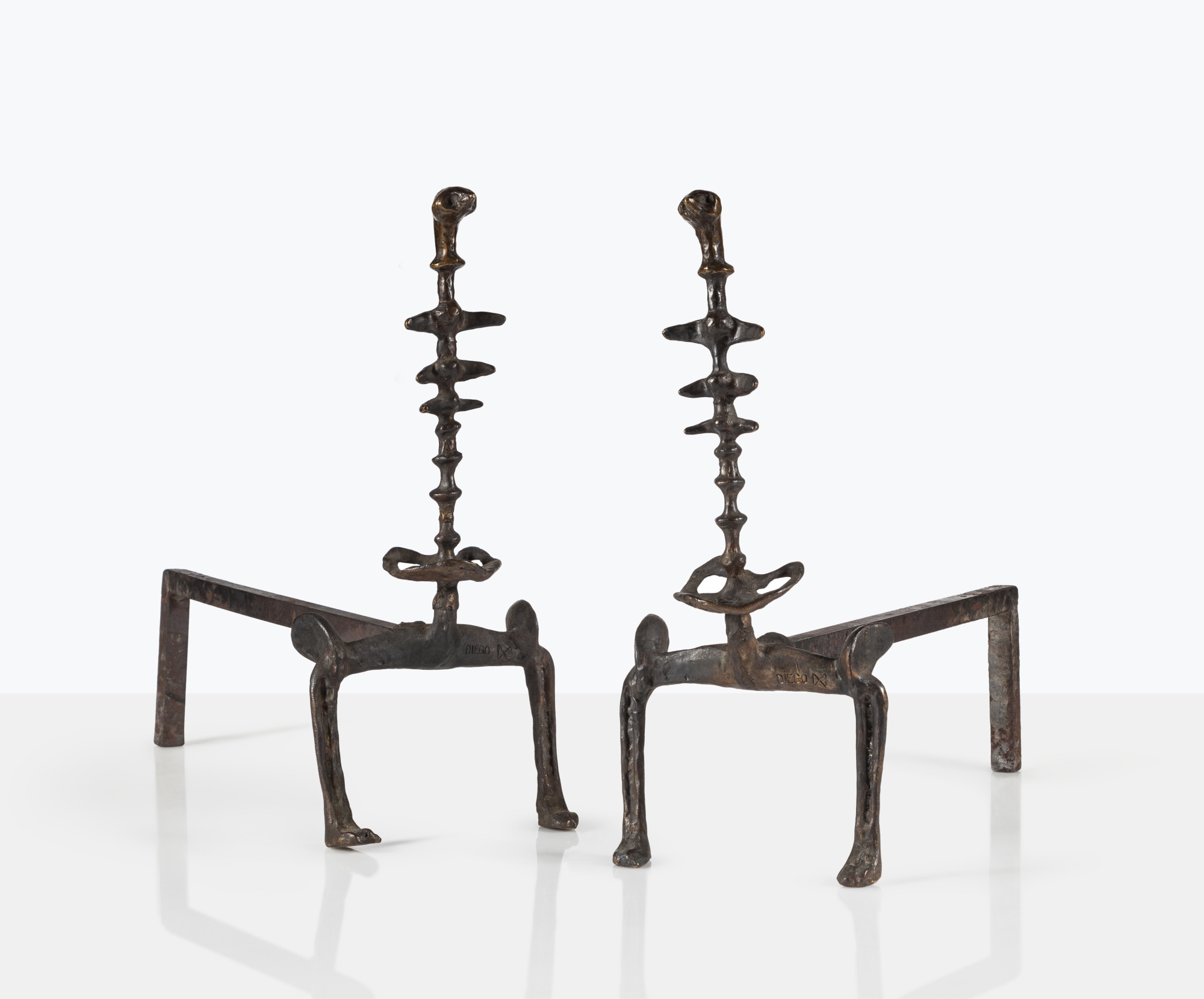
Pair of "Carcasse" Andirons
Diego's independent artistic practice took shape slowly and with characteristic modesty. He had spent so many years in service to another vision that finding his own language required patience rather than rupture. Through the 1950s and into the 1960s, he began producing furniture and decorative objects that drew on his deep knowledge of bronze casting and his lifelong observation of the natural world. His references were not the avant garde movements churning through Paris galleries but something older and more instinctive: Etruscan bronzes, Egyptian decorative arts, Romanesque ironwork, and above all the animals and plants he had observed since childhood in the Alps.
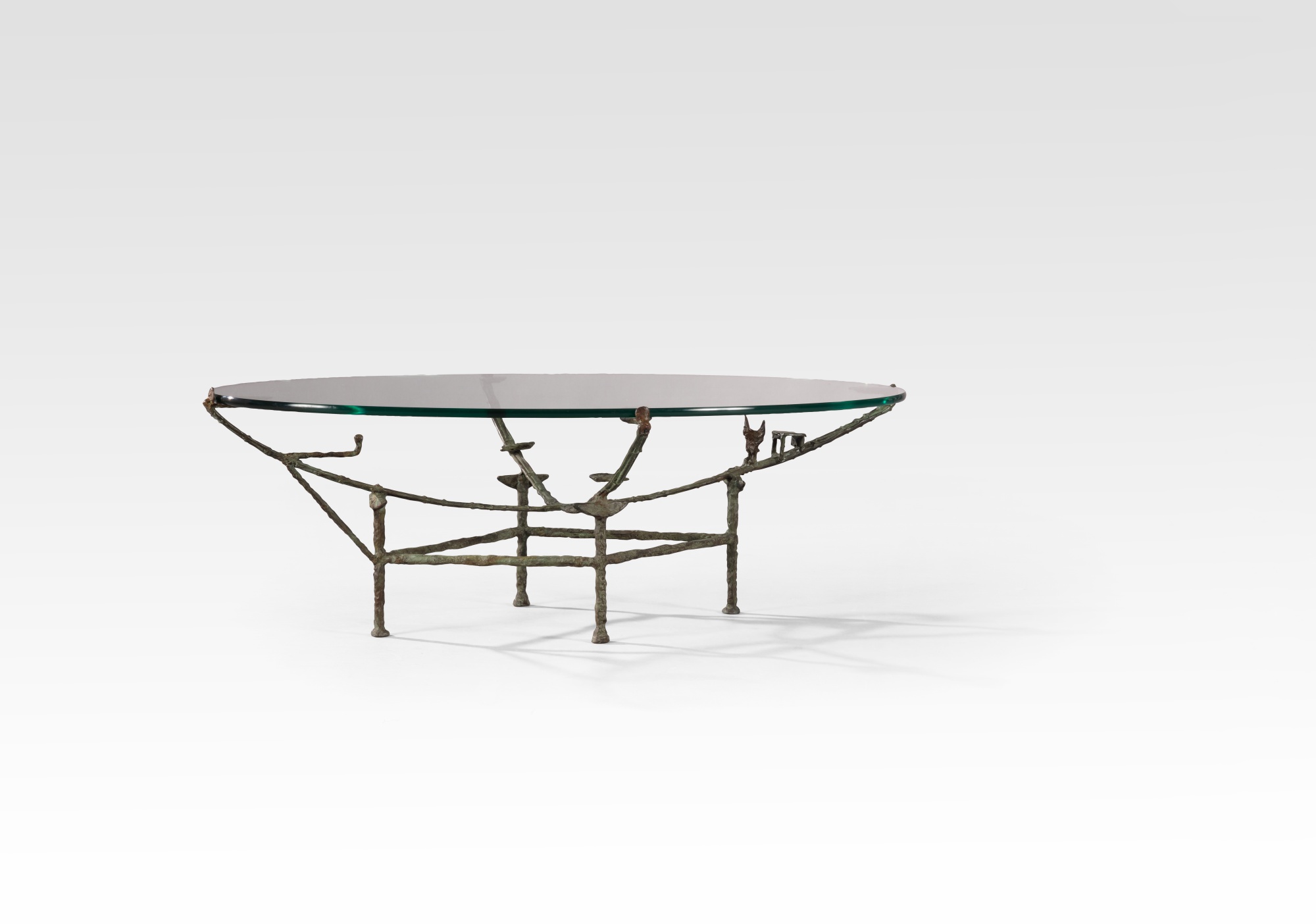
What emerged was a vocabulary entirely his own, one that felt timeless rather than stylish and all the more powerful for it. The works Diego produced across the following two decades represent one of the most cohesive and quietly revolutionary bodies of decorative art of the twentieth century. His tables, chairs, lamps, andirons, sconces, and console pieces rewrote the boundary between fine art and applied craft. A table such as the celebrated Table basse Carcasse modèle à la chauve souris, with its skeletal bronze frame punctuated by a bat in quiet repose, is simultaneously a functional object and a sculpture of genuine poetic weight.
Diego Giacometti
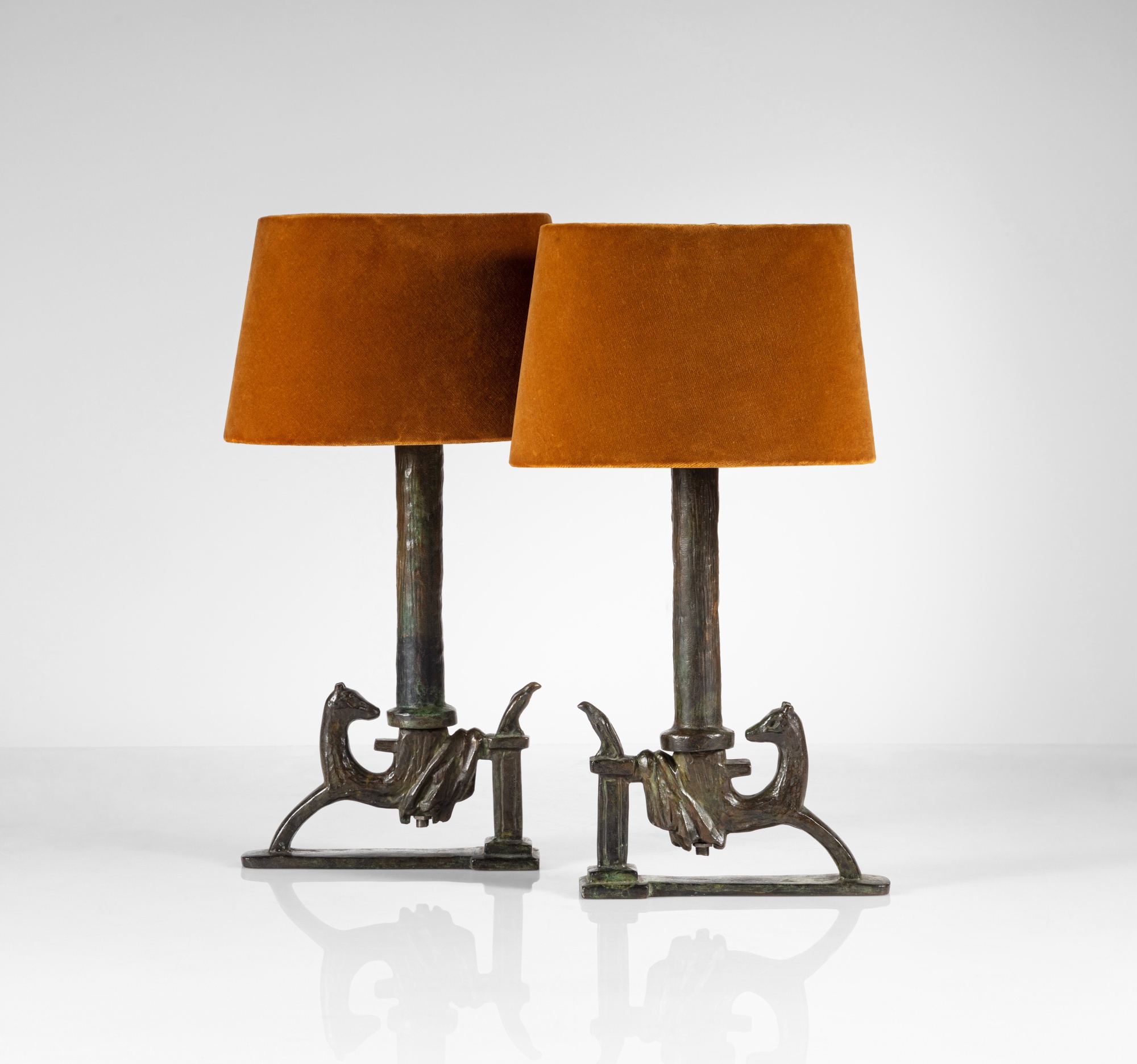
Pair of "Chien et Faucon" Table Lamps
The Table feuilles modèle bas aux grenouilles, cast in 1980, places bronze frogs among leaf forms with an ease that suggests observation rather than invention. His Pair of Carcasse Andirons and his various lamp designs, including the Pair of Chien et Faucon Table Lamps with their patinated bronze dogs and falcons, demonstrate the range of his zoological imagination and his mastery of the way bronze can capture both the weight and the lightness of living creatures. A single Cerf or Chat or Tête de Cheval, taken alone, holds its own against the finest animalier bronzes of any period. Diego worked extensively on private commissions throughout his career, creating bespoke interiors and furnishing schemes for collectors and cultural institutions who recognized that his work transformed a space rather than merely decorating it.
The Fondation Maeght in Saint Paul de Vence, which commissioned him to furnish portions of its interiors, became one of the most celebrated examples of his environmental vision, a place where the boundaries between garden, architecture, and object dissolved in ways that felt entirely coherent. His relationship with Aimé and Marguerite Maeght, and with the wider circle of artists and collectors around the foundation, placed him at the heart of French cultural life even as he remained personally reserved and averse to the machinery of art world celebrity. For collectors, Diego Giacometti's work occupies a position of remarkable desirability precisely because it operates on multiple levels at once. The objects are useful and beautiful, intellectually serious and emotionally warm.
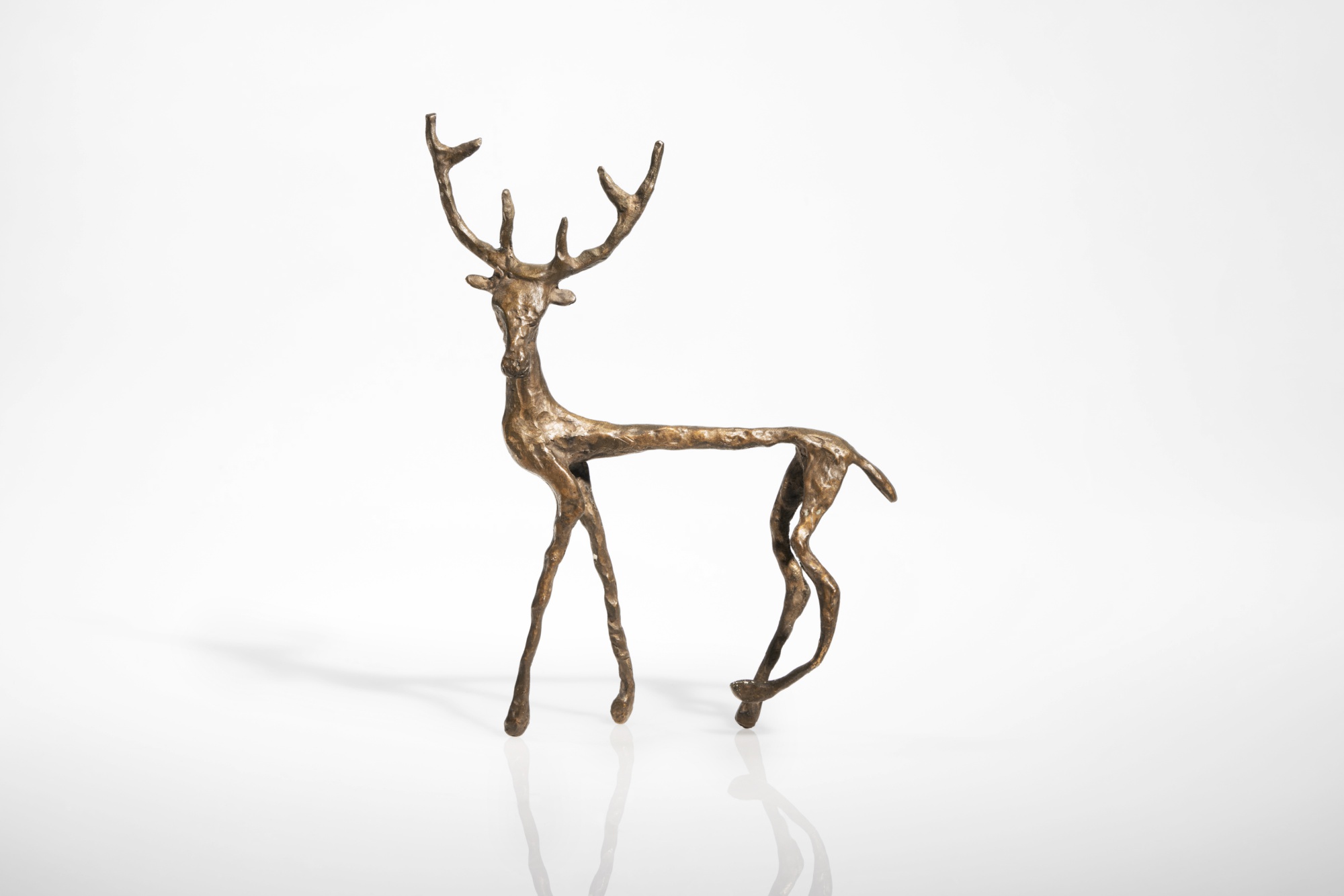
Diego Giacometti
Cerf
They hold their place in a minimalist interior as naturally as they do in a richly layered one. Auction results over the past two decades have reflected growing international appetite for his bronzes, with major works achieving significant multiples of their estimates at the principal Paris and London sale rooms. Sotheby's and Christie's have both dedicated considerable attention to his furniture and objects, and private dealers who specialize in twentieth century decorative arts regard his pieces as among the most sought after on the market. Collectors drawn to the work of Line Vautrin, Serge Roche, or Jean Michel Frank tend to find in Diego a natural companion, someone who shares their commitment to handcraft and poetic invention while operating in a register entirely his own.
Within art history, Diego Giacometti occupies a fascinating position. He belongs to no movement and submitted to no manifesto. His closest relatives are perhaps the great animalier sculptors of the nineteenth century, artists like Antoine Louis Barye whose commitment to observed animal form prefigured his own, but also the Surrealists who surrounded him in Paris and whose taste for the strange domesticity of the unconscious found an echo in his populated tables and haunted sconces. There is something of Alberto in the attenuated forms that appear occasionally in his work, but Diego's emotional register is warmer, more inhabited, more at ease with the world.
Diego Giacometti died in Paris in 1985, leaving behind a body of work that has only grown in stature with time. The retrospective exhibition organized by the Musée des Arts Décoratifs in Paris in 1986, shortly after his death, introduced many collectors to the full scope of his achievement and set the terms for the serious appreciation that followed. His work reminds us that the decorative and the fine arts are not categories that nature itself recognizes, and that an artist who chooses to make things people live with rather than things people only look at is not making a lesser choice. Diego Giacometti made that choice with complete conviction, and the rooms that hold his work are among the most quietly enchanted in the world.
Explore books about Diego Giacometti
Diego Giacometti
François Marquet
Diego Giacometti: Furniture and Objects
Kreiswirth, Lea
Giacometti: The Complete Works
Reinhard Onnasch
Diego Giacometti 1902-1985
Pierre Schneider

The Giacometti Brothers: Art and Friendship
James Lord