Diane Arbus
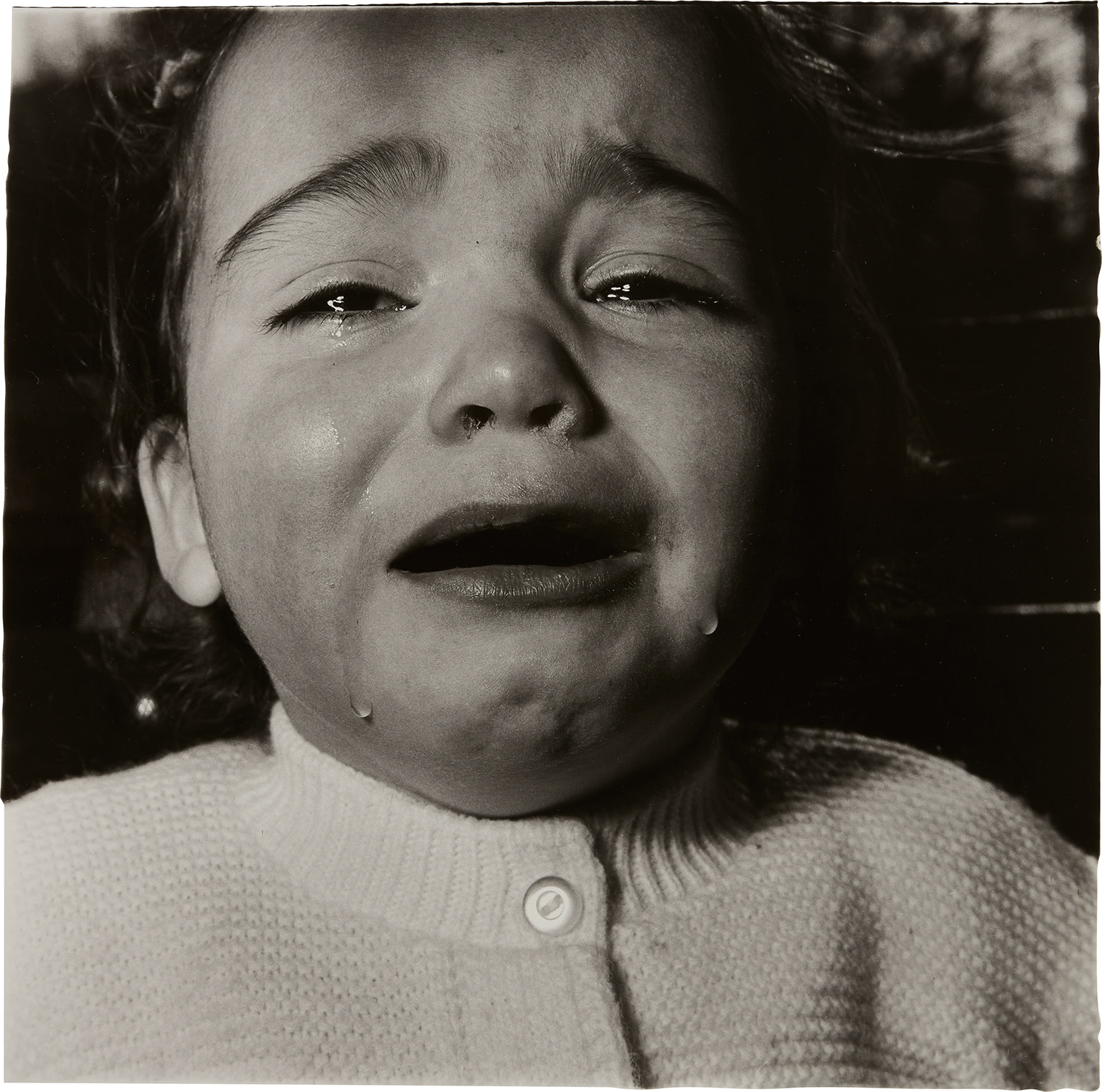
Diane Arbus: A Vision That Transforms Everything
Artist Spotlight · The Collection Editorial
“I really believe there are things nobody would see if I didn't photograph them.”
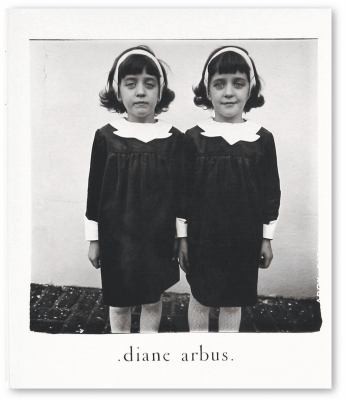
Diane Arbus: An Aperture Monograph, 1972
In 1972, just one year after her death, Diane Arbus became the first American photographer to have work included in the Venice Biennale. The rooms were reportedly so crowded that visitors pressed shoulder to shoulder to stand before her square format black and white prints, many of them moved to tears, others simply silenced. That moment announced something the art world was only beginning to understand: that Arbus had not merely taken photographs, but had fundamentally reordered what photography was allowed to be, who it was allowed to love, and what counted as a life worth looking at. Diane Nemerov was born in 1923 in New York City into the Russek family, owners of a prosperous Fifth Avenue fur and fashion store.
Diane Arbus
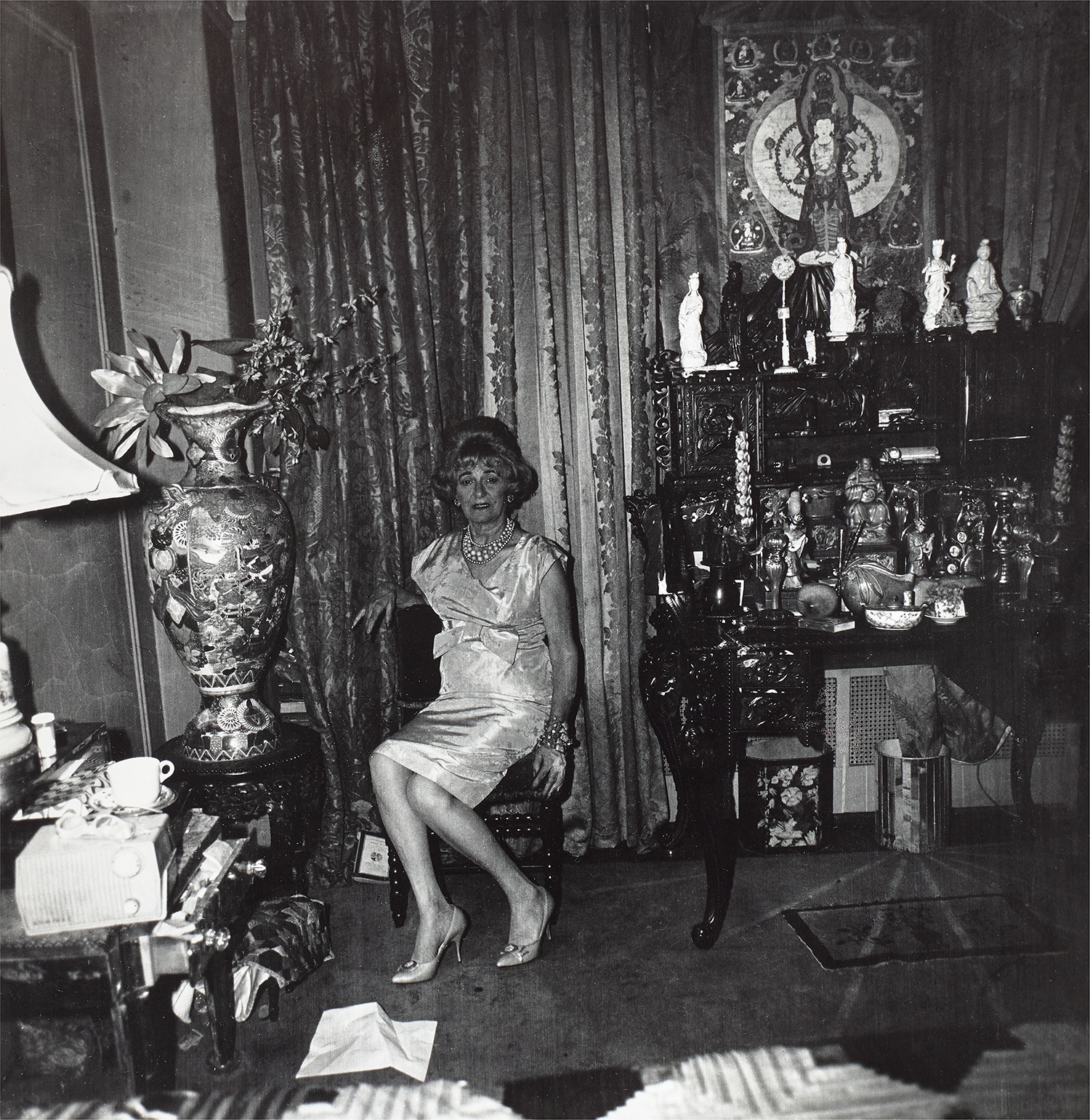
Elizabeth Taylor look-alike reclining on a bed, London, England
Hers was a childhood of comfort and careful surfaces, the kind of upbringing that prizes appearance and propriety above almost everything else. She would later describe feeling a certain unreality growing up wealthy, a sense of being insulated from the textures of actual life. At eighteen she married Allan Arbus, and the two built a successful commercial fashion photography business through the 1940s and into the 1950s, shooting campaigns for Glamour and Harper's Bazaar. The work was elegant and well regarded, but it was not hers, not yet.
The turning point came in the late 1950s when Arbus began studying with Lisette Model, the Austrian born photographer whose street work carried a raw, democratic energy that had little patience for glamour. Model is often credited with giving Arbus the permission and the language to follow her instincts. Around the same time, Arbus began walking the streets of New York with a twin lens reflex camera, entering the worlds of Coney Island sideshow performers, nudist colonies, Times Square hotels, and the quiet domestic interiors of suburban families. She was not documenting the exotic, she was documenting the human.
Diane Arbus
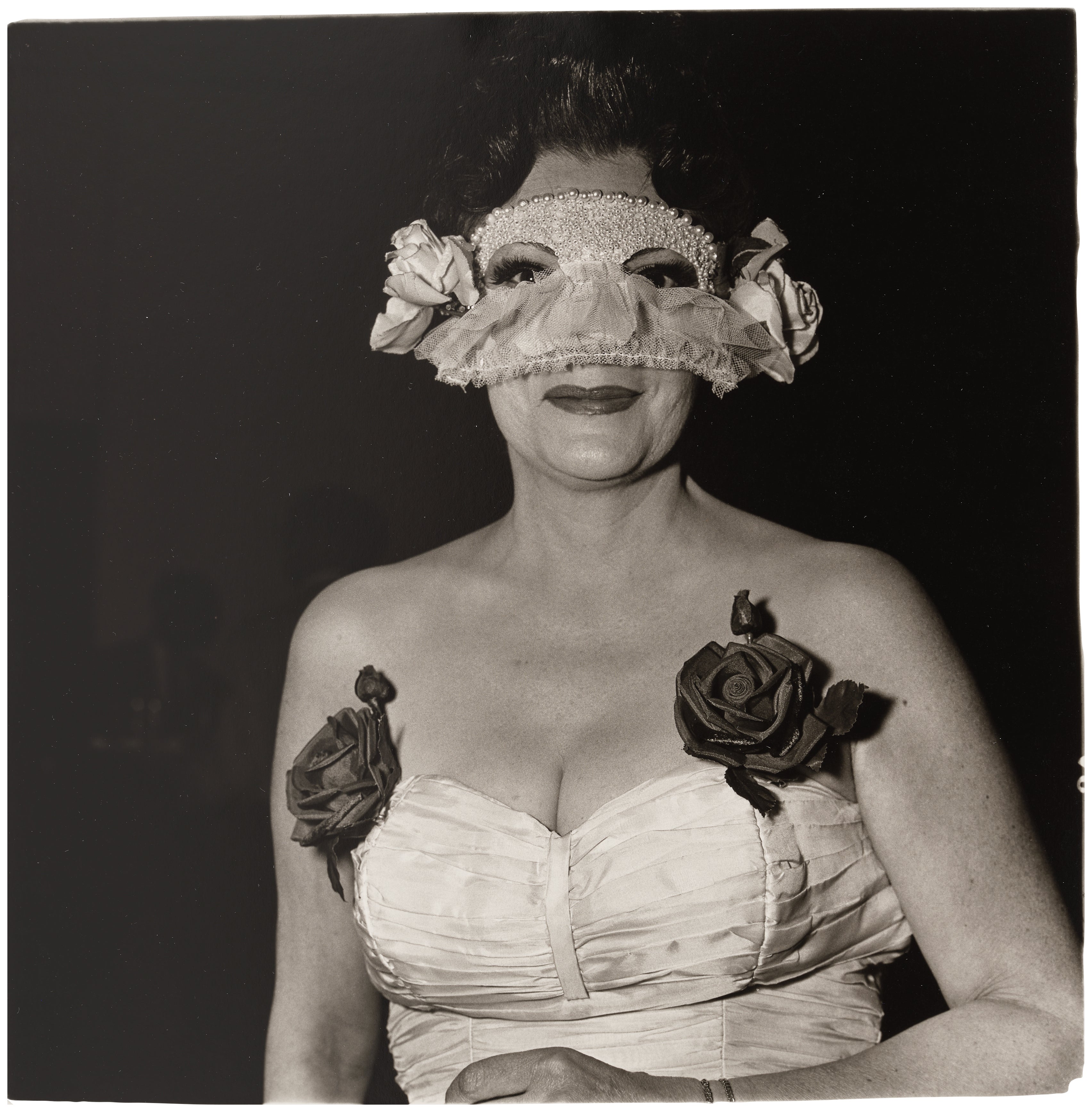
Lady at a Masked Ball with Two Roses in Her Dress, NYC
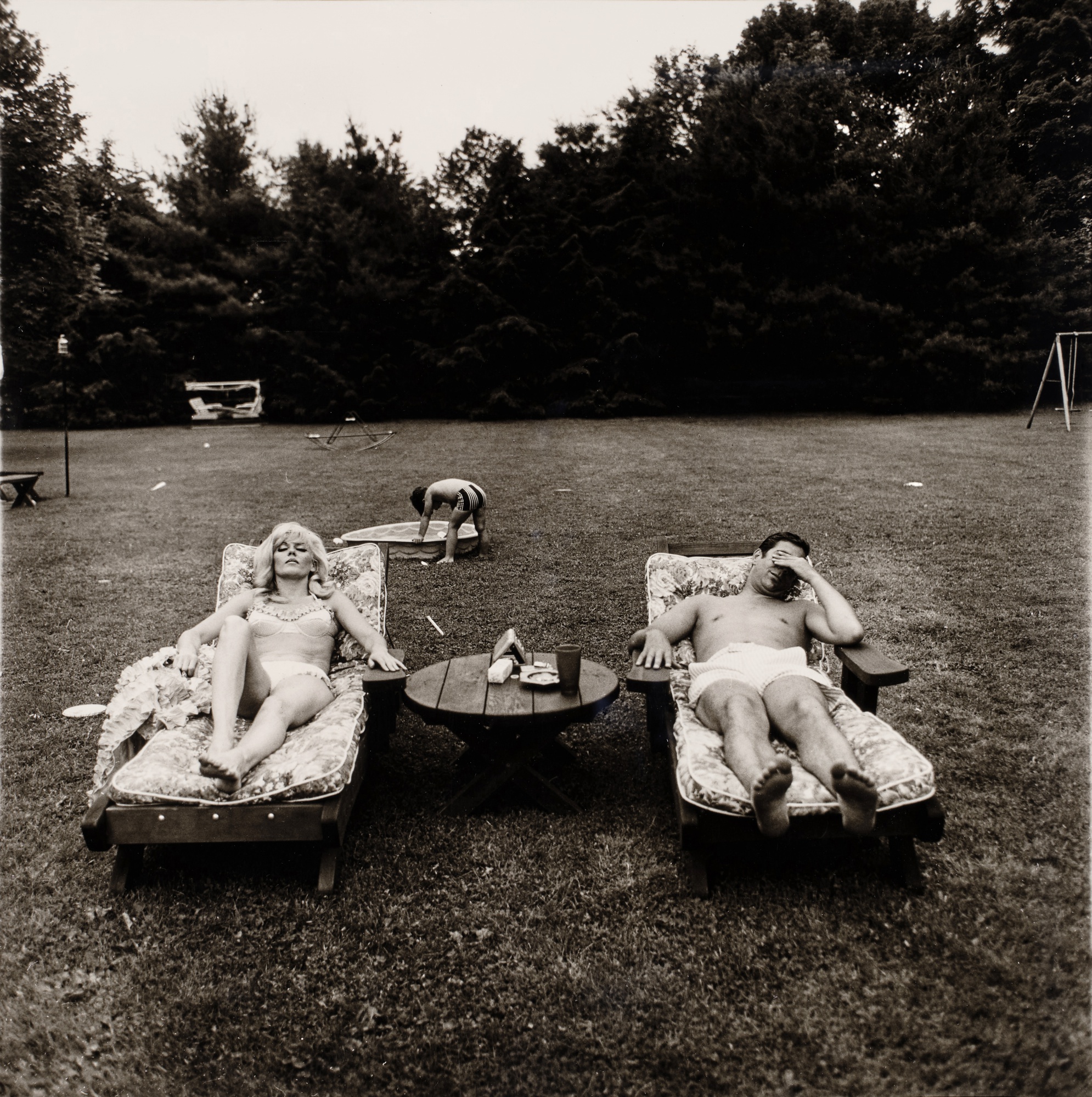
The distinction matters enormously. Arbus worked primarily in gelatin silver print, using a square format that gave her images an unusual frontality and stillness. Her subjects almost always faced the camera directly, and she cultivated a quality of mutual presence in her portraits, a feeling that the person being photographed had genuinely consented to be seen, had perhaps even wanted to be seen in exactly this way. Works like A Family on Their Lawn One Sunday in Westchester, N.
“A photograph is a secret about a secret. The more it tells you, the less you know.”
Diane Arbus
Y., made in 1968, carry this quality with particular force. The image of an outwardly ordinary suburban family radiates an interior strangeness that has nothing to do with judgment and everything to do with attention. Similarly, A Naked Man Being A Woman, N.
Diane Arbus
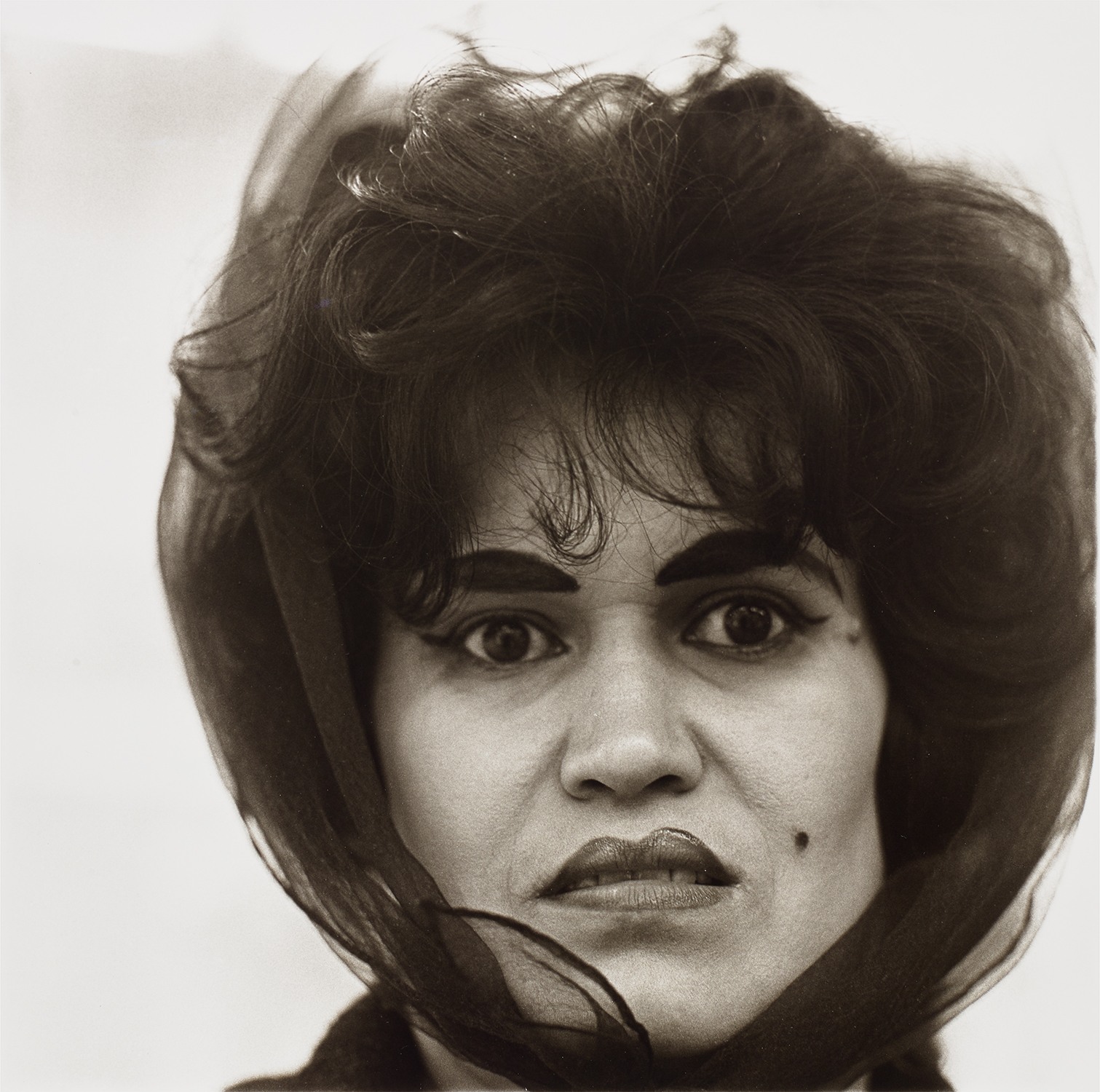
A woman passing on the street, N.Y.C.
Y.C., also from 1968, approaches its subject with the same unflinching tenderness, finding in gender nonconformity not spectacle but dignity. These are not images that exploit.
“My favorite thing is to go where I've never been.”
Diane Arbus
They are images that witness. Among the works that demonstrate her remarkable range, the Elizabeth Taylor look alike reclining on a bed, London, England captures Arbus at her most quietly unsettling and most compassionate simultaneously. The image plays with ideas of performance, celebrity, and self construction in ways that feel strikingly contemporary. Lady at a Masked Ball with Two Roses in Her Dress, NYC is another essential work, suffused with a melancholy glamour that recalls the theatrical portraiture of August Sander while remaining entirely Arbus's own.
Diane Arbus
A Family on Their Lawn One Sunday in Westchester, N. Y., 1968
Max Maxwell Landar, Uncle Sam, N.Y.C., her portrait of the man who spent his life embodying the national symbol, is both funny and deeply poignant, a distillation of her gift for finding the mythic inside the mundane.
A Couple Arguing, Coney Island, N. Y. from 1960 is among her earliest masterworks, showing the velocity and emotional directness that would define her mature practice. For collectors, Arbus represents one of the most significant and historically stable positions in postwar American photography.
Her estate prints, made after her death by the printer Neil Selkirk under the authorization of the Arbus estate, are widely considered among the most carefully produced posthumous editions in the history of the medium. Selkirk's involvement is itself a mark of quality, and works bearing his printing credit carry both documentary authority and a high standard of craft. Lifetime prints, produced during Arbus's own working life, are rarer and correspondingly prized, appearing at major auction houses including Christie's and Sotheby's where they have achieved significant results. Collectors are drawn not only to her art historical importance but to the way her prints reward sustained looking, the longer you spend with an Arbus photograph, the more it gives back.
To understand Arbus fully it helps to place her within a constellation of photographers who were rethinking documentary practice at the same moment. Her near contemporary Robert Frank had just published The Americans in 1958, cracking open the mythologized image of postwar prosperity with his own oblique, restless vision. Garry Winogrand was prowling the same New York streets. Lisette Model remained a guiding presence.
But Arbus was doing something distinct from all of them: she was making portraiture, sustained and consensual, with people who had largely been rendered invisible by polite society. In this she anticipates the work of later photographers like Nan Goldin, whose own intimate documentation of subcultural communities owes a clear debt to the emotional territory Arbus opened up. What makes Arbus indispensable today is precisely what made her radical in her own time: her absolute belief that every human life, regardless of how the world categorized it, deserved to be looked at fully and without flinching. In an era saturated with images that flatten, filter, and optimize human appearance, her work feels not like a relic but like a corrective.
Museums including the Metropolitan Museum of Art and the Museum of Modern Art hold her work in their permanent collections, and her photographs continue to generate serious scholarly and curatorial attention. The 2003 retrospective organized by the San Francisco Museum of Modern Art, which traveled internationally, introduced her to a new generation and confirmed her standing as one of the essential artists of the twentieth century. To collect Arbus is to collect a way of seeing that has never been more needed.
Explore books about Diane Arbus

Diane Arbus: An Aperture Monograph
Diane Arbus

Diane Arbus: A Biography
Patricia Bosworth
Diane Arbus: Revelations
Doon Arbus and Marvin Israel
Diane Arbus: Family Albums
Diane Arbus
Diane Arbus Untitled
Diane Arbus
Diane Arbus: Notes
Arthur Danto
Diane Arbus: Just Before My Life Got Better
Doon Arbus
Diane Arbus: Documents
Fraenkel Gallery