Dexter Dalwood
Dexter Dalwood Paints the Rooms History Left Behind
Artist Spotlight · The Collection Editorial
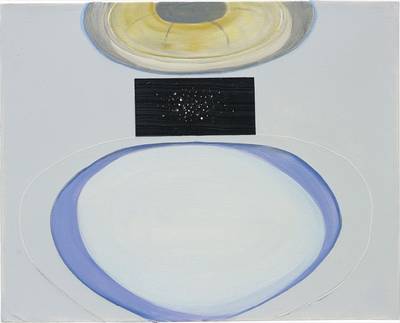
There is a particular kind of anticipation that surrounds Dexter Dalwood whenever his work enters a room. His paintings arrived at a significant cultural moment when Tate Britain mounted its Turner Prize exhibition in 2010, placing Dalwood's large, architecturally charged canvases before the broadest possible audience and confirming what many collectors and curators had quietly understood for over a decade: that this British painter had developed one of the most intellectually generous and visually arresting practices of his generation. The shortlisting brought renewed international attention to a body of work that had already found a home in the permanent collections of Tate and the Museum of Modern Art in New York, two institutions whose acquisitions together constitute perhaps the most persuasive endorsement a living painter can receive. Dalwood was born in Bristol in 1960, and his formation as an artist carried the particular texture of that transitional British moment when punk's energy was dissolving into new wave and postmodernism was beginning to reshape how artists thought about representation and history.
Dexter Dalwood
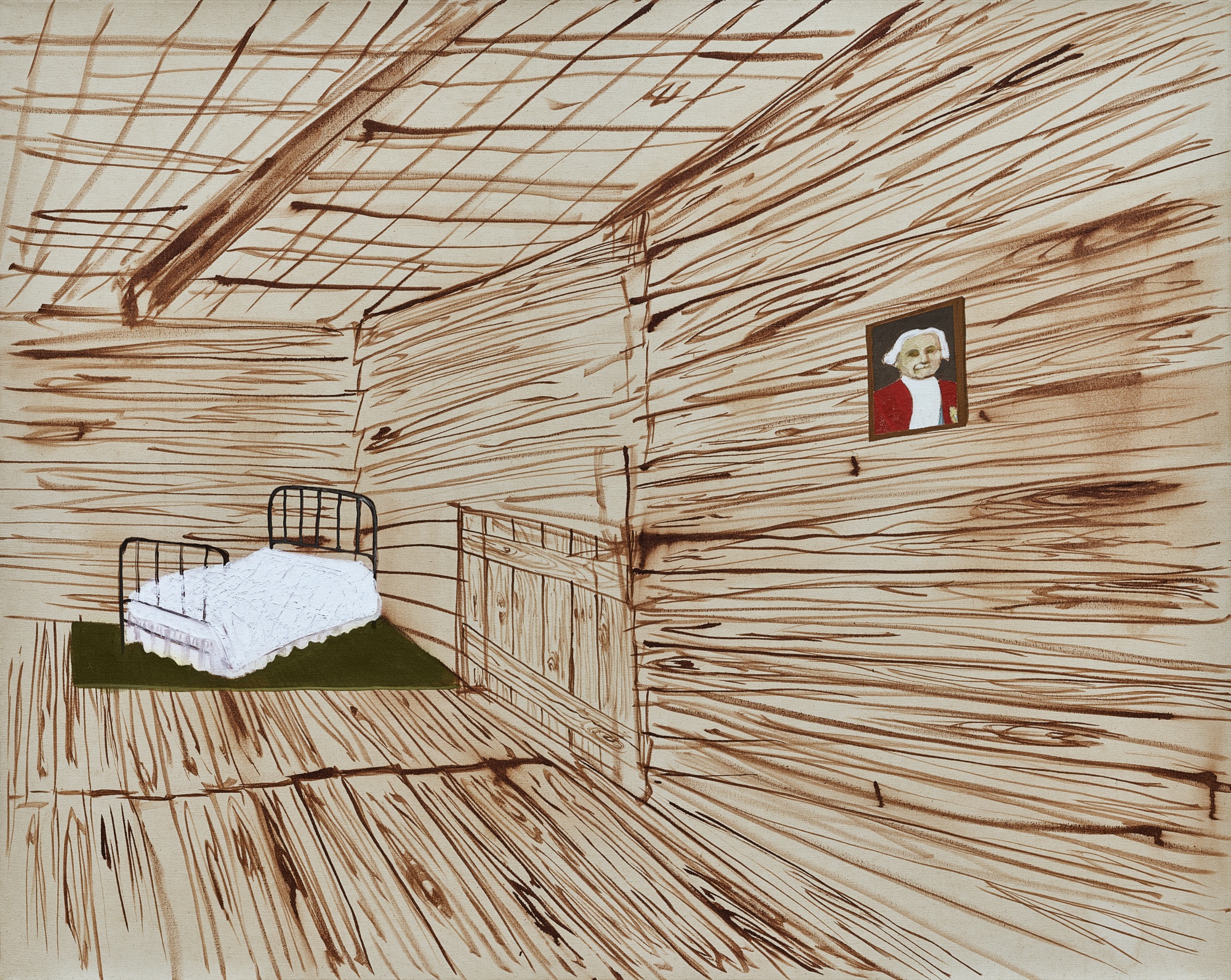
Uncle Tom's Cabin 湯姆叔叔的小屋, 1998
He studied at Saint Martin's School of Art in London, an institution whose alumni and faculty in that era were wrestling seriously with questions of appropriation, image culture, and the relationship between painting and photography. These were precisely the questions that would come to define Dalwood's practice, though he would answer them through deeply personal and painterly means rather than through conceptual detachment. His artistic development through the late 1980s and 1990s saw him evolve a method that is at once rigorously researched and freely imaginative. Dalwood constructs spaces that no camera has ever recorded, rooms and landscapes associated with figures of enormous cultural weight, assembling his compositions from archival photographs, film stills, art historical sources, and his own acute pictorial intelligence.
The result is a body of work that engages with collective memory and the mythology of modern celebrity, politics, and catastrophe, while remaining unmistakably rooted in the long tradition of Western painting. He absorbed the lessons of Matisse and de Kooning, of Hockney and Richter, and synthesised them into something entirely his own. The paintings that brought Dalwood to wider notice in the late 1990s announced his signature approach with striking confidence. Works from 1998 such as Bridge of the Starship Enterprise, The Liberace Museum, and Uncle Tom's Cabin each demonstrate his ability to evoke absence with tremendous presence.
Dexter Dalwood
And the days are not full enough / And the nights are not full enough; Empty are the ways of this land; Fortitude as never before.... / Frankness as never before; You stand about the streets / You loiter at the corners and bus-stops / You do next to nothing at all; The thought of what America would be like / If the classics had a wide circulation; and I had laid out just the right books / I had almost turned down the pages
Uncle Tom's Cabin, rendered in acrylic on canvas, conjures the ideological and emotional weight of Harriet Beecher Stowe's foundational American text through an imagined interior suffused with melancholy and moral urgency. These are not illustrations or reconstructions in any archaeological sense. They are meditations, spaces where the viewer is invited to feel the proximity of a historical or cultural force without ever encountering its human source directly. The figure is always just out of frame, and that absence becomes the subject.
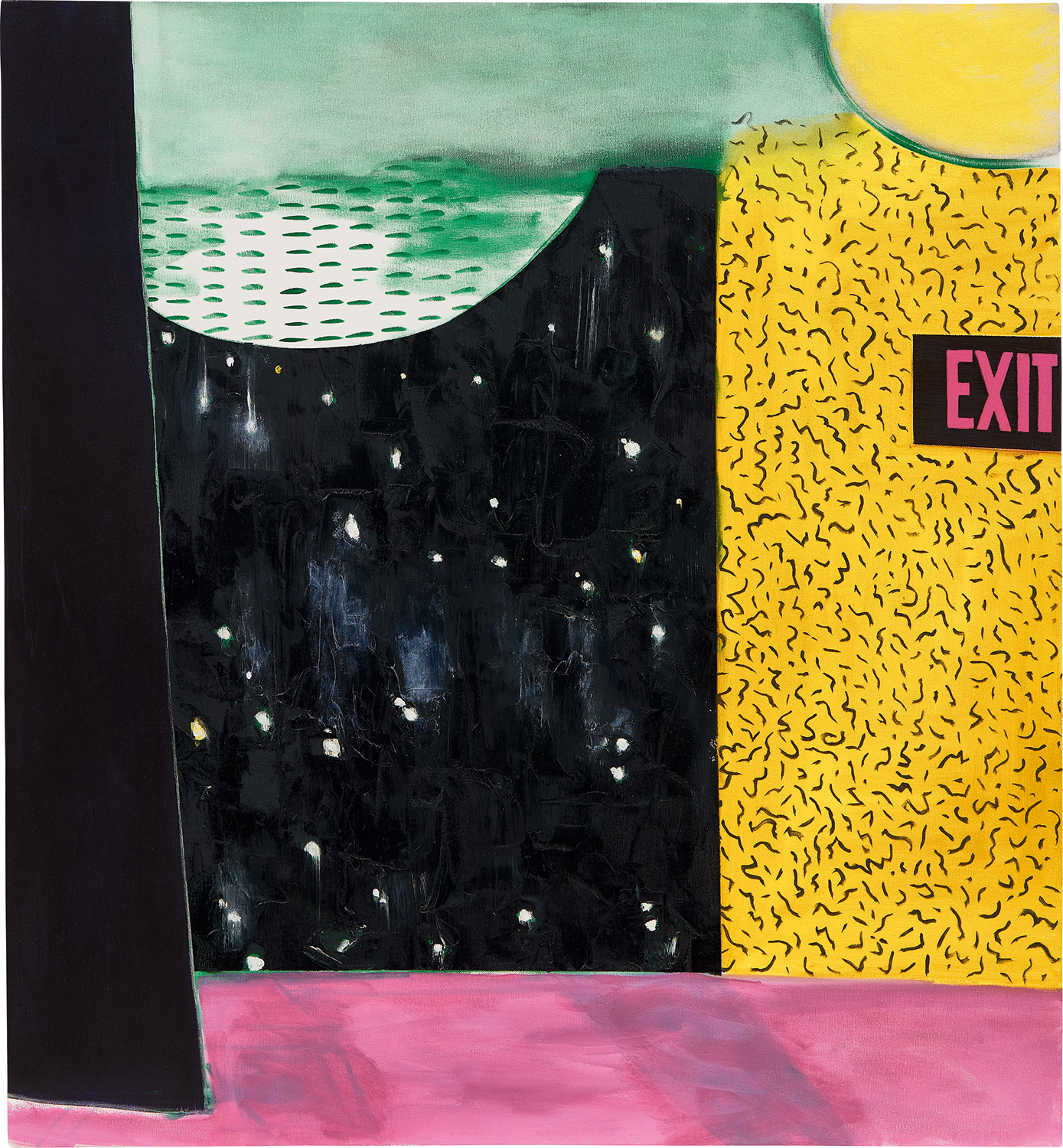
Wittgenstein's Bathroom from 2001 exemplifies the wit and rigour that runs through the practice. Dalwood imagines the private space of one of the twentieth century's most demanding philosophers and produces something both funny and genuinely unsettling, a cool, spare room that feels entirely plausible as the habitat of a mind committed to precision and austerity. Heaven from 2012 shows the painter's continued evolution, with a more lyrical and expansive handling of space and colour that reveals how deeply he had absorbed both the formal ambitions of abstraction and the emotional intelligence of figuration. The Queen's Bedroom and A View from a Window further expand his range, demonstrating that his interest extends beyond the American mythology that dominated his early work toward a broader inquiry into power, domesticity, and the politics of space.
Dexter Dalwood
Heaven, 2012
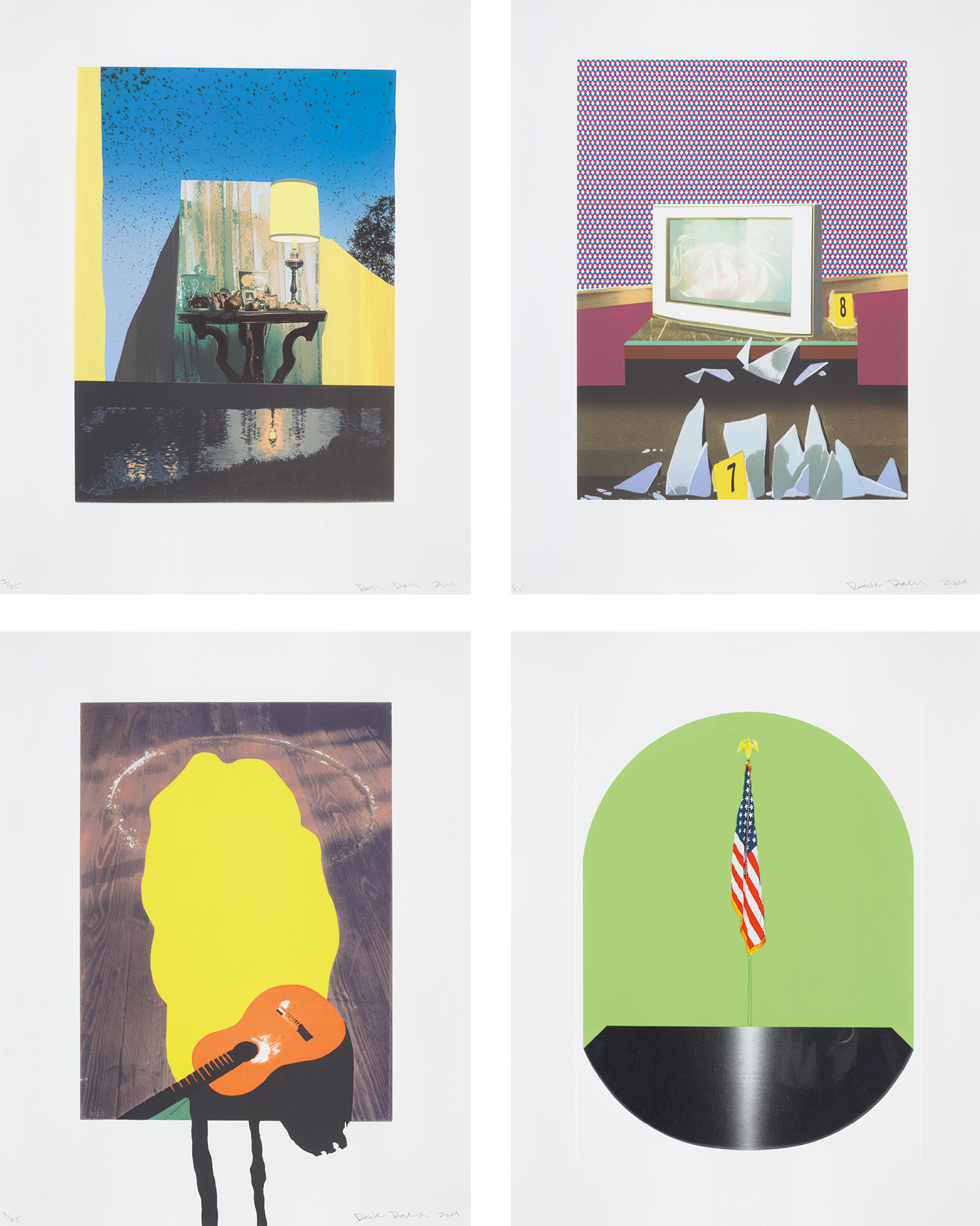
For collectors, Dalwood's practice offers something genuinely rare: paintings that reward sustained looking and sustained thinking in equal measure. His canvases operate simultaneously as formal achievements and as cultural arguments, which means they bring intellectual energy into a collection alongside visual pleasure. Works on paper and prints, including the substantial and beautifully produced edition published by Alan Cristea Gallery in London, offer collectors an accessible point of entry into the practice. Alan Cristea has been a significant platform for Dalwood's works on paper, and their editions carry the same conceptual density as his paintings, making them serious acquisitions in their own right.
Collectors drawn to painters who engage with art history, such as Neo Rauch, Peter Doig, or Luc Tuymans, will find Dalwood's work occupies a compelling position within that conversation, though his approach to narrative and cultural mythology is distinctly his own. Within the broader context of contemporary British painting, Dalwood belongs to a distinguished lineage that runs from the kitchen sink realists through the YBA generation and into the more reflective, historically conscious painting that has characterised the past two decades. He shares with artists like Peter Doig a commitment to painterly surfaces that carry emotional and psychological resonance, and with painters in the American tradition of Eric Fischl a willingness to construct scenes laden with social and political implication. But his focus on the absent figure and the imagined site gives his work a philosophical dimension that feels genuinely singular.
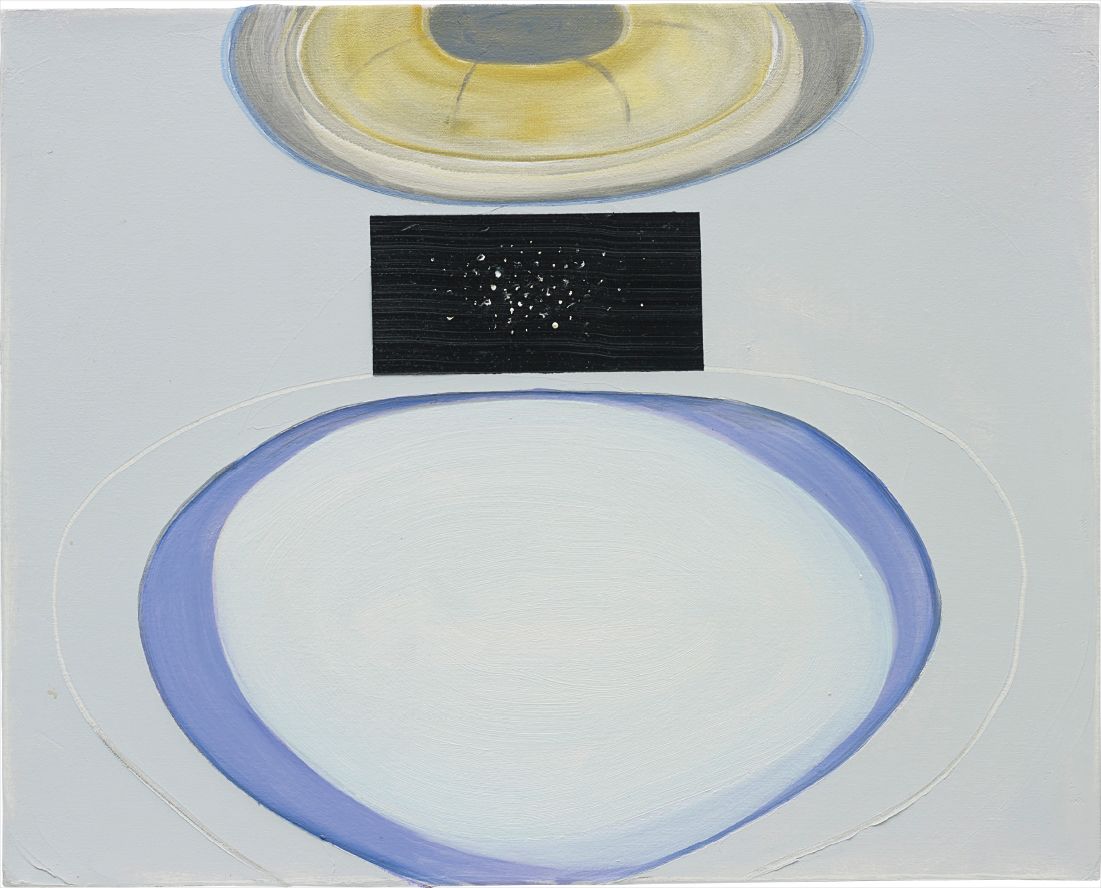
Dexter Dalwood
Bridge of the Starship Enterprise, 1998
He is asking, in every canvas, what spaces reveal about the people and ideas that inhabited them, and what we project onto history when we try to picture it. The legacy of Dexter Dalwood is still being written, which is precisely what makes this moment so rewarding for those paying close attention. His presence in the permanent collections of Tate and MoMA ensures that future generations will encounter his vision alongside the art historical touchstones that shaped it. His Turner Prize shortlisting placed him in the public record in the most official of ways, but the more enduring measure of his importance is the quality of sustained engagement his paintings provoke in those who stand before them.
To own a Dalwood is to live with a painting that keeps asking questions, about history, about mythology, about the spaces we imagine for the people who haunt our cultural consciousness. That is a rare and precious thing to bring into a home.