Derek Fordjour
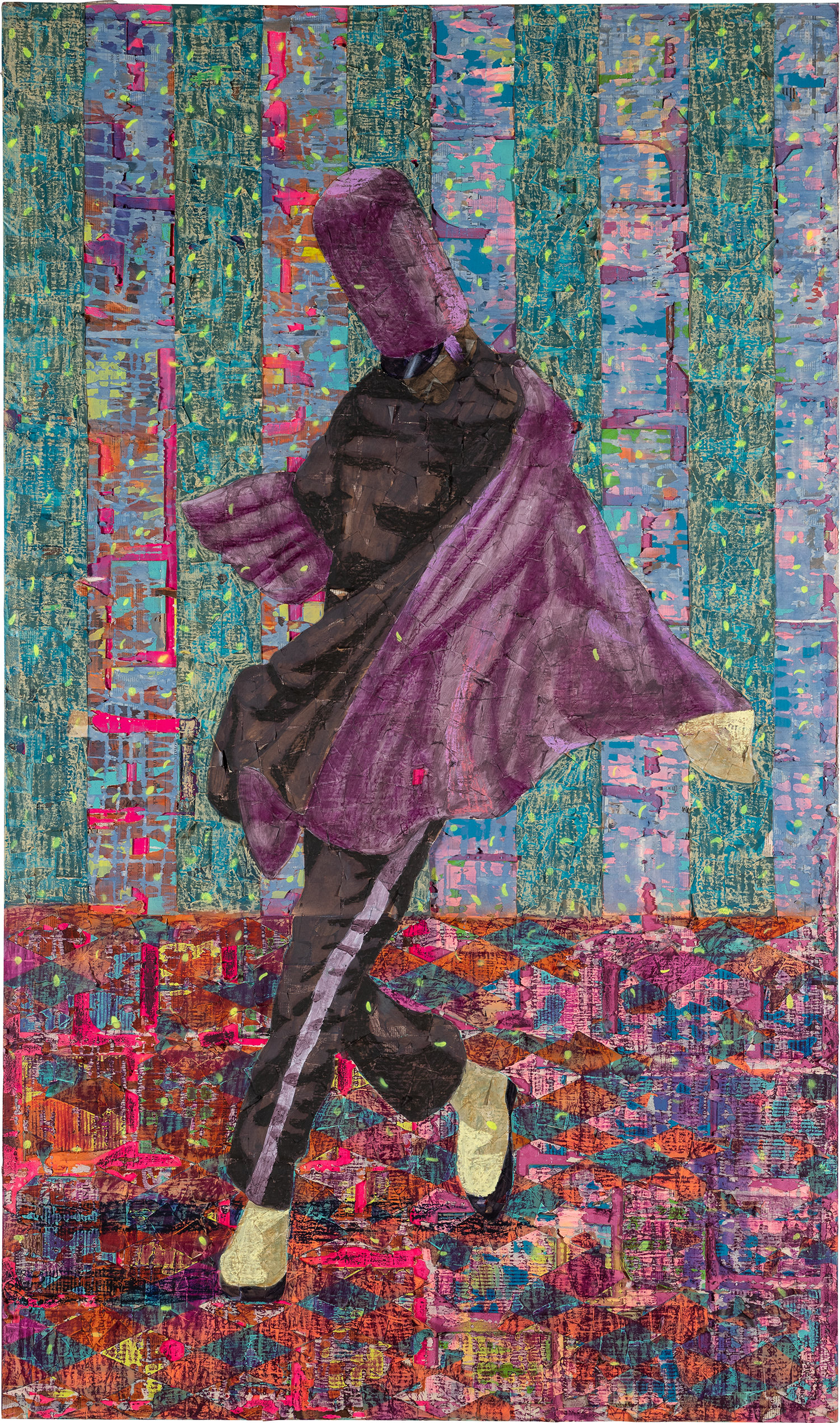
Derek Fordjour Turns the Arena Into Art
Artist Spotlight · The Collection Editorial
When Derek Fordjour's work entered the galleries of the Whitney Museum of American Art, something shifted in the conversation around contemporary American painting. Here was an artist working with materials as humble as torn newspaper and cardboard, yet producing compositions of such formal authority and emotional density that they stopped visitors in their tracks. His canvases do not whisper. They announce, with the scale and ceremony of a sporting event, that the spectacle of competition and the labor of Black life in America are among the most urgent subjects a painter can address today.
Derek Fordjour
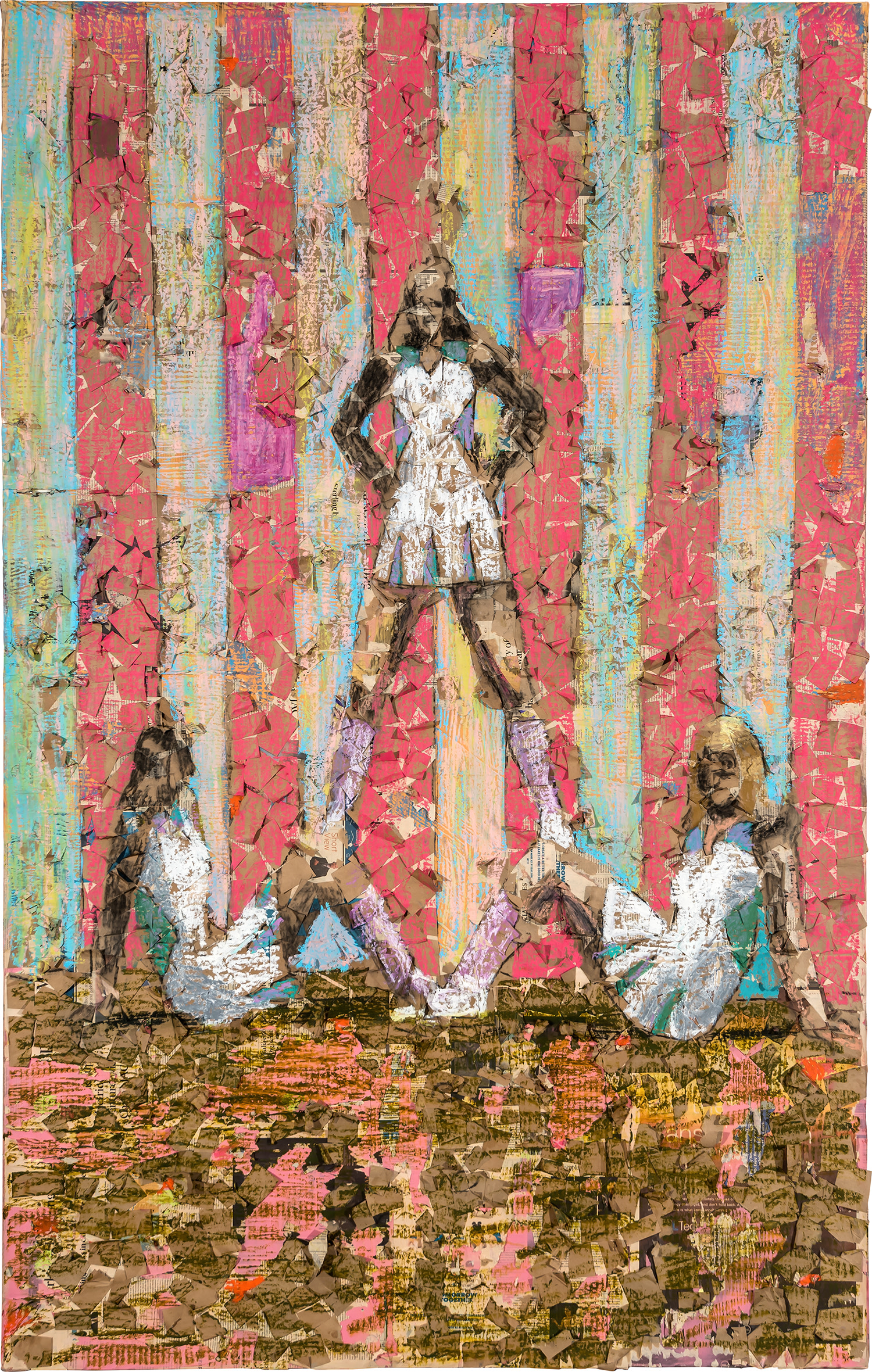
One Up Two Down, 2016
Fordjour was born in 1974, and his formation as an artist reflects a rich weaving together of cultural inheritance and American experience. Raised with an awareness of both his African roots and the vivid, often brutal theater of American public life, he came to his practice through a path that combined formal training with a deeply personal investigation of what it means to strive, to perform, and to be seen. His academic background gave him the technical fluency that undergirds even his most fragmented and layered compositions, while his sensibility as a thinker and observer pushed him well beyond the purely aesthetic. The development of Fordjour's practice over the past decade has been a study in how an artist finds and refines a visual language that is entirely his own.
In his earlier works, such as Prize Winner from 2015, painted in oil and oil stick on panel, one can already sense the preoccupation with figures caught in moments of effort and ambition, their identities both celebrated and obscured by the systems that surround them. By 2016, with works like One Up Two Down and Windfall, he was layering charcoal, oil pastel, acrylic, and spray paint over collaged newspaper, creating surfaces that feel simultaneously archaeological and immediate, as if the news of the world were literally the ground beneath every human gesture. The newspaper collage that serves as the substrate for so many of his most celebrated works is far more than a compositional choice. It is an argument.
Derek Fordjour
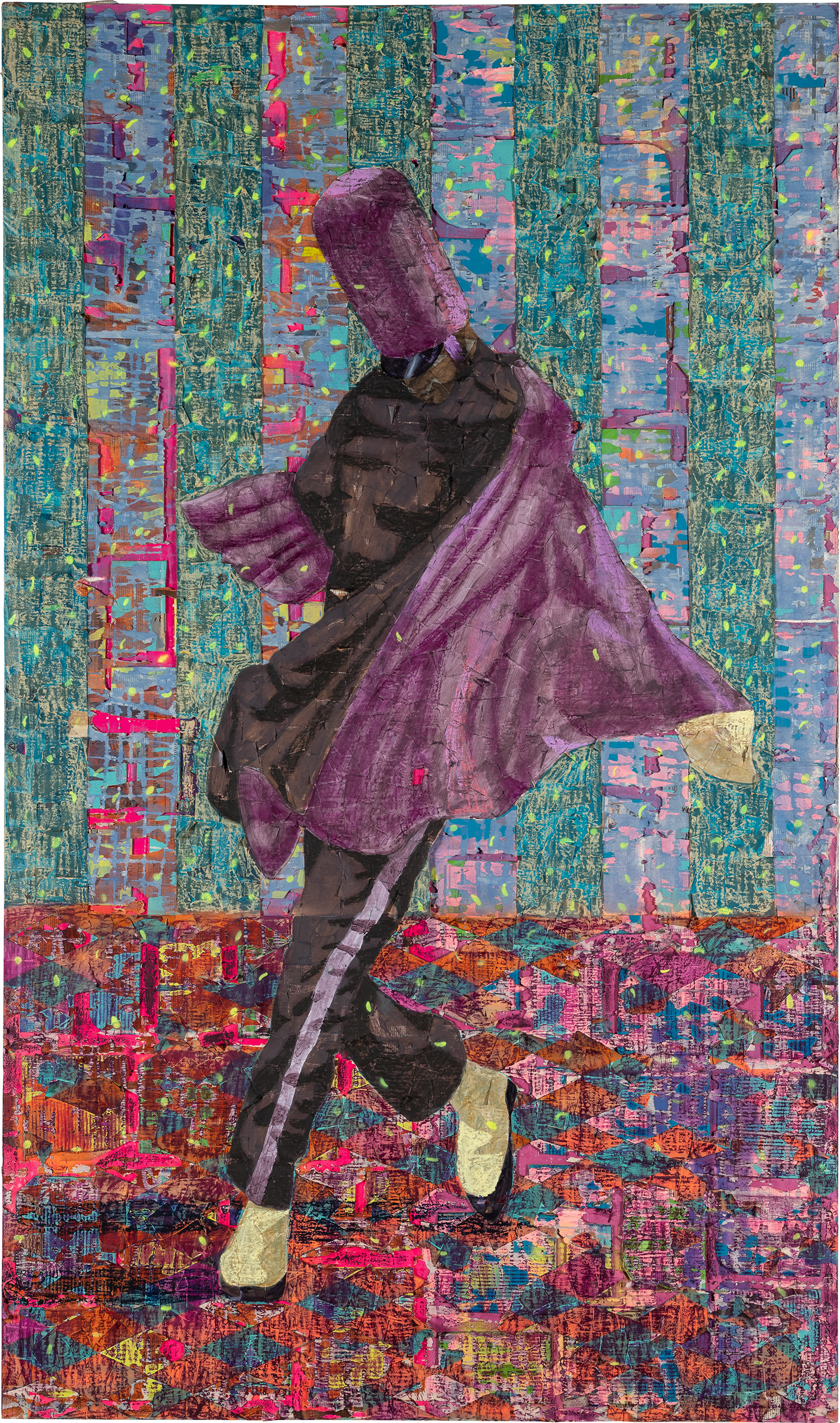
Single Pivot Turn, 2018
The headlines, columns of text, and photographic fragments that bleed through his painted surfaces remind us that the figures straining across his canvases exist within a media landscape that frames, defines, and too often diminishes them. Works like Single Pivot Turn and Numbers from 2018, both built on newspaper mounted to canvas, use this layering to extraordinary effect: the athletic figures at the center of these compositions seem to push back against the very material from which they emerge, asserting presence against the flattening force of representation. Tandem Blue and Six Count from the same year add foil to the mix, introducing a flickering, almost theatrical light that gives the surfaces a quality of spectacle and ceremony. Among the most ambitious works in Fordjour's output, Twelve Tribes from 2021 stands as a monument to his ability to think in series and across scale.
Executed in acrylic, charcoal, cardboard, and oil pastel on newspaper mounted to canvas and presented in twelve parts within an artist's frame, the work carries unmistakable spiritual and communal resonance. The division into twelve panels invites readings that are at once biblical, sociological, and deeply personal, suggesting a community bound together not by geography or blood alone but by shared labor, shared aspiration, and shared vulnerability to the forces that govern public life. The artist's frames, a consistent feature of many of his multi part works, underscore the idea that the presentation of these figures is itself a form of argument, a deliberate staging. For collectors, Fordjour's work offers something rare: the combination of material richness, intellectual seriousness, and genuine emotional power that defines enduring art.
Derek Fordjour
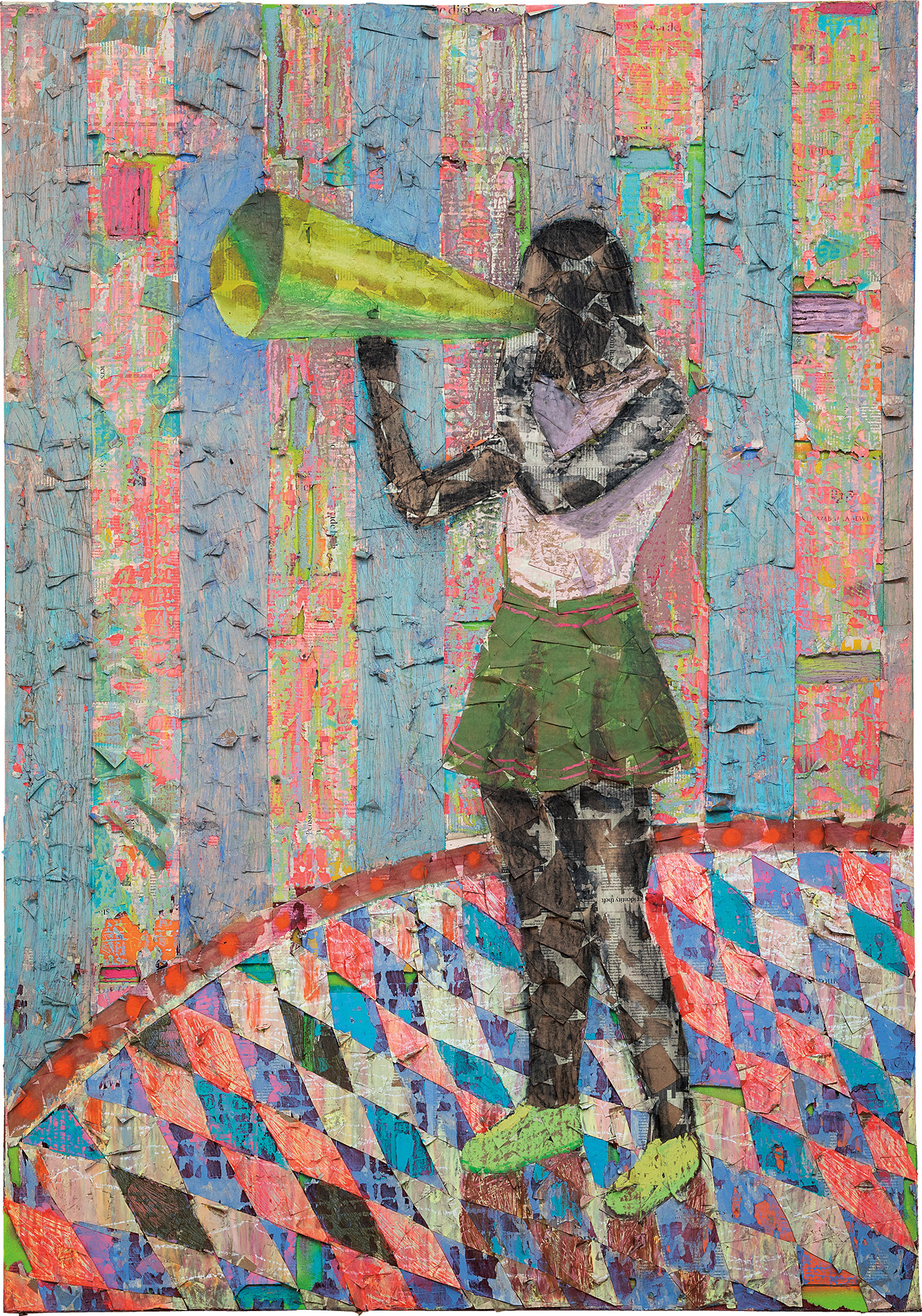
Green Horn, 2017
His mixed media approach means that each work is genuinely singular, the result of an accumulation of decisions made in real time across layered surfaces that cannot be replicated. Works from his core period of 2015 through 2021 have drawn sustained interest from serious collectors, and his presence in major institutional collections and exhibitions, including shows at the Pérez Art Museum Miami, confirms that the art world's attention to his practice is well founded and growing. Collectors who have acquired his works on paper and canvas, including the screenprint Magic, Mystery and Legerdemain, have found that even Fordjour's works on paper carry the full weight of his conceptual and formal intelligence. Within the broader landscape of contemporary American painting, Fordjour occupies a position that is both singular and richly connected to a tradition of artists who have used figuration to address questions of race, power, and visibility.
His work invites comparison with painters who have interrogated the spectacle of Black athletic and cultural life, and his use of collage and layered surfaces places him in productive dialogue with the legacies of Neo Expressionism and Conceptual Art, movements that valued both emotional directness and structural rigor. Like the best painters working in this tradition, he refuses to choose between beauty and argument, insisting that the two are inseparable. Derek Fordjour matters today because the questions he asks are not going away. What does it mean to compete in a system not built for your success?
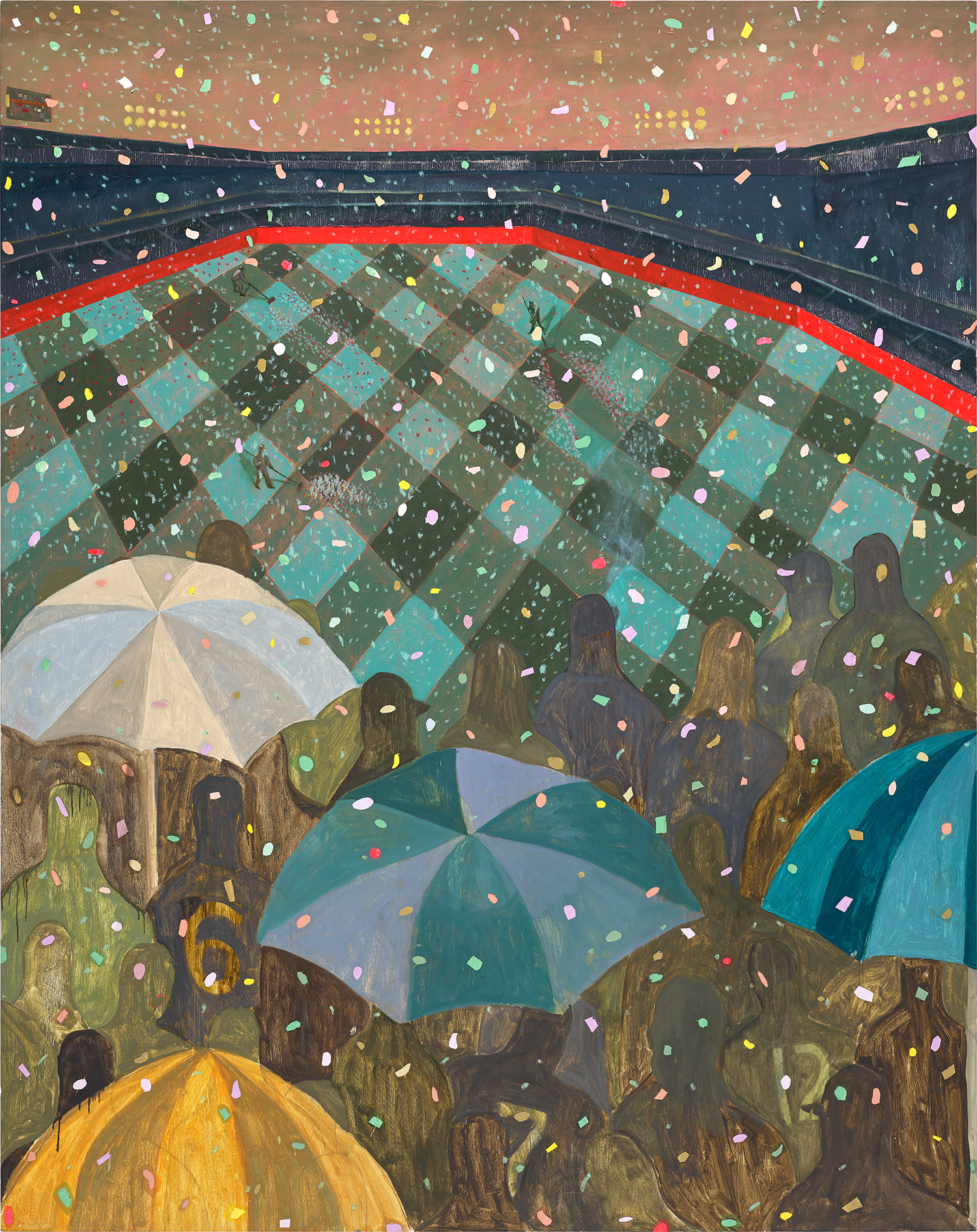
Derek Fordjour
Windfall, 2016
Who is watching, and what do they see? How do labor and spectacle intersect in the American imagination, and at whose expense? His canvases hold these questions open with a generosity and formal brilliance that rewards sustained looking. At a moment when the art world is rightly expanding its understanding of whose stories deserve to be told on the grandest scale, Fordjour stands as proof that the answer, rendered in charcoal and newsprint and foil and paint, can be both beautiful and true.