Delos Van Earl
Steel Dreams: Delos Van Earl's Joyful Creatures
Artist Spotlight · The Collection Editorial
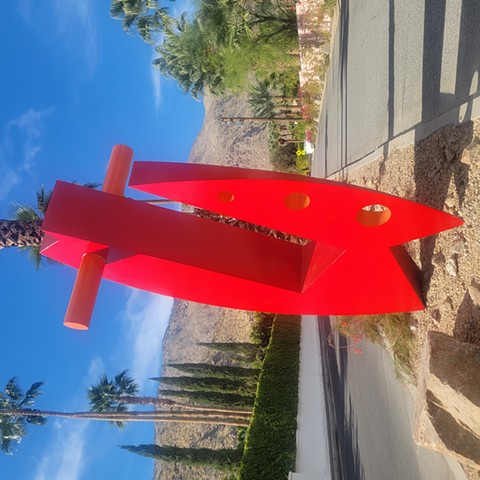
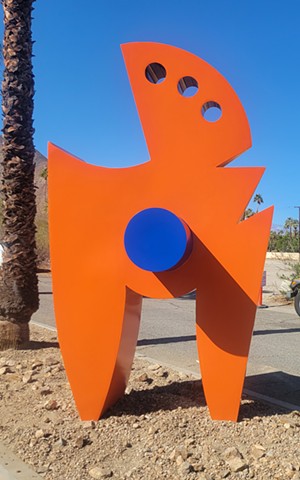
Something is stirring in the world of contemporary American sculpture, and collectors who have been paying attention already know the name Delos Van Earl. His large scale outdoor installation in a sun drenched desert setting, a towering orange form with a vivid blue disc at its center, has become one of those works that stops people in their tracks. Planted among palms and open sky, it commands the landscape not through solemnity but through sheer exuberance, the kind of piece that makes you want to understand everything else the artist has ever made. Van Earl is a working American sculptor whose practice has developed with remarkable focus and consistency across the years documented in the public record, from 2018 through the present.
Delos Van Earl
Untitled
The biographical details of his early formation remain largely outside the public record, which in some ways only deepens the sense that his work speaks entirely for itself. What is clear from the body of work is that Van Earl arrived at his mature practice already certain of his vocabulary: painted steel, oil enamel surfaces, bold geometric silhouettes, and a chromatic sensibility that draws from the warmest and most saturated reaches of the color wheel. The medium itself is worth dwelling on. Van Earl works in steel, fabricating forms that range from wall mounted reliefs to freestanding outdoor sculptures of considerable scale.
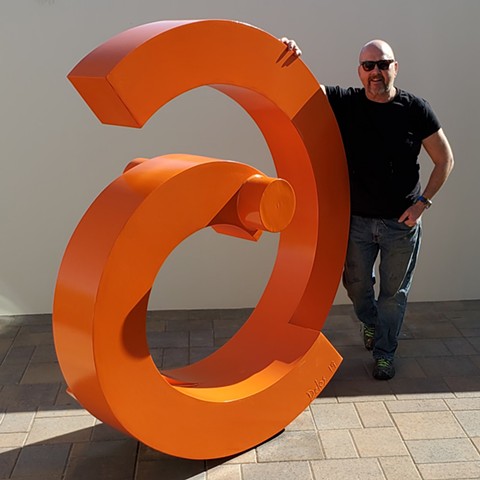
The choice of oil enamel as his surface treatment is not incidental. Where many painters working on metal lean into the industrial coldness of the material, Van Earl uses enamel to achieve surfaces of almost candy like depth and warmth. The orange of a work like Big Orange is not a flat signal color but a layered, luminous field that catches light differently across the day. The same is true of the aqua and cobalt of Aqua Mariner, where two painted steel elements interlock with a jagged, almost architectural seam that feels both playful and precise.
Delos Van Earl
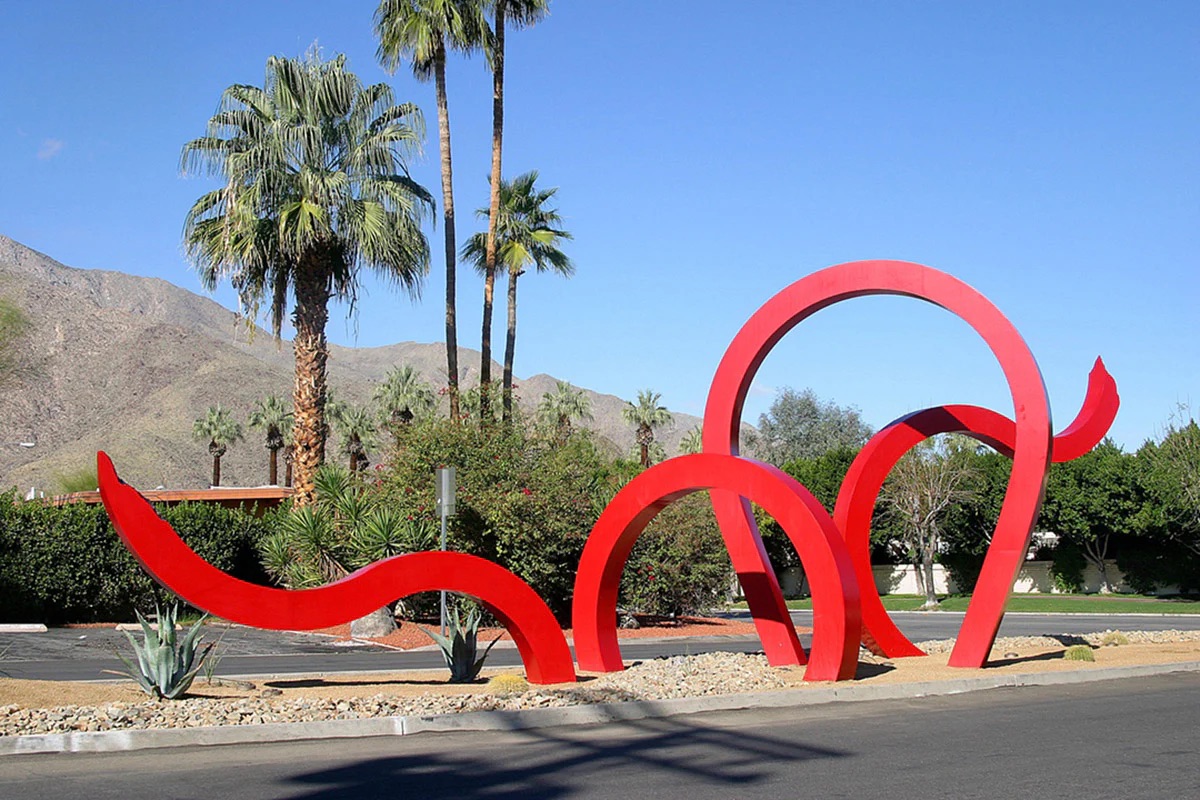
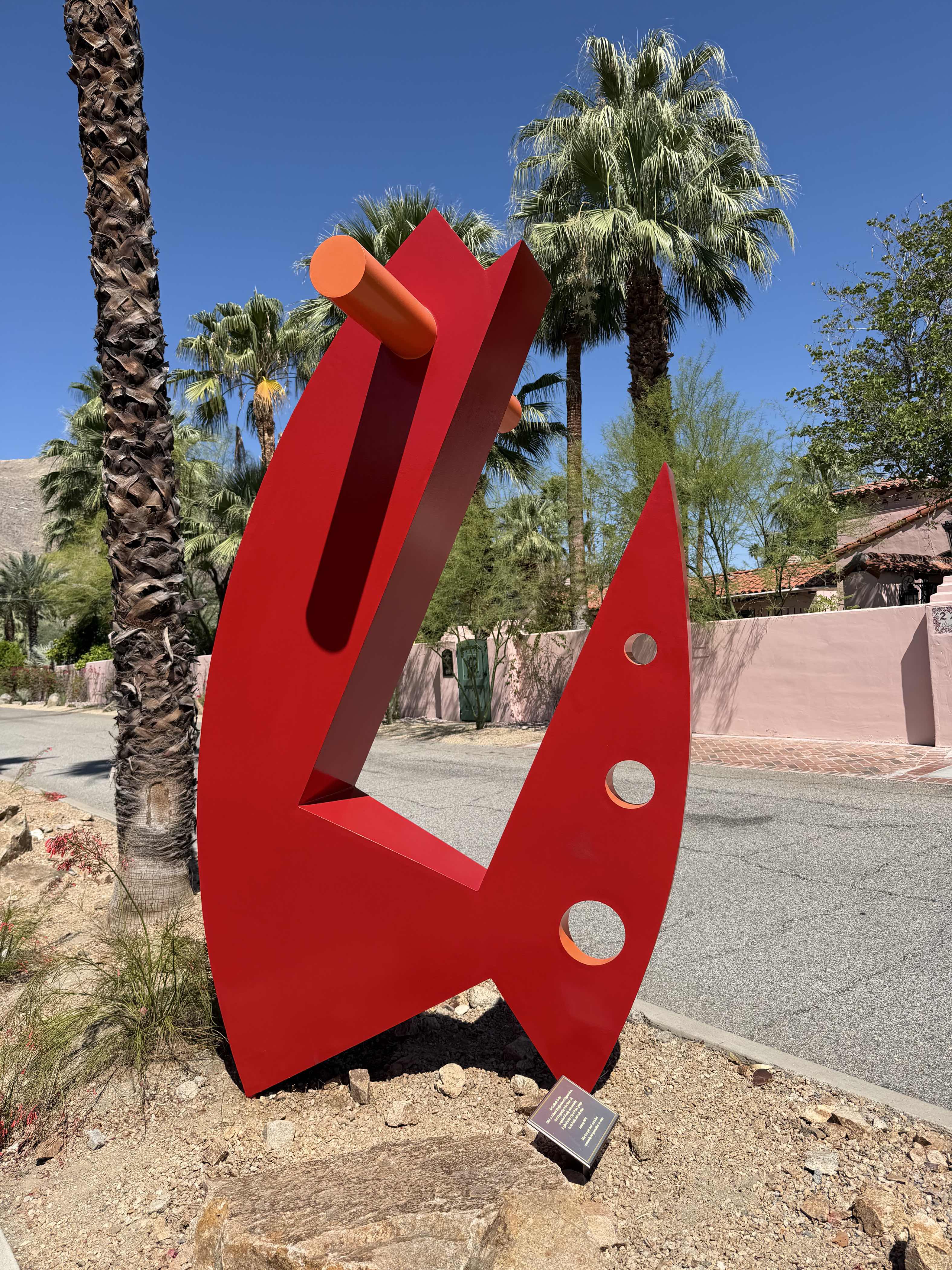
Red Dragon, 2024
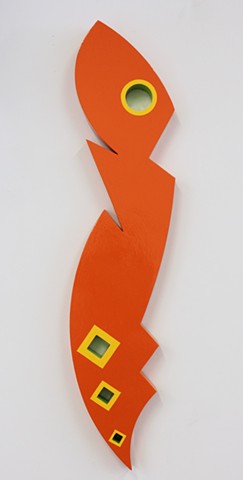
Looking carefully at the four works documented here, a consistent formal language emerges. Van Earl builds his sculptures from curved, sweeping silhouettes that suggest living things without ever illustrating them literally. Circular cutouts, which appear in nearly every piece, serve multiple functions simultaneously: they reduce visual weight, allow light and shadow to pass through the form, and read as eyes or breathing holes or simple punctuation marks depending on the viewer's imagination. In the wall mounted works, these cutouts are drilled cleanly through painted steel panels, creating a rhythm across the surface that feels almost musical.
In the large outdoor sculpture, three circles punched into the upper register of the orange form give the piece a face, or at least the suggestion of one, anchoring it in the tradition of totemic imagery without making the reference labored. The works have been grouped under titles like Teka Creatures, Creature Series, and individual names such as Red Dragon, Rabbit, and Fig Newt, and these titles tell you a great deal about Van Earl's relationship to his own practice. He is not making abstract sculpture in the purely formalist sense. He is making beings.
Delos Van Earl
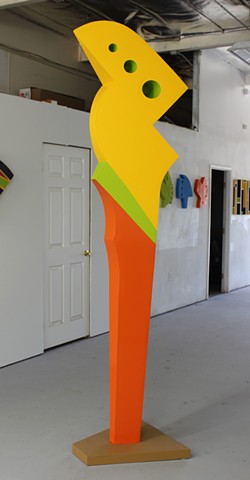
Flight of Fancy, 2018
Each piece has a presence that feels inhabited, a sense that the form has arrived from somewhere rather than been constructed. The yellow and orange work documented in the studio photographs, tall and narrow with a swooping upper mass that leans forward like a bird about to take flight, embodies this quality perfectly. It is vertical, slightly precarious, alive. The palette Van Earl employs is one of his most distinctive signatures, and it is worth noting how deliberately it departs from the muted, serious tones that have dominated so much contemporary sculpture in recent decades.
He works in oranges that recall desert sunsets and ripe citrus, blues that range from the cool depth of a swimming pool to the clear midday sky, greens that feel almost tropical in their intensity, and yellows that vibrate with warmth. These are not accidental choices or crowd pleasing gestures. They reflect a genuine belief, evident in the work itself, that sculpture can be a source of direct pleasure and that joy is a legitimate artistic ambition. For collectors, Van Earl presents a particularly compelling proposition.
Delos Van Earl
Blu Belly Crab, 2025
His wall mounted works, such as Aqua Mariner and Flight of Fancy, are scaled for significant residential and institutional interiors. They carry real visual weight and hold a wall with authority, yet they also possess a warmth that makes them livable in a way that much contemporary sculpture is not. The outdoor pieces, like the large orange installation documented here, open the possibility of transforming a garden, courtyard, or institutional landscape into something genuinely memorable. The use of oil enamel on steel means the surfaces are durable and weather resistant, practical considerations that matter when a collector is thinking about a work that will live outdoors for decades.
In the broader context of American sculpture, Van Earl's practice invites comparison with artists who have worked at the intersection of abstraction, figuration, and bold industrial materiality. The spirit of Alexander Calder hovers nearby, not in direct formal influence but in the shared conviction that sculpture should be lively, accessible, and emotionally generous. There is also a connection to the tradition of painted steel sculpture that runs through mid century American modernism, though Van Earl's creature logic and narrative warmth give his work a distinctly contemporary and personal flavor that sets it apart from the more austere minimalism that tradition sometimes produced. What Van Earl has built, work by work across the years since 2018, is a genuinely coherent body of sculpture with a sensibility all its own.
The creatures he makes are serious as formal propositions and delightful as presences, a combination that is rarer in contemporary art than it should be. Collectors who bring one of these works into their lives tend to find that it changes the room, or the garden, or the courtyard in which it lives, not by dominating the space but by animating it. That quality of animation, of bringing a manufactured steel object to the threshold of something living, is the measure of Van Earl's achievement and the foundation of his growing reputation among collectors who value work that is both rigorous and alive.