De Wain Valentine
De Wain Valentine: Light Made Magnificently Solid
Artist Spotlight · The Collection Editorial
There is a moment, standing before a De Wain Valentine resin disc, when the object before you ceases to feel like sculpture at all. It breathes. It shifts. The color pooled inside its depths seems to arrive from somewhere beyond the surface, as though the work is generating its own interior weather.
De Wain Valentine
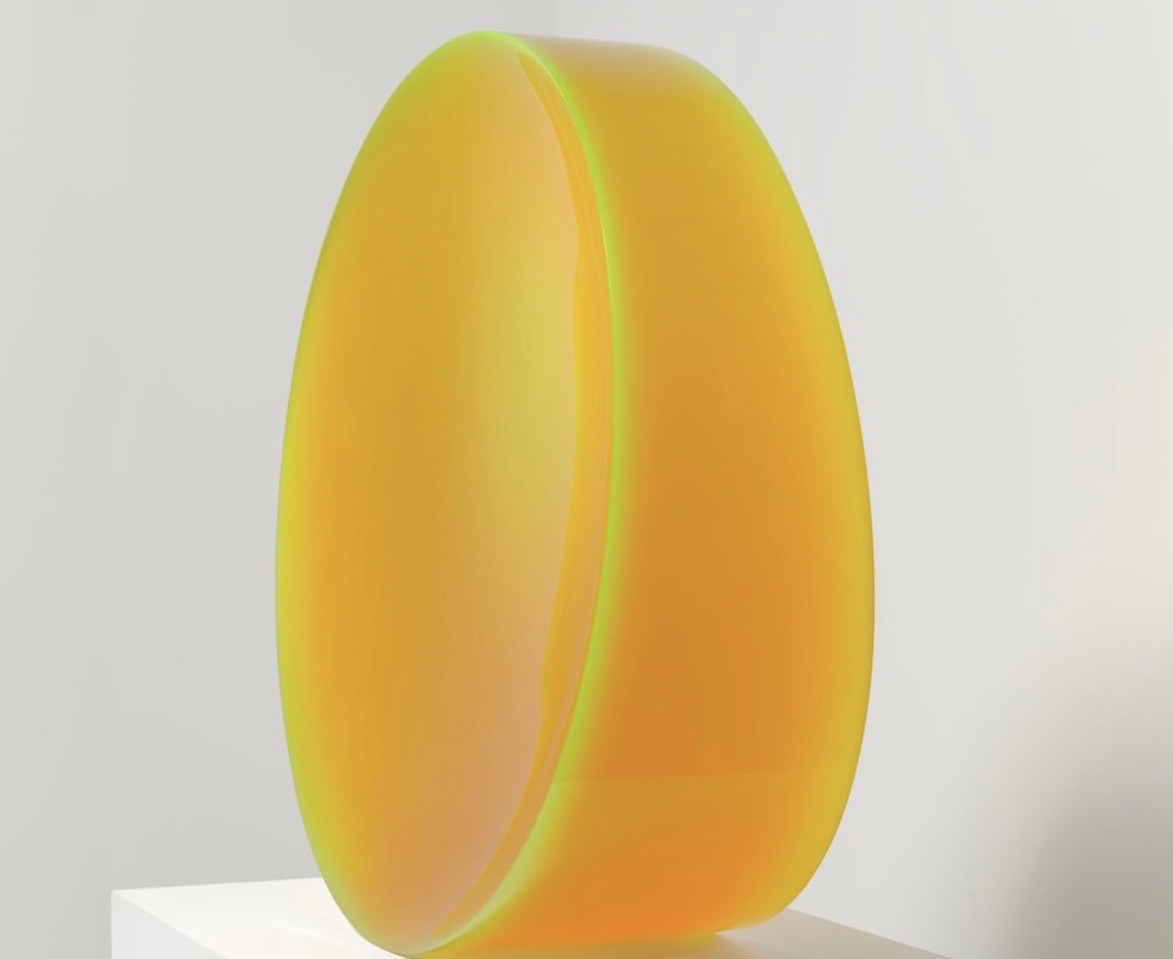
Concave Circle Fluorescent Yellow, 1968
That experience, at once sensory and almost philosophical, is precisely what has drawn renewed institutional attention to Valentine's practice in recent years. The Getty Research Institute in Los Angeles, which holds significant documentation of the Light and Space movement, has been instrumental in recontextualizing Valentine's contribution alongside peers such as Robert Irwin and James Turrell, cementing his place not merely as a regional figure but as one of the essential voices in postwar American art. De Wain Valentine was born in 1936 in Fort Collins, Colorado, a landscape defined by extraordinary light and vast atmospheric distance. That early relationship with the American West, where the sky is an event unto itself and color changes register across enormous open spaces, would leave a permanent mark on his sensibility.
He pursued his undergraduate studies at the University of Colorado before heading east to Yale University, where he earned his MFA in 1960. Yale in that era was a crucible of serious artistic ambition, and Valentine arrived with a sculptor's instincts and a curiosity about materials that no conventional training could fully satisfy. The decisive turn came when Valentine relocated to Los Angeles in the early 1960s. Southern California in that decade was experiencing a remarkable cultural fermentation.
De Wain Valentine
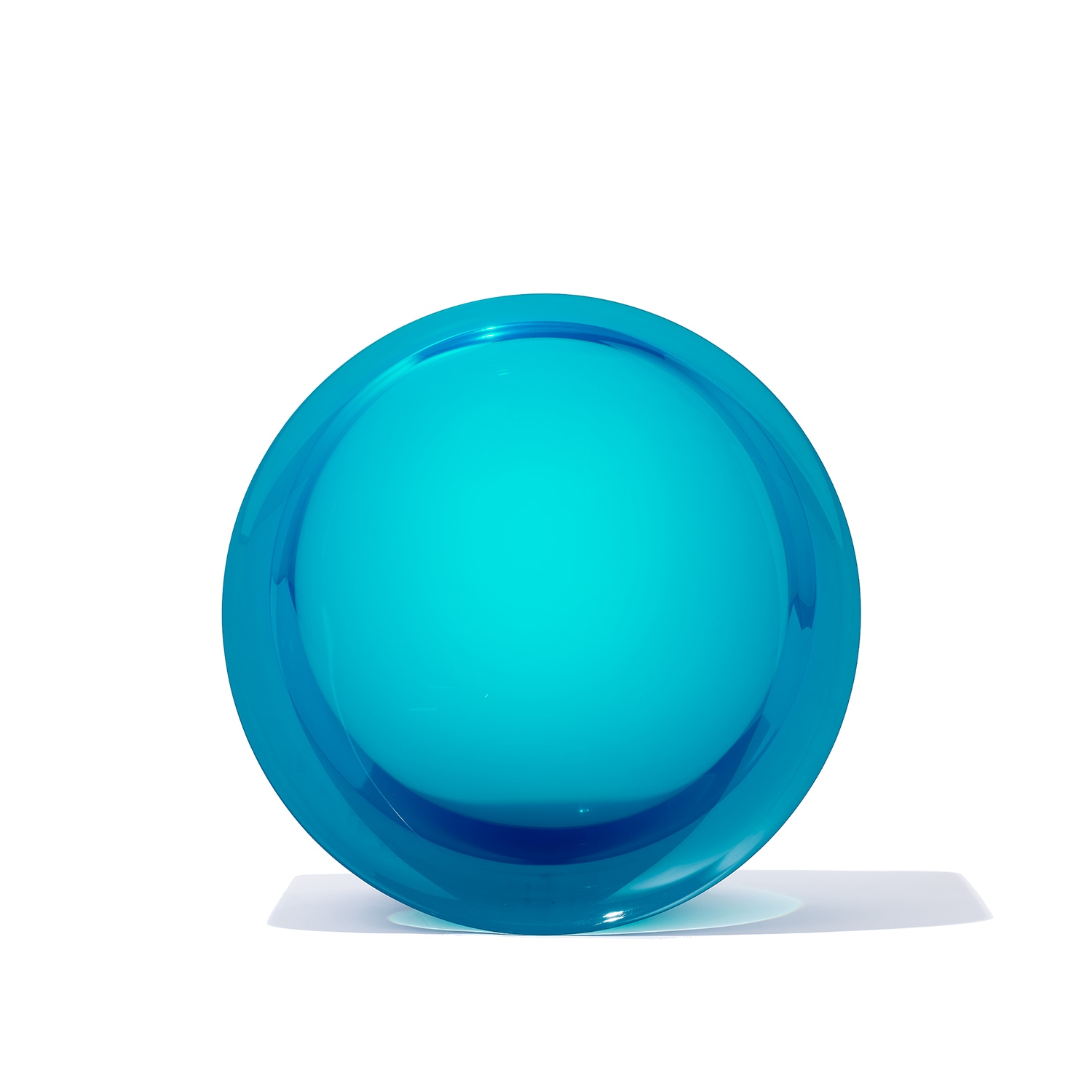
Concave Circle Blue Green, 1968
Artists there were less interested in the gestural expressionism that dominated New York than in questions of perception itself: how light moves through space, how the eye is deceived or educated by what it encounters, how an object can dissolve the boundary between itself and its surroundings. Valentine found his community among artists who would come to define what critics and curators named the Light and Space movement, a loose but coherent tendency centered in and around Los Angeles. The desert light, the aerospace industry infrastructure, and the particular quality of the Pacific coast atmosphere all fed into this work in ways that were invisible in Manhattan lofts. Valentine's breakthrough as an artist came through a material that was, at the time, almost entirely uncharted territory for fine art: industrial polyester resin.
He began experimenting with the substance in the mid 1960s, working through significant technical challenges to understand how pigment suspended within resin could produce color that felt radiant from within rather than applied from without. The scale of his ambition was considerable. He wanted to cast forms of a size that had never been attempted in this material, and he pursued that goal with the methodical persistence of someone who understood that the idea and the technical solution were inseparable. Working closely with industrial chemists and material suppliers, he eventually developed processes that allowed him to cast large format discs and concave circles that remain technically astonishing even by contemporary standards.
De Wain Valentine
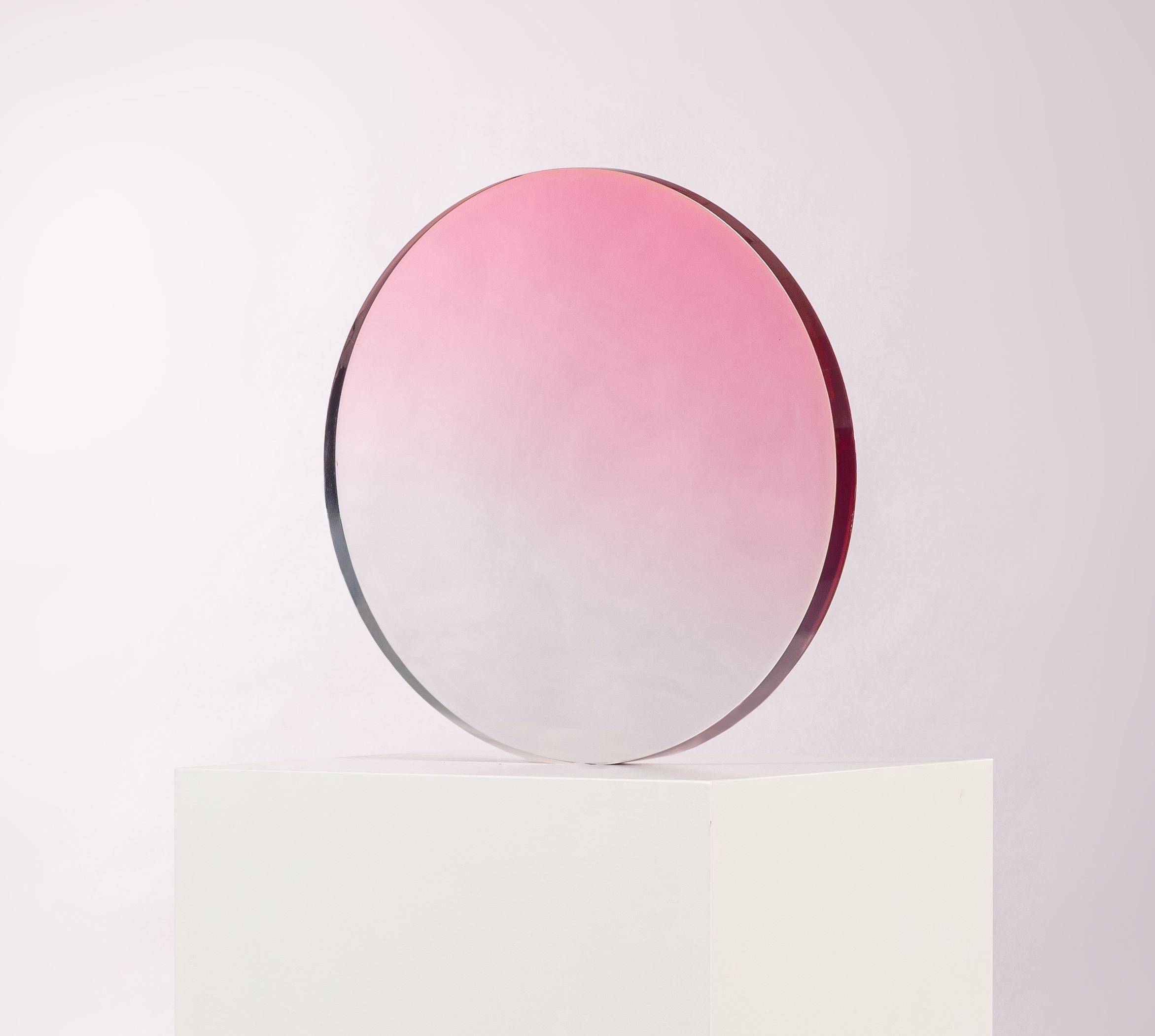
Circle Clear Rose, 1970
Among the works that define his legacy, the Concave Circle series from 1968 stands at the apex of his early achievement. Works such as Concave Circle Fluorescent Yellow and Concave Circle Blue Green, both cast in polyester resin, demonstrate what makes Valentine so singular. The concave form is not merely a geometric choice. It is a perceptual one.
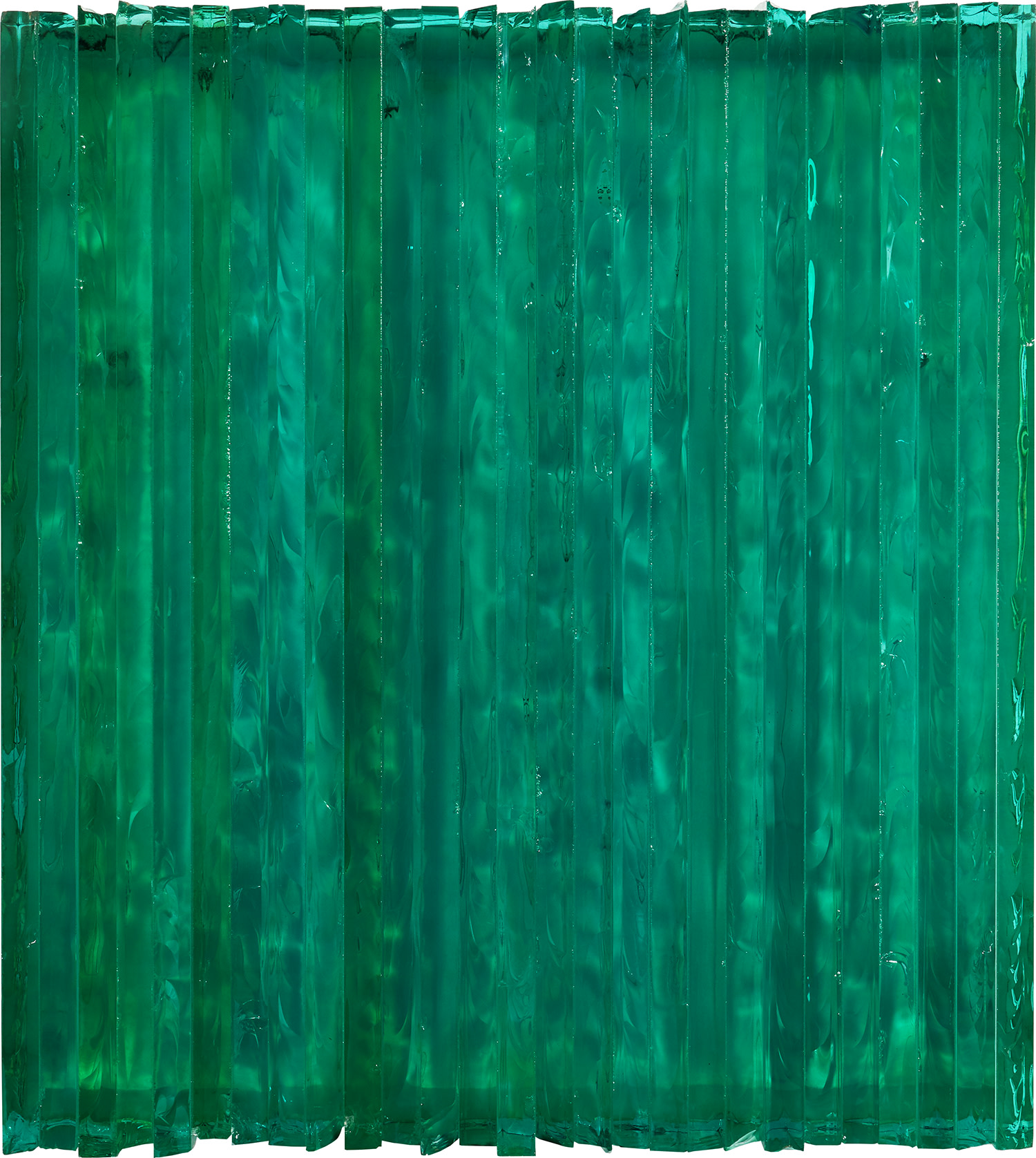
The curvature gathers light differently depending on where the viewer stands, creating a work that appears to change character as one moves around it. The fluorescent yellow vibrates with a near electric insistence, while the blue green carries a depth and stillness more oceanic than anything achieved through paint. Circle Clear Rose from 1970 extends this inquiry into transparency itself, allowing the surrounding environment to become part of the work's chromatic statement. Waterwall, also from 1970, suggests a further evolution toward works that invoke natural phenomena rather than simply referencing color as a formal property.
De Wain Valentine
Waterwall, 1970
For collectors, Valentine's work occupies a position of considerable distinction. His pieces have been acquired by major institutional collections including the Museum of Contemporary Art in Los Angeles and the Hirshhorn Museum and Sculpture Garden in Washington. On the secondary market, significant examples of his resin works have drawn serious attention, and the relative scarcity of prime examples from the late 1960s and early 1970s, the period of his most concentrated formal invention, means that opportunities to acquire major works are genuinely rare. Collectors drawn to the Light and Space movement frequently find that Valentine's pieces anchor a collection in a way that complements works on paper or canvas, providing a sculptural and perceptual counterpoint that transforms the spaces in which they live.
The physical presence of a Valentine disc in a room is unlike that of almost any other object. It reorganizes the light around it. To understand Valentine's position in art history, it helps to consider who surrounds him. Robert Irwin, with whom Valentine shares the Light and Space designation, approached similar questions through installation and architectural intervention rather than discrete objects.
Larry Bell worked with coated glass to achieve related chromatic and reflective effects. John McCracken pursued another trajectory through lacquered plank forms of vivid monochromaticism. What distinguishes Valentine within this constellation is his insistence on the large cast form as a vehicle for something close to natural revelation. His discs do not merely reflect their environment.
They seem to contain one. The resin, with its capacity to suspend color in three dimensional depth rather than two dimensional surface, gives his work a quality that has no precise equivalent in the work of his contemporaries. Valentine's legacy is not merely a matter of historical record. It is a living argument about what sculpture can do and what material intelligence looks like at its most inspired.
At a moment when collectors and institutions alike are revisiting the full range of postwar American art beyond the canonical New York narratives, his work arrives with fresh authority. The perceptual questions he posed in Fort Collins's light, refined at Yale, and answered definitively in Los Angeles remain unresolved in the most productive sense: each work opens them again for the person standing before it. That is the measure of an art that does not date. It only deepens.
Explore books about De Wain Valentine