David Young Cameron
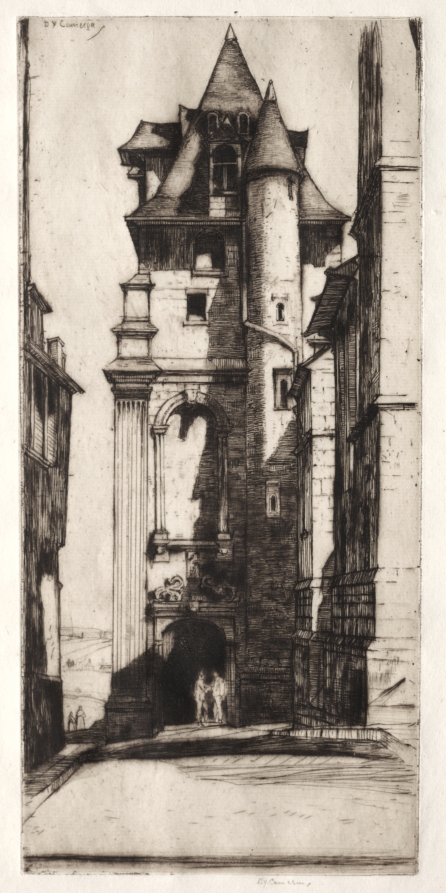
David Young Cameron: Scotland's Master Printmaker Endures
Artist Spotlight · The Collection Editorial
There is a moment, standing before a David Young Cameron etching, when the eye adjusts and a whole world resolves from a web of fine lines. Light seems to fall from the plate itself. Atmosphere gathers in the whites. This is the particular alchemy that made Cameron one of the most admired printmakers of the late nineteenth and early twentieth centuries, and it is the same quality that continues to draw collectors, curators, and lovers of the graphic arts back to his work more than a century after his greatest prints were made.
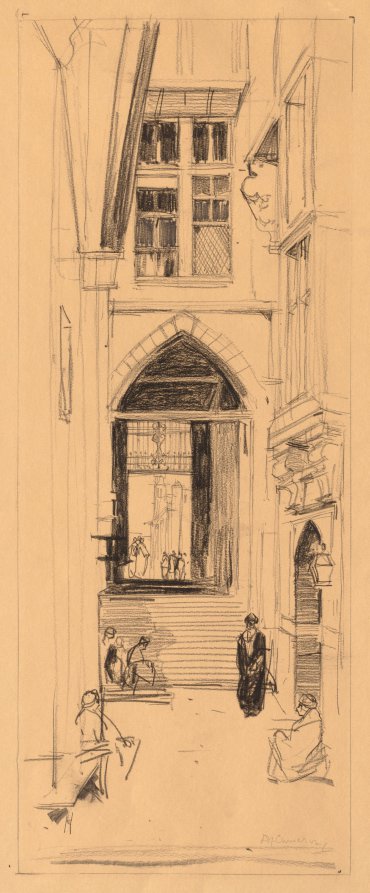
David Young Cameron
A Courtyard in Cairo, 1880
The Scottish National Gallery holds significant examples of his output, and periodic exhibitions at institutions across the United Kingdom have ensured that his reputation, though quieter than some of his contemporaries, has never truly dimmed. Cameron was born in Glasgow in 1865, the son of a Free Church minister, and the moral seriousness and deep attachment to landscape that characterised Scottish Presbyterian culture left a lasting imprint on his temperament and his art. He trained at the Glasgow School of Art and later at the Edinburgh School of Art, entering a world alive with the influence of James McNeill Whistler and the etching revival that Whistler had done so much to ignite. Glasgow in the 1880s was a city of extraordinary creative energy, and Cameron absorbed the ambitions of his generation while developing an aesthetic sensibility that was distinctly his own.
His brother in law was the artist Robert Macaulay Stevenson, and he moved in circles that included many of the Glasgow Boys, though his own practice was anchored firmly in printmaking rather than the oil painting that defined that celebrated group. The etching revival of the 1880s and 1890s gave Cameron his first great subject matter: the architecture, streets, and topography of Scotland. Early works depicting Edinburgh closes, the tenements of Glasgow, and the ecclesiastical buildings of his native country established him as a printmaker of exceptional skill and sensitivity. He had an architect's eye for structure and a poet's instinct for mood.
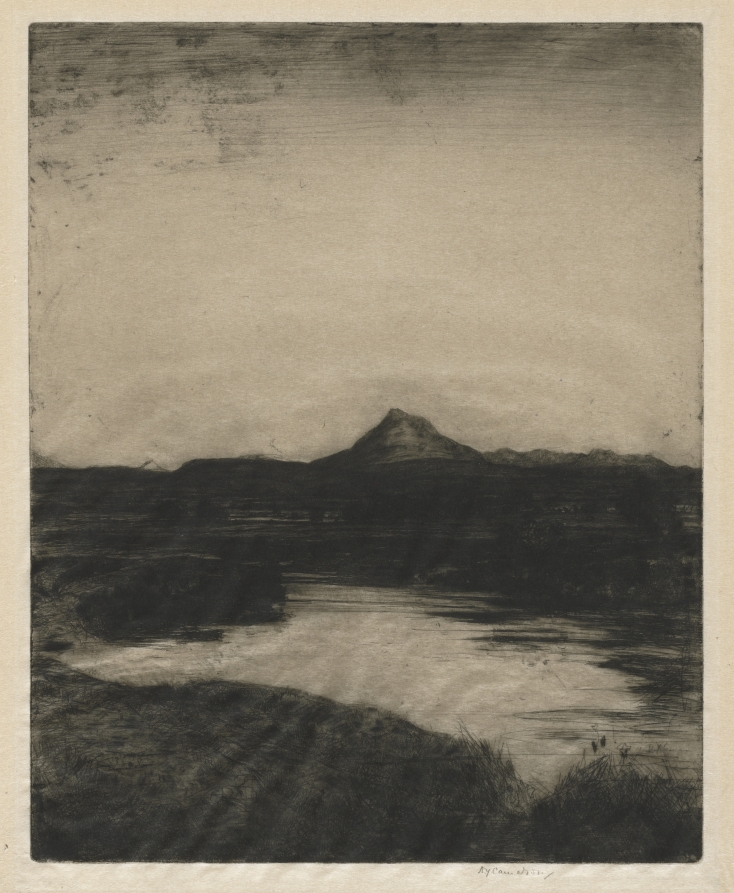
David Young Cameron
Ben Ledi, 1911
Where lesser artists in the revival produced competent topographical records, Cameron produced something closer to meditation. His lines describe stone and shadow with economy and confidence, and his compositions achieve a stillness that feels genuinely earned. By the turn of the century he had attracted serious critical attention and a loyal following among collectors on both sides of the Atlantic. Travel became central to Cameron's artistic development in the first decade of the twentieth century.
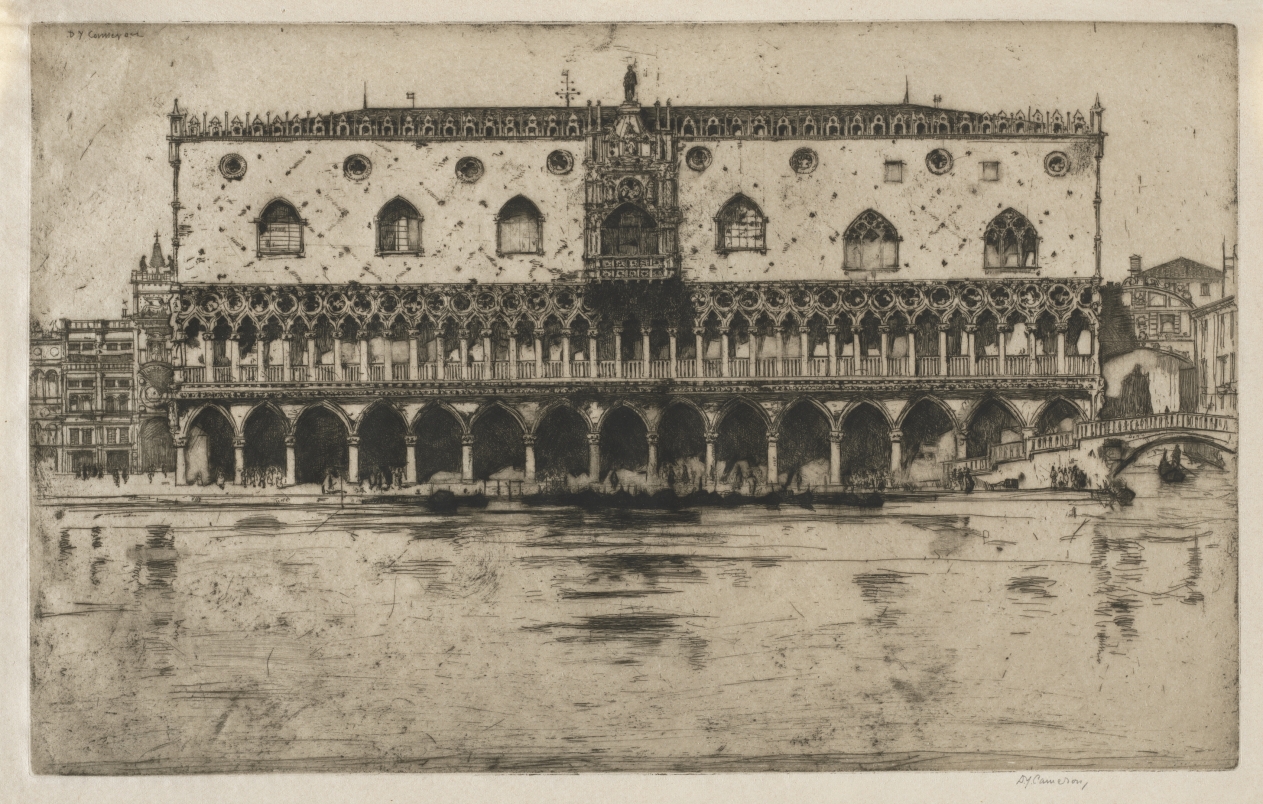
Works such as Street in Cairo from 1910 and An Egyptian Mirror from 1909 demonstrate the ambition and range of his vision. The Cairo print is a masterclass in rendering brilliant Mediterranean light through the controlled tonal range of etching and drypoint, capturing the layered textures of the city with what feels like both scholarly attention and genuine emotional response. His visit to Venice produced St. Mark's No.
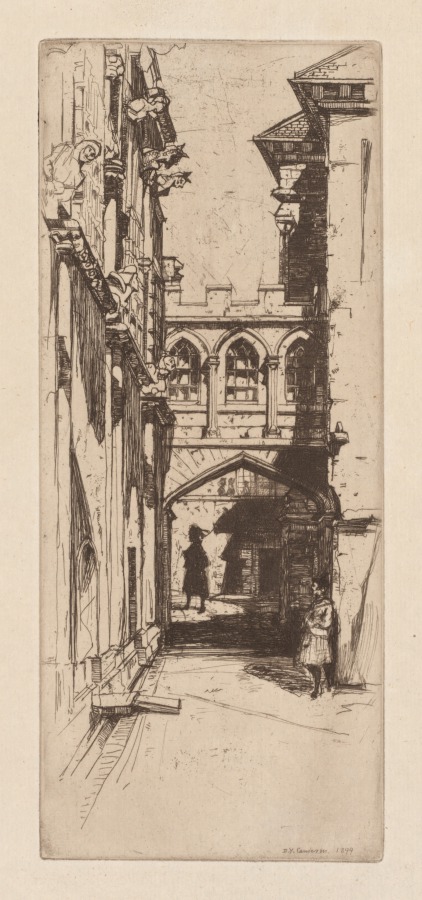
David Young Cameron
In Stirling Castle or A Scottish Palace (Un Palais Ecossais), 1899
2 from 1900, a work that invites comparison with Whistler's own celebrated Venetian etchings while asserting Cameron's independent sensibility. He returned again and again to France, and works such as St. Aignan, Chartres from 1916 reveal an artist responding to Gothic architecture with a reverence that feels personal and unforced. These European and North African plates show a man deeply engaged with the world and with the full resources of his medium.
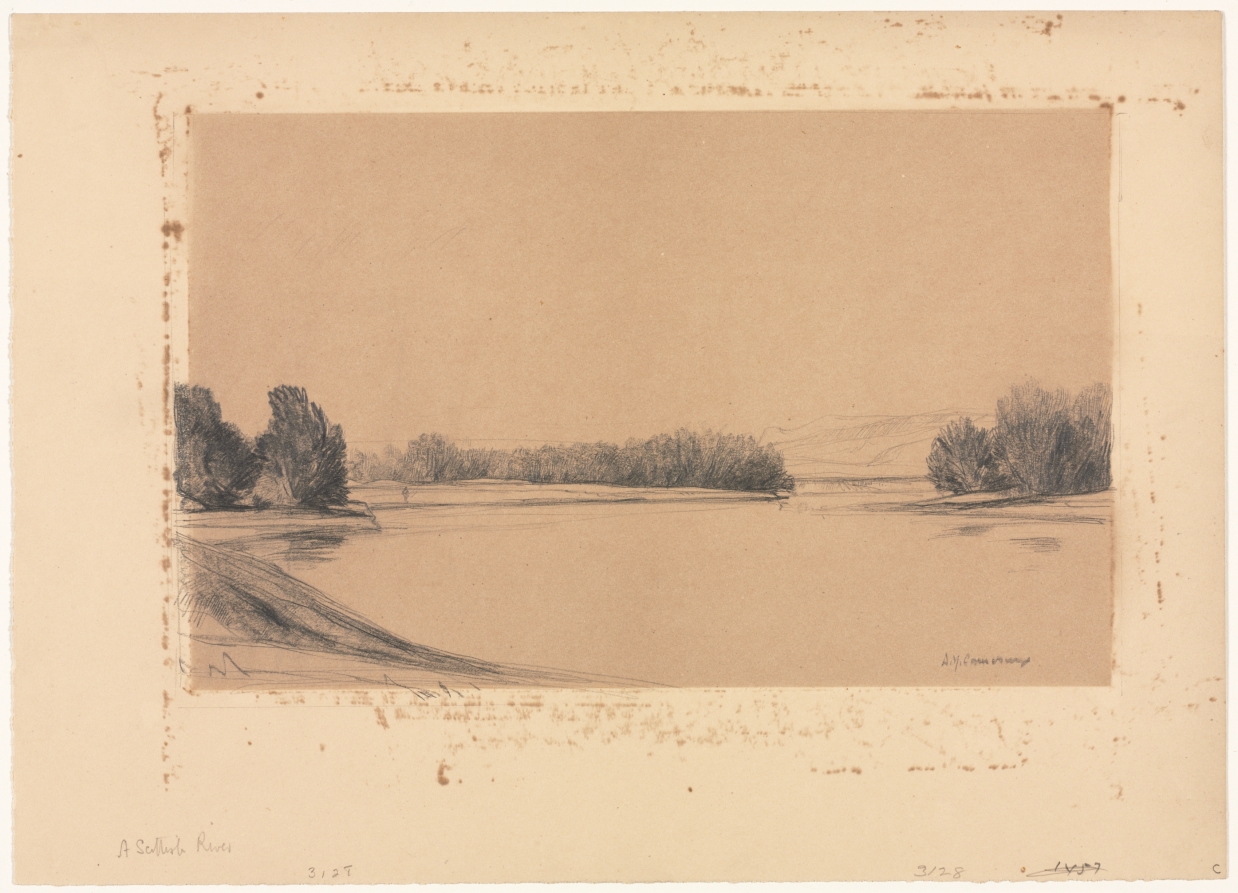
Scottish landscape eventually claimed the deepest part of Cameron's imagination. The series of prints depicting the Highlands, including Hills of Tulloch from 1915, Arran Peaks from 1912, and Appin Rocks from 1913, represent the summit of his achievement as a landscape printmaker. These are not merely scenic records. They carry a quality of longing and solemnity that connects them to the broader tradition of Romantic landscape while remaining entirely grounded in direct observation.
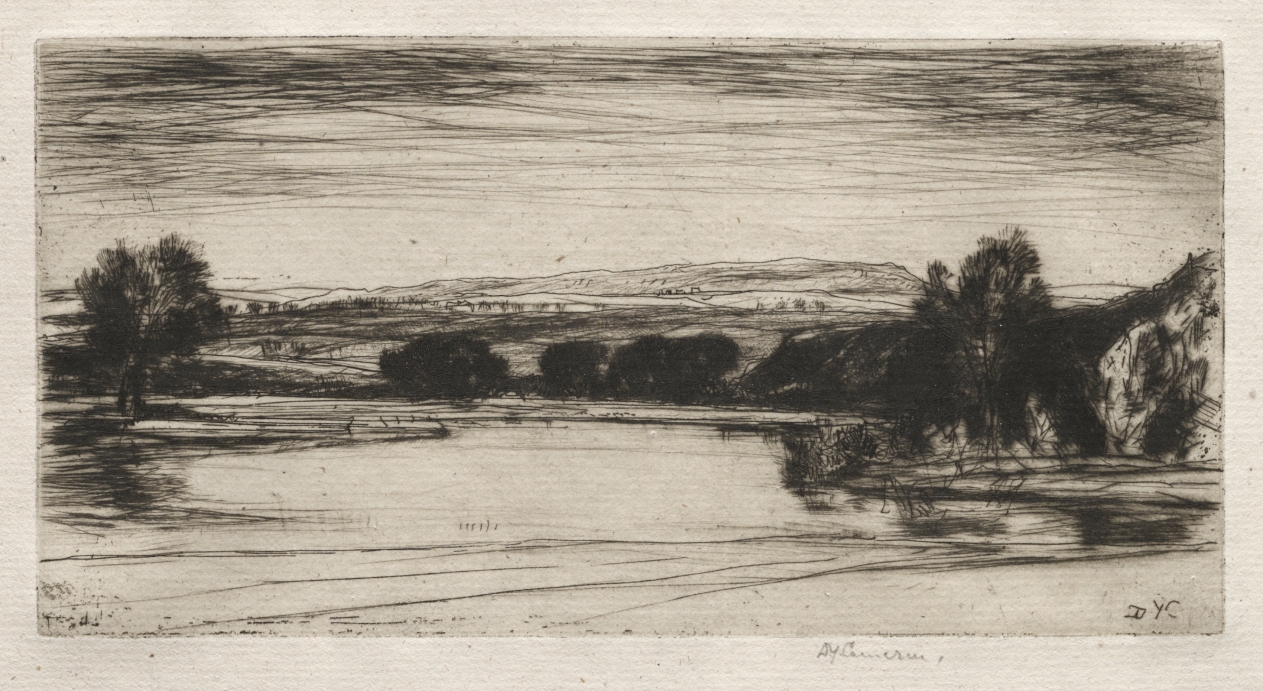
David Young Cameron
The Lochan, 1914
Cameron understood the west Highland light with unusual intimacy, and his drypoint technique, which allowed for the soft velvety burr that enriches shadow and texture, suited the soft edges of that landscape perfectly. These works are among the finest landscape prints in the entire British tradition, and collectors who encounter them tend to feel their force immediately. The knighthood Cameron received in 1924 and his appointment as King's Painter and Limner in Scotland in 1933 were formal recognitions of a standing that the art world had long acknowledged informally. For collectors, the appeal of Cameron's work is both aesthetic and historical.
His prints were made in relatively limited editions and with genuine care for the quality of each impression. Early, well inked impressions on good paper carry a richness and depth that later printings cannot fully replicate, and collectors with an eye for quality will find that distinction worth attending to. His work appears regularly at auction houses including Bonhams, Lyon and Turnbull, and Christies, where strong examples from his Highland series and his architectural plates command sustained interest. The works on The Collection span a generous range of his career and geography, from the intimacy of John Knox's House and The Avenue from 1905 to the grandeur of his Distant View of Winchester and St.
Croix from 1902, offering a rare opportunity to trace the arc of a remarkable practice. Cameron sits most naturally alongside the great British and European printmakers of his era. His sensibility connects him to Francis Seymour Haden, who was among the founding figures of the etching revival in Britain, and to Muirhead Bone, the Scottish draughtsman and printmaker whose work shares Cameron's architectural seriousness and tonal discipline. The influence of Whistler is present but never overwhelming.
Collectors drawn to the work of William Strang or Ernest Stephen Lumsden will find in Cameron a related spirit, and those who love the northern European tradition of landscape printmaking will recognise in his Highland plates something that sits comfortably beside the best of that lineage. Cameron matters today because he reminds us what printmaking at its finest can achieve. In an era when the graphic arts are being reconsidered and celebrated with new energy, his work offers a model of seriousness, craft, and emotional intelligence. He found in the etching needle and the drypoint stylus tools capable of recording not just appearances but feelings, not just topography but the felt meaning of place.
His landscapes of the Scottish Highlands carry within them a whole relationship to land, to weather, to silence, and to time. That is not a small thing. It is, in fact, the very thing that makes art worth collecting.
Featured Works
Explore books about David Young Cameron
David Young Cameron: A Catalogue Raisonné of the Etchings and Dry Points
Campbell Dodgson
The Etchings of D. Y. Cameron
James Lewis May
David Young Cameron: His Life and Art
Hardie
D. Y. Cameron: The Man and His Art
Walter Shaw Sparrow
David Young Cameron: Scottish Artist
William Buchanan