David Shrigley
David Shrigley Makes the Whole World Laugh
Artist Spotlight · The Collection Editorial
“I think humour is something I use because I think it is a powerful tool. It can be quite subversive.”
David Shrigley, interview with The Guardian
In 2013, David Shrigley was nominated for the Turner Prize, and the art world paid close attention to what had long been an open secret among collectors and curators: this was an artist of genuine, singular importance. His installation Really Good, a giant bronze sculpture of a hand giving a comically oversized thumbs up, was later commissioned for the Fourth Plinth in Trafalgar Square in 2016, where it stood for two years and became one of the most photographed public artworks in London's recent memory. The piece encapsulated everything that makes Shrigley so vital: an absurdist optimism that cuts right through the noise of contemporary life, delivered with a warmth that never condescends and a wit that never grows stale. Shrigley was born in Macclesfield, England in 1968 and grew up in the English Midlands before heading north to study at the Glasgow School of Art in the late 1980s.
David Shrigley
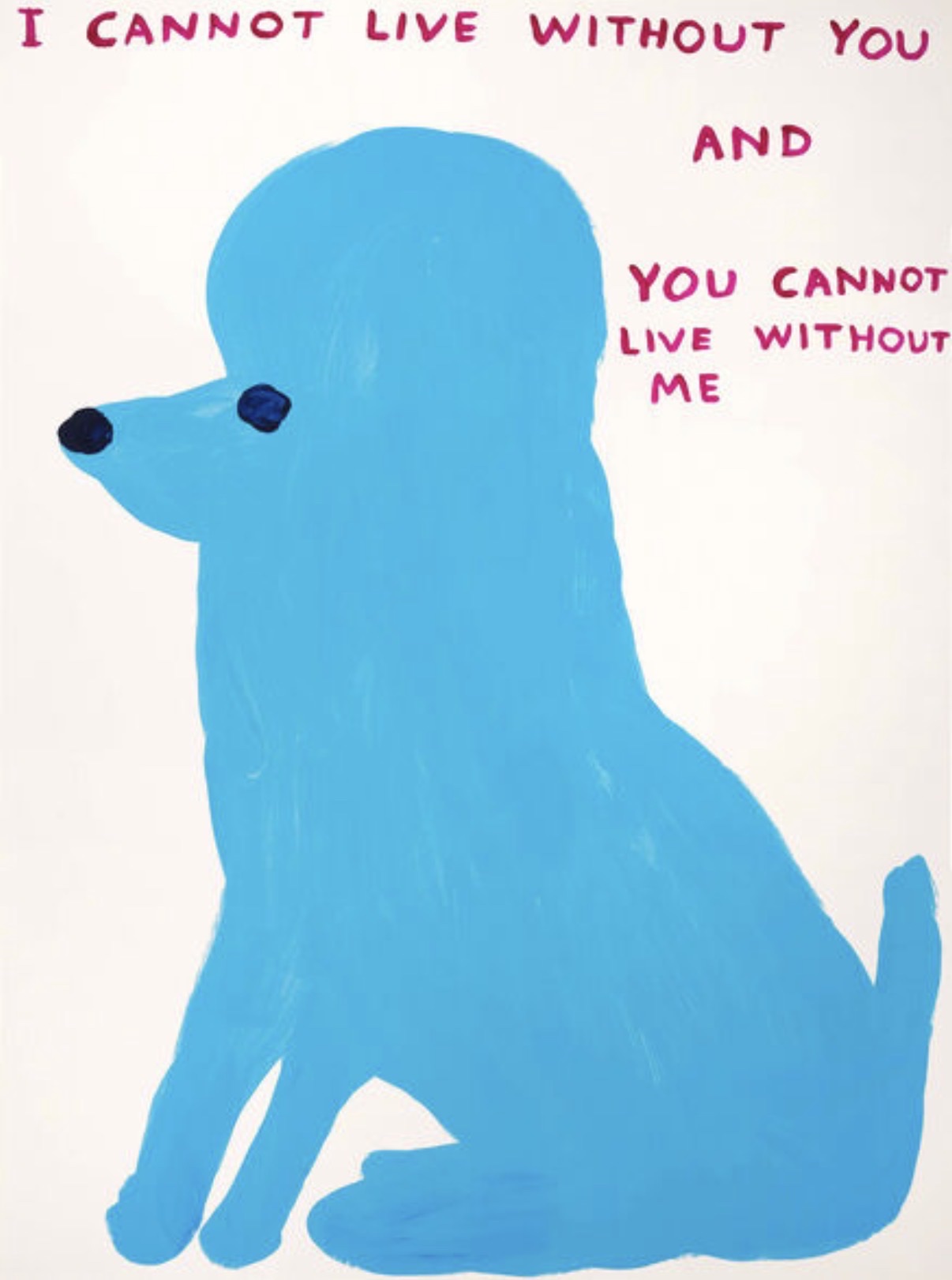
I Cannot Live Without You, 2019
Glasgow at that time was a genuinely electric place for young artists, a city in the midst of a cultural renaissance, and the school itself was producing a remarkable generation of practitioners. It was there that Shrigley developed the scrappy, self published aesthetic that would define his early career, producing zines and photocopied booklets that he distributed himself, often leaving them in record shops and bookstores around the city. That DIY spirit never left him, even as his profile grew enormously in the decades that followed. His artistic development is inseparable from his relationship with language.
Where many visual artists treat text as a secondary element, Shrigley places it at the very centre of his practice, deploying words with the precision of a poet and the comic timing of a stand up comedian. His drawings, executed in a deliberately crude black line that mimics the unselfconscious mark making of a child or an obsessive doodler, are typically accompanied by short texts that twist expectations and expose the small absurdities and anxieties of being alive. The apparent simplicity is the point: Shrigley has spoken about the importance of accessibility, of making work that does not require specialist knowledge to enter. And yet the more time you spend with his drawings, the more layers of melancholy, philosophy and social observation reveal themselves beneath the surface humour.
David Shrigley
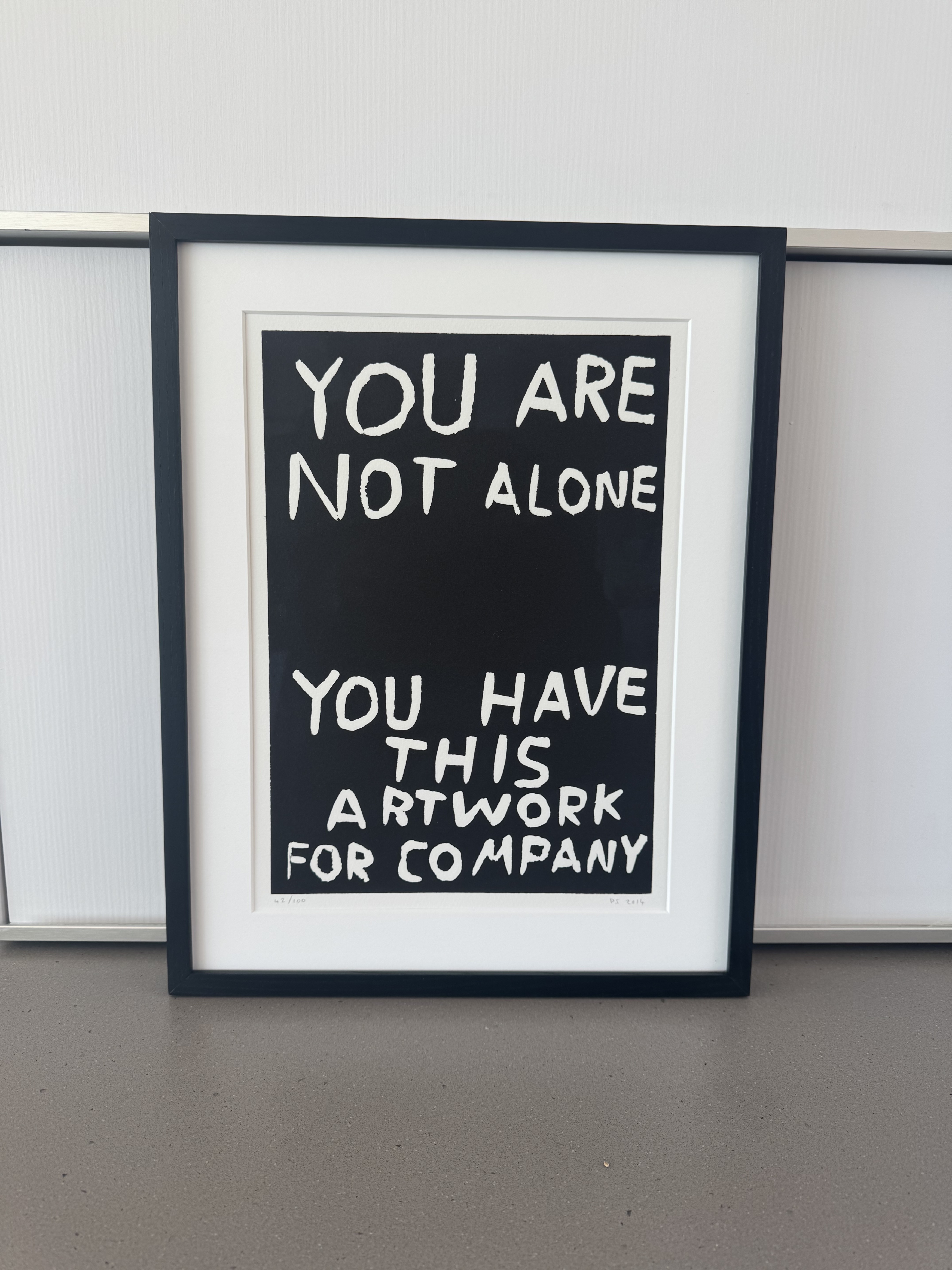
You Are Not Alone (You Have This Artwork For Company), 2014
Through the 1990s and into the 2000s, Shrigley built a devoted following through a series of published books, beginning with works like Err in 1996 and continuing through dozens of volumes that have since sold hundreds of thousands of copies worldwide. His reputation crossed over from the art world into broader culture in a way that very few contemporary artists achieve, earning him fans among musicians, writers and filmmakers as well as collectors and museum curators. He has produced album artwork, animated films, and large scale installations, each medium filtered through the same instantly recognisable sensibility. A Shrigley is always, unmistakably, a Shrigley.
“I want people to feel that they understand the work immediately, and then maybe feel something else later.”
David Shrigley, interview with Tate
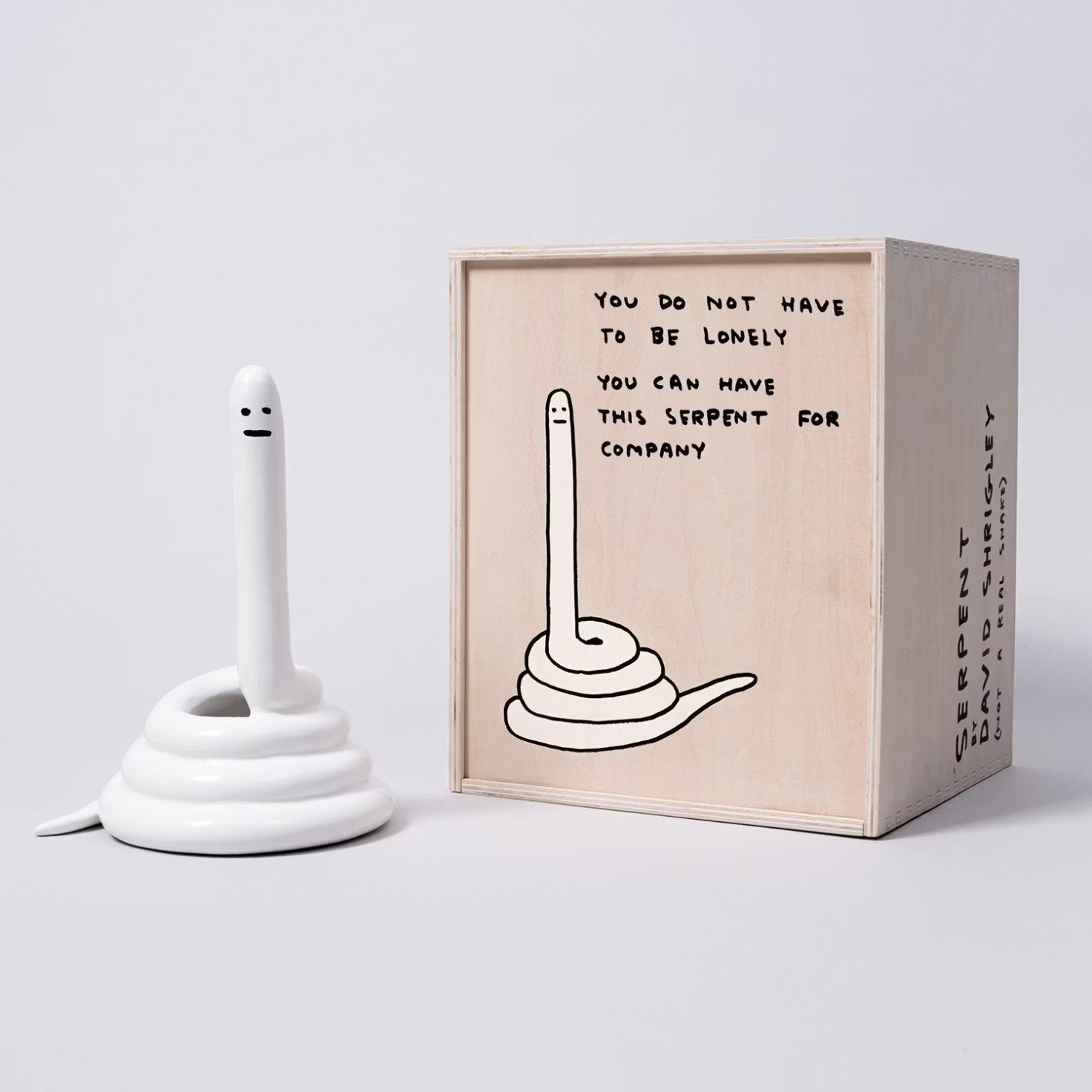
Among his most important works on paper and in print are pieces that have become touchstones for collectors who responded to the particular emotional frequency he operates on. You Are Not Alone (You Have This Artwork For Company) from 2014 is a perfect example of the Shrigley method: a simple statement that is simultaneously funny, tender, and faintly devastating, delivered with the economy of a haiku. His screenprints, including Stop Panicking from 2021 and I Hate Human Beings from the same year, demonstrate how effectively his practice translates into editions, retaining all of the spontaneity and directness of his drawn originals while offering collectors an accessible point of entry. His ceramic works, such as Serpent from 2020, extend the vocabulary of his drawings into three dimensions, the glazed surfaces carrying the same impish, knowing energy as anything he has made on paper.
David Shrigley
Serpent, 2020
From a collecting perspective, Shrigley represents one of the most compelling propositions in the contemporary British market. His editions are produced in relatively small numbers and have shown consistent strength at auction, with demand from a broad international collector base that spans first time buyers and seasoned institutional collectors alike. Works on paper and unique drawings remain particularly sought after, offering the intimacy of his hand alongside the broader cultural currency his name now carries. The market has been notably buoyant for his ceramic works and large format screenprints in recent years, reflecting both the maturation of his practice and a growing recognition that his output has a depth and ambition that rewards serious long term collecting.
Shrigley occupies a distinctive position in art history, one that connects him to a lineage of artists who have used humour and deliberate naivety as tools of genuine critical intelligence. His work invites comparison to the absurdist traditions of artists like Edward Lear and Saul Steinberg, while in a contemporary context he shares sensibilities with artists such as Raymond Pettibon and Paul McCarthy, practitioners who have similarly used crude or popular visual languages to address serious questions about culture, psychology and social behaviour. He is also a natural counterpart to fellow British artists who have used wit and accessibility to reach beyond the gallery walls, though his particular register, self deprecating, quietly philosophical, deeply human, is entirely his own. The reason Shrigley matters so profoundly today is that he has found a way to speak to the condition of contemporary life with both honesty and grace.
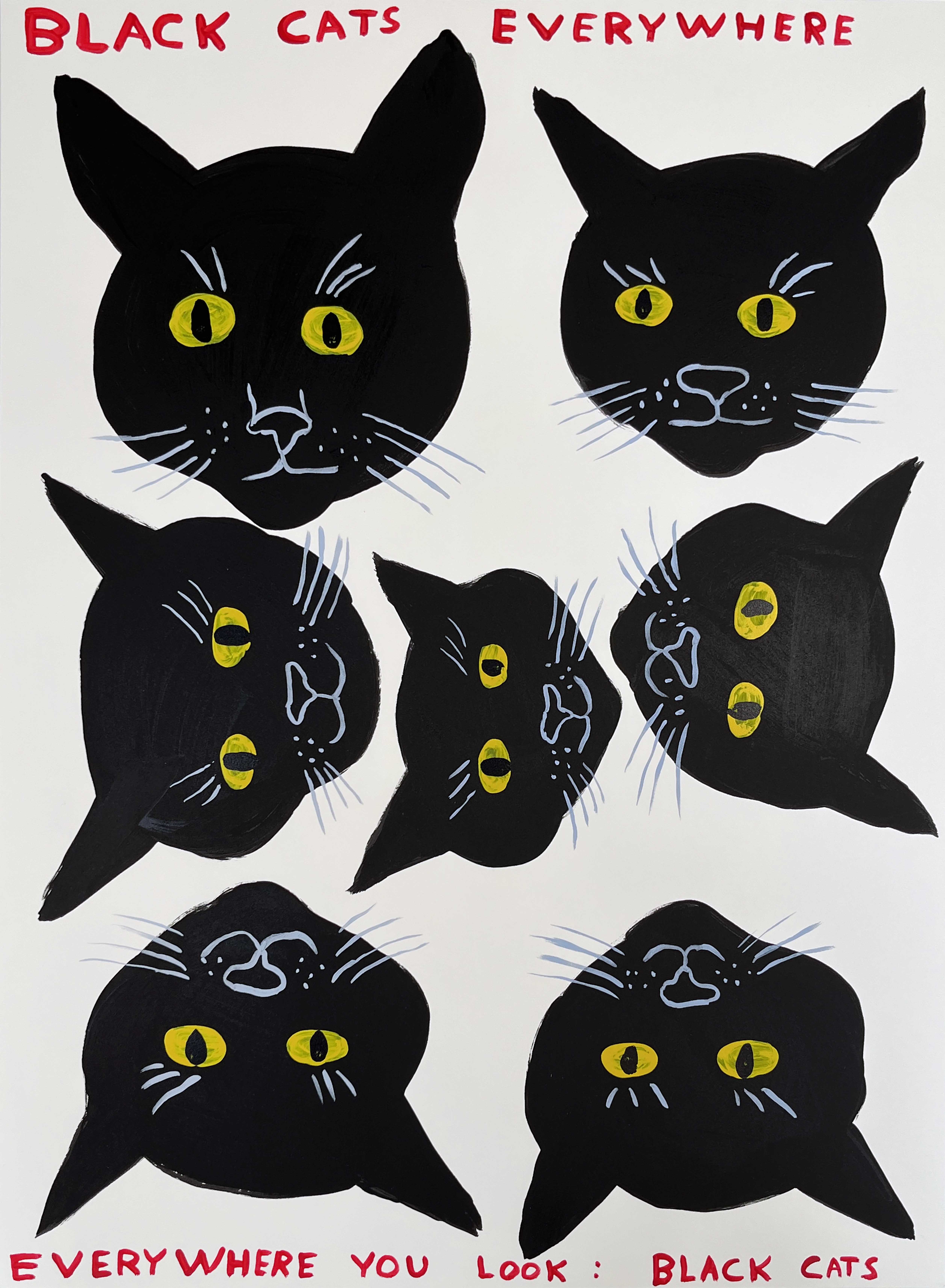
David Shrigley
Black Cats, 2021
In an era saturated with anxiety, irony and information overload, his work offers something rare: a genuine laugh that does not feel cheap, and a genuine tenderness that does not feel sentimental. To own a Shrigley is to have a companion in the truest sense, a presence that surprises you, makes you smile, and occasionally makes you think in ways you did not expect. That is a remarkable thing for an artwork to do, and it is why collectors return to his practice again and again, and why institutions from the Hayward Gallery to the Museum of Modern Art in New York have collected and exhibited his work. He is, without question, one of the great artists of his generation.