David Bomberg
David Bomberg: A Vision Blazing With Life
Artist Spotlight · The Collection Editorial
“I look for the spirit in the mass.”
David Bomberg, Borough Polytechnic lectures, late 1940s
Stand before David Bomberg's 'The Mud Bath' at Tate Modern and something remarkable happens. The painting stops you completely. A tangle of figures rendered in stark geometric planes of white and crimson, it radiates a confidence so absolute, so fully formed, that it is almost impossible to believe it was made by a man in his early twenties. Bomberg completed it in 1914, the year Europe tipped into catastrophe, and it remains one of the most electrifying paintings produced on British soil in the entire twentieth century.
David Bomberg
Three Dancers, 1919
That it was made by a largely self taught son of a Polish Jewish immigrant leather worker in Whitechapel makes it all the more astonishing. David Bomberg was born in Birmingham in 1890, the fifth of eleven children. His family moved to the Whitechapel district of London's East End when he was five, and it was in that dense, vital, immigrant neighbourhood that his sensibility took root. He was apprenticed to a lithographer at fourteen, but his ambition was already pointed elsewhere.
The artist John Singer Sargent personally recommended him for admission to the Slade School of Fine Art, where Bomberg studied from 1911 to 1913 alongside a generation of remarkable talents including Mark Gertler, Paul Nash, and C.R.W. Nevinson.
David Bomberg
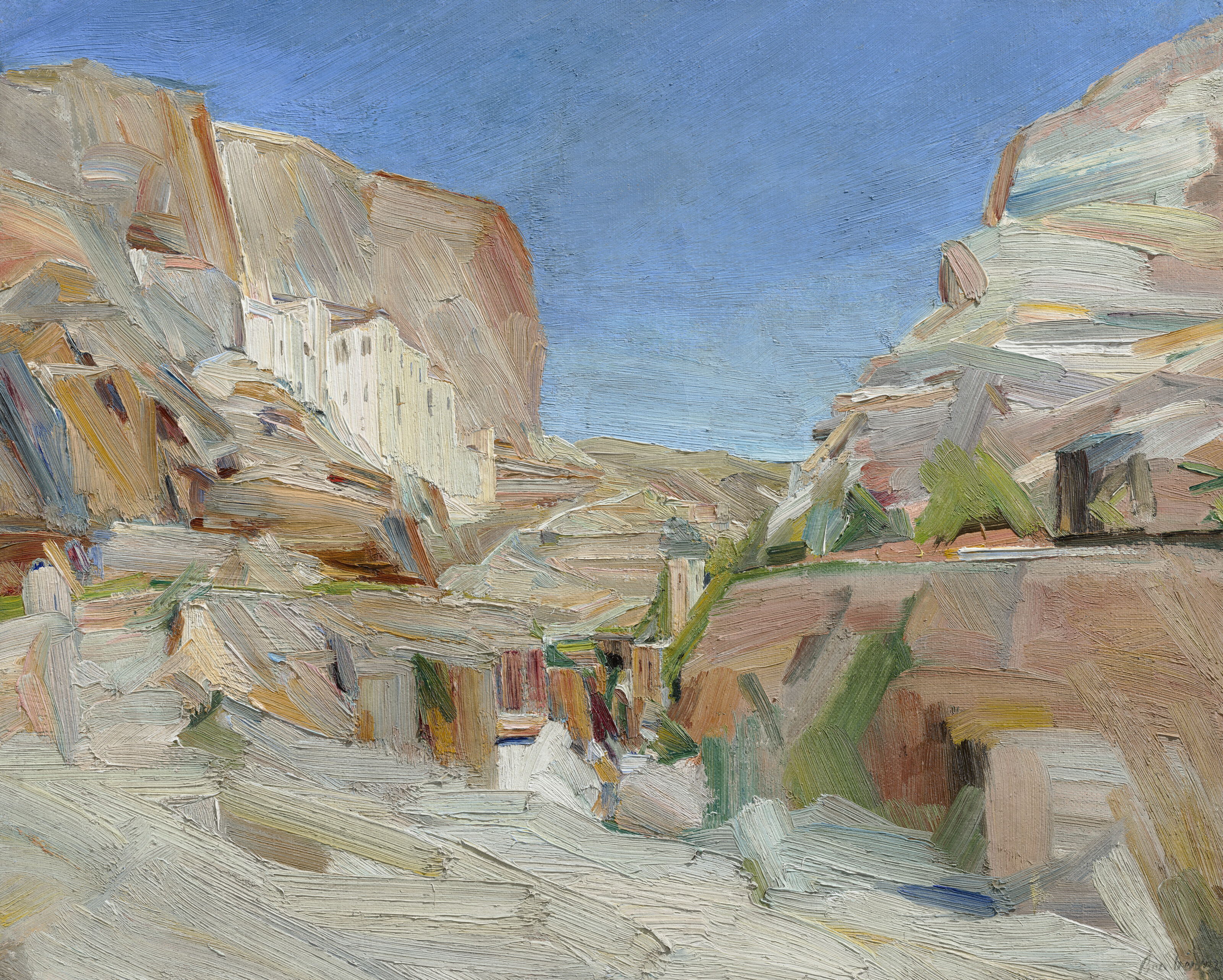
The Monastery of St George, Wadi Kelt
He also attended Walter Sickert's evening classes at Westminster, absorbing the older master's hard won lessons about paint and observation. The Slade in those years was arguably the most stimulating art school in Britain, and Bomberg absorbed everything it offered while already straining against its academic conventions. What set Bomberg apart from his contemporaries was the ferocity and originality of his formal thinking. He encountered Cubism and Futurism through visits to Paris and through the charged London art world of the early 1910s, but he digested these influences rather than merely reproducing them.
Works such as 'In the Hold' from 1913 to 1914 push geometric abstraction further than almost anyone else working in Britain at the time, dissolving figures into a shimmering grid of angular forms that seem to vibrate with industrial energy. Wyndham Lewis and the Vorticists recognised a kindred spirit, though Bomberg famously refused to join their movement, insisting on his independence. That refusal was characteristic. He would spend his whole life refusing the comfort of belonging.
David Bomberg
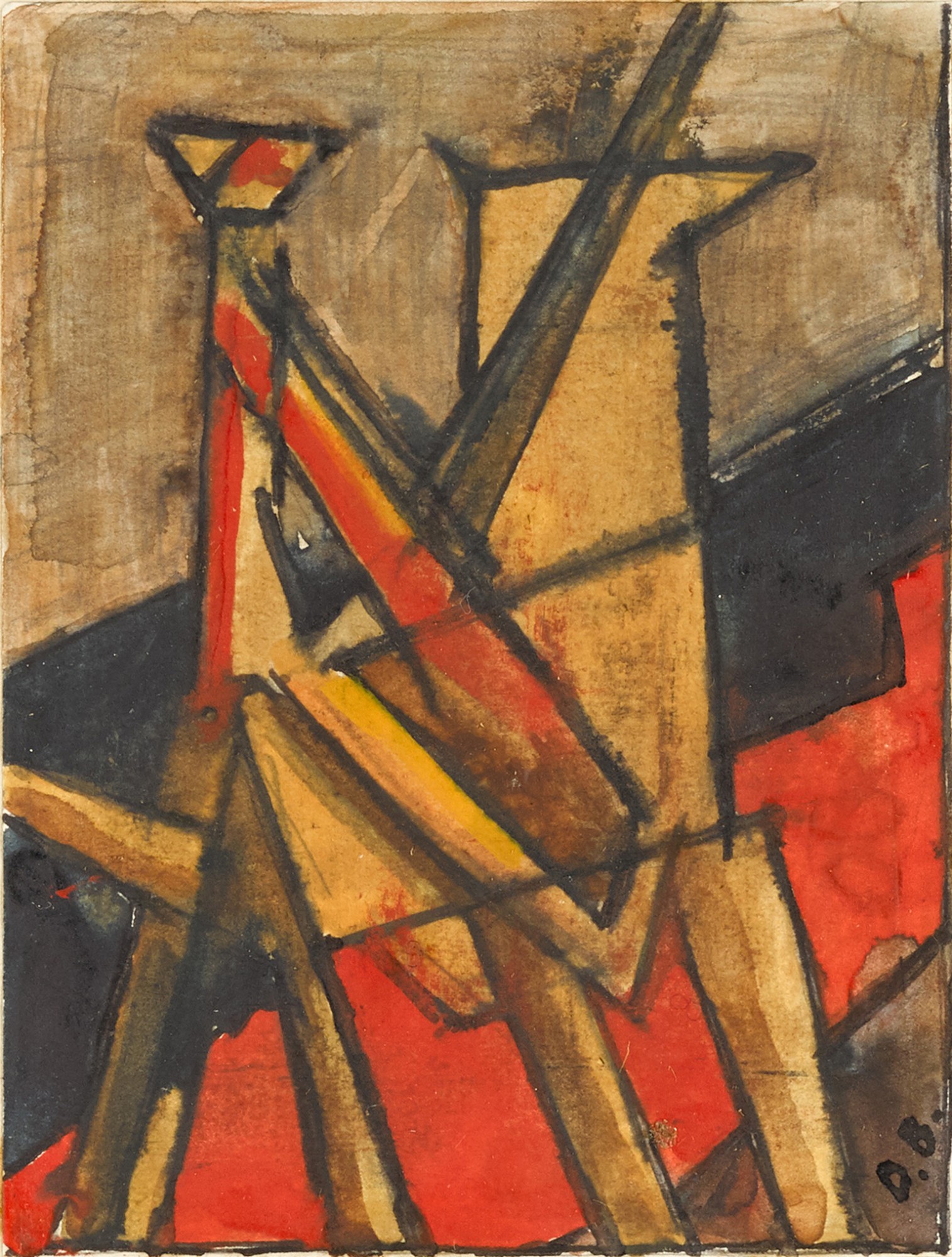
Study of Man and Horse, 1919
The First World War shattered Bomberg's early trajectory as it shattered so much. He served as a sapper in the Royal Engineers and witnessed the mechanised horror of the trenches at first hand. The experience did not drive him deeper into abstraction but instead toward something more humanly direct. Through the late 1910s and into the 1920s, his work shifted register.
The works on paper from around 1919, including studies such as 'Three Dancers,' 'Bargee Figure,' and 'Study of Man and Horse,' reveal an artist working with pen, ink, watercolour, and gouache to locate the essential gesture, the distilled movement of a body in space. These are not tentative transitional pieces. They are fully achieved works of singular grace, and they demonstrate Bomberg's genius for economy, his ability to say everything with the fewest possible marks. 'Figure Composition (Stable Interior Series)' from the same year shows him thinking through oil on paper with a looseness and directness that anticipates Abstract Expressionism by decades.
David Bomberg
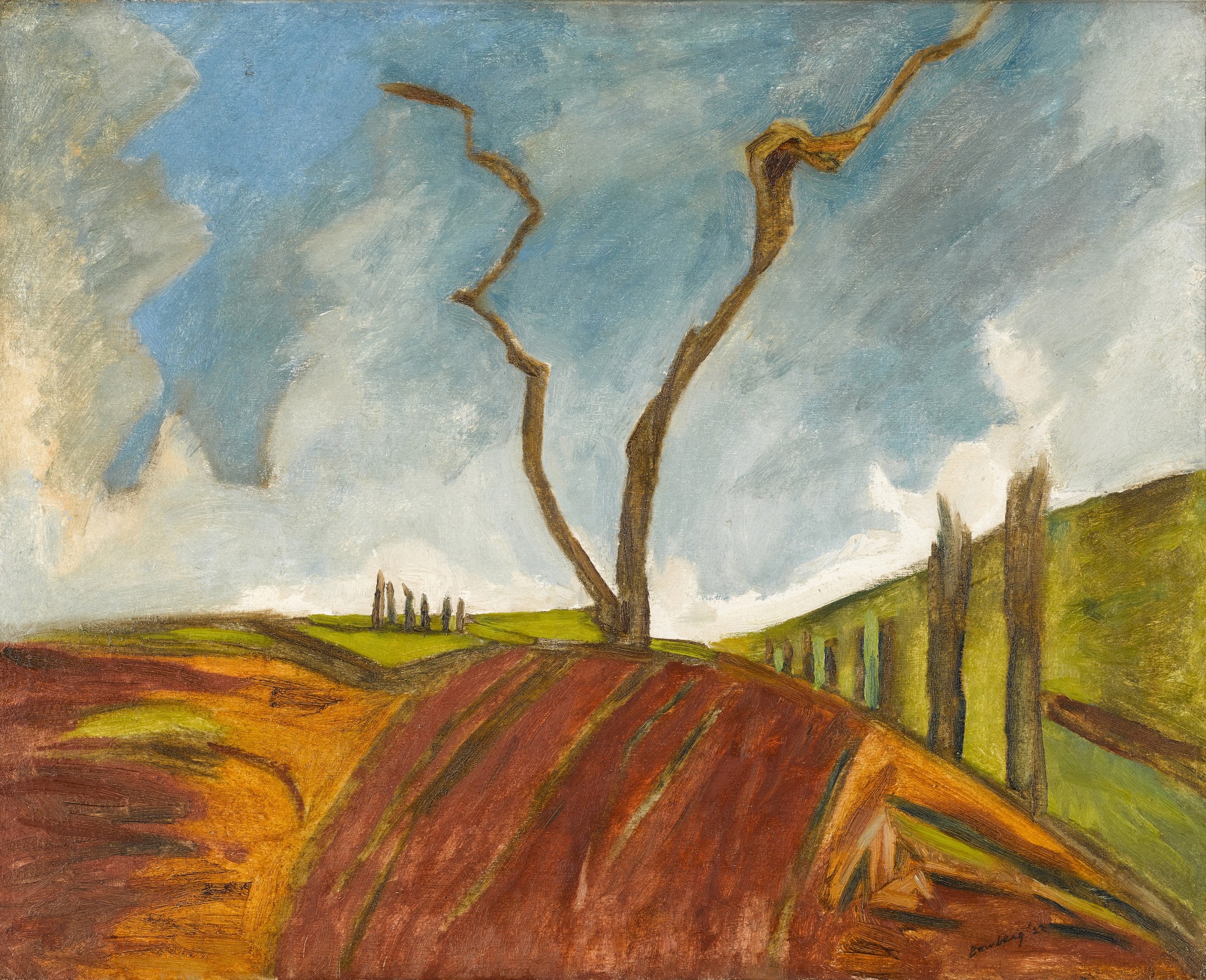
The Tree, 1922
The defining characteristic of Bomberg's mature practice is what he himself described as seeking the spirit in the mass. He wanted paint to carry not just the appearance of things but their inner weight, their lived reality. His travels were central to this quest. He visited Palestine in the early 1920s, and the landscapes he encountered there, including the stony ancient terrain around Jerusalem and the desert light of the Wadi Kelt, produced work of extraordinary intensity.
'Rooftops, Jerusalem' and 'The Monastery of St George, Wadi Kelt' are among the most atmospheric landscapes in modern British art, built from dense, active brushwork that makes the heat and silence of those ancient places almost palpable. Later travels to Spain produced the magnificent Toledo paintings, and his time in Cyprus in the mid 1940s gave rise to luminous works such as 'Sunset, Mount Hilarion, Cyprus' from 1946, in which the island's rocky landscape seems to glow from within. His wartime commission 'Bomb Store' from 1942 captures the ominous geometry of a munitions depot with the same unflinching authority he brought to everything else. For collectors, Bomberg presents one of the most compelling cases in the modern British canon.
His work spans an extraordinary range of media and mood, from the architectural precision of his early geometric canvases to the raw urgency of his late portraits and self portraits. The 'Self Portrait' in charcoal and pencil from 1948 is a case in point: unflinching, searching, drawn with the kind of directness that only comes from total commitment to the act of looking. Works on paper from the productive period around 1919 offer an accessible entry point and demonstrate that Bomberg's gifts were no less present in intimate scale than on large canvases. Oil paintings from his Palestinian and Spanish periods are among the most sought after by serious collectors of modern British art, and auction appearances of significant examples at Christie's and Sotheby's have consistently drawn strong attention from institutions and private buyers alike.
His market has deepened considerably since major retrospectives brought his work to wider audiences, and there is a growing consensus among scholars and curators that his place in the history of modern art has been systematically underestimated. The artists with whom Bomberg is most naturally in conversation are those who shared his conviction that painting must carry lived experience rather than merely describe surfaces. Leon Kossoff and Frank Auerbach, both of whom studied with Bomberg at the Borough Polytechnic in the late 1940s and early 1950s, acknowledged their profound debt to his teaching and to his insistence on working directly from observation with full physical commitment. That lineage connects Bomberg to the broader project of postwar British figuration, and through Auerbach and Kossoff to the continuing vitality of expressive painting today.
His influence on Lucian Freud's generation was also significant, felt more as a charge in the atmosphere than a direct stylistic inheritance. What makes Bomberg matter now, in the current moment, is precisely his independence. He refused schools, movements, and easy categorisation. He worked against the grain of critical fashion for most of his career, accepted poverty and neglect rather than compromise, and kept faith with a vision of painting as a fundamentally serious act of attention.
His legacy is not just a body of magnificent works but a model of artistic integrity that speaks directly to any collector or institution serious about what art can do and be. To live with a Bomberg is to live with that conviction, and with the particular joy of a painter who burned, as he put it, to get at the truth of things.
Explore books about David Bomberg