Daniel Richter
Daniel Richter, Painting the World Brilliantly Alive
Artist Spotlight · The Collection Editorial
When Daniel Richter's large scale canvases filled the rooms of the Kunsthalle Wien in Vienna, visitors found themselves standing inside something that felt less like an exhibition and more like a reckoning. The paintings pulsed with figures, light, and political urgency, each surface alive with a kind of restless intelligence that refused to settle into any single mood or meaning. That show, like so many moments in Richter's long and remarkable career, confirmed what collectors and curators across Europe and North America had long understood: here was a painter of rare and serious ambition, one whose work demanded not just attention but genuine sustained looking. His reputation, built steadily across three decades of exhibitions at major institutions and galleries, has only deepened with time.
Daniel Richter
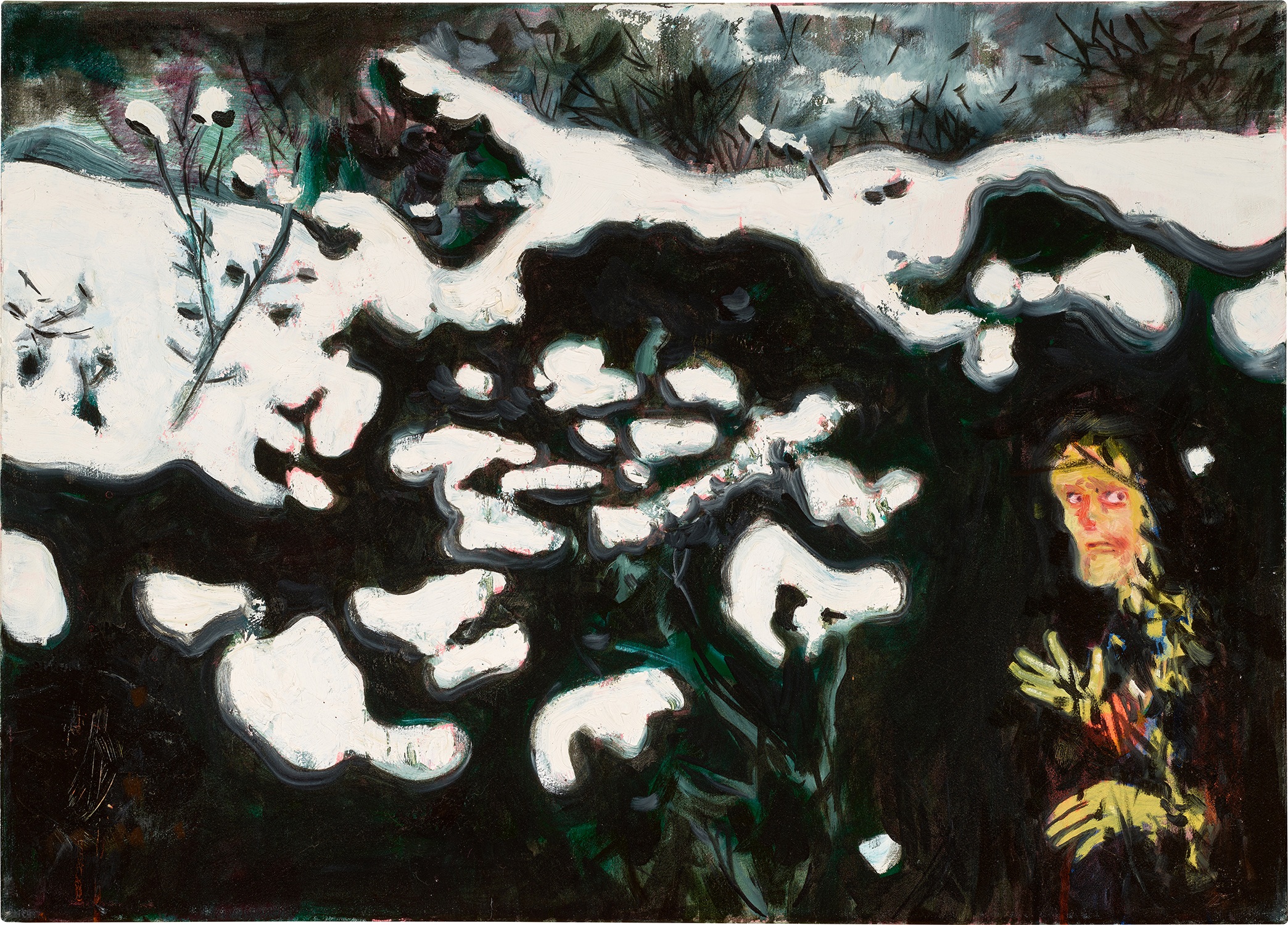
Winterreise 6, 2009
Richter was born in Neumünster, in northern Germany, in 1962, and came of age in a country still navigating the profound cultural and political ruptures of the postwar period. He came to painting relatively late, first working as a record sleeve designer for the Hamburg punk and hardcore scene in the 1980s, an experience that left a permanent mark on his visual sensibility. That background gave him a comfort with bold graphic energy, with the way an image can arrest attention and carry ideological charge simultaneously. He studied at the Hochschule für Bildende Künste Hamburg under Werner Büttner, a figure closely associated with the irreverent, politically engaged strand of German painting that emerged in that decade, and the education proved formative in every sense.
His early work in the 1990s was largely abstract, rooted in dense fields of color and form that owed something to the psychedelic and to the ornamental traditions of painting without being reducible to either. These were paintings that seemed to hold immense energy just below the surface, as though something was always on the verge of emerging from the pattern. Then, in the early 2000s, figures began to appear, and the work underwent a transformation that felt less like a change of direction than a necessary revelation. Human forms, often ambiguous in their identity, crowded into vast nocturnal spaces, caught up in events that suggested conflict, displacement, and collective experience without ever collapsing into simple allegory.
Daniel Richter
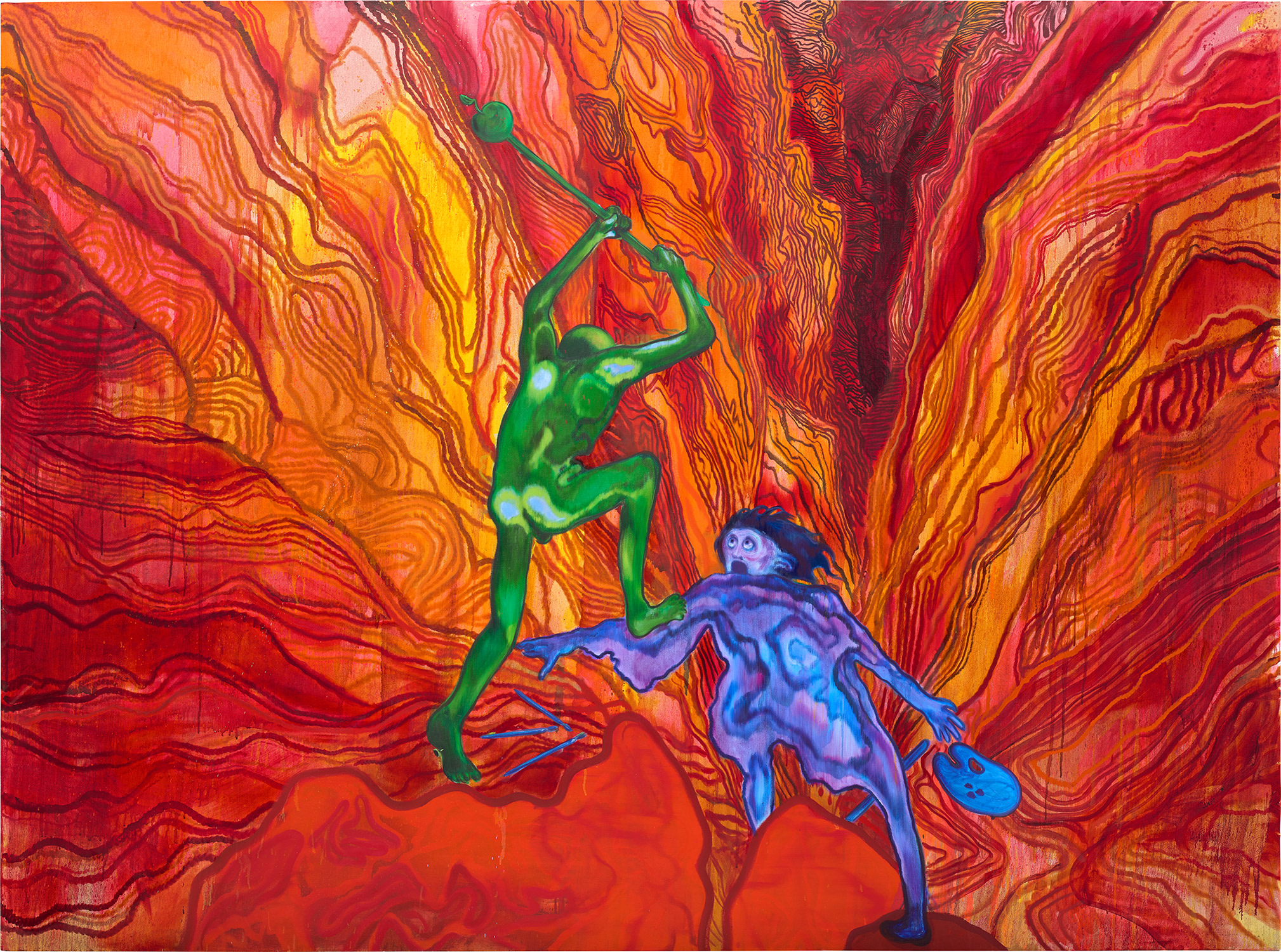
Death of the Esoteric Painter, 2011
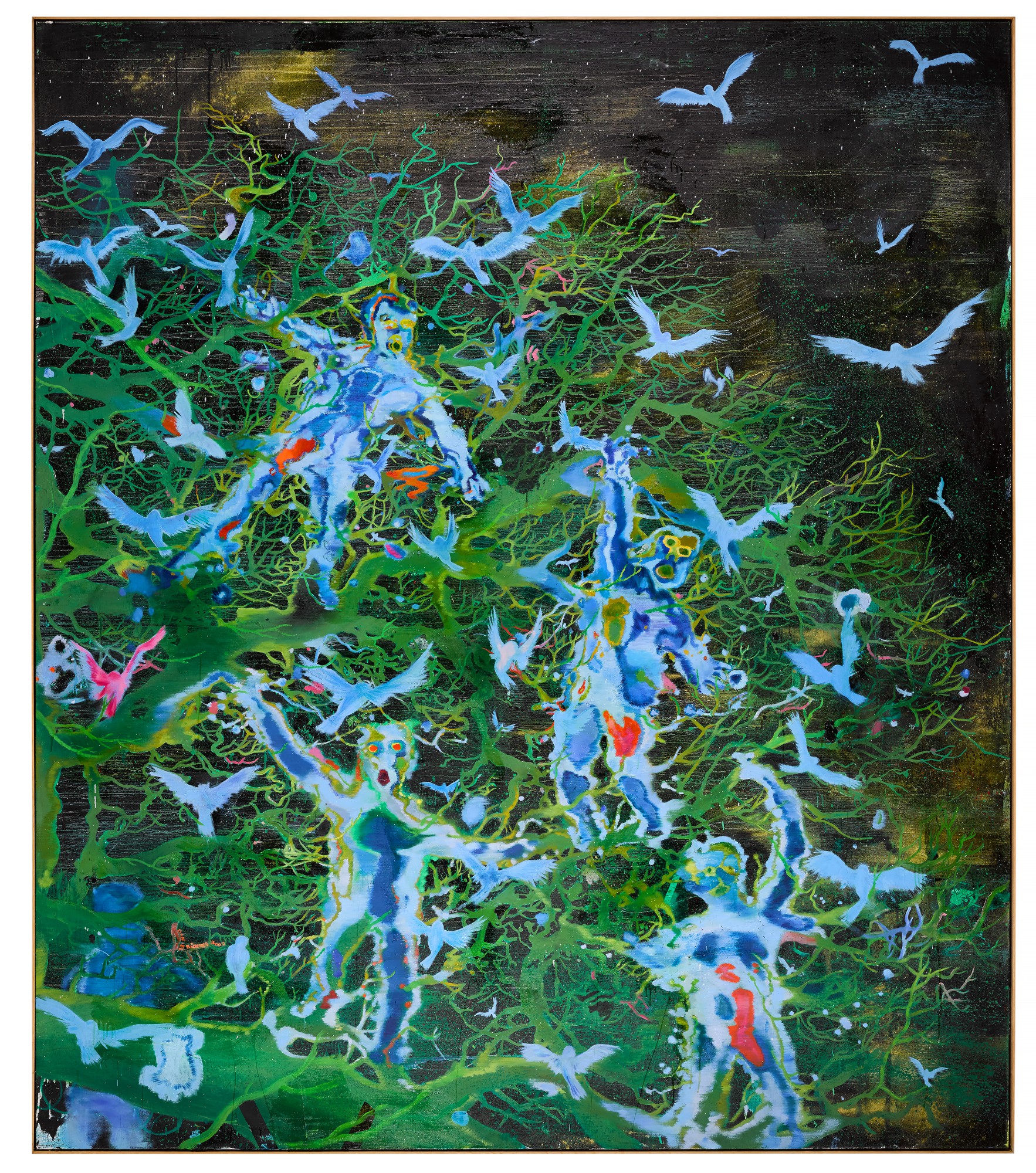
This figural turn was decisive, and it brought Richter to international prominence with extraordinary speed. The works from this period remain among the most compelling in his output. Süden, from 2002, exemplifies the synthesis he achieved between abstraction and figuration, between the decorative and the desperately serious. The canvas is at once beautiful and unsettling, its surface thick with paint applied in ways that seem simultaneously deliberate and ecstatic.
Kathe und Rolf, from 2003, brings the same intensity to a more intimate scale, rendered in oil and graphite and tape on paper, the mixed materials themselves suggesting a kind of improvised urgency. Winterreise 6, painted in 2009 and taking its title from Schubert's great song cycle of longing and wandering, shows how deeply literary and musical thinking runs through Richter's practice, even as the paintings refuse to illustrate anything so straightforwardly as a story. These are works about the condition of being alive in a specific historical moment, with all the noise and beauty and violence that entails. Death of the Esoteric Painter, from 2011, marks another significant moment, a work that seems to turn inward and interrogate the very mythology of the artist, the romantic notion of the painter as solitary visionary.
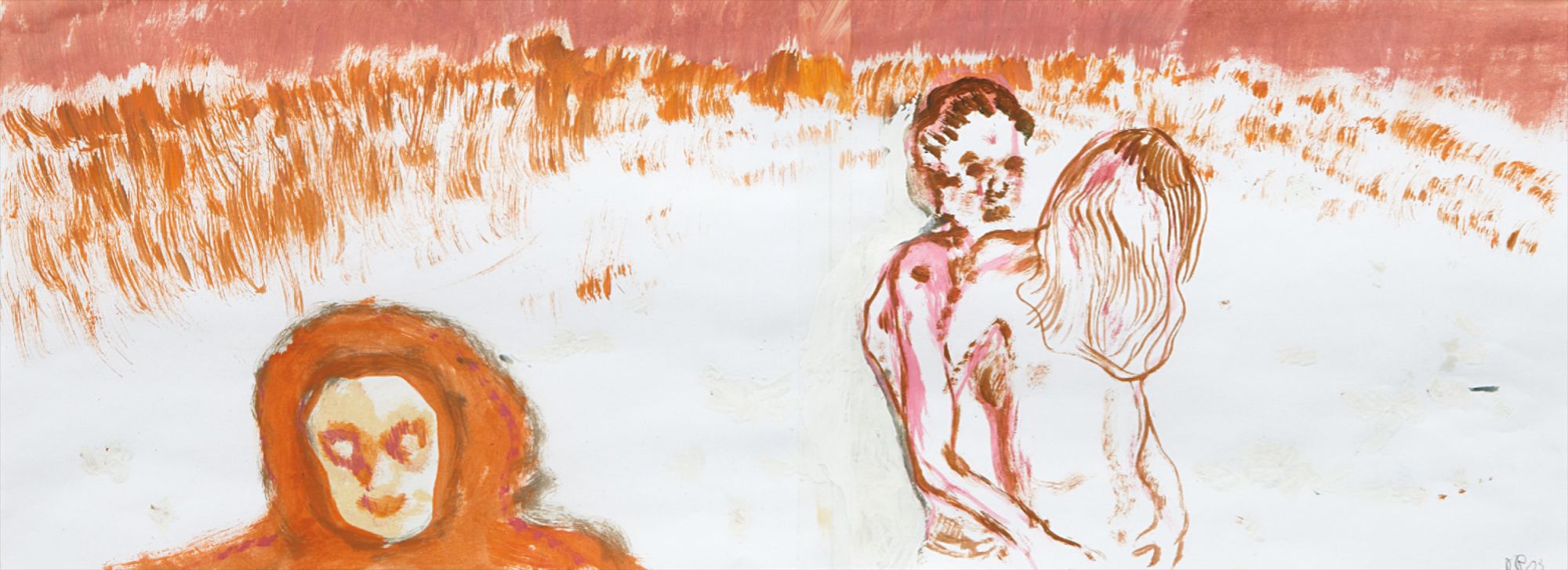
Daniel Richter
Schemen
Richter has always been suspicious of that mythology, and his time as a professor at the Akademie der bildenden Künste Wien in Vienna, a position he held for many years, reflects a genuine commitment to the collective and the social dimensions of artistic life. The Decorative Immigrant, from 2015, continues this engagement with questions of identity, belonging, and the politics of visibility, the title itself carrying an ironic charge that opens outward into much larger questions about culture and its borders. Across all of these works, what remains constant is a painterly intelligence of the highest order, and a refusal to let formal beauty serve as cover for evasion. From a collecting perspective, Richter's work occupies a genuinely distinguished position in the contemporary German painting landscape.
His canvases have been sought by serious collections across Europe and have appeared at auction at Sotheby's and Christie's, where larger works from his figural period have achieved prices that reflect both their historical importance and their continued relevance to contemporary conversations about painting. Works on paper, such as Schemen and Kathe und Rolf, offer collectors a more intimate entry point into his practice, revealing the thinking and the hand in ways that the large canvases sometimes conceal behind their theatrical ambition. For those building collections with an eye toward the history of painting since 2000, a work by Richter is not an option among many but something closer to an essential presence. Richter belongs to a generation of German painters who collectively reestablished figurative painting as a serious intellectual and political practice in the late twentieth and early twenty first centuries.
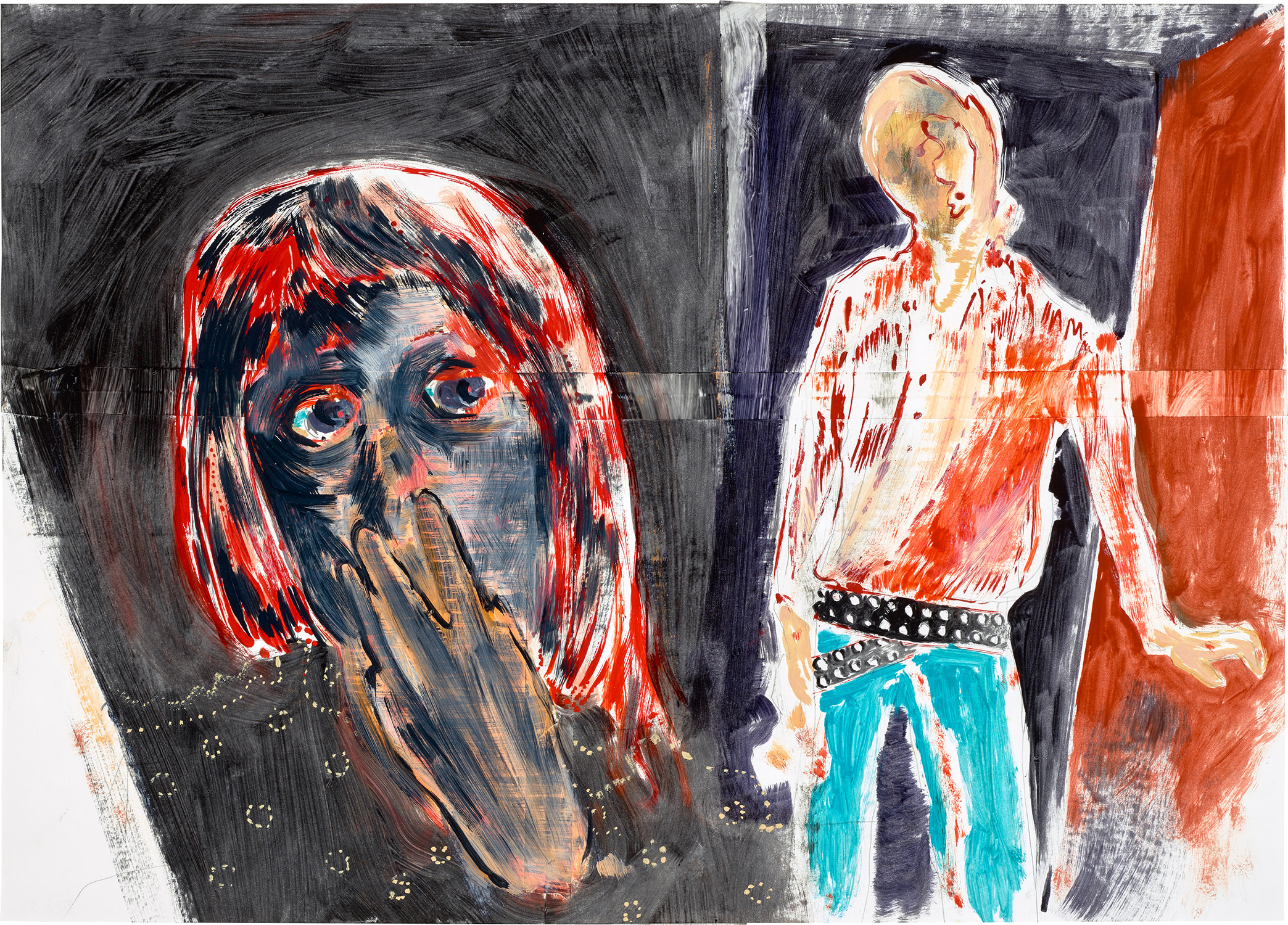
Daniel Richter
Kathe und Rolf, 2003
His work resonates in conversation with that of Neo Rauch, whose dreamlike figurative canvases share something of Richter's atmospheric intensity while arriving from a very different cultural tradition. There are echoes, too, of the social density found in the work of Kai Althoff, and of the commitment to painting's expressive extremes that one finds in the work of Albert Oehlen, with whom Richter shares a formative Hamburg connection. Yet Richter's voice remains distinctly his own, shaped by punk, by politics, by philosophy, and by an evident love of painting that has never curdled into mere facility. What makes Richter matter today, in a moment when painting is once again the subject of intense critical attention and renewed collector passion, is precisely his refusal to be comfortable.
His canvases do not offer resolution. They offer something rarer: the sensation of being in the presence of a mind fully alive to the world, using paint to think through things that language cannot quite reach. For collectors who believe that art's highest purpose is to expand what is possible to feel and to understand, Daniel Richter's work is an invitation that rewards every return visit.
Explore books about Daniel Richter