Dang Xuan Hoa
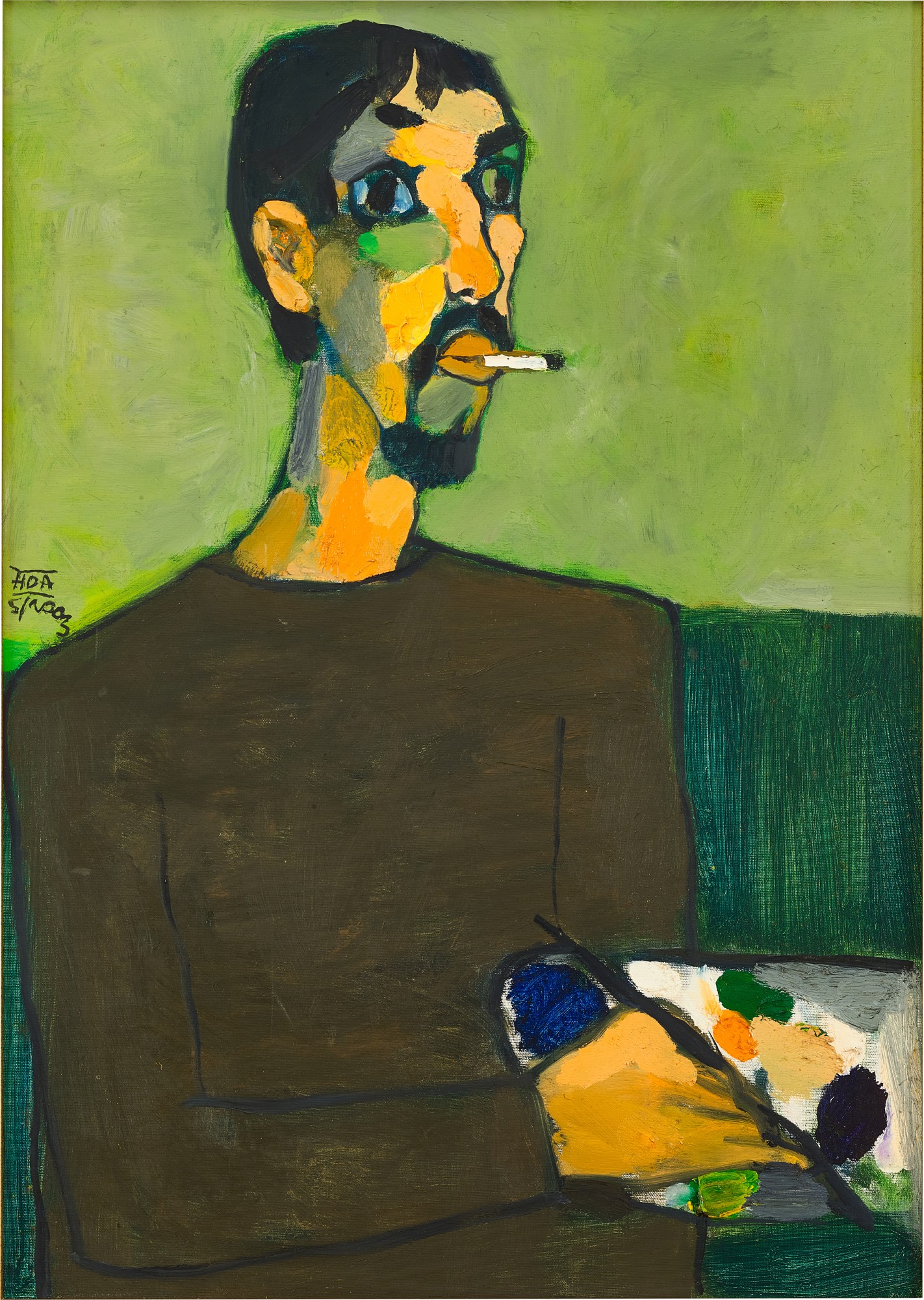
Dang Xuan Hoa, Vietnam's Visionary Inner Voice
Artist Spotlight · The Collection Editorial
When the Hanoi based painter Dang Xuan Hoa exhibited at the prestigious Fukuoka Asian Art Museum in Japan in the late 1990s, curators and collectors across East Asia took notice of something rare: a Vietnamese artist whose work felt simultaneously rooted in the particulars of post Doi Moi Hanoi and entirely free of the need to explain itself to any outside gaze. That exhibition, part of a broader wave of international recognition for Vietnamese contemporary art, confirmed what those closer to the Hanoi art scene had understood for years. Dang Xuan Hoa was among the most psychologically complex and visually original painters of his generation. Born in Hanoi in 1959, Dang Xuan Hoa came of age during one of the most turbulent periods in Vietnamese history, shaped by the aftermath of war, the strictures of a centrally planned economy, and the gradual opening that would follow the Doi Moi reforms of 1986.
Dang Xuan Hoa
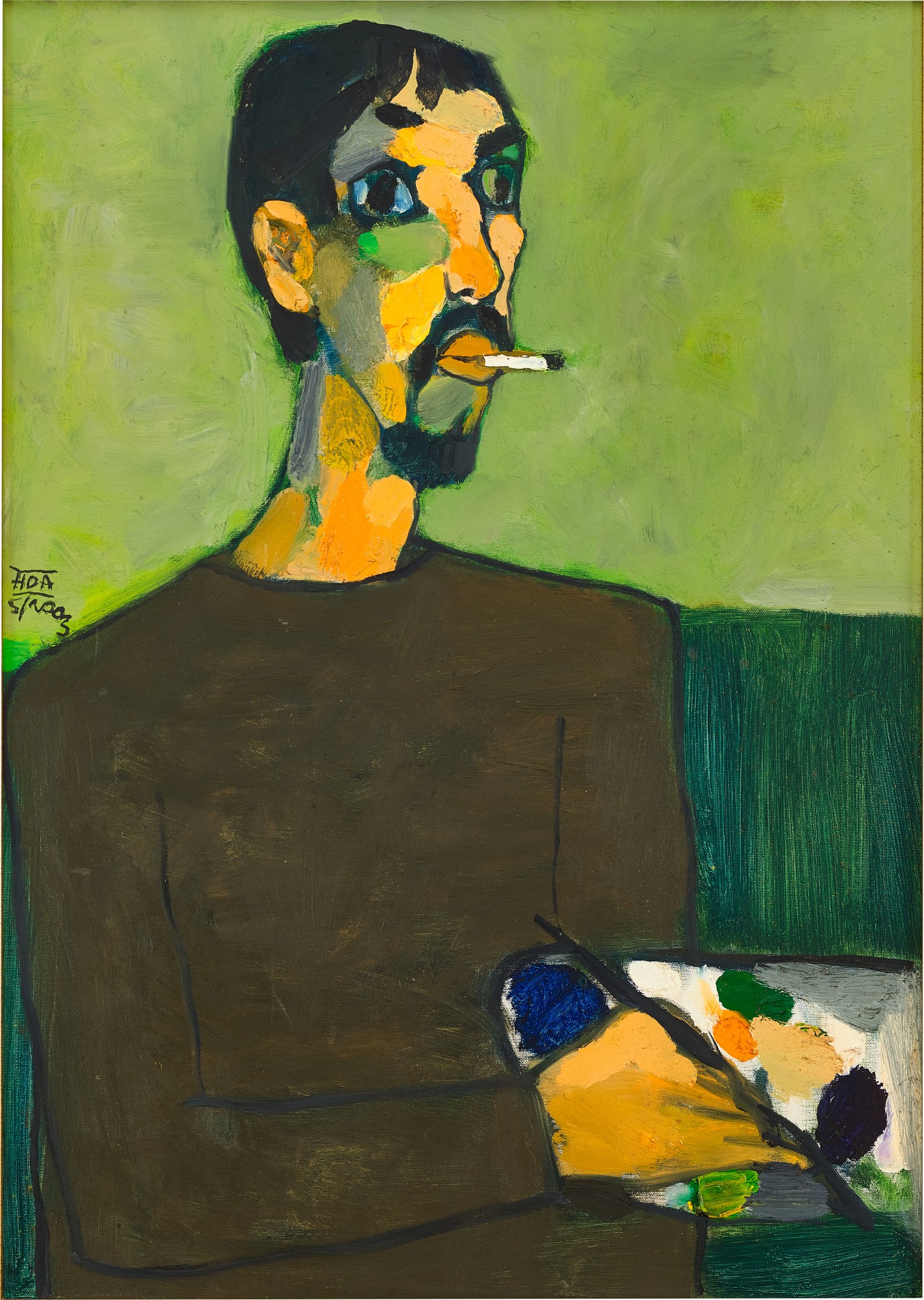
Self-Portrait 自畫像
He trained at the Vietnam University of Fine Arts in Hanoi, the country's most prestigious institution for visual art education, where he absorbed the European academic tradition filtered through decades of French colonial pedagogy and later Soviet influence. Yet from the beginning, he was drawn not toward official socialist realism but toward the interior life, the face as a map of feeling, the body as an archive of experience. The Doi Moi period was transformative for Vietnamese artists in ways that are difficult to overstate. As the country opened cautiously to foreign investment, tourism, and cultural exchange in the late 1980s and through the 1990s, a generation of painters in Hanoi and Ho Chi Minh City found themselves with access to international art publications, foreign collectors passing through, and a newly energized gallery scene.
Dang Xuan Hoa was at the center of this ferment. He was a founding member of the Gang of Five, an informal collective of Hanoi painters that included Tran Luong, Pham Quang Vinh, Ha Tri Hieu, and Nguyen Quan Truong. Together they pushed Vietnamese painting toward expressionism, figuration charged with psychological intensity, and a willingness to depict the ambiguities of urban life rather than idealized landscapes or heroic narratives. The signature quality of Dang Xuan Hoa's painting is its capacity to hold tension without resolving it.
Dang Xuan Hoa
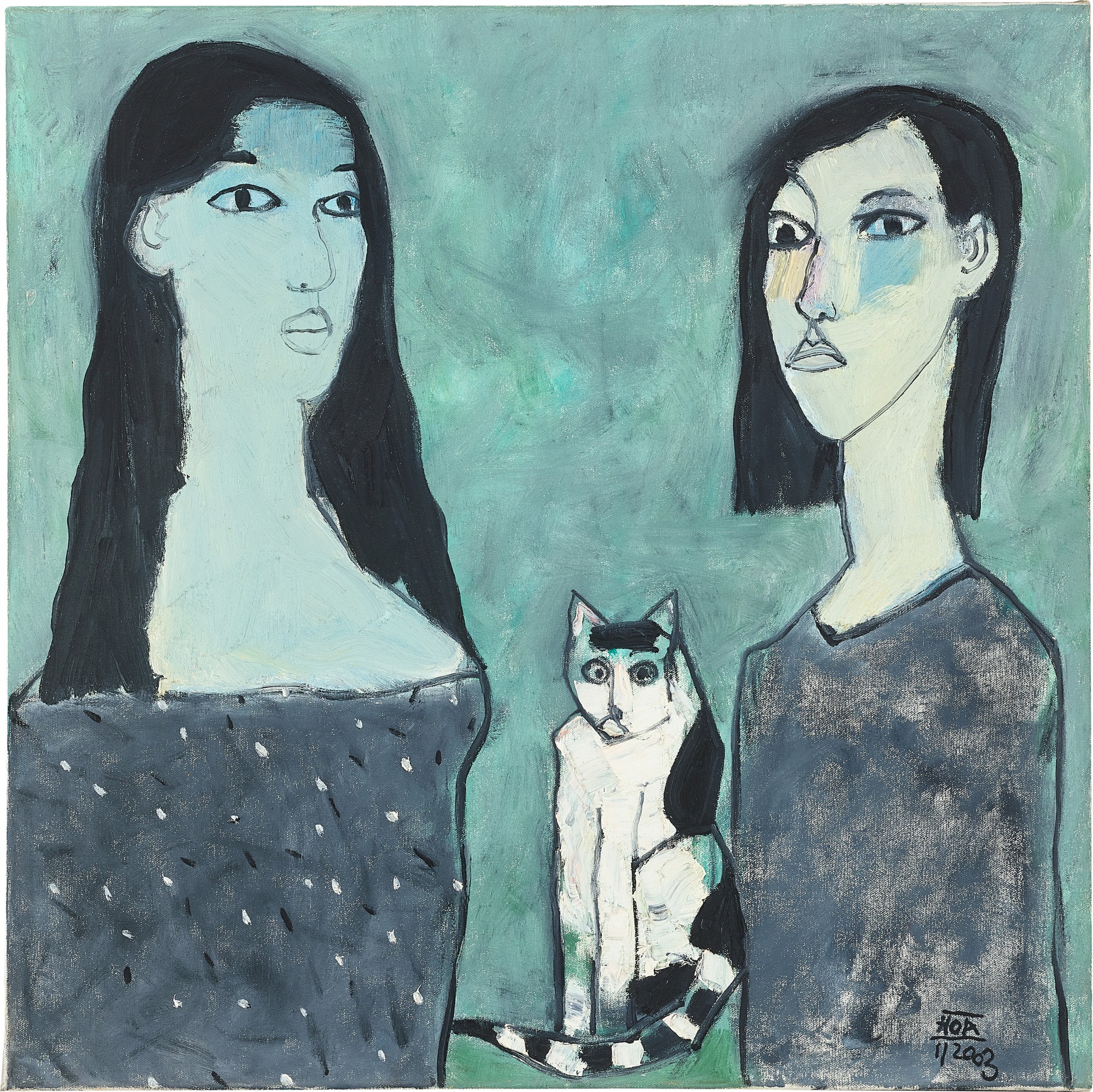
Two Sisters 姊妹
His figures, rendered in oil on canvas with a technique that is at once assured and deliberately unfinished in places, seem to exist at the threshold between revelation and concealment. The self portrait as a form has occupied him throughout his career, and it is here that his achievement is perhaps most concentrated. His "Self Portrait" works return obsessively to the act of looking inward, the face rendered with loose, searching brushwork that refuses the flattery of portraiture and insists instead on something more uncomfortable and more honest. The paint surface in these works is alive with revision, with marks that accumulate meaning over time.
"Two Sisters" represents another enduring strand of his practice, the depiction of familial and feminine relationships that are tender without being sentimental. His figures share a pictorial space that feels psychological as much as physical, their proximity suggesting bonds that language cannot fully articulate. There is a quality in these works that connects them to the broader tradition of figurative expressionism in twentieth century painting, drawing comparison to the emotionally charged canvases of Egon Schiele, to certain works by Francis Bacon in their willingness to distort in service of truth, and to the introspective figuration of Chinese painters like Zhang Xiaogang, whose work similarly engages the individual face as a site of historical and personal memory. For collectors, Dang Xuan Hoa's work represents a significant opportunity to engage with a body of work that has been recognized internationally for several decades but remains far less known in Western markets than its quality warrants.
His works entered major collections through the active Vietnamese art market of the 1990s and early 2000s, when galleries in Hanoi such as Apricot Gallery and international institutions dealing in Southeast Asian contemporary art brought his canvases to buyers in Singapore, Hong Kong, Japan, and Europe. The best of his works combine the intimacy of his self portraiture with a rawness that has only deepened as his practice has matured. Collectors drawn to the expressionist tradition, to artists who have made the face and figure their primary subject across a lifetime of sustained inquiry, will find in Dang Xuan Hoa a painter whose commitment to psychological honesty is absolute. In the broader context of Southeast Asian and global art history, Dang Xuan Hoa belongs to a generation that transformed what Vietnamese painting could mean and who it could speak to.
His Gang of Five colleagues each pursued their own distinct paths, Tran Luong moving toward installation and performance, others toward conceptual practice, but Dang Xuan Hoa remained devoted to painting, to oil and canvas, to the stubborn, demanding conversation between a painter and the visible world. This loyalty to a medium that many of his contemporaries abandoned gives his work a particular depth and continuity. Related artists worth considering alongside his practice include Le Quoc Viet, whose lacquer paintings explore similar tensions between tradition and modernity, and Nguyen Trung, the elder statesman of Vietnamese abstraction whose career also spans the Doi Moi transition. The legacy of Dang Xuan Hoa is still being written, and that is precisely why this moment feels important for collectors and institutions to pay attention.
He is an artist whose work rewards sustained looking, whose paintings grow richer with familiarity, revealing layers of feeling and technical intelligence that are not immediately apparent. As interest in the full range of twentieth and twenty first century Asian art continues to deepen globally, and as Vietnam's cultural moment becomes increasingly recognized by major museums and auction houses, Dang Xuan Hoa stands as one of the essential figures: a painter who captured the interior life of a nation in transformation with the honesty, skill, and formal daring that defines lasting art.