César Baldaccini
César Baldaccini, Sculptor of Glorious Transformation
Artist Spotlight · The Collection Editorial
“I compress, therefore I am.”
César Baldaccini
There is a moment, somewhere between destruction and rebirth, where César Baldaccini found his life's work. In 1960, at the Salon de Mai in Paris, he presented three crushed automobiles, stacked and compressed into dense metallic monoliths, and the art world paused to reckon with something genuinely new. Those works, known simply as Compressions, announced a sculptor of radical instinct and profound intelligence, an artist who could look at the wreckage of industrial civilization and find in it something monumental, even beautiful. More than six decades on, the resonance of that gesture has only deepened.
César Baldaccini
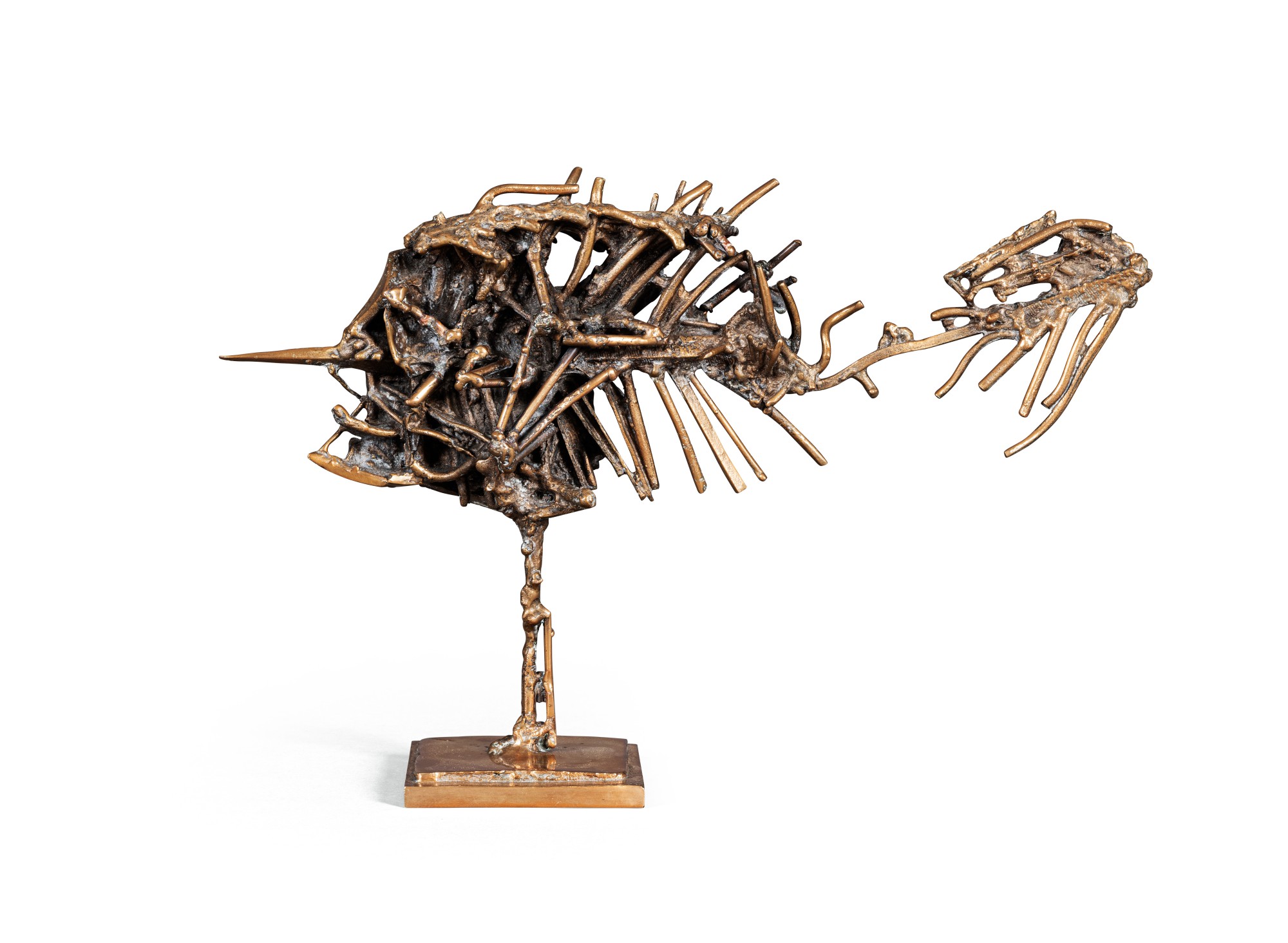
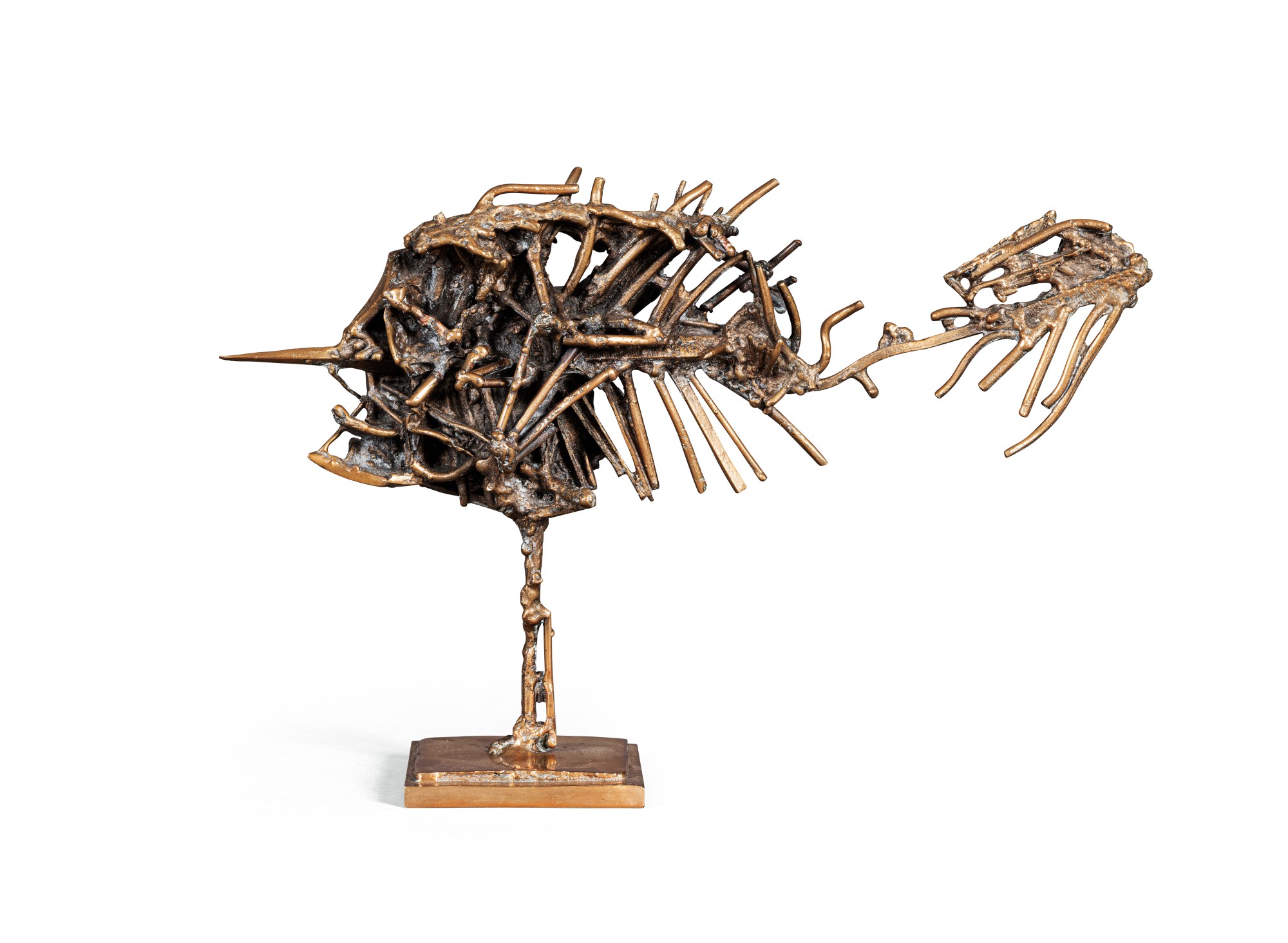
La Rascasse , 1955
César François Baldaccini was born in Marseille in 1921, the son of Italian immigrants who ran a small bar in one of the city's working class neighborhoods. Growing up in the industrious, sun bleached port city shaped him in fundamental ways. He was surrounded by the physicality of labor, by metal and machinery, by the detritus of trade and manufacture. He trained at the École des Beaux Arts in Marseille before moving to Paris in 1943 to continue his studies, and the contrast between the raw energy of his origins and the refined traditions of the French academy became a productive tension that never quite left him.
He studied under the sculptor Henri Georges Adam, among others, absorbing the classical discipline that would later give his most unconventional work its structural authority. His early career in Paris was marked by genuine struggle. Unable to afford bronze, César turned to salvaged iron and scrap metal, welding together insects, animals, and human figures from industrial waste. These works, produced throughout the late 1940s and 1950s, are remarkable objects.
César Baldaccini
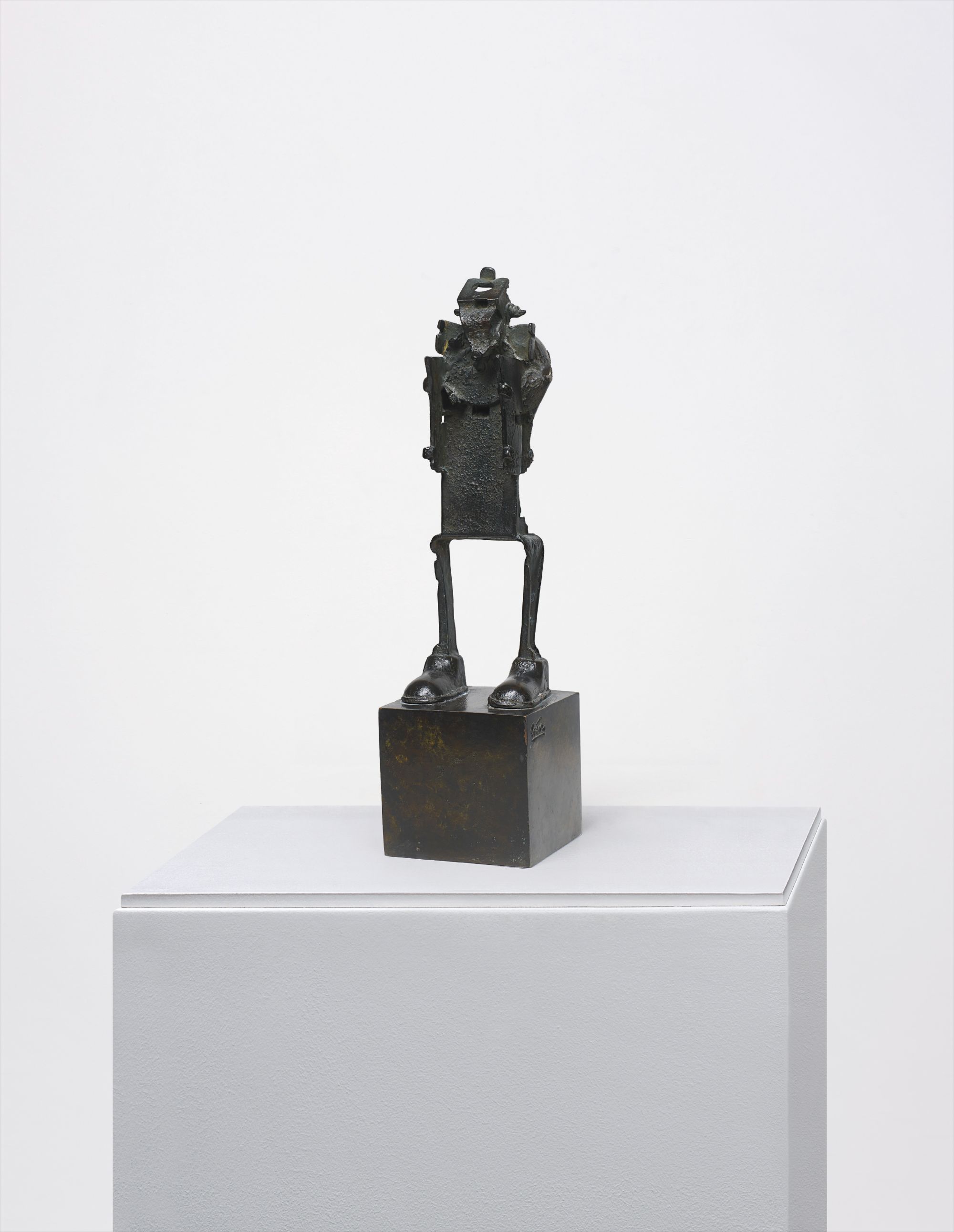
Mickey
They possess an organic vitality that feels almost impossible given their materials, and they established him as a sculptor of serious ambition within the Parisian avant garde. La Rascasse, his bronze study of the spiny Mediterranean fish completed in 1955, exemplifies this early period beautifully. The work carries both the naturalist's eye and the metalworker's confidence, a creature rendered with such tactile immediacy that you can almost feel the scales. It remains one of the most telling windows into the artist before his fame.
The Compressions arrived like a conceptual thunderclap. Working with industrial hydraulic presses, César began crushing entire automobiles into compact rectangular blocks in 1960, presenting the results as finished sculptures. The gesture was provocative in ways that reverberated far beyond Paris. He was a founding member of Nouveau Réalisme, the movement convened by the critic Pierre Restany in 1960 alongside artists including Yves Klein, Jean Tinguely, Niki de Saint Phalle, and Arman.
César Baldaccini
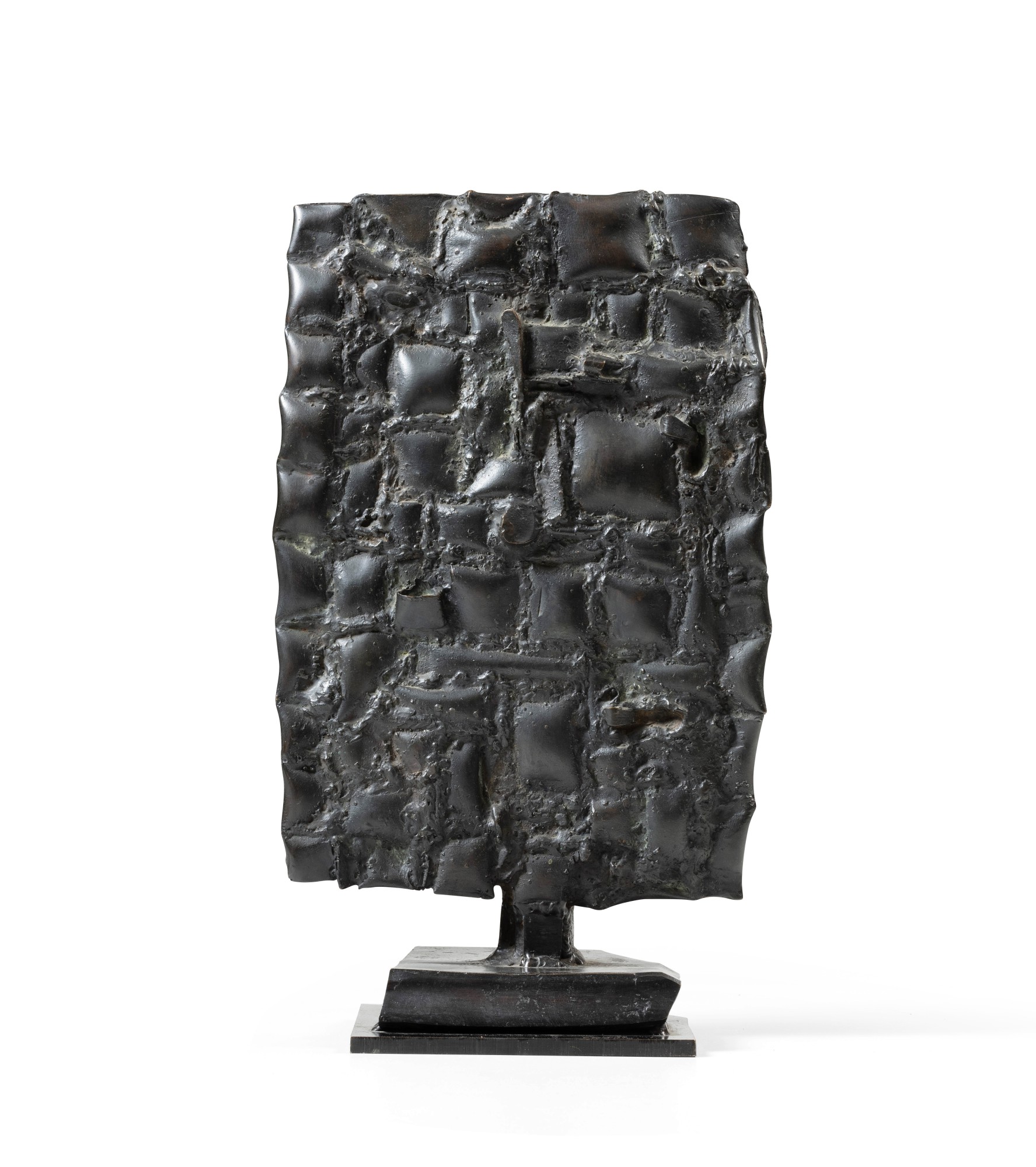
Plaque , 1955
Where American Pop Art was engaging with consumer culture through representation and image, the Nouveau Réalistes incorporated consumer objects themselves, elevating the thing rather than the picture of the thing. César's Compressions were perhaps the most visceral expression of this philosophy. They did not depict the automobile age; they absorbed it, compacted it, and asked you to stand before its consequences. A decade later, César moved in an entirely different direction with his Expansions.
Beginning in 1967, he began working with polyurethane foam, pouring the liquid material and allowing it to expand and solidify in unpredictable, cascading forms. If the Compressions were about industrial force and control, the Expansions surrendered to chance and organic growth. Many were produced as performative gestures, poured in public and in galleries, the artist guiding but never quite commanding the result. The contrast between the two bodies of work speaks to a restless creative intelligence, an artist unwilling to be defined by even his most celebrated breakthrough.
The Expansions in their brightly colored, exuberant forms share an unexpected kinship with the gestural abstraction of their era, even as they remained rooted in César's fascination with material transformation. Perhaps his most widely recognized creation came in 1965, when César produced his Thumb, an enlarged cast of his own right thumb realized at monumental scale in bronze. The work became iconic. It was reproduced at various dimensions over the years, installed in public spaces across France, and lent its silhouette to the César Awards, the French cinema prize established in 1975 and named in his honor.
The Thumb is a beguiling object because it refuses easy categorization. It is figurative and abstract at once, intimate in its origin and overwhelming in its presence. The Mickey bronze in César's catalogue carries a similar wit and warmth, that quality of the artist finding unexpected grandeur in the familiar and the everyday. For collectors, César represents a genuinely compelling proposition at multiple points of entry.
His early bronze works from the 1950s, including pieces like La Rascasse and the 1955 Plaque, offer proximity to a formative artistic mind working at the height of its curiosity, before the fame of the Compressions reshaped expectations around his name. These works appear with relative rarity at auction and are prized by those who understand the full arc of his development. The Compressions themselves, when they appear, command serious institutional and private attention. Major auction houses in Paris and London have seen strong results for César's bronzes across editions and periods, with collector interest particularly robust in France, where his cultural presence remains enormous.
The Centre Pompidou holds significant works from throughout his career, and his presence in that collection lends important institutional weight to any work that comes to market. Within art history, César occupies a pivotal position as a bridge between European assemblage traditions and the broader post war engagement with consumer society. His peers in Nouveau Réalisme remain touchstones for understanding his context, and comparisons with Arman's accumulations and Tinguely's kinetic machines are instructive. His dialogue with American artists including John Chamberlain, who was working with crushed automobile bodies in New York at almost exactly the same moment, is one of the great parallel developments of the early 1960s, two artists arriving independently at remarkably similar ideas from entirely different cultural vantages.
That convergence only underscores how urgently the post war world demanded new sculptural languages. César died in Paris in 1998, leaving a body of work of extraordinary range and enduring vitality. His legacy is not merely one of formal innovation, though the innovation was real and lasting. It is a legacy of courage, the courage to look at crushed metal and see sculpture, to pour expanding foam and call it finished, to cast your own thumb and offer it as a monument.
He found dignity and grandeur in materials the art world had not yet learned to respect, and he did so with a warmth and physicality that remains deeply human. To collect César is to hold a piece of that transformation in your hands.
Explore books about César Baldaccini