Constant Troyon
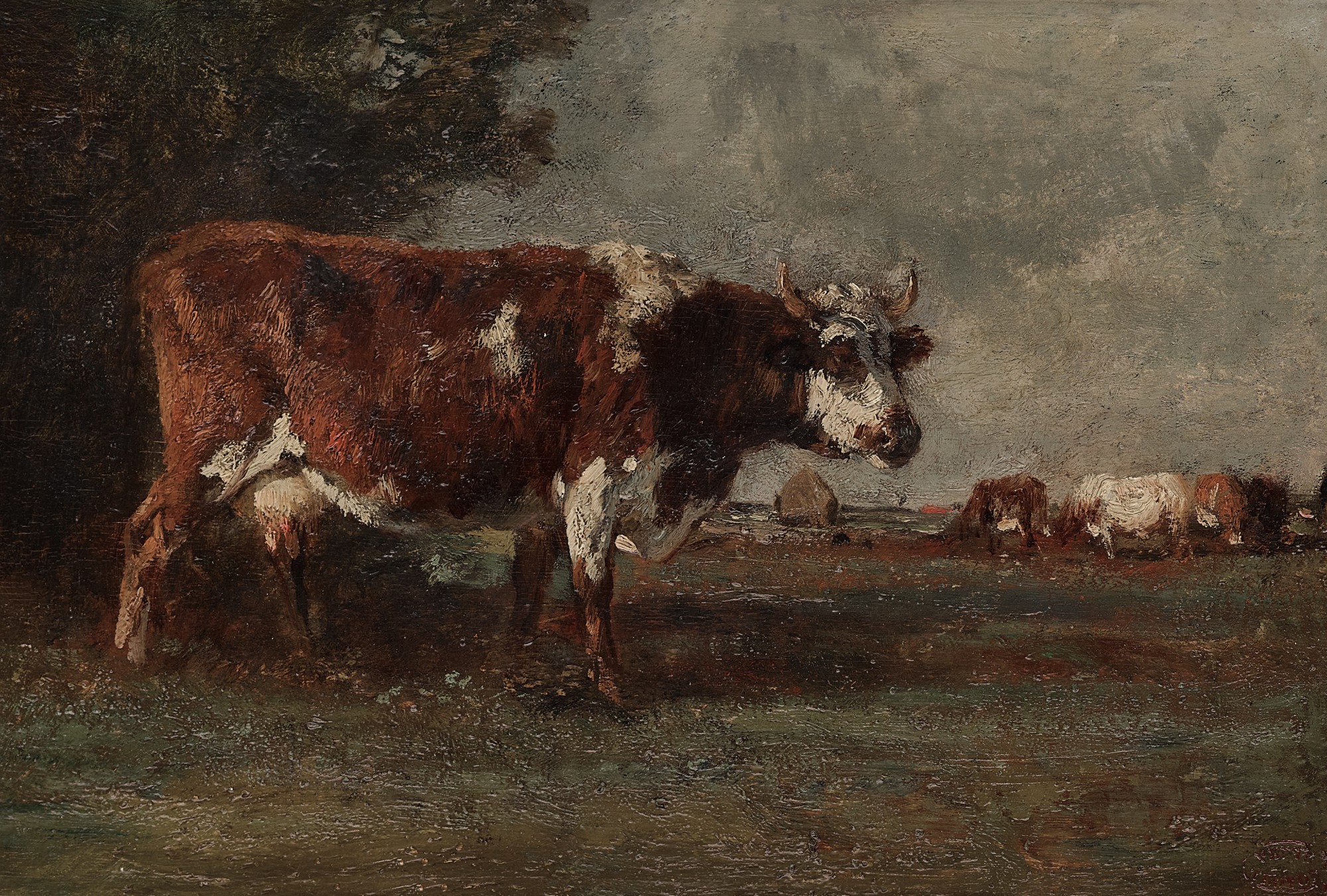
Constant Troyon: Painter of the Living Land
Artist Spotlight · The Collection Editorial
There is a particular quality of light in the Île de France countryside during the long, warm hours of a summer afternoon, when the grasses bend gently and cattle move with unhurried grace across open pastures. It is precisely this light, this sense of a world both ordinary and quietly sacred, that Constant Troyon spent a lifetime pursuing on canvas and panel. As interest in nineteenth century French naturalism continues to grow among collectors and museum curators alike, Troyon stands out as one of its most gifted and emotionally intelligent practitioners, an artist whose reputation is enjoying a richly deserved reassessment in the international market. Troyon was born in 1810 in Sèvres, just outside Paris, into a family with deep ties to the decorative arts.
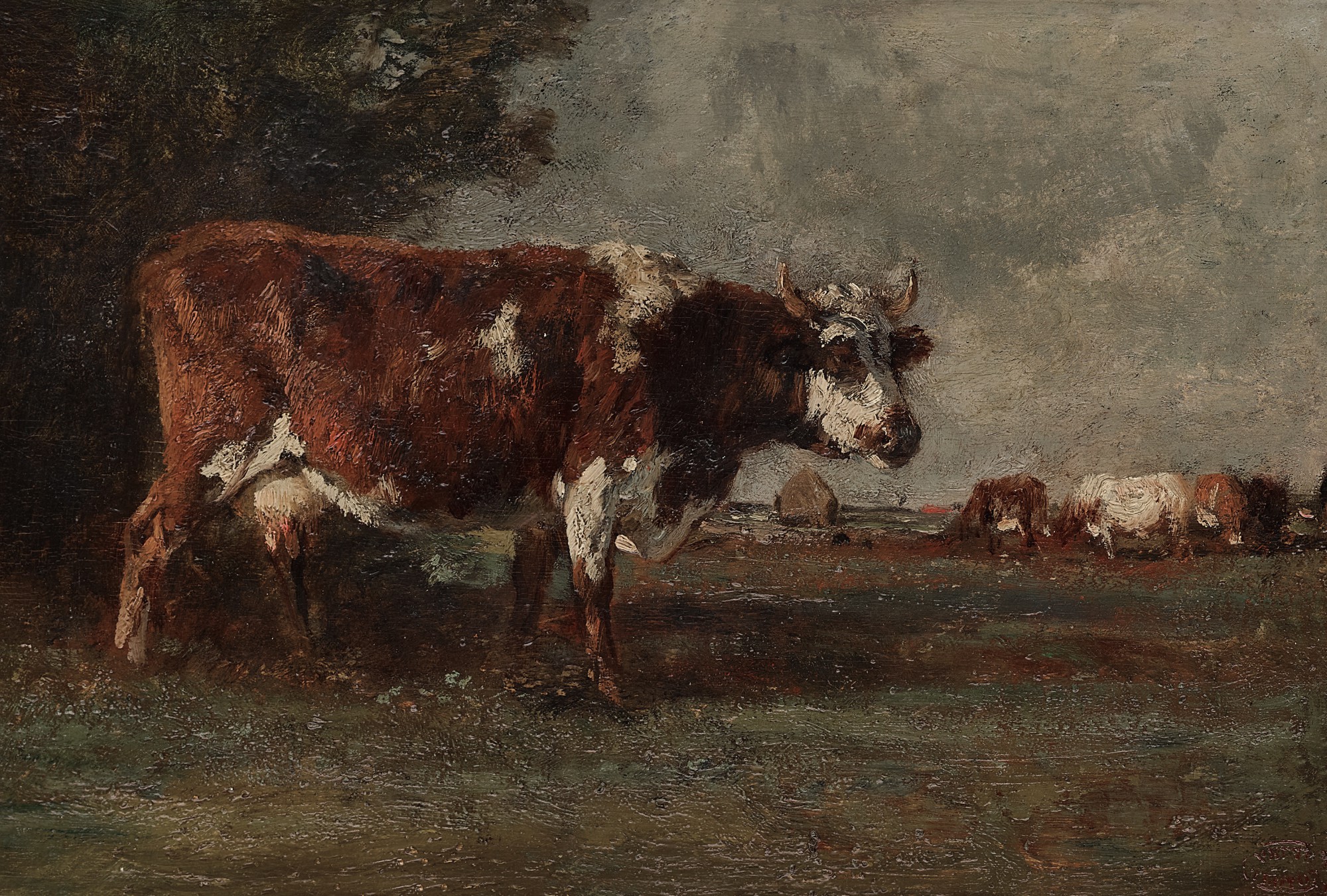
Constant Troyon
Grazing Cows
His father was a painter at the famous Sèvres porcelain manufactory, and Constant himself began working there as a young boy, learning the discipline of applied ornament and the careful rendering of botanical and animal forms. This early training gave him an extraordinary sensitivity to surface, texture, and the way pigment could evoke the warmth of living things. It was an education rooted in craft rather than abstraction, and it would define his practice for the rest of his life. His formal artistic development accelerated through his connections to the landscape painters working in and around the Forest of Fontainebleau in the 1830s and 1840s.
Though Troyon was not strictly a member of the Barbizon School in the narrow sense, his sensibility aligned closely with that of Théodore Rousseau, Charles François Daubigny, and Jean Baptiste Camille Corot, all of whom were committed to painting directly from observation of the natural world. These artists collectively pushed French painting away from the idealized historical landscapes of the academic tradition and toward something more immediate, more honest, and more emotionally resonant. Troyon absorbed these lessons and made them entirely his own. A pivotal moment in his development came during a journey to the Netherlands and Belgium in 1847, where he encountered the great Dutch and Flemish animal painters of the seventeenth century, most notably Aelbert Cuyp and Paulus Potter.
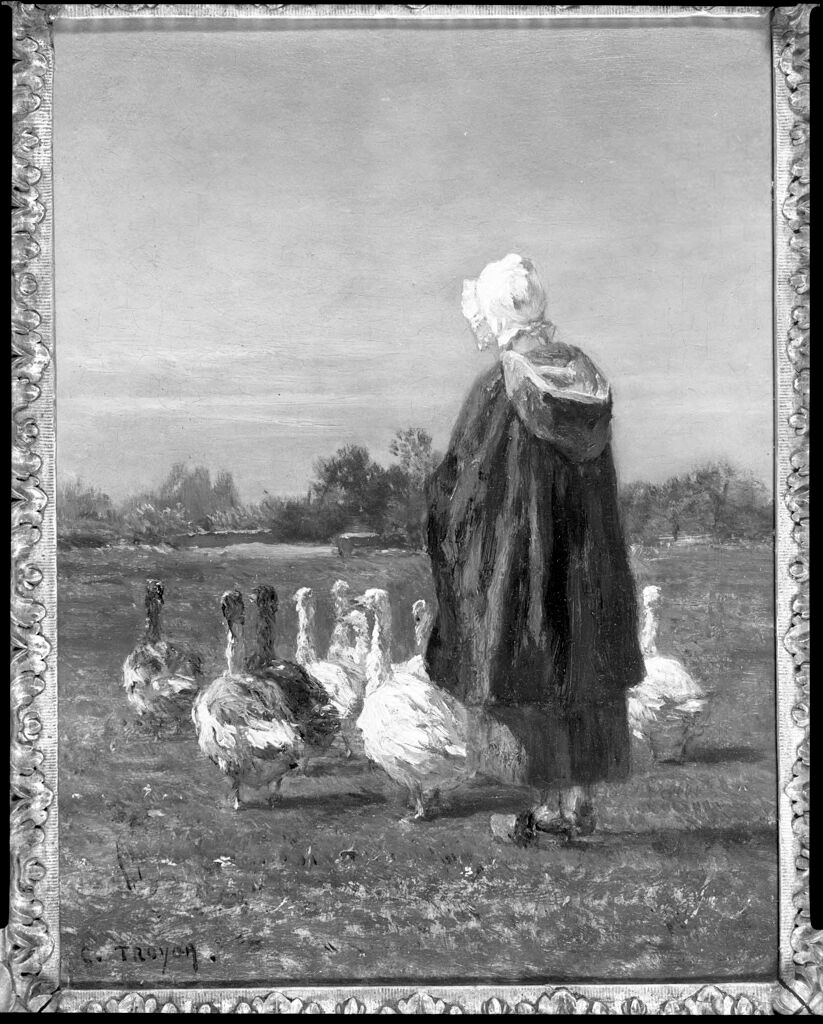
Constant Troyon
The Gooseherd
The experience was transformative. Troyon returned to France with a new ambition: to bring the same monumental presence and painterly confidence to the depiction of cattle and working animals that those earlier masters had achieved. From this point forward, animals became the defining subject of his work, not as picturesque accessories to landscape but as subjects of genuine dignity and physical weight. He began exhibiting large scale animal paintings at the Paris Salon with considerable success throughout the late 1840s and into the 1850s, earning medals and the admiration of collectors across Europe.
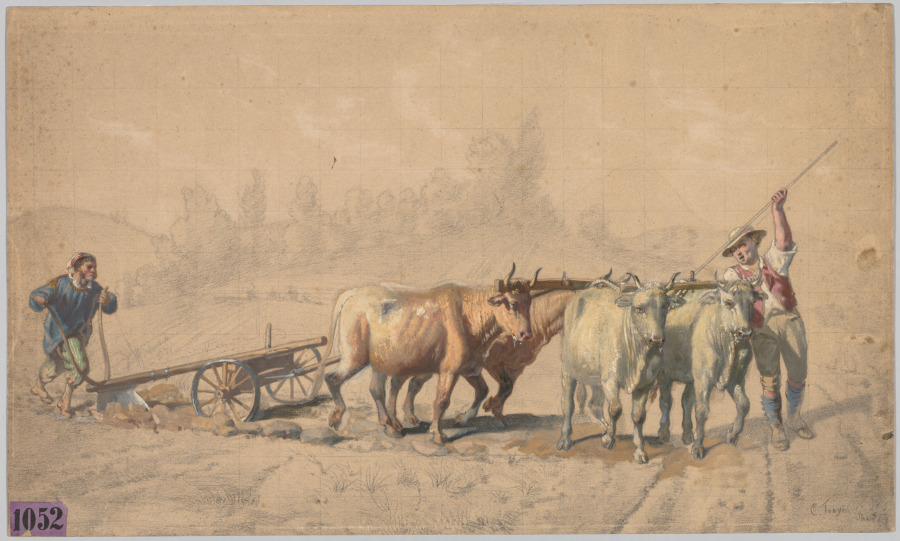
The works available on The Collection offer an illuminating cross section of Troyon's range and mastery. Grazing Cows and Cows in a Pasture, both executed in oil, demonstrate his genius for capturing the specific quality of an animal at rest, the heaviness of a flank, the way light falls across a damp coat, the sense that these creatures exist in real weather and real time rather than in any idealized pictorial space. The Gooseherd, executed on panel, shows a different register of his talent, more intimate in scale and gentle in mood, with the small figures of geese and their tender moving through a softly rendered countryside. Then there is Four Oxen Pulling a Plough from 1853, a study in black chalk and gouache with graphite and gum arabic and traces of white chalk, squared for transfer in black chalk.
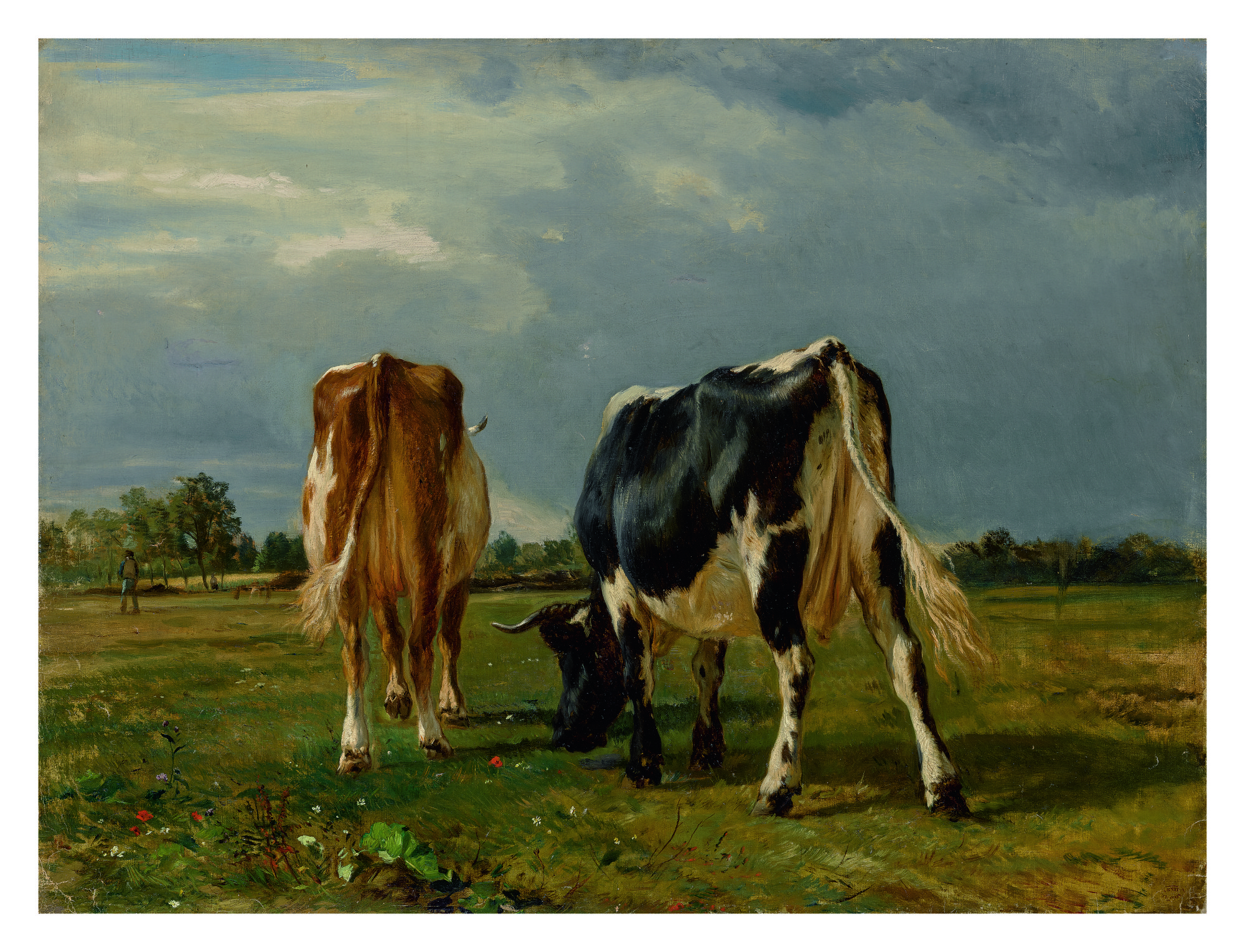
Constant Troyon
Cows In A Pasture
This work is particularly significant because it reveals the serious preparatory intelligence behind his finished paintings. The squaring for transfer indicates that Troyon treated this as a working document, a bridge between observation and composition, and it gives the modern viewer rare access to his process. For collectors, Troyon represents a compelling proposition on several levels. His works appear at major auction houses with some regularity, and quality examples on panel in particular have demonstrated sustained strength.
The intimacy of his smaller panel paintings makes them exceptionally liveable works, the kind that reward prolonged attention in a domestic setting rather than demanding the theatrical distance of a museum gallery. Collectors drawn to the Barbizon School, to Dutch Golden Age animal painting, or to the broader tradition of European naturalism will find in Troyon an artist who bridges those worlds with rare fluency. His drawings and works on paper, such as the extraordinary 1853 chalk and gouache study, are especially sought after by those who appreciate the intelligence of an artist's working process laid bare. In terms of art historical context, Troyon occupies a fascinating middle position between the pure landscape painters of Barbizon and the later Impressionists who would absorb and transform so many of the same concerns about light and observation.
Constant Troyon
Four Oxen Pulling a Plough, 1853
His influence on younger French painters was significant. Jules Dupré admired him, and there are clear lines of connection running forward to the work of Rosa Bonheur, who similarly elevated animal subjects to a position of monumental seriousness in French painting. Looking backward, his debt to Dutch naturalism places him in a long tradition of northern European painters for whom the working landscape and its creatures were worthy of the same sustained attention given to religious or mythological subjects. What makes Troyon genuinely moving as an artist, and what ensures his continued relevance, is the quality of attention he brought to subjects that others routinely overlooked.
A cow in a field was not, for Troyon, a background element or a signifier of pastoral simplicity. It was a living thing with mass and breath and particularity, deserving of the same careful, loving observation that a portraitist brings to a human face. In an era when painting increasingly turned toward the self referential and the conceptual, Troyon's fundamental commitment to the visible world feels not nostalgic but quietly radical. His paintings remind us that looking carefully, with patience and without irony, is itself a form of generosity.
That is a lesson collectors and viewers continue to find both beautiful and necessary.
Explore books about Constant Troyon
Constant Troyon: Catalogue Raisonné de l'Œuvre Peint
Étienne Breton
Constant Troyon 1810-1865
Hélène Toussaint
Les Peintres de L'Animalité: Troyon et Ses Contemporains
Philippe Grunchec