Clarence Holbrook Carter
Clarence Holbrook Carter, America's Quiet Visionary
Artist Spotlight · The Collection Editorial
There is a particular kind of American painting that does not announce itself loudly. It settles into the room, asks you to slow down, and then, when you are ready, it tells you something true. Clarence Holbrook Carter painted that kind of picture. Born in Portsmouth, Ohio in 1904, Carter spent a long and remarkably productive life making work that honored the texture of ordinary American experience, from the fog lifting off Lake Erie to the rough dignity of a working woman's face, from the gleam of an industrial refinery to the haunted stillness of a circus horse standing in winter light.
Clarence Holbrook Carter
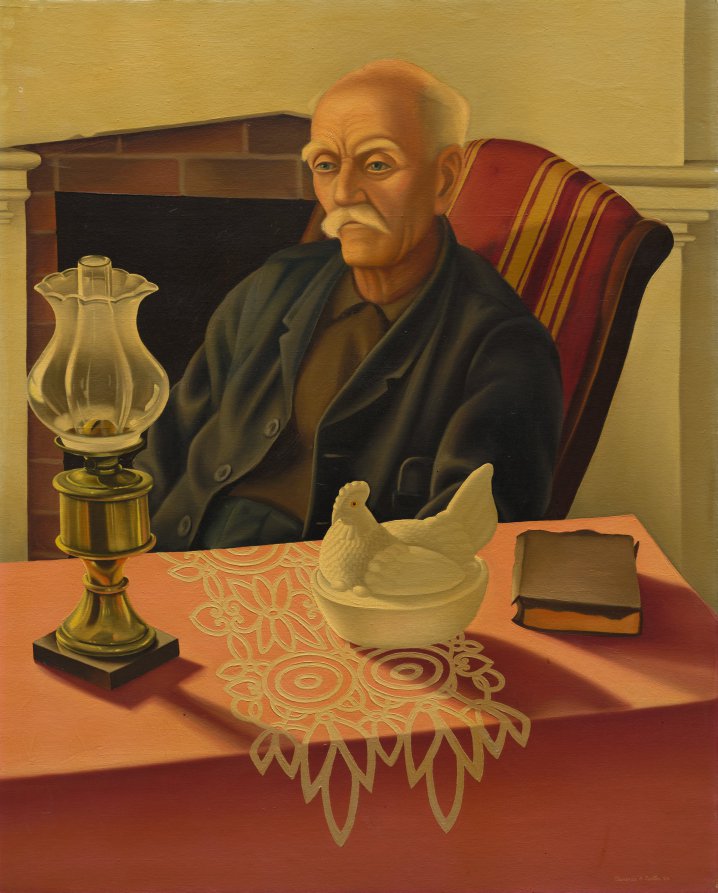
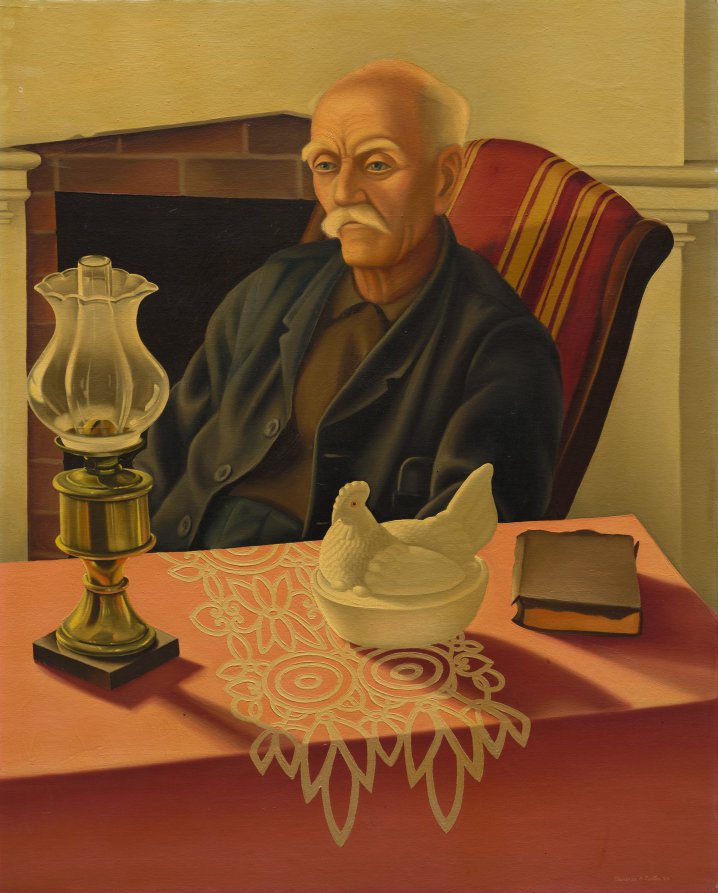
Portrait of Ezra Davenport, 1929
His paintings reward patience, and for collectors who have discovered him, they reward it abundantly. Carter grew up in Portsmouth at a moment when the Ohio River Valley was a place of real industrial energy and also of quiet rural beauty existing side by side. He studied at the Cleveland School of Art, where he received rigorous classical training, and later traveled to Europe, spending time in Italy and absorbing the lessons of Renaissance painting. That European apprenticeship left a lasting mark.
Carter returned to America with a heightened sense of compositional architecture, a devotion to the integrity of the picture plane, and a reverence for the way old masters had made light feel like a moral force. He brought all of that home to Ohio, and it changed how he looked at a factory wall or a woman sitting in a chair. In the late 1920s and through the 1930s, Carter came into his own as an artist working in the orbit of American Social Realism and Regionalism, movements that were then reshaping the national conversation about what art could and should depict. He was a peer and, in many ways, a quiet equal of painters like Charles Burchfield, who also worked from the Ohio region and shared Carter's sensitivity to the uncanny edges of everyday life.
Clarence Holbrook Carter
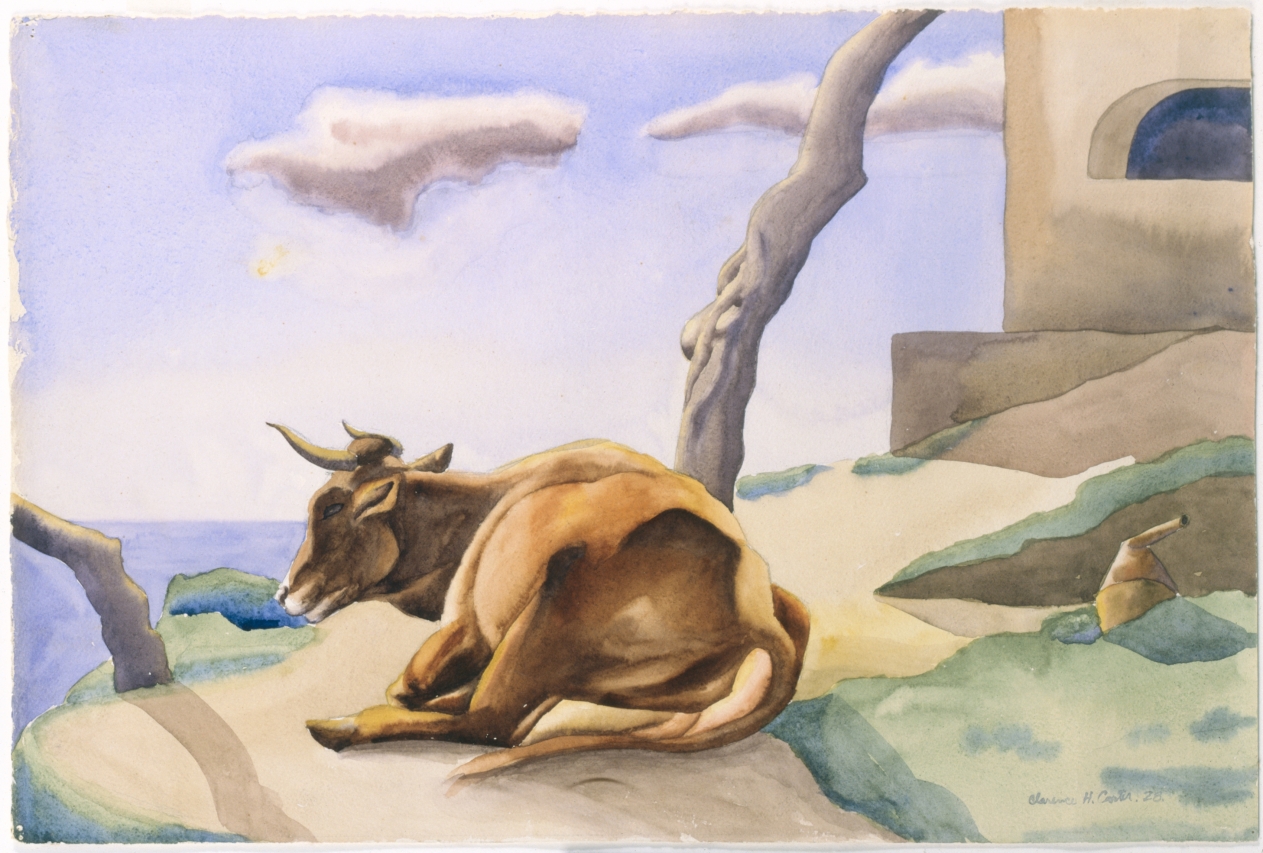
The Patient Cow, 1928
Like Grant Wood and Thomas Hart Benton, Carter believed that American subjects deserved the full weight of painterly attention. But his voice was distinctly his own: more restrained than Benton, more precise than Wood, and possessed of a melancholy lyricism that set him apart from nearly everyone working in his moment. The works from this early period reveal an artist already in command of his gifts. "The Patient Cow" from 1928, rendered in watercolor, demonstrates Carter's extraordinary ability to find dignity and even tenderness in the most modest rural subject.
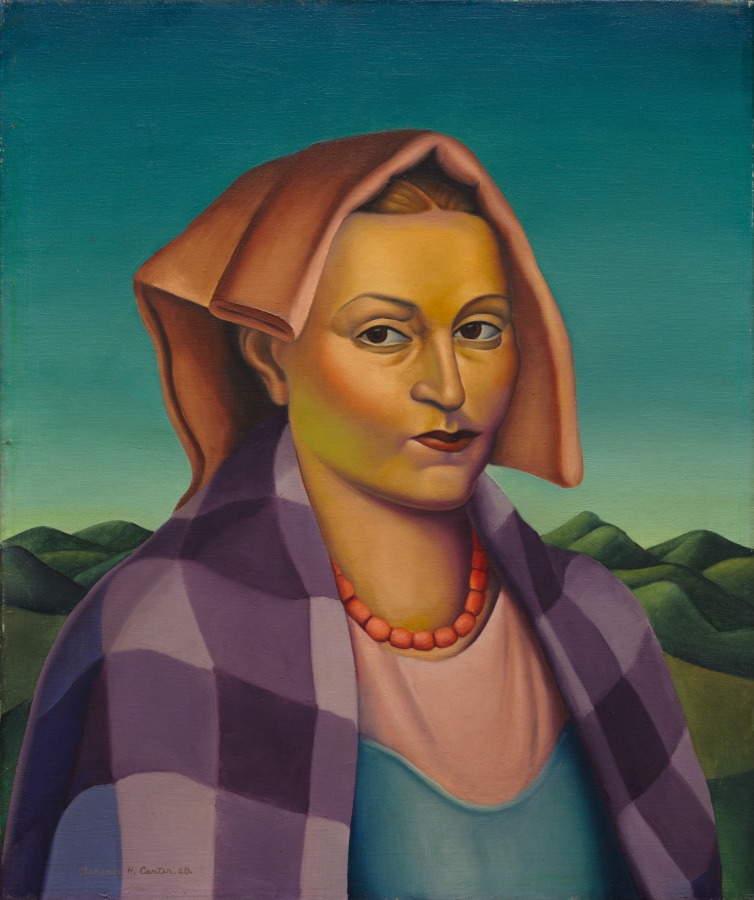
That same year he completed "A Woman of the Sabines," an oil on canvas that shows his European influences surfacing in an American idiom, classical in its pose and gravity, yet grounded in a specific, recognizable humanity. "Portrait of Ezra Davenport" from 1929 is perhaps the most striking of these early oils: a study in character rendered with the kind of unflinching attentiveness that recalls the great American portrait tradition running from Thomas Eakins forward. These are not decorative pictures. They are acts of witness.
Clarence Holbrook Carter
A Woman of the Sabines, 1928
By 1930, Carter was producing work like "Lake Erie Patterns," an oil on canvas that signals a fascinating turn in his thinking. Here the industrial and the natural begin to rhyme with one another, the surface of the lake parsed into geometric rhythms that anticipate the more abstracted directions his work would eventually take. The study for this painting, "Mysterious Lake Patterns, Lake Erie" from 1925, executed in watercolor with black chalk, shows Carter working through the problem with great sensitivity, feeling his way toward a visual language that could hold both documentary clarity and something closer to poetry. This tension between the observed and the imagined would define his practice for decades.
"Circus Horses" from 1933 carries a similar charge: the animals are entirely real, entirely present, and yet the painting breathes with a strangeness that lifts it beyond mere representation. Carter also worked extensively in printmaking, and his lithographs and screenprints represent a significant and sometimes underappreciated dimension of his achievement. Works like "Bauxite Factory, Suriname" demonstrate his willingness to travel, to seek out industrial subjects beyond American borders, and to bring the same concentrated visual intelligence to a Surinamese refinery that he brought to the Ohio landscape. "Concentric Space (Silver)," a screenprint of considerable formal sophistication, shows how far Carter traveled from his Regionalist origins without ever abandoning the underlying commitment to structured observation that made his early work so powerful.

Clarence Holbrook Carter
Concentric Space (Silver)
In his prints, the influence of his classical training fuses with a modernist awareness of flatness and pattern. For collectors, Carter represents an exceptionally compelling opportunity. He occupied a significant position in American art history without ever quite receiving the canonical recognition that some of his peers enjoyed, and that relative obscurity has kept prices accessible even as the quality of his work compares favorably with artists who command far greater attention at auction. Collectors drawn to American Scene painting, to the intersection of Social Realism and Modernism, or simply to pictures of genuine human warmth and technical excellence will find in Carter a reliable source of satisfaction.
Works on paper, including his watercolors and lithographs, offer a particularly inviting entry point, combining affordability with the full range of his visual intelligence. His oils, when they appear, are simply beautiful objects to live with. Carter belongs in a conversation that includes not only Burchfield and the Regionalists but also painters like Edward Hopper, who shared his interest in American light and American loneliness, and Raphael Soyer, who brought a similar tenderness to working class subjects. He was a product of his time and also, in the best sense, slightly ahead of it.
His late explorations of pattern and abstraction connect him to currents that were reshaping American painting in the postwar decades, suggesting that Carter was always listening carefully to what the moment required. He died in 1999, having worked as an artist for more than seven decades, a record of sustained creative engagement that very few painters of any generation can match. What Carter ultimately offers, to the viewer and to the collector alike, is something that art has always offered at its most essential: the feeling that another human being has looked at the world with great care and found it worthy of attention. His factories are not grim.
His working people are not objects of pity. His animals and his lakes and his circus scenes all carry the same generous, searching quality of regard. In an era when the American art of the mid twentieth century is being reconsidered with fresh eyes and genuine enthusiasm, Clarence Holbrook Carter stands as one of its most rewarding discoveries, an artist who repays every hour spent in his company.