Chuang Che
Chuang Che: Where Two Worlds Become One
Artist Spotlight · The Collection Editorial
There are artists who translate between cultures, and then there are artists who dissolve the boundary between them entirely. Chuang Che belongs to the rarer second category. Now in his tenth decade, the Taiwanese painter has spent more than sixty years building a body of work that feels simultaneously ancient and urgently alive, rooted in the ink soaked mountains of classical Chinese painting while reaching outward into the gestural freedoms that defined the most radical Western art movements of the twentieth century. His canvases have been shown across Taiwan, the United States, and Europe, and as global interest in postwar Asian modernism continues to accelerate, collectors and institutions are returning to his work with fresh attention and deepened appreciation.
Chuang Che
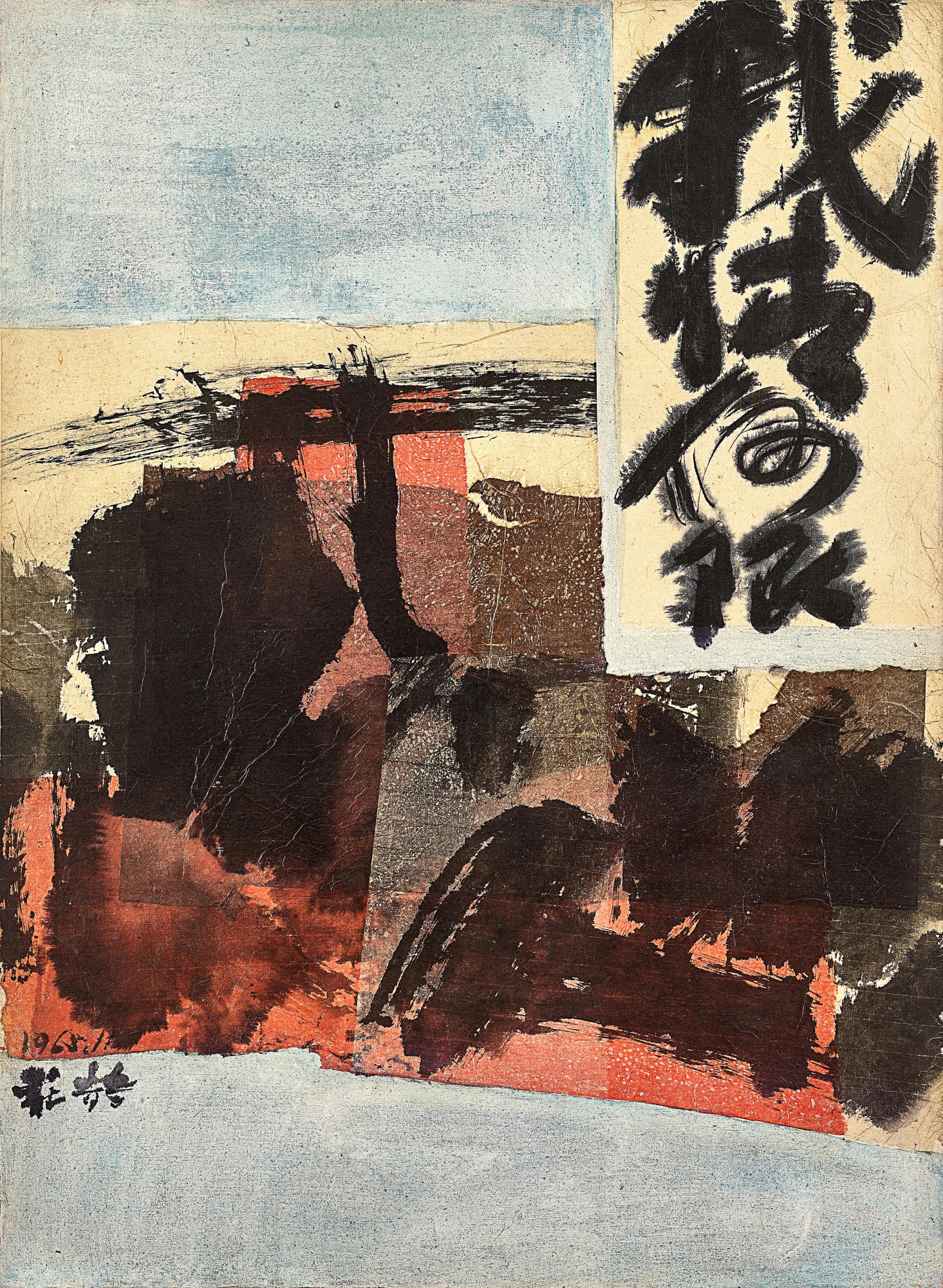
Unlimited Passion 我情何限, 1965
Chuang Che was born in Beijing in 1934, a child of a China on the edge of profound transformation. His early formation was grounded in traditional Chinese ink painting, a discipline that instills in its practitioners an understanding of breath, emptiness, and the relationship between mark and void that is entirely unlike anything in the Western academic tradition. When the political upheavals of the mid twentieth century reshaped the map of the Chinese speaking world, Chuang Che eventually settled in Taiwan, where he became part of a remarkable generation of artists grappling with questions of identity, modernity, and cultural inheritance. Taiwan in those postwar decades was a place of intense creative ferment, and Chuang Che found himself at the center of it.
His artistic development took a decisive turn when he traveled to the United States to study, encountering firsthand the raw ambition of the New York School. The abstract expressionists, with their insistence on the physical act of painting as a form of existential statement, resonated deeply with a painter already trained in the gestural traditions of Chinese calligraphy and ink work. Rather than simply adopting the vocabulary of painters like Franz Kline or Mark Rothko, Chuang Che understood that the most interesting conversation was not imitation but genuine dialogue. He brought to Western abstraction a spatial sensibility, a feeling for atmospheric depth and energetic stillness, that had no direct equivalent in the New York lofts where abstract expressionism had been born.
Chuang Che
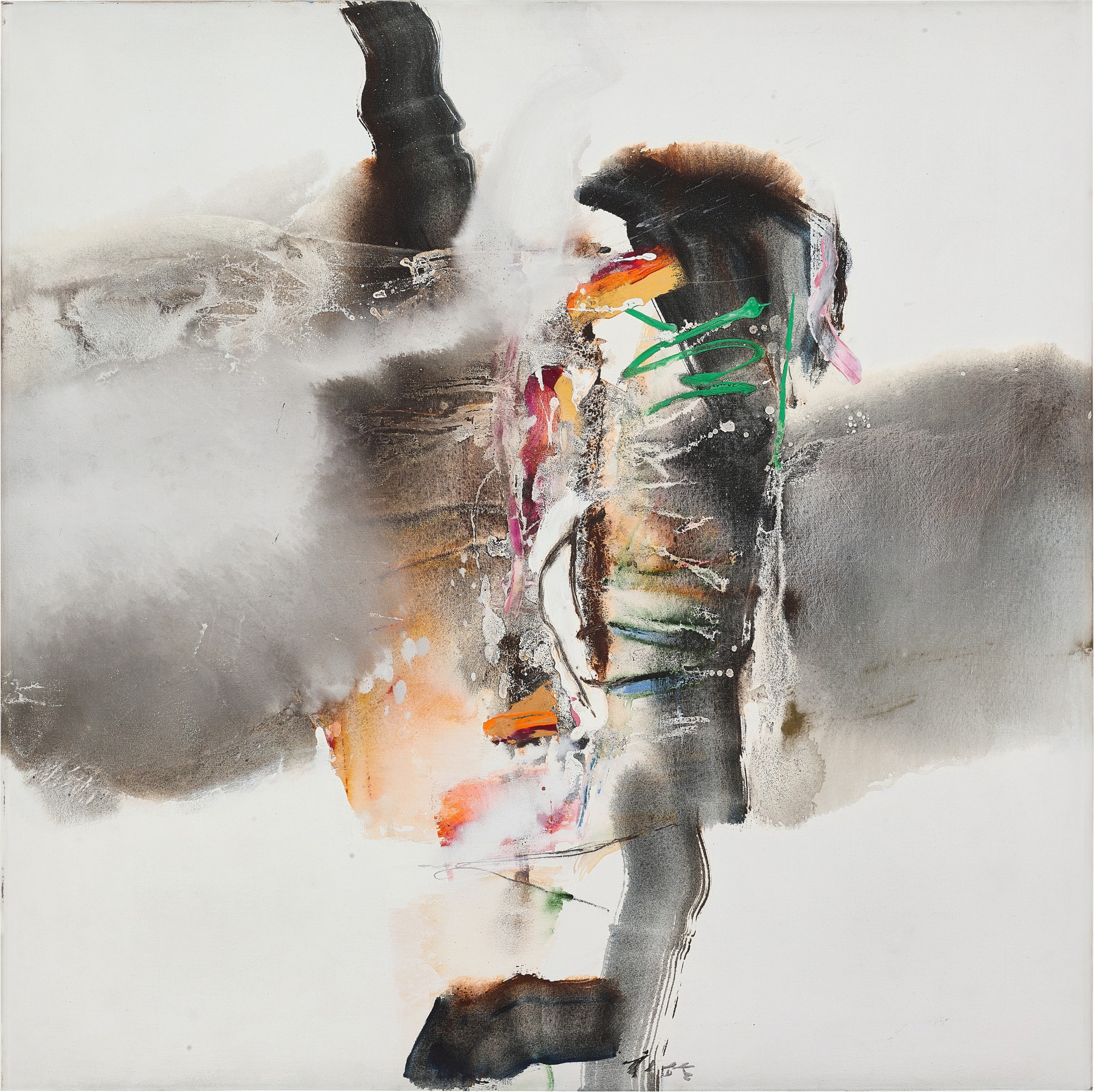
#4384
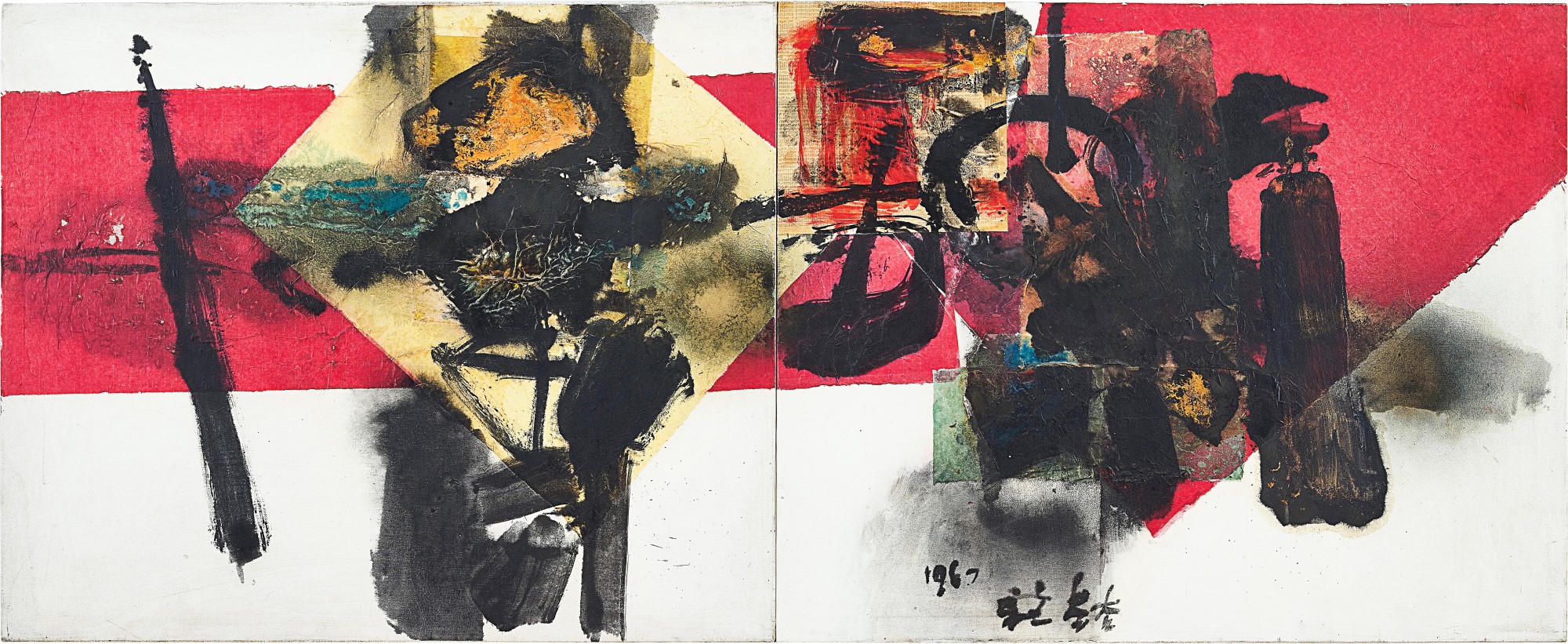
The result was a synthesis that felt neither derivative nor forced but genuinely new. The works from the 1960s represent some of the most electrifying moments in his career and in postwar Taiwanese art as a whole. "Unlimited Passion" from 1965 announces itself with an almost volcanic energy, its mixed media surface alive with layered gesture and chromatic intensity that reads as both spontaneous and deeply considered. "The Battle" from 1967, a diptych in mixed media on canvas, carries that same force but channels it into something more structural, the two panels in conversation with each other across the divide of the join, suggesting conflict and resolution simultaneously.
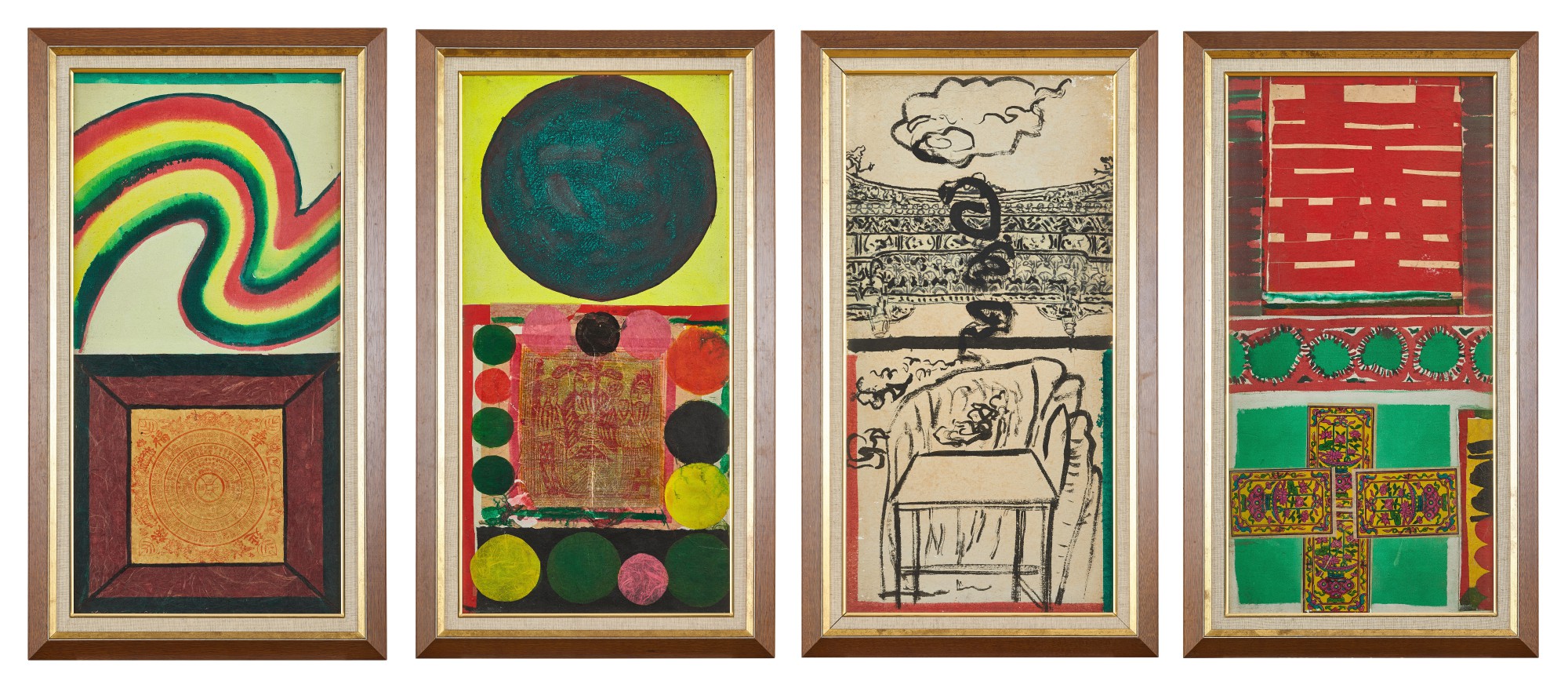
"Prosperity and Happiness" from 1968 draws on the symbolic vocabulary of Chinese tradition while refusing any nostalgic literalism, transforming cultural signs into pure pictorial event. These are paintings that reward sustained looking; they do not give themselves up quickly. Moving through the 1970s and into the 1980s, Chuang Che's work evolves with remarkable consistency of vision and breadth of exploration. "Landscape 74 to 12" from 1974 and the diptych "Landscape 76 to 65" from 1976 signal an increasingly explicit return to landscape as both subject and structure, though the landscape in question is always more philosophical than topographical.
Chuang Che
Prosperity and Happiness 福祿壽囍, 1968
By the time of "Fantasy Landscape No. 7" in 1980 and the canvases of the mid 1980s, including his "Landscape 1987" works executed in oil and acrylic, Chuang Che has achieved a kind of luminous equilibrium between action and contemplation. The surfaces carry memory, revision, and energy in equal measure. His later untitled works from the early 1980s demonstrate that even within an established signature language, he continued to push, question, and surprise himself.
For collectors, the appeal of Chuang Che operates on several levels at once. There is the purely visual pleasure of the work, which is considerable. But there is also the historical significance of what he represents: a bridge figure in the truest sense, someone whose practice genuinely transforms both traditions it draws from rather than merely sampling them. Collectors of postwar Asian modernism have increasingly come to understand that figures like Chuang Che occupy a position of art historical importance comparable to their Western contemporaries.
Chuang Che
The Battle 戰役, 1967
In terms of what to look for, the works of the 1960s carry particular intensity and rarity, while the landscape paintings of the 1970s and 1980s offer extraordinary depth and meditative quality. Mixed media works on canvas demonstrate his willingness to push beyond the boundaries of any single medium, and the diptych format recurs as a meaningful structural choice rather than a merely decorative one. To place Chuang Che in art historical context is to understand how rich and interconnected the global conversation around abstraction truly was in the postwar decades. His synthesis of Eastern and Western impulses aligns him, in spirit if not always in direct influence, with artists such as Zao Wou Ki, the Chinese French painter who similarly built a bridge between ink tradition and lyrical abstraction, and with Walasse Ting, another figure who moved fluidly between cultural worlds.
Within Taiwan specifically, he stands alongside the artists associated with the Fifth Moon Group, the landmark collective founded in 1957 that brought Taiwanese modernism into international dialogue. Understanding Chuang Che means understanding that the story of twentieth century abstraction was never solely a Western story. The legacy of Chuang Che is still being written, and that is part of what makes engaging with his work so compelling at this particular moment. As museums and auction houses worldwide deepen their focus on postwar art from Taiwan, Hong Kong, and the broader Chinese diaspora, his contribution is being reassessed with the seriousness it has always deserved.
He represents something essential: the possibility of holding two vast traditions in a single vision without betraying either, and of finding in that tension not conflict but extraordinary creative freedom. For anyone building a collection with genuine historical intelligence and aesthetic ambition, his paintings are not simply desirable objects. They are a form of understanding.