Christiane Baumgartner
Christiane Baumgartner: Where Time Becomes Visible
Artist Spotlight · The Collection Editorial
In the spring of 2023, visitors to the Kunsthalle Bremen found themselves standing before woodblock prints of extraordinary scale and stillness. Christiane Baumgartner's works filled the room with the quiet authority of images that had been coaxed, line by line, from sheets of wood and then pressed onto delicate Japanese paper. The effect was paradoxical in the best possible way: images born from digital video footage, rendered through one of the oldest printmaking traditions in human history, somehow felt more alive, more urgent, than the frictionless screens they had originated from. For those who had not yet encountered Baumgartner's practice, it was a revelation.
Christiane Baumgartner
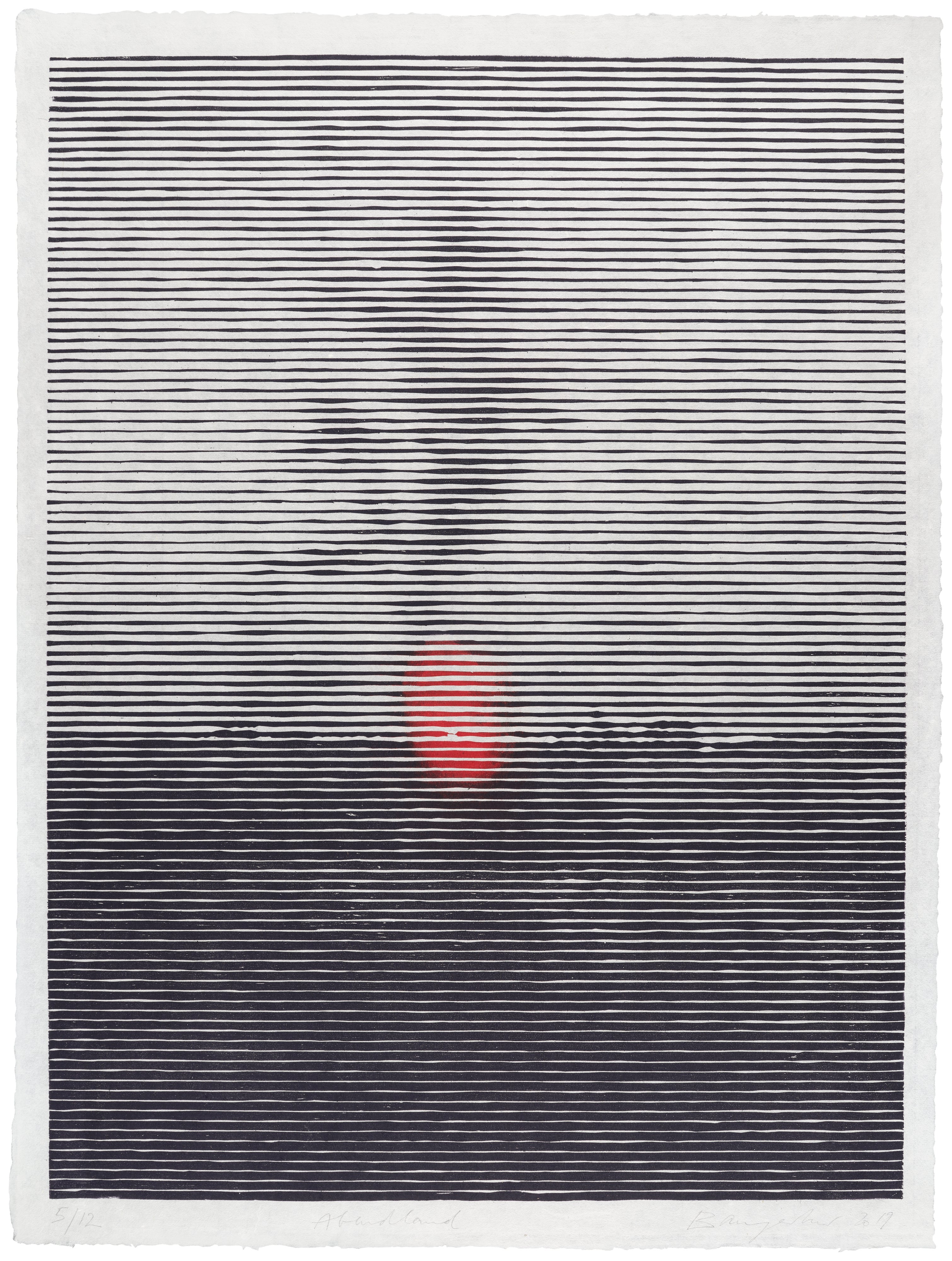
Abendland
For those who had followed her career across two decades, it was confirmation of something they had long understood: this is one of the most quietly radical artists working today. Baumgartner was born in Leipzig in 1967, in what was then East Germany, a biographical fact that resonates quietly through her entire practice. Growing up in a society where the flow of images and information was carefully managed and controlled, she developed an acute sensitivity to the ways in which technology mediates experience. After German reunification opened new possibilities, she pursued her artistic education with serious commitment, eventually studying at the Hochschule für Grafik und Buchkunst in Leipzig, an institution with a formidable printmaking tradition.
She later refined her practice through residencies and study in the United Kingdom, including a period at the Royal College of Art in London, where engagement with international contemporary art expanded both her ambition and her conceptual vocabulary. The central move of Baumgartner's practice is deceptively simple to describe and extraordinarily difficult to execute. She begins with video footage, often shot from a moving vehicle or aircraft, capturing the world as it rushes past in blurred, pixelated motion. She then isolates individual frames from this footage and translates them, by hand, into woodcut prints.
Christiane Baumgartner
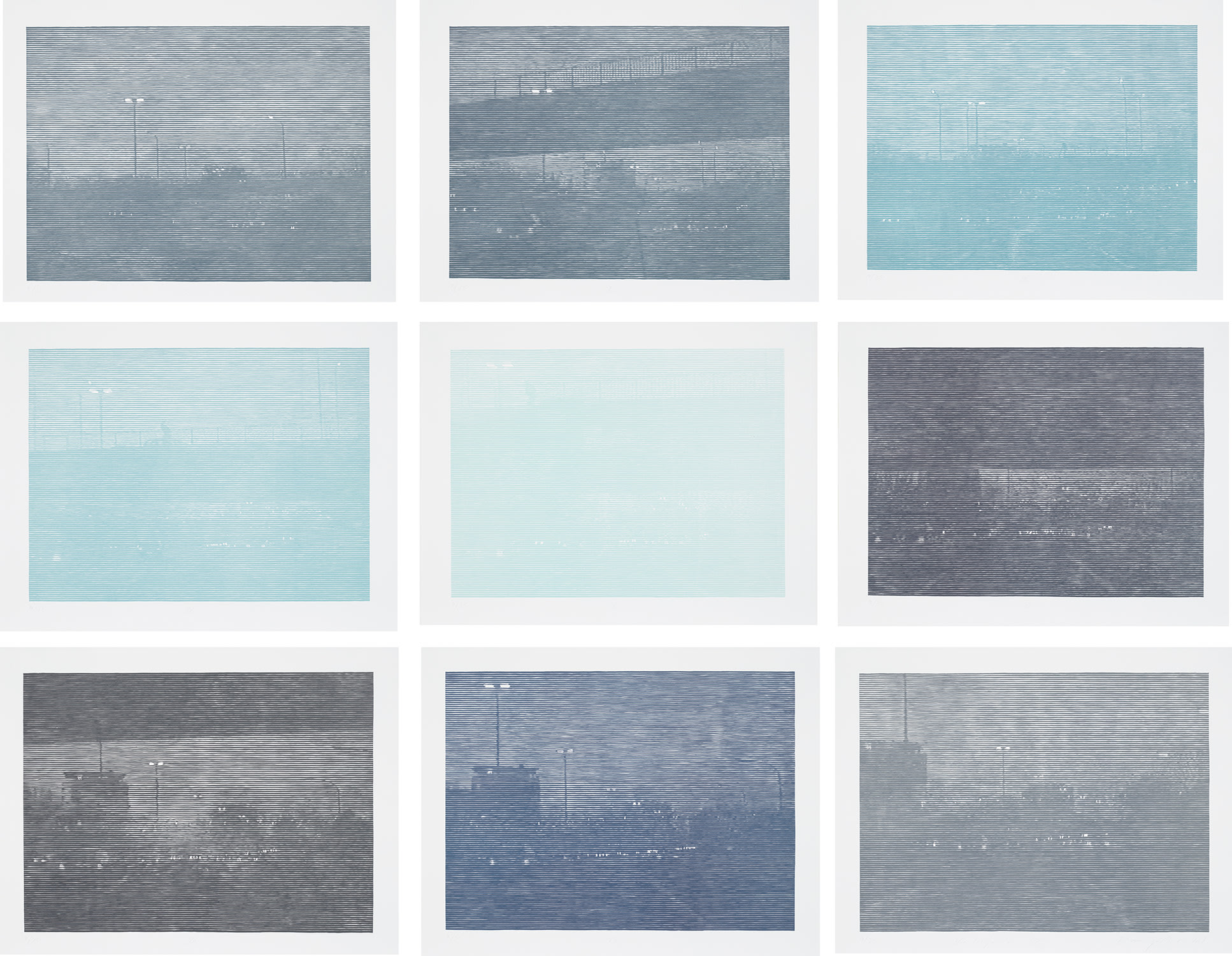
Nachtfahrt (Night Drive)
Every line, every grain of static, every artifact of compression is carved directly into the wood. The process is monastic in its demands, requiring weeks or months for a single large work. What emerges is a print that carries within it the ghost of movement, the texture of digital noise rendered as physical mark, the memory of speed translated into patient stillness. It is a practice that refuses the easy separation of old and new, analog and digital, fast and slow.
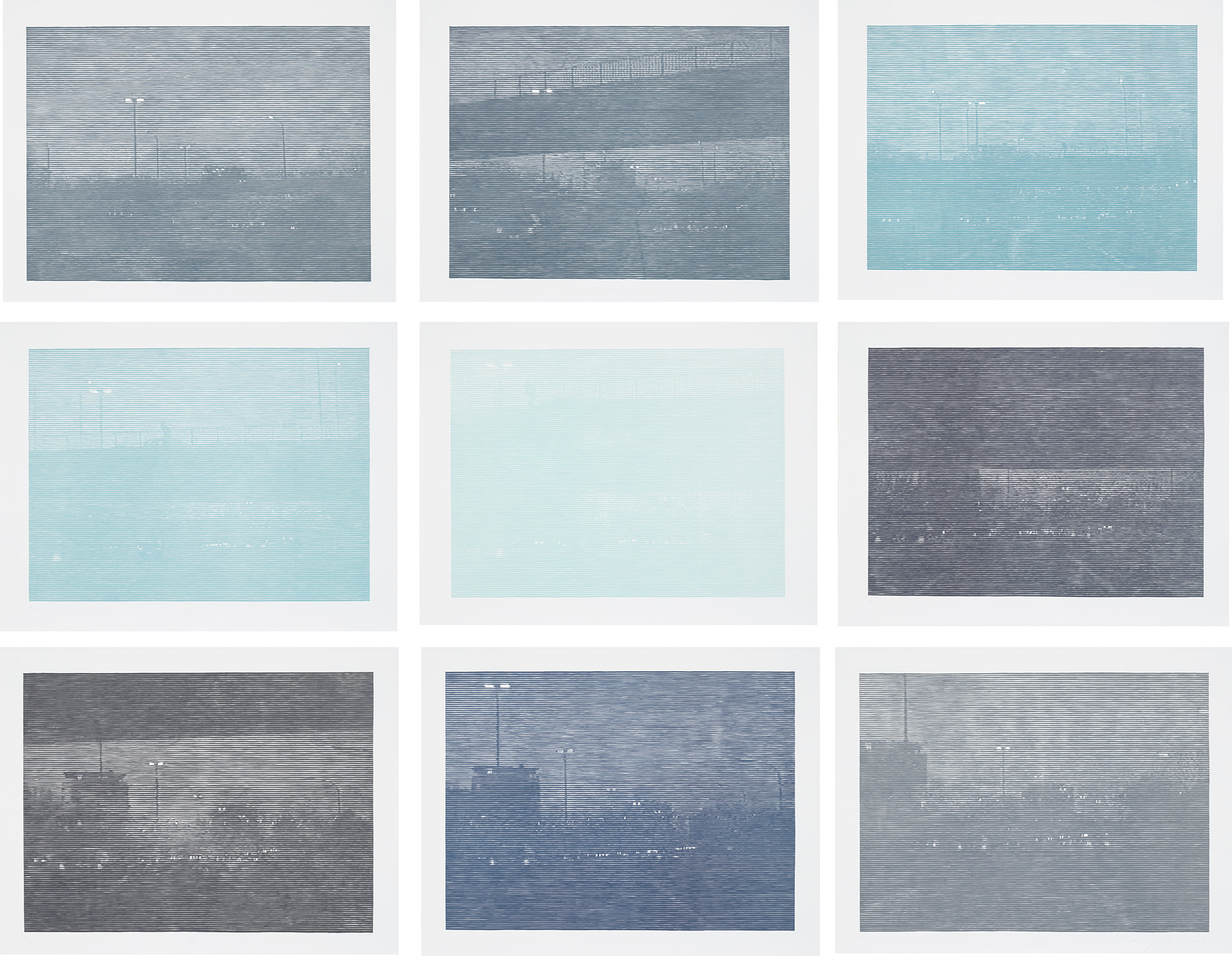
Among the works that have defined Baumgartner's reputation, Nachtfahrt, or Night Drive, stands as one of the most celebrated. This suite of prints captures the experience of moving through a nocturnal landscape, the world reduced to streaks of light and swelling darkness, rendered with a technical mastery that astonishes viewers familiar with the demands of woodblock carving. Abendland, whose title translates roughly as Western World or Evening Land, carries an almost elegiac quality, the pixelated grain of the original video transformed into something resembling the texture of memory itself. The series Schkeuditz, named after the area surrounding Leipzig's airport, draws on footage of aircraft and infrastructure, finding unexpected poetry in transit and displacement.
Christiane Baumgartner
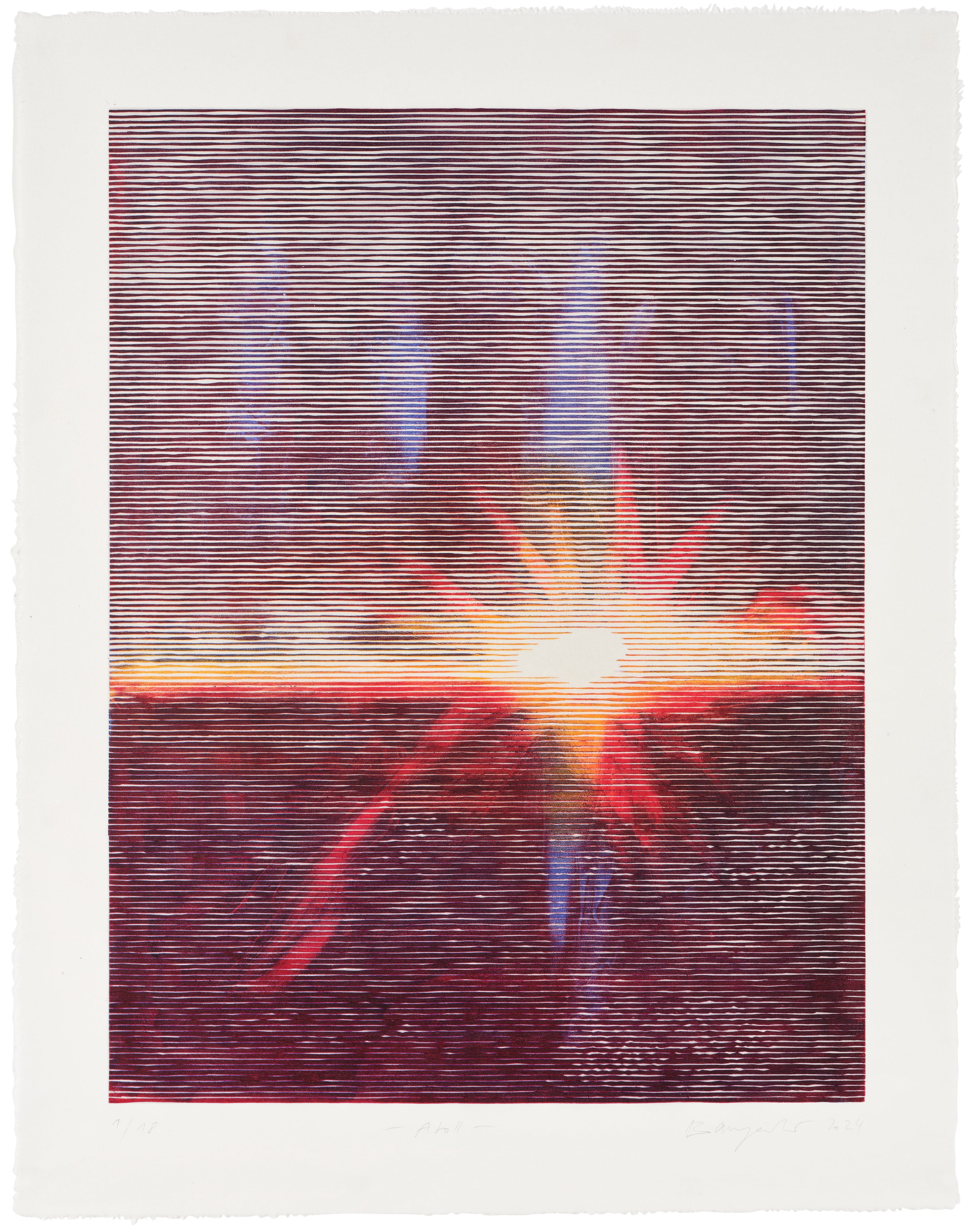
Atoll
And Manhattan Transfer, printed on Kozo paper in monochrome, brings her characteristic sensibility to the dense visual energy of the New York cityscape, the horizontal blur of motion rendered with remarkable precision and warmth. For collectors, Baumgartner's work offers something rare in contemporary art: a practice that is at once intellectually rigorous and viscerally beautiful, conceptually ambitious and grounded in extraordinary craft. Her prints exist in carefully limited editions, with each impression hand printed and supervised by the artist, and many works have been published by the artist herself or by respected specialist publishers including Johan Deumens in Haarlem and Carivari in Leipzig. The editions are typically small, often ten or twenty five impressions, and works from key series are now held in significant institutional collections across Europe and North America.
Collectors who have followed her career from its earlier stages have watched with satisfaction as her market has grown steadily, driven by genuine critical recognition rather than speculative enthusiasm. The materials she chooses, including Shiohara Japanese paper and Kozo paper, are themselves objects of beauty, and they lend her prints a physical presence that reproduces poorly and rewards close looking enormously. Within the broader landscape of contemporary printmaking, Baumgartner occupies a singular position. Her work invites comparison with artists who have used mechanical or photographic imagery as raw material for handmade work: one thinks of Gerhard Richter's engagement with photography, or the way that Sigmar Polke explored the dot matrix and grain of mass media imagery.
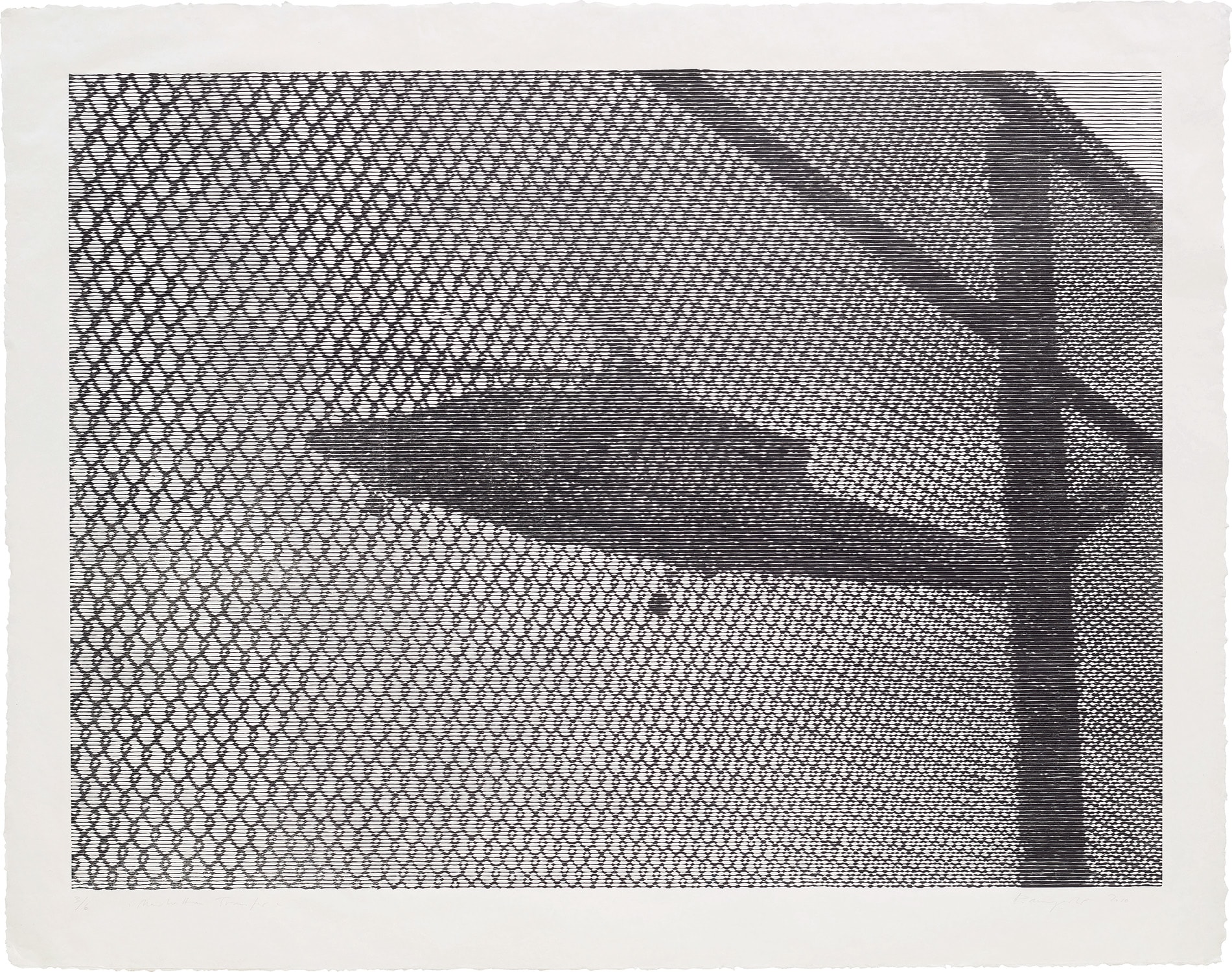
Christiane Baumgartner
Manhattan Transfer
But Baumgartner's commitment to the woodcut as her primary medium gives her practice a distinctly different character, one rooted in a tradition that stretches back to Albrecht Dürer and the great German printmakers of the Renaissance. She is also in conversation with a generation of artists who have interrogated the nature of the moving image, including those working in video and film, though she arrives at her conclusions through the most tactile and time consuming of means. Her work sits beautifully alongside that of other artists who explore landscape, motion, and perception, and collectors who are drawn to the meditative quality of her prints often find affinities with the work of photographers and painters exploring similar questions about how we see the world in motion. What makes Baumgartner's work so enduring is its refusal to resolve the tensions it creates.
Her prints do not celebrate technology or mourn the analog past. They hold both in suspension, honoring the hand and the algorithm equally, finding in their collision something that neither could produce alone. At a moment when the question of how we relate to the torrent of images produced by our devices has never felt more pressing, her patient, exacting, deeply human practice offers not an answer but something more valuable: a new way of looking. To live with a Baumgartner woodcut is to be reminded, daily, that slowness and attention are themselves a form of resistance, and that beauty can be found precisely at the point where the digital world is forced to stop and submit to the pressure of a human hand.