Chiho Aoshima
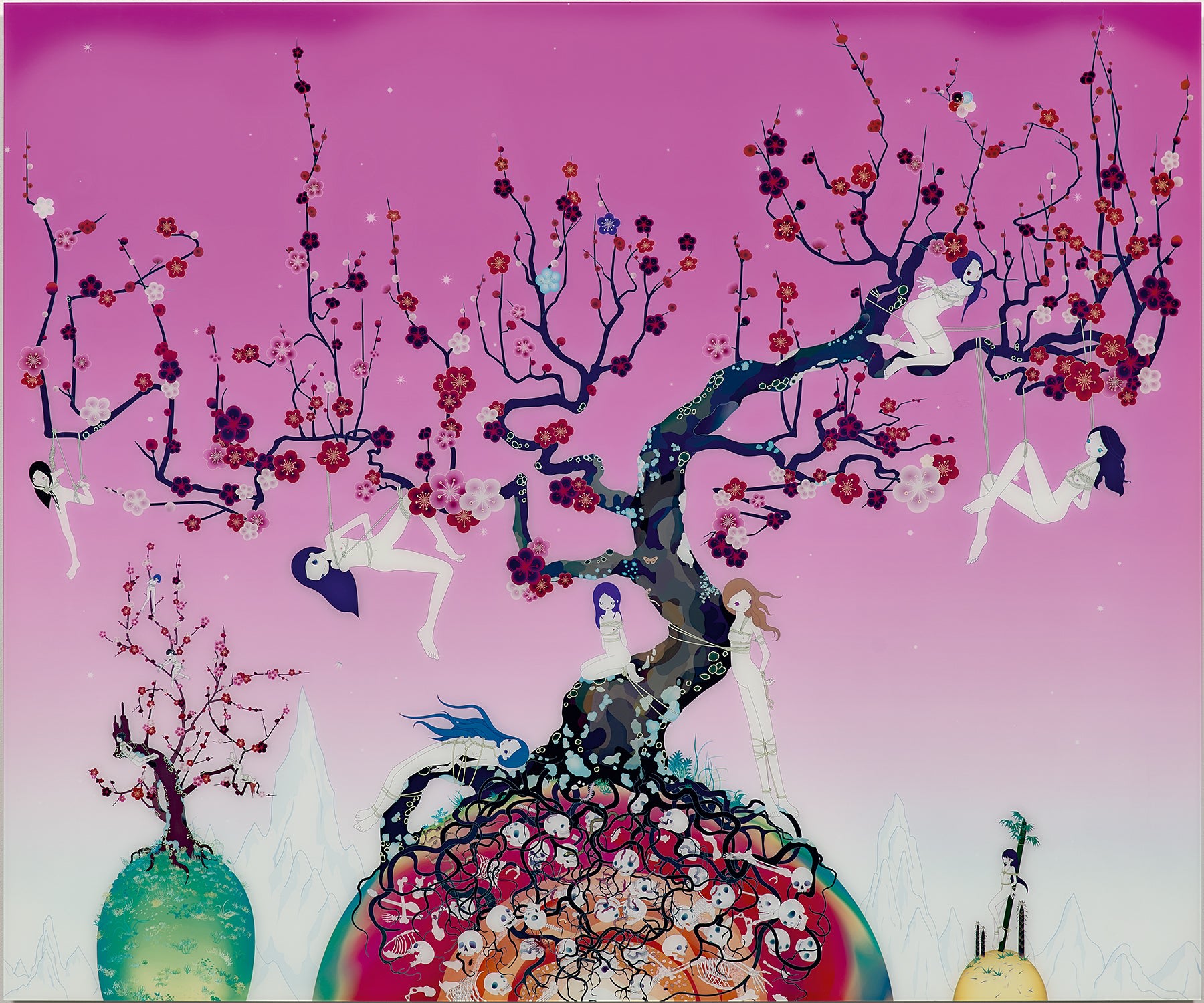
Chiho Aoshima: Where Dream Worlds Bloom
Artist Spotlight · The Collection Editorial
When the Museum of Contemporary Art Los Angeles opened its doors to Chiho Aoshima's large scale digital installations, visitors found themselves standing inside something that felt less like a gallery and more like a vision glimpsed at the edge of sleep. Luminous girls drifted through landscapes of impossible color. Spirits pressed through ancient forest floors. The work was at once deeply rooted in Japanese visual tradition and entirely, unmistakably contemporary.
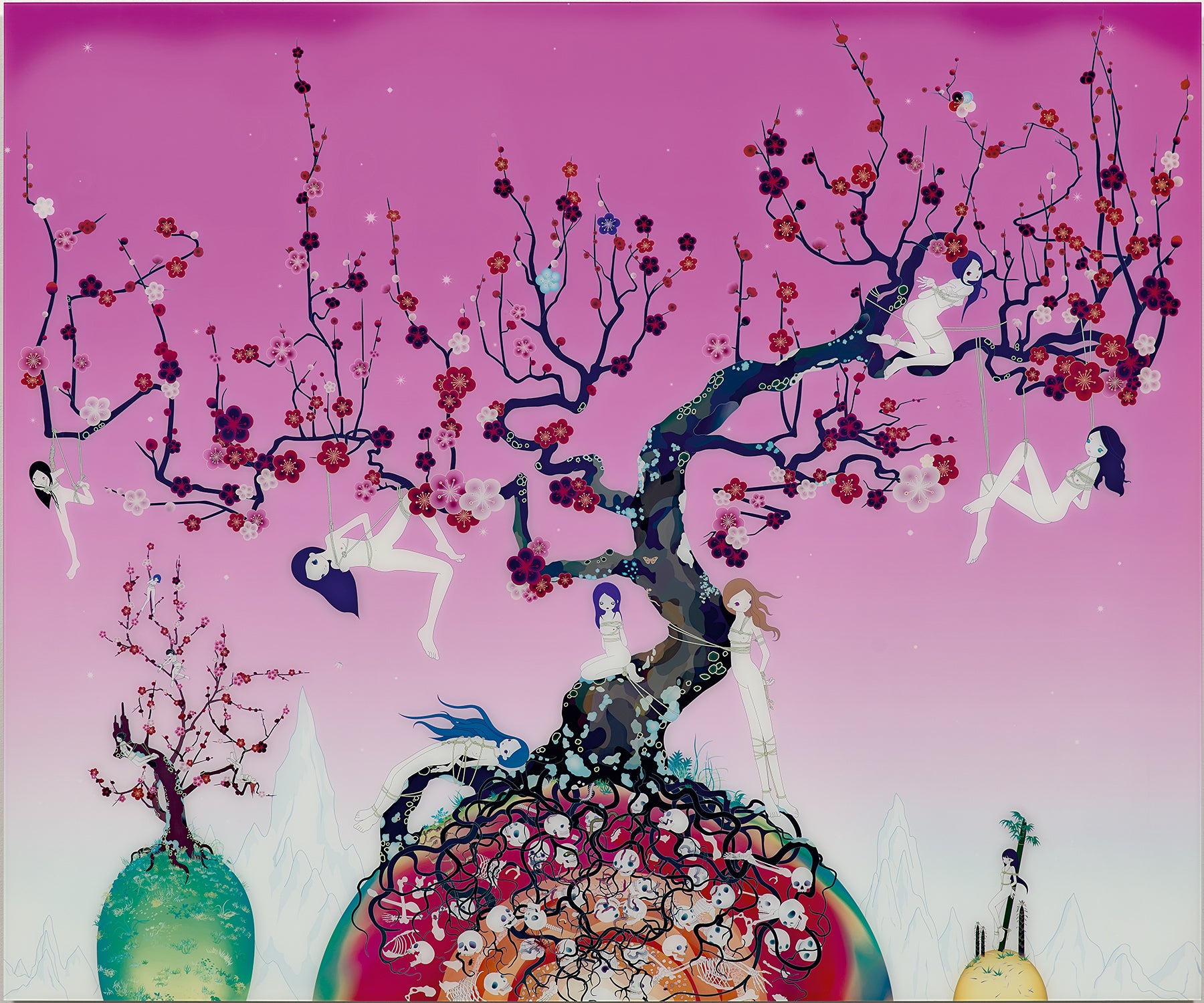
Chiho Aoshima
digital print mounted under Plexiglass, 2007
It was the kind of encounter that reminds you why art still has the power to alter the atmosphere of a room. Aoshima was born in Tokyo in 1974, coming of age during a period of extraordinary cultural ferment in Japan, when manga, anime, and digital technology were reshaping the visual imagination of an entire generation. Unlike many artists whose paths lead through formal fine arts academies, Aoshima's training was rooted in economics, which she studied before finding her way to the studio through the singular gravitational pull of Takashi Murakami. She joined his Kaikai Kiki collective in the late 1990s, entering a creative environment that demanded both technical rigor and an expansive sense of artistic possibility.
The studio became her laboratory and her academy at once. The Kaikai Kiki context is essential for understanding how Aoshima developed her practice, but it would be a mistake to read her work as simply a product of that environment. From early on she brought something distinctly her own to the digital canvas: a preoccupation with the liminal space between the living and the dead, between the ancient landscape and the contemporary body, between innocence and something far more complex lurking just beneath its surface. Her early works from around 1999 already show the visual architecture that would define her career, buildings rendered with the flat precision of graphic design yet pulsing with an inner life that feels genuinely otherworldly.
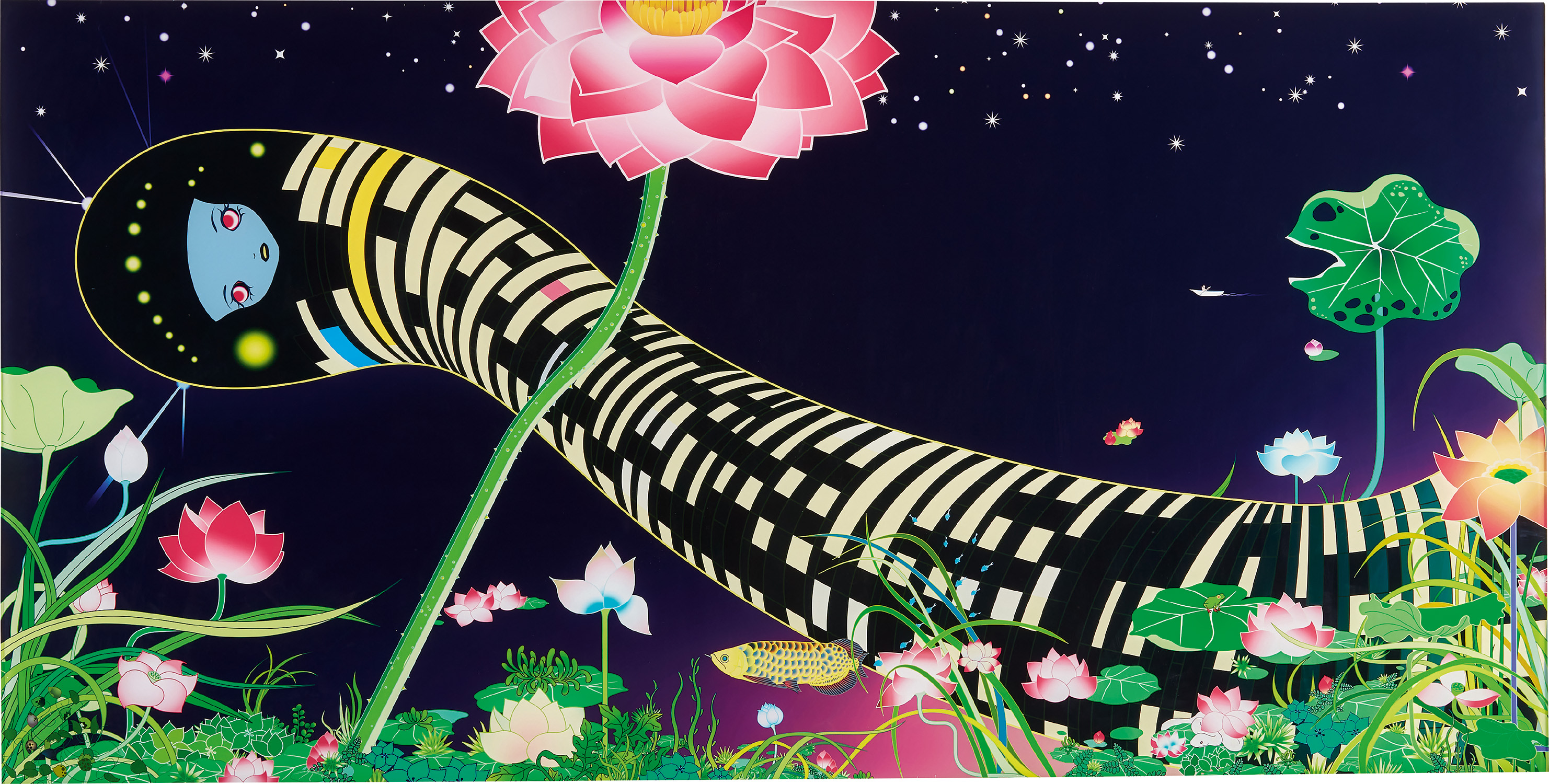
Chiho Aoshima
Building of the Lotus Pond, 2005
Aoshima works almost exclusively in digital media, building her images entirely on computer before outputting them as large format prints, often mounted under Plexiglas or face mounted to acrylic in ways that give the surface a luminous, jewel like depth. The chromogenic print and Diasec mounting techniques she favors are not merely technical choices but aesthetic ones: they give her work a glow that feels sourced from within the image rather than reflected from without. Works like Sublime Grave Dweller Shinko from 2004 and Building of the Lotus Pond from 2005 demonstrate this quality with particular clarity, their colors hovering in that exquisite register between the saturated and the delicate that is almost impossible to achieve through traditional printmaking. The 2007 Japanese Apricot series, with its cascading blossoms rendered in tones of deep pink and pale gold, represents perhaps the fullest expression of her ability to translate classical Japanese aesthetic sensibility into a digital idiom without losing any of its emotional resonance.
What distinguishes Aoshima from her peers working in similar territory is the way she holds disparate cultural registers in productive tension without ever forcing a resolution between them. Her girls, those recurring figures who drift through ruined cities and spirit filled landscapes, carry traces of the kawaii visual culture that permeates contemporary Japanese popular art, yet they are never merely cute. They mourn, they witness, they inhabit a world where the boundary between the living and the dead is experienced as geography rather than metaphysics. This is deeply traditional Japanese territory: the Buddhist notion of the spirit world pressing against the material one, the Shinto understanding of landscape as sacred and inhabited.
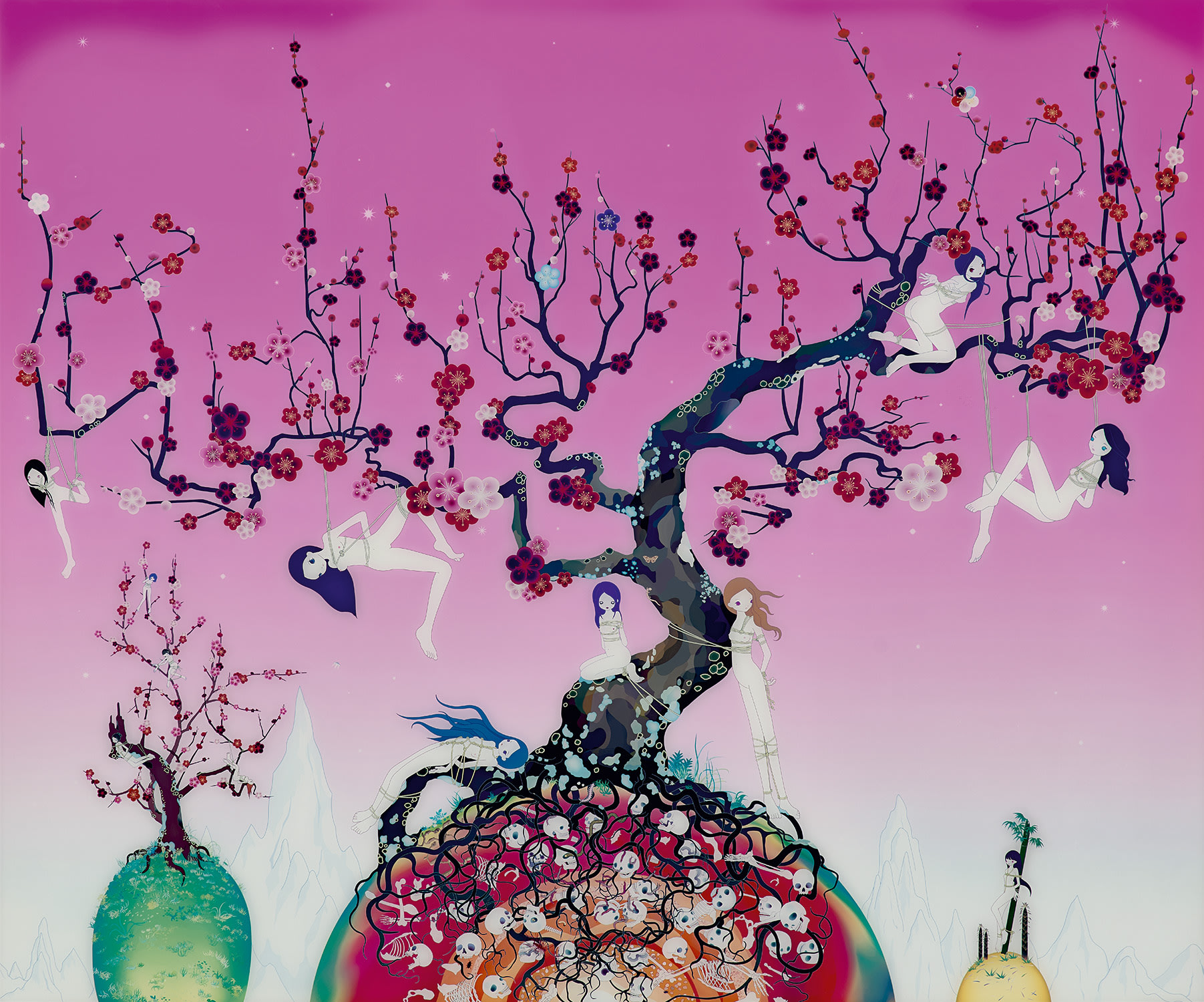
Chiho Aoshima
digital print mounted under Plexiglas, 2007
Aoshima navigates this territory with the assurance of someone who has absorbed it as lived culture rather than borrowed reference. For collectors, Aoshima's work presents a compelling and in many ways underrecognized opportunity. Her editions, produced in controlled numbers and typically available through established channels associated with the Kaikai Kiki network and select gallery partners, have maintained steady collector interest since the mid 2000s. Works from her Building series and her chromogenic print editions from the early to mid 2000s represent a particularly strong entry point, combining historical significance within her practice with the visual impact necessary to anchor a room.
The three dimensional work Rinko Chan on the Building, incorporating FRP, resin, acrylic, fabric, and LED lights, points toward the sculptural and installation dimension of her practice that remains less widely collected and arguably undervalued relative to her flat works. As institutional interest in the broader Superflat movement continues to deepen among major museums globally, artists like Aoshima who helped define its emotional and spiritual register are receiving renewed and well deserved critical attention. Aoshima belongs to a generation of Japanese artists who transformed the conversation about what digital art could be and feel. In the broader context of contemporary art history, her work sits in illuminating dialogue with artists across multiple traditions: with Yoshitomo Nara, whose similarly charged images of young girls carry emotional weight far exceeding their apparently simple surfaces; with the long lineage of Japanese printmaking running from Hiroshige through to the present; and with Western artists working in digital and installation modes who have sought to give technological processes genuine poetic charge.
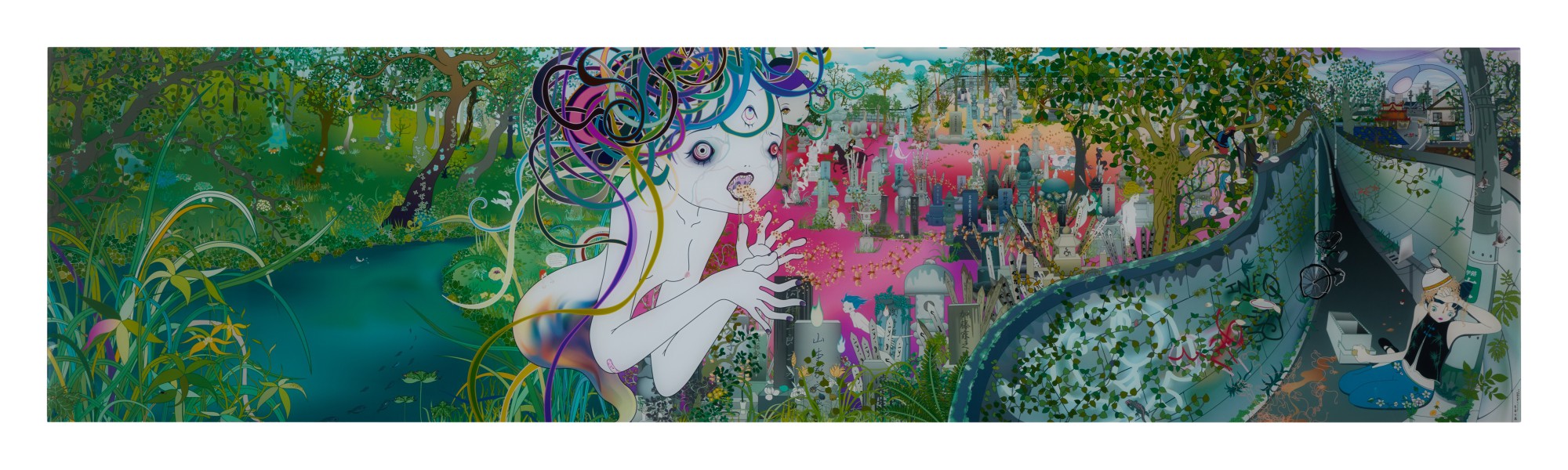
Chiho Aoshima
Sublime Grave Dweller Shinko, 2004
She has exhibited at institutions including the Asia Society, and her work has entered significant collections on multiple continents. The Gushing Zombies chromogenic print and The Fountain of the Skull demonstrate that her vision has never shied from confronting mortality directly, giving her body of work a philosophical coherence that separates it from artists content to dwell only in the beautiful. There is a tendency in some critical quarters to discuss artists associated with the Superflat movement primarily through the lens of their relationship to Murakami, and this tendency does a quiet disservice to artists like Aoshima who have built genuinely autonomous practices with their own internal logic and emotional vocabulary. Her work is a sustained meditation on what it means to inhabit a world where ancient spirits and digital screens coexist, where the feminine body is both vulnerable and cosmically powerful, where beauty and grief are not opposites but close companions.
That meditation has been unfolding across more than two decades now, and it shows no signs of losing either its urgency or its grace. For collectors drawn to work that is simultaneously visually extraordinary and intellectually rich, Chiho Aoshima represents one of the most rewarding discoveries contemporary art has to offer.
Explore books about Chiho Aoshima