Chen Yingjie
Hua Tunan Paints the World Alive
Artist Spotlight · The Collection Editorial
In recent years, the walls of cities from Hong Kong to Paris have come alive with cascading ink, animal forms that seem to breathe, and bursts of color that stop pedestrians mid stride. The artist responsible, Chen Yingjie, better known by his alias Hua Tunan, has quietly become one of the most compelling figures working at the intersection of Eastern artistic tradition and contemporary urban expression. His large scale murals have drawn audiences who may never set foot in a gallery, while his canvases have earned the attention of serious collectors who recognize in his work something rare: a genuinely new visual language built from centuries of inherited wisdom. Chen Yingjie was born in 1989 in China, coming of age during a period of extraordinary cultural transformation.
Chen Yingjie
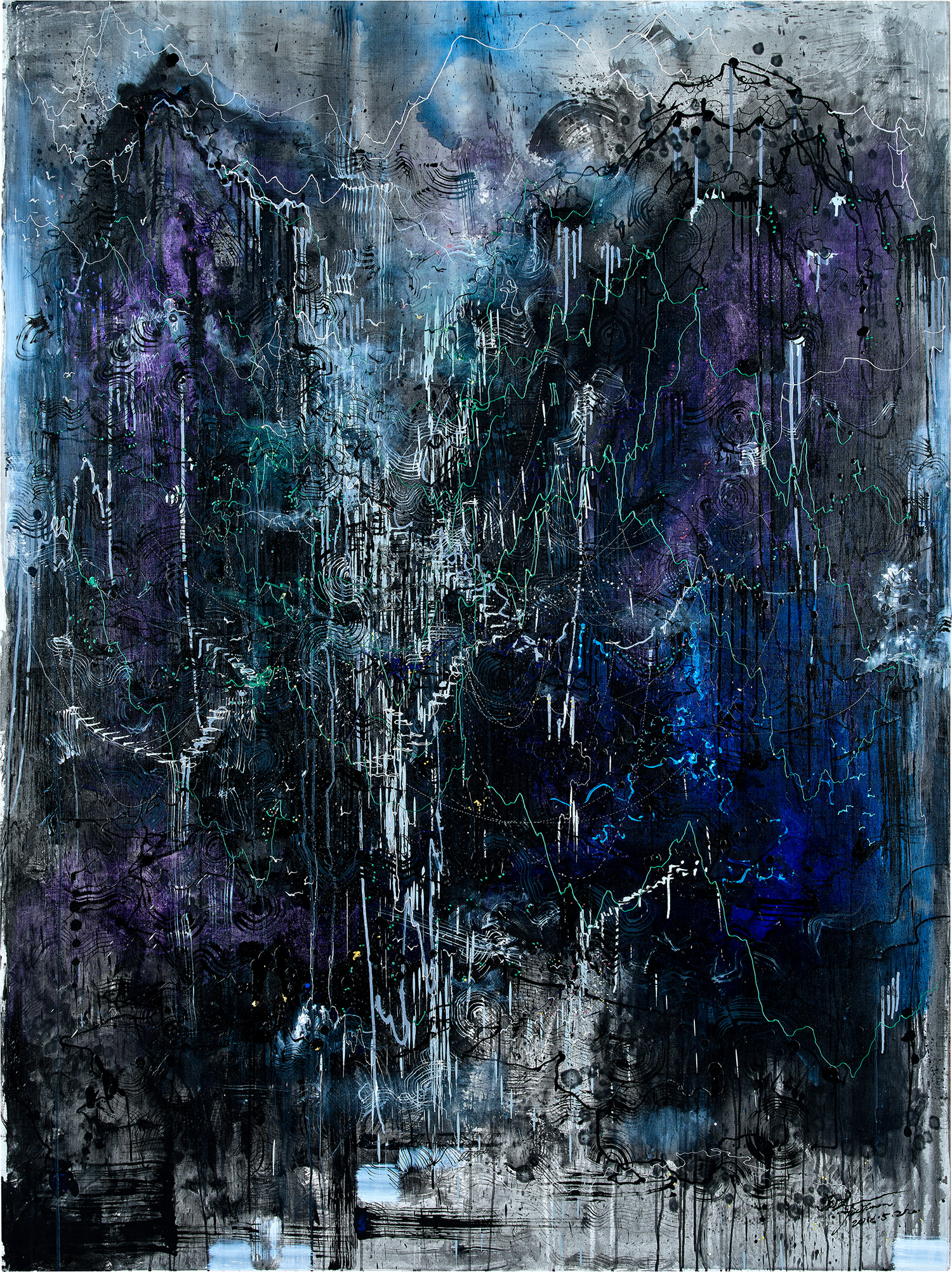
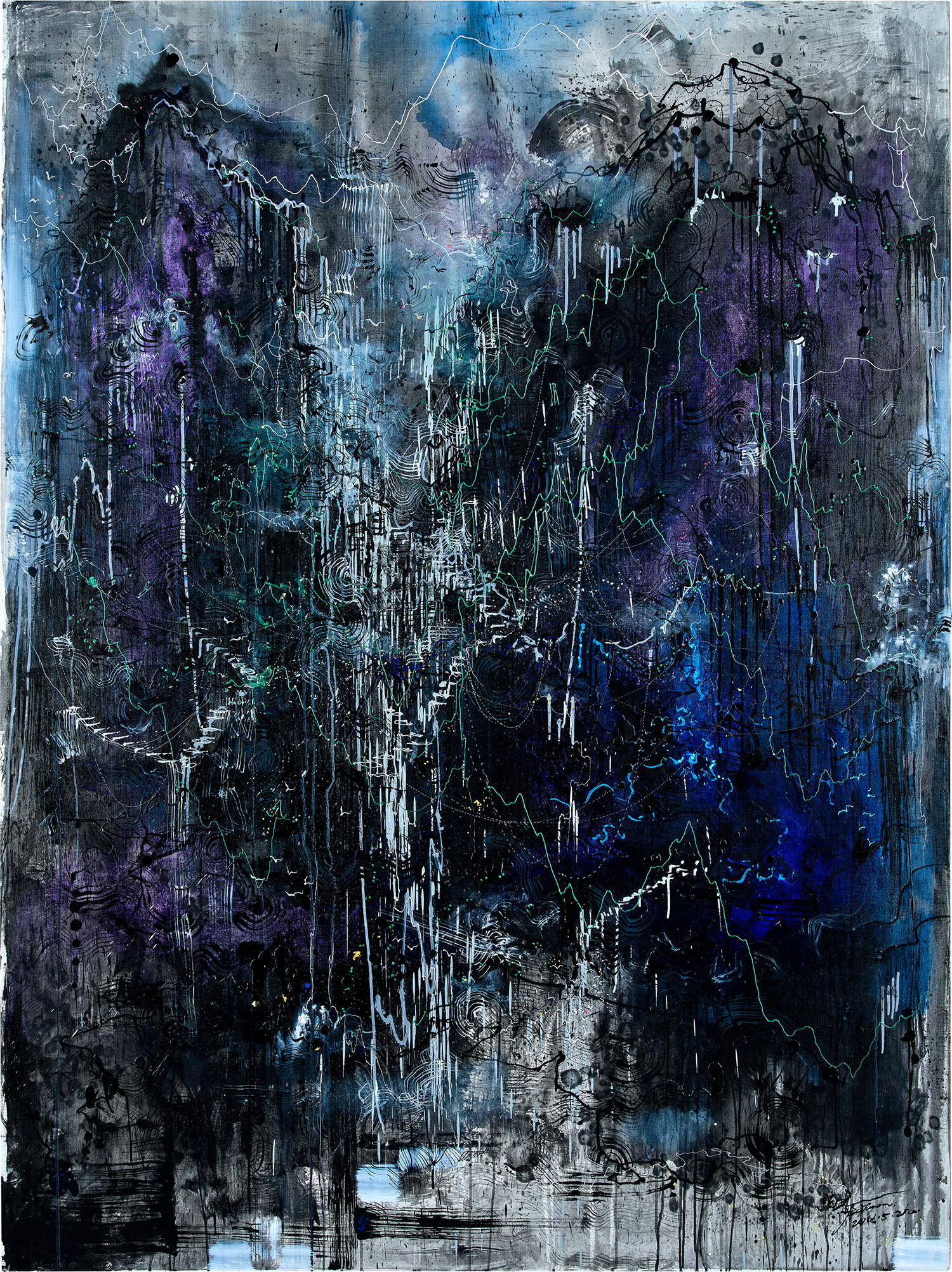
Natural Stigma, 2018
The China of his youth was simultaneously looking inward, rediscovering classical traditions, and opening outward toward global influences in art, music, and youth culture. He trained in fine arts with a grounding in traditional Chinese ink painting, a discipline that demands not only technical precision but a philosophical relationship with the brush, the ink, and the space of the page. That foundation proved essential. Rather than abandoning it in pursuit of contemporary relevance, Chen absorbed it so thoroughly that it became the engine of everything that followed.
The alias Hua Tunan, which can be loosely understood as a nod to painting and the south of China, signals the duality at the heart of his identity as an artist. He encountered graffiti and street art culture as a young man and found in it not a contradiction to his classical training but a continuation of the same fundamental impulse: to mark a surface with urgency, to make something that feels alive in the moment of its creation. Where traditional ink painters spoke of the vital energy flowing through the brush, street artists spoke of style, movement, and presence. Chen recognized these as the same conversation conducted in different dialects.
Chen Yingjie
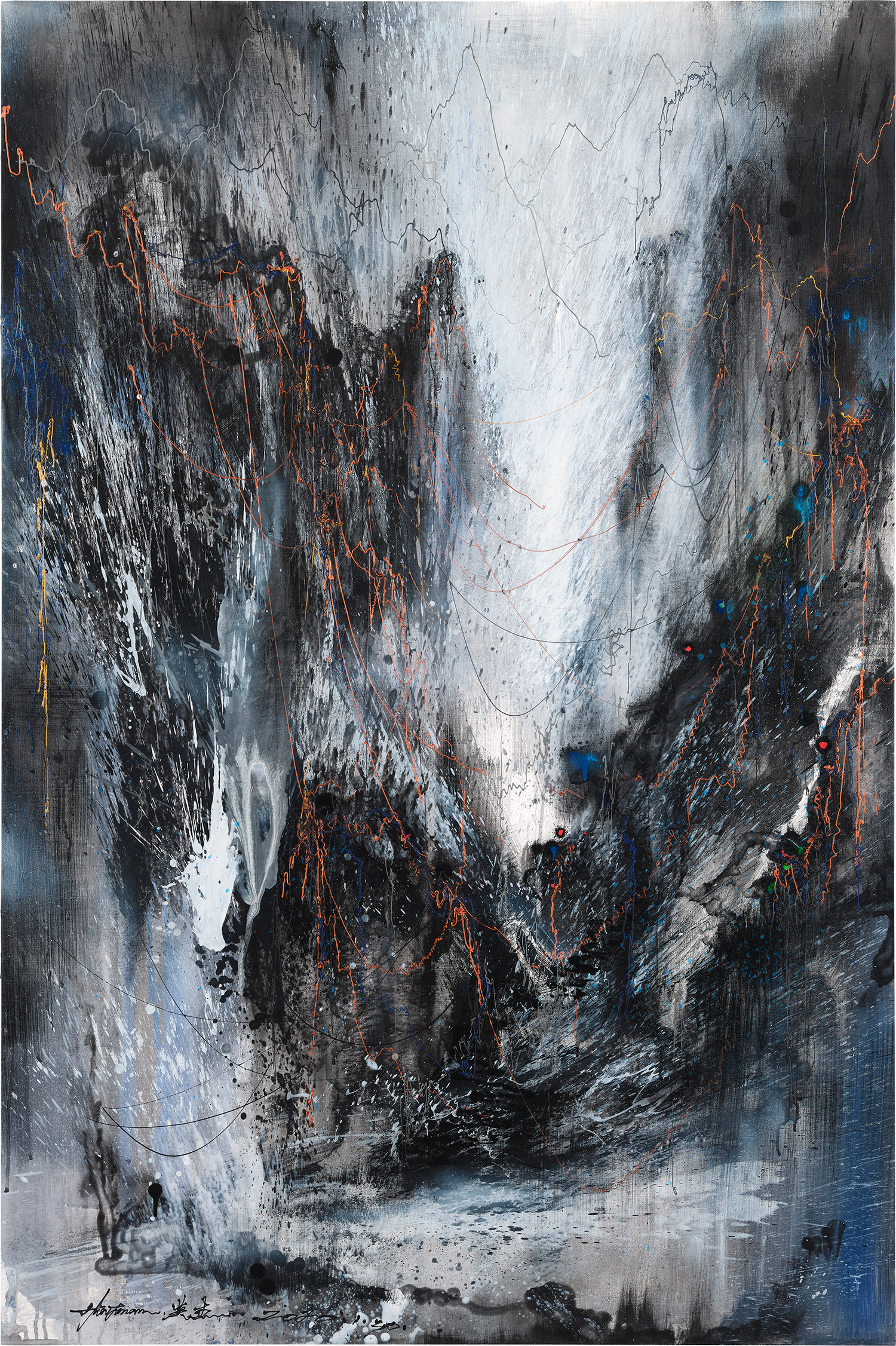
Fall I, 2020
His artistic breakthrough came as he developed a signature technique that has since become unmistakable. Working with acrylic paint, spray paint, and ink, he builds images in explosive layers, beginning with gestural washes that evoke the spontaneous quality of classical ink work before introducing the saturated, directional energy of spray. The result is imagery that feels simultaneously ancient and urgently modern. Animals are his most recurring subjects: tigers, birds, and fish rendered not as illustrations but as concentrations of force.
Each creature seems to be mid transformation, caught between stillness and explosion, between the discipline of centuries old technique and the raw freedom of a wall in an open city. Among the works available through The Collection, two pieces offer particularly strong entry points into understanding his practice. "Natural Stigma," completed in 2018, is a powerful example of his mature voice, combining acrylic and spray paint on canvas in a composition that pulses with controlled intensity. The marks feel simultaneously spontaneous and deeply considered, a tension that is central to everything Chen does.
"Fall I," from 2020, shows a continued refinement of his approach, with color and form working together to evoke both the natural world and something more internal and psychological. Both works reward sustained attention, revealing new layers the longer one spends with them. For collectors, Chen Yingjie represents an increasingly compelling opportunity. His international profile has grown steadily through mural projects and exhibitions across Asia, Europe, and beyond, building a reputation that crosses the sometimes limiting boundaries between street art and gallery art.
The collectors drawn to his work tend to be those with sophisticated appetites, people who are equally comfortable with the legacy of Chinese ink painting and the energy of contemporary urban culture. His canvases bring something of the scale and immediacy of mural work into domestic and institutional spaces, without losing the intimacy that makes a work on canvas so personally powerful. Contextually, Chen occupies a fascinating position within a broader global conversation about what painting can be in the twenty first century. His work invites comparison with artists such as Retna, whose integration of calligraphic tradition into street art opened new territory for text based abstraction, and with the Chinese ink painting revival that has seen figures like Liu Dan reintroduce classical disciplines to contemporary audiences.
But Chen's particular synthesis feels genuinely his own. He is not simply bridging East and West in a programmatic way. He is working from the inside of both traditions simultaneously, and the results have an authenticity that is immediately felt. What makes Chen Yingjie matter today, beyond the beauty and energy of individual works, is what his practice represents about the possibilities of cultural inheritance.
In an art world that sometimes prizes rupture over continuity, he offers a different model: one in which deep respect for tradition and genuine innovation are not opposites but collaborators. His animals leap from surfaces with the force of something long held finally released. His brushwork carries the weight of history and the freedom of the present moment at once. For collectors and institutions beginning to build relationships with his work now, there is every reason to believe they are encountering an artist whose reputation will only deepen with time.