Chen Hongshou
Chen Hongshou: The Ming Master Endures
Artist Spotlight · The Collection Editorial
In the grand halls of the Palace Museum in Beijing and the Metropolitan Museum of Art in New York, visitors pause before album leaves and hanging scrolls that seem to pulse with an almost electric strangeness. The figures rendered within them lean at impossible angles, their robes billowing in rhythms that defy anatomy, their faces carrying expressions simultaneously archaic and utterly contemporary. These are the works of Chen Hongshou, and more than three and a half centuries after his death, they continue to stop people in their tracks. His art occupies a singular place in Chinese cultural history, and a growing international audience is only now beginning to fully reckon with the depth of what he achieved.
Chen Hongshou
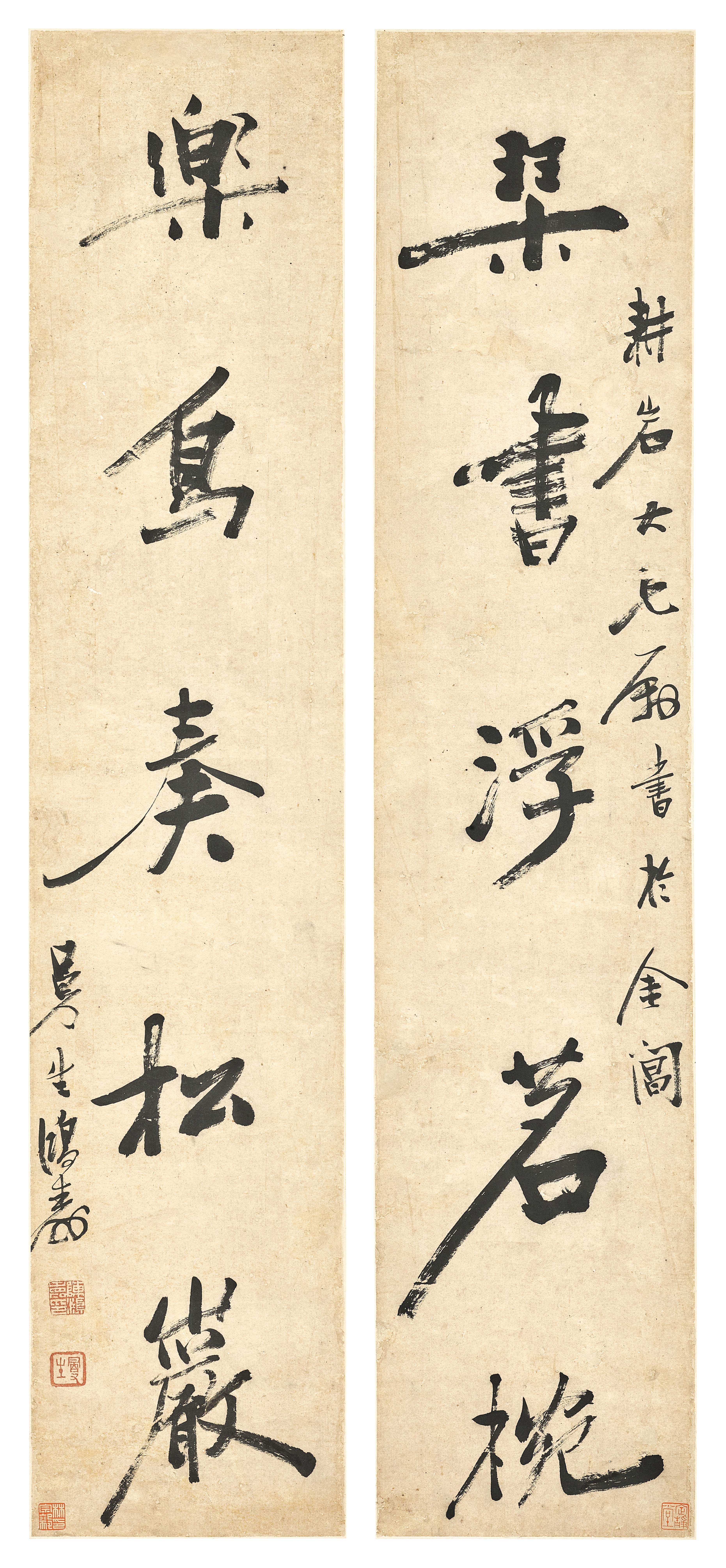
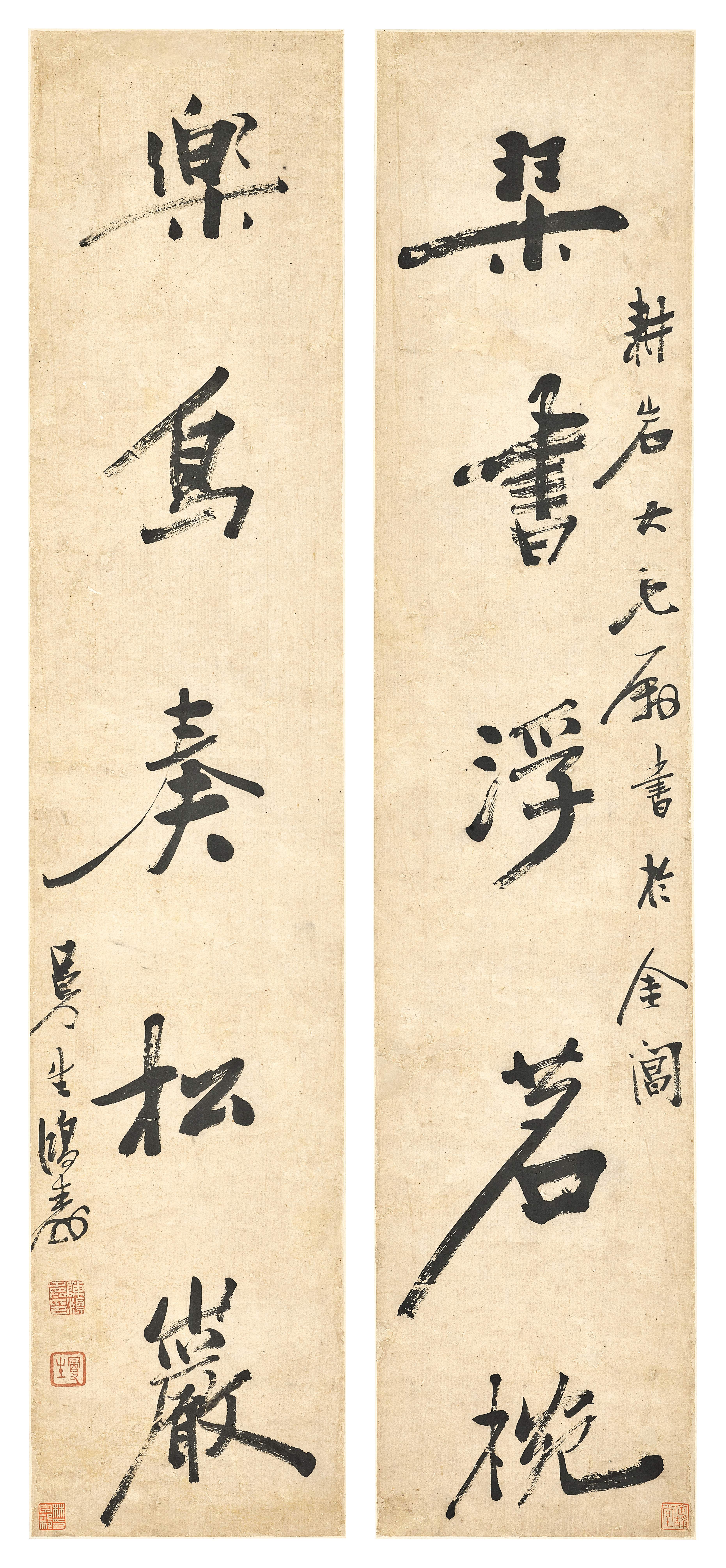
Calligraphy Couplet in Running Script 行書五言聯
Chen Hongshou was born in 1598 in Zhuji, in the Zhejiang province of China, during the final decades of the Ming Dynasty. He came of age in a world of tremendous intellectual and artistic ferment, surrounded by the legacy of the great Song and Yuan masters while also absorbing the heterodox philosophies circulating through late Ming literati culture. His early studies brought him into contact with the works of Li Gonglin and the antique figure painting tradition, and from a young age he demonstrated a precocious facility that set him apart from his contemporaries. His family background gave him access to classical education, and his prodigious talent in both painting and calligraphy was recognized early by teachers and patrons who understood they were encountering something rare.
His artistic formation was marked by an obsessive engagement with ancient models. Chen famously spent extended periods copying works in imperial and private collections, absorbing the visual language of Tang and Song dynasty figure painting with a discipline that bordered on devotion. Yet what emerged from this immersion was not mere imitation but a radical reimagining. He developed a distinctive vocabulary of elongated, archaic figures rendered with a quality of line that art historians have described as simultaneously archaistic and deeply personal.
His brushwork carried tension and deliberateness, each stroke feeling weighted with intention, and his compositions arranged figures and objects in ways that created a dreamlike, almost theatrical atmosphere unlike anything his contemporaries were producing. The range of Chen Hongshou's practice was remarkable. He excelled as a painter of figures, flowers, rocks, and landscapes, but he also channeled his gifts into calligraphy and, perhaps most influentially, into the design of woodblock prints. His illustrations for the 1639 edition of the play Xixiang Ji, or The Romance of the Western Chamber, are considered among the finest examples of Ming woodblock print design ever created, bringing his signature figural style into a medium that allowed his work to circulate widely and shape generations of subsequent artists and craftsmen.
This engagement with printmaking was not a lesser pursuit but a genuine artistic commitment, and it positioned Chen as a figure who understood the power of images to move beyond the walls of private collections. The work held in The Collection, the Calligraphy Couplet in Running Script, offers a concentrated encounter with Chen Hongshou's mastery of the written word as visual art. Executed in ink on paper and presented as a pair of hanging scrolls, the couplet demonstrates the quality of controlled energy that defines his best calligraphic work. Running script, known in Chinese as xingshu, sits between the formality of regular script and the spontaneous freedom of cursive script, and it was in this mode that Chen found a vehicle perfectly suited to his temperament.
The brushwork moves with confidence and internal logic, each character connected to the next by invisible threads of rhythm, and the work as a whole carries the authority of a man equally at home with the literary traditions he was channeling and the expressive possibilities of the medium itself. For collectors, works on paper by Chen Hongshou represent a category of Chinese art that commands serious attention in the international market. His paintings and prints have appeared at Christie's and Sotheby's with regularity, with significant album leaves and hanging scrolls achieving results that reflect both his historical importance and the enduring scarcity of authenticated works. Collectors drawn to late Ming art often find Chen Hongshou to be the figure who best crystallizes the spirit of that remarkable moment, a time when orthodox tradition and individual eccentricity were held in productive tension.
His work sits comfortably alongside that of other late Ming masters, and collectors familiar with the paintings of Xu Wei or the prints associated with the Hu Zhengyan studio will find in Chen a figure who shared their commitment to pushing the boundaries of established forms. Within the broader arc of Chinese art history, Chen Hongshou occupies a position analogous in some ways to figures like El Greco in the Western tradition, an artist whose deliberate stylization was once misread as incapacity but is now understood as the expression of a highly sophisticated pictorial intelligence. His influence extended forward into the Qing dynasty and touched artists working in figure painting and popular illustration for generations. Contemporary Chinese artists and scholars have returned to him repeatedly as a touchstone for thinking about the relationship between tradition and individual vision, and exhibitions in mainland China, Taiwan, and the United States have helped cement his reputation as one of the indispensable figures of Chinese art.
Chen Hongshou died in 1652, just a year into the Qing dynasty, having lived through the traumatic fall of the Ming, an event that profoundly shaped the final years of his life and work. He briefly took Buddhist vows after the dynastic collapse, a gesture that reflected the grief and dislocation felt by many Ming loyalists of his generation. Yet his legacy is not one of loss but of extraordinary creative achievement sustained across decades of political turbulence. To encounter his calligraphy is to feel the steadiness at the center of a life lived with full artistic commitment.
For collectors seeking a point of entry into the extraordinary world of late Ming art, and into one of the most distinctive artistic personalities China has ever produced, his work offers a threshold well worth crossing.
Featured Works
Explore books about Chen Hongshou
Chen Hongshou and His World
James Cahill
The Eccentric Brush: Chinese Painting from the Ming Dynasty
Richard Vinograd
Chen Hongshou: Master of the Brush
Wang Zhaozheng
The Art of Chen Hongshou: Painting and Calligraphy
Susan Bush and Hsio-yen Shih
Chen Hongshou: A Ming Dynasty Master
Marianne Sung-sheng Sung